GAT Travel Guide

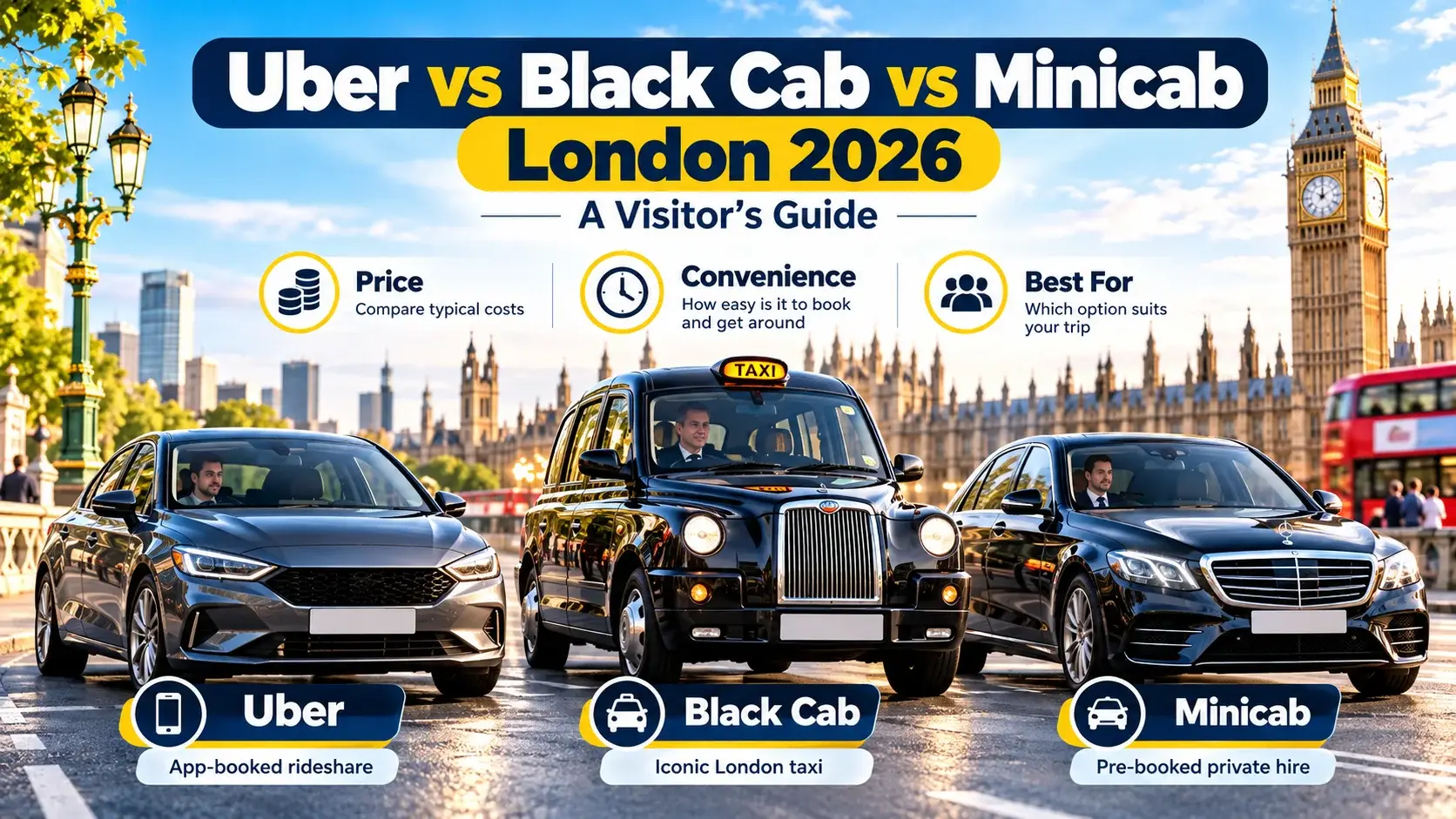
Uber vs Black Cab vs Minicab in London: A Visitor's Guide for 2026

Uber vs Black Cab vs Minicab in London: A Visitor's Guide for 2026
Visiting London

Uber vs Black Cab vs Minicab in London: A Visitor's Guide for 2026

London has three kinds of ride, and they follow different rules from the taxis and apps you may know at home. Here is how each one works, what changed in 2026, and which to choose from the airport, the street or your hotel.

Global Airport Taxi Travel Desk Published Updated 30 min read

In short

Black cabs are London's licensed taxis: you can hail them in the street or take one from a rank, and they charge a regulated meter that never surges. Minicabs are private hire cars that must be booked in advance, usually at a fixed price. Uber and Bolt are also private hire, booked through an app, with prices that change with demand and, since 2 January 2026, 20% VAT on London fares. For short trips in central London, an app or a black cab is usually quickest. For airports, groups, luggage and early or late flights, a pre-booked minicab with a fixed fare is usually the most predictable choice.

What is the difference between a black cab, a minicab and Uber in London?

The difference is legal, not just the car. London licenses two kinds of vehicle: taxis (black cabs) and private hire vehicles. Minicabs, Uber, Bolt and chauffeur cars are all private hire. Both are licensed by Transport for London (TfL), but they have different rights on the road.

Black cab vs minicab vs Uber in London
FeatureBlack cab (taxi)Minicab (pre-booked)Uber, Bolt (app)
Hail in the streetYes, when the yellow TAXI light is onNo, must be bookedNo, app only
Taxi ranksYesNoNo
Bus lanesYesNoNo
How the price is setTfL meter, by time and distanceFixed price agreed when you bookApp price that changes with demand
VAT on the fareNot added to the meterDepends on the operator20% on London fares since January 2026
Driver testThe Knowledge of LondonTfL private hire licence testsTfL private hire licence tests
Wheelchair accessEvery cab has a rampOn requestDepends on vehicle and option
Best forSpontaneous trips, ranks, accessibilityAirports, groups, early and late journeysShort on-demand trips when prices are normal

What is The Knowledge, and why do black cab drivers rarely use sat-nav?

To drive a London black cab, drivers pass The Knowledge, a test of roughly 25,000 streets within six miles of Charing Cross that usually takes three to four years. Private hire drivers, including Uber drivers, take shorter TfL tests and normally rely on navigation apps. In heavy central London traffic or around road closures, a black cab driver's route knowledge, and access to bus lanes, can make a real difference.

What is the difference between a green badge and a yellow badge cab driver?

All London drivers hold a green badge and can pick up passengers anywhere in Greater London, including central London and Heathrow. Suburban drivers hold a yellow badge: they have passed a shorter Knowledge for one or more outer London sectors and can only be hailed in those areas, although they can take you anywhere. TfL figures reported in September 2025 showed just over 14,800 All London drivers and around 1,600 suburban drivers.

What is a hackney carriage, and where does the word minicab come from?

The legal name for a London black cab is a hackney carriage. Horse-drawn hackney coaches were first licensed in London in 1654, and cab drivers have had to pass The Knowledge since around 1865. The word minicab dates from the 1960s, when smaller private hire cars that could not be hailed appeared on London streets. Licensing of London private hire operators, drivers and vehicles was introduced in stages from 2001 under the Private Hire Vehicles (London) Act 1998, and Uber arrived in London in 2012 as one of those licensed operators.

How many black cabs and minicabs are there in London?

London has around 14,200 licensed black cabs and roughly 96,500 licensed private hire vehicles, according to TfL licensing figures reported in September 2025. Private hire drivers outnumber taxi drivers by more than six to one, at about 105,700 against 16,500. That is one reason an app car is often close by when you open the app, while black cabs are concentrated in central London, at stations and at Heathrow.

Is Uber in London the same as Uber at home?

The Uber app works the same in London, but the rules are different: Uber is legally a minicab, so you cannot hail one, prices include 20% VAT since January 2026, and drivers cannot use bus lanes or taxi ranks. If you use Uber in another country, a few things in London may surprise you:

  • It is legally a minicab. Uber is a TfL-licensed private hire operator, and every driver holds a private hire licence. A driver cannot pick you up without a booking in the app.
  • Prices include 20% VAT. Since 2 January 2026, Uber, Bolt and other London private hire operators can no longer use a special VAT scheme and charge 20% VAT on the full fare.
  • No bus lanes or ranks. In central London traffic, an Uber sits in the same queue as private cars.
  • Airport pickups are in designated areas. App drivers wait at set pickup points, often in airport car parks, not at the arrivals door.
  • Black cabs are in the app too. Uber and other apps can also dispatch licensed black cabs, which charge the regulated meter rather than a surge price.

What Uber options are there in London: UberX, XL, Exec or Uber Taxi?

Uber in London offers several ride types, and only one of them, Uber Taxi, sends a licensed black cab. The others are private hire cars of different sizes and price levels. Names and availability change from time to time, so check the options and the price of each in the app before you confirm.

Uber ride options in London
OptionWhat it isSeats (typical)Best for
UberXStandard private hire carUp to 4Everyday trips when prices are normal
Uber ComfortNewer car with extra legroomUp to 4Longer journeys and quieter rides
UberXLLarger car or people carrierUp to 6Small groups and extra luggage
Uber ExecPremium car with highly rated driversUp to 4Business travel
Uber TaxiA licensed black cab dispatched through the appUp to 6 in most newer cabsMetered fare with no surge, plus bus lanes
Uber Assist and wheelchair-accessible optionsDrivers trained to help, or an accessible vehicle, where availableVariesPassengers who need extra help

Is Uber licensed in London?

Yes. Uber holds a TfL private hire operator's licence, renewed for 30 months in September 2024 and running to March 2027. TfL refused to renew Uber's licence in 2017 and again in 2019 over safety concerns. Uber kept operating while it appealed, and a court restored its licence in 2020. Every Uber driver and car in London must also hold its own TfL licence, just like any other minicab.

How are London taxi and Uber fares worked out?

London black cab fares are set by TfL and charged by a meter that counts time and distance, Uber and Bolt use dynamic app prices that rise with demand, and a pre-booked minicab charges a fixed price agreed when you book. Each model suits different trips, so the cheapest option changes with the time of day, the traffic and the distance.

What are the London black cab tariffs in 2026?

TfL sets black cab fares. From 25 April 2026, the minimum fare rose from £4.20 to £4.40 and Tariffs 1, 2 and 3 rose by 2.88%. Which tariff the meter uses depends on the time:

London black cab tariffs (from 25 April 2026)
TariffWhen it appliesWhat to expect
Tariff 1Monday to Friday, 05:00 to 20:00The lowest rate
Tariff 2Monday to Friday, 20:00 to 22:00, and weekends 05:00 to 22:00Evening and weekend rate
Tariff 3Every night 22:00 to 05:00, and public holidaysThe highest rate
Tariff 4Longer journeys over six milesCharged at the same rates as Tariff 2

Extras can be added to the meter, such as a £1.60 charge for journeys starting at a Heathrow rank and a £6 London City Airport drop-off extra introduced on 25 April 2026. Christmas and New Year extras also apply.

How much is a black cab in London? TfL's typical fares for 2026

A one-mile black cab ride in London typically costs £8.40 to £13.20, and a black cab from Heathrow to central London typically costs £70 to £120, according to TfL's 2026 taxi fare card. The exact fare depends on traffic, the time of day and the route, because the meter counts both distance and time.

Typical London black cab fares from 25 April 2026 (TfL)
DistanceTypical timeTariff 1 (weekday)Tariff 2 (evening, weekend)Tariff 3 (night, holiday)
1 mile6 to 13 min£8.40 to £13.00£8.40 to £13.20£9.00 to £13.20
2 miles10 to 20 min£12.60 to £20.20£13.40 to £20.40£13.60 to £20.40
4 miles16 to 30 min£21.00 to £31.00£23.00 to £32.00£23.00 to £35.00
6 miles28 to 40 min£33.00 to £42.00£41.00 to £45.00£41.00 to £45.00
Heathrow to central London30 to 60 min£70.00 to £120.00

Black cabs do not charge extra for luggage, extra passengers or paying by card. If you book a black cab by phone or app, a booking fee of up to £2.00 can be added. Inside London, a driver must accept a hiring of up to 12 miles, or up to 20 miles from Heathrow. For journeys ending outside Greater London, the fare can be agreed before you set off; if it is not, the driver cannot charge more than the meter shows.

How does Uber surge pricing work in London?

App prices are calculated by algorithm and rise when demand is high, for example in rain, after events or when many flights land at once. The price you see includes VAT. Some extras, such as airport charges or the Congestion Charge, may appear on the final receipt; check the fare breakdown in the app.

How do pre-booked minicab fares work?

A pre-booked minicab quotes one price when you book. With Global Airport Taxi, the full fare is shown before you pay, so traffic, delays or busy periods do not change it.

Do black cabs, Uber and minicabs pay the Congestion Charge?

Licensed black cabs are exempt from London's Congestion Charge, but Uber, Bolt and minicabs are not. From 2 January 2026 the daily charge rose to £18, and electric private hire cars lost their full exemption: they now get a 25% discount on Auto Pay, paying £13.50 a day. Only wheelchair-accessible private hire vehicles carrying out a booking stay exempt. Private hire drivers pay the charge, so for trips into the central zone during charging hours it can feed into app and minicab prices. Licensed black cabs are also exempt from the ULEZ charge, and every newly licensed London taxi has had to be zero-emission capable since 2018, which is why most cabs you see today are electric with a small petrol range extender.

What changed for London taxis and Uber in 2026?

Three changes made London rides more expensive in 2026: Uber, Bolt and other private hire apps started charging 20% VAT on 2 January, black cab fares rose by 2.88% with a £4.40 minimum on 25 April, and airport drop-off charges went up, including £9 for 12 minutes at Luton. The Congestion Charge also rose to £18 a day in January.

2026 changes that affect what you pay
DateChangeWho it affects
2 January 202620% VAT on the full fare for London private hire, after the Tour Operators' Margin Scheme stopped applying to taxi and private hire journeysUber, Bolt and other private hire apps and operators in London
January 2026London City Airport introduced a forecourt drop-off chargeEveryone dropping off at London City
25 April 2026Black cab minimum fare up to £4.40; Tariffs 1 to 3 up 2.88%; new £6 London City drop-off extraBlack cab passengers
September 2026Luton drop-off charge rose to £9 for 12 minutesEveryone dropping off or collecting at Luton

Airport drop-off charges now apply at every major London airport. In 2026, reported charges were £7 at Heathrow, £10 for 10 minutes at Gatwick, £10 for 15 minutes at Stansted and £9 for 12 minutes at Luton. See our Luton drop-off charges guide for how they work.

Ride chooser: which should I take?

Answer three questions for a suggestion.

Our suggestion Black cab

You can hail one straight away, the meter never surges, and it can use bus lanes.

Get a fixed-price quote

Which is cheapest: Uber, black cab or minicab?

Uber or Bolt is usually cheapest for short trips at quiet times, a black cab is often better value in rain, late at night or when the app surges, and a pre-booked minicab is usually cheapest for airports, long journeys and groups. It depends on distance, time and group size, not on the brand. As a rule of thumb:

  • Short central hops off-peak: app rides are often cheapest; a black cab can be close on very short trips.
  • Busy times, rain and late nights: app prices can surge; the black cab meter and a fixed quote do not.
  • Airports and long journeys: a fixed pre-booked fare is usually the most predictable, especially once airport charges and possible surge are counted.
  • Groups: one larger pre-booked vehicle usually costs less per person than two cars.

Compare like with like. Before choosing, check four things for each option: the base fare, whether VAT is included, whether airport or congestion charges are added, and whether the price can change before you arrive.

When does Uber cost more than a black cab?

Uber usually costs more than a black cab when surge pricing is high, at night, in heavy rain and after big events, and the 20% VAT added in 2026 means that point now comes sooner. An older UK analysis by ValuePenguin found a standard Uber was cheaper than a black cab until surge reached roughly 1.7 times the normal price. That study was carried out before VAT was added to London app fares, so the crossover today is likely to be lower; we have not found an up-to-date study that measures it.

The simplest check takes a minute. Open the app and note the quoted price, then compare it with TfL's typical black cab fare for the same distance and time of day, for example £8.40 to £13.20 for one mile. If the app price is near or above the top of the black cab range, a cab from a rank or a hail is likely to be the better deal, and it will not change while you travel. For airport journeys, also compare both with a fixed pre-booked fare, which includes the drop-off or pickup charge.

London black cab, app-booked car and pre-booked minicab side by side outside a London airport terminal
Black cabs wait at ranks; app and pre-booked cars use designated pickup points or meet you in arrivals.

Which has more room for passengers and luggage: a black cab, Uber or a minicab?

A black cab has the most passenger space for its size, an app car is usually a standard saloon, and a pre-booked minicab lets you choose the vehicle to fit your group and luggage.

Passenger space and luggage by vehicle
VehiclePassengersLuggageGood to know
Black cab (LEVC TX and similar)Up to 6 in most newer cabsCases usually ride in the passenger area beside youFlat floor, built-in ramp and a partition between driver and passengers
UberX, Bolt or other standard app carUp to 4Usually two large cases in the bootCar model varies; many are hybrid or electric
UberXL or other app people carrierUp to 6Room for more casesCosts more than a standard app car
Pre-booked saloonUp to 3Up to 3 bagsFixed fare, chosen in advance
Pre-booked estate, MPV or vanUp to 8Matched to your luggage when you bookChild seats can be added for £15 per seat
Pre-booked minibus or coach8 to 50Space for the whole groupOne vehicle so everyone travels together

What are the pros and cons of a black cab, Uber and a minicab?

No option wins every time: black cabs win on certainty and access, apps on convenience for short trips, and pre-booked minicabs on fixed prices and planning.

Black cab vs Uber vs minicab: pros and cons
OptionProsCons
Black cabHail anywhere or use a rank; bus lanes; regulated meter that never surges; Knowledge-trained drivers; a wheelchair ramp in every cabThe meter keeps running in traffic; can cost more than an app at quiet times; fewer cabs in outer London
Uber or BoltFamiliar app; price shown before you ride; often cheapest for short off-peak trips; many cars availableSurge pricing at busy times; 20% VAT since 2026; no bus lanes; airport pickups in car parks; needs mobile data
Pre-booked minicabFixed price agreed in advance; a confirmed driver at any hour; meet and greet and flight tracking at airports; choice of vehicle and child seatsMust be booked ahead; cannot be hailed; less flexible for a spontaneous short hop

Uber, black cab or minicab? Six real London situations

The best choice depends less on the brand and more on the situation: who is travelling, how much luggage you have, the time of day and whether demand is high. These are the situations visitors ask us about most often.

Which ride to choose in common London situations
SituationBest choiceWhy
Family of four with luggage, Heathrow to WestminsterPre-booked minicabFixed price, meet and greet, child seats and space for cases, no surge after a long flight
A one-mile hop on a weekday afternoonApp or black cabPrices are close; take whichever arrives first, or hail a cab if one is passing
Leaving a West End theatre alone at 11pmBlack cabHail or use a rank straight away, the meter does not surge when shows let out, and every cab is licensed
Rainy Friday evening with a suitcaseBlack cabApp surge is common in rain; a cab can be hailed and uses bus lanes to beat traffic
Group of six to Gatwick for an early flightPre-booked people carrierOne vehicle for everyone, a fixed price agreed in advance, and a driver confirmed for the early start
Wheelchair user arriving at St PancrasBlack cab from the rankEvery black cab has a ramp and wheelchair space, with no booking needed

Which is best for your kind of trip?

First-time visitors and solo travellers at night usually do best with a black cab, families and groups with a pre-booked car, and budget travellers with public transport plus an app for short hops. Here is what usually works best for different kinds of visitor:

  • First-time visitors: a black cab from a rank or a pre-booked car is the easiest start, with no app, local number or data needed.
  • Families with young children: a pre-booked car with the right child seats fitted; see our child seat guide.
  • Business travellers: Uber Exec or a pre-booked executive car for a set pickup time and an emailed receipt. App receipts for London trips now show VAT; ask your accountant whether your business can reclaim it.
  • Solo travellers late at night: a black cab from a rank or hailed with its light on, or an app ride with trip sharing switched on. Never take a car that has not been booked.
  • Older travellers and anyone with limited mobility: a black cab, with its high roof, ramp and grab handles, or a pre-booked car with help with luggage.
  • Budget travellers and students: the Tube and buses for most trips, an app for short off-peak hops, and a shared pre-booked car when a group splits the fare.
  • Visitors without a UK SIM: black cabs need no phone at all. Uber works with a foreign number and card but needs mobile data or Wi-Fi, so an eSIM helps.

Which is best from London airports?

For most arrivals, a pre-booked car is the simplest; black cabs are best if you have not booked; apps work if you are happy to walk to a pickup area and accept the price on the day.

Getting a ride from a London airport
OptionWhere you meet itPriceGood to know
Pre-booked minicabDriver meets you in arrivals, following the airport's rulesFixed when you bookFlight tracking; best for families, groups and late arrivals
Black cabOfficial taxi rank outside the terminalMeter plus airport extrasNo booking needed; queues can form after busy arrival waves
Uber or BoltDesignated app pickup area, often in a car parkApp price on the dayPrice can rise when many flights land; check charges on the receipt

Book airport transfers from Heathrow, Gatwick, Stansted, Luton, London City and Southend. If you are choosing between airports, see Heathrow vs Gatwick vs Stansted.

Where can I get a taxi at London stations, events and on a night out?

All major London stations have official black cab ranks, while app cars pick up from nearby streets or set pickup points. At King's Cross, St Pancras, Paddington, Euston, Waterloo, Victoria and Liverpool Street, follow the taxi signs to the rank, where cabs queue and the meter starts when you set off. Eurostar passengers arriving at St Pancras International can use the rank beside the station.

After big events at venues such as Wembley Stadium or The O2, app prices often surge and nearby roads close, so the pickup point can be a long walk away. Walking a few streets before booking, taking public transport, or pre-booking a pickup point and time usually works better.

For nights out, the Night Tube runs on some lines on Friday and Saturday nights and night buses run every night. If you take a car, use a rank, hail a black cab with its light on, or book through a licensed app or operator.

Do you need a taxi at all? Taxi vs the Tube and trains

For one person with light bags, the Tube, the Elizabeth line or an airport express train is usually cheaper than any taxi. For families, groups, heavy luggage and very early or late journeys, a taxi is usually easier and can cost less per person.

Taxi or public transport? Common London journeys
JourneyUsually bestWhy
Heathrow to central London, alone with one bagElizabeth line or Piccadilly lineMuch cheaper than a car, frequent, and avoids road traffic
Heathrow to a hotel, family of four with suitcasesPre-booked minicabOne fare for everyone, door to door, with no stairs or changes with cases
Gatwick, Stansted or Luton to central London, alone in the daytimeExpress train or ThameslinkFast into central London and usually cheaper for one person
Any airport before 5am or after midnightPre-booked carTrains are limited or not running at these times
A short trip across central LondonTube, bus, walking or a black cabIn heavy traffic a car can be slower than the Tube

How do I know a London taxi or minicab is licensed?

A licensed black cab has a TAXI sign on the roof and a TfL licence plate, while a licensed minicab or Uber shows a TfL private hire disc in the windscreen and must match the car and driver in your booking. Every legal ride in London is TfL-licensed, and each type shows it differently.

  • Black cab: a TAXI sign on the roof (lit yellow when free), a TfL licence plate, a visible meter and a driver's badge.
  • Minicab and app cars: a TfL private hire licence disc in the windscreen, and a driver with a TfL photo badge.
  • Check before you get in: for app and pre-booked rides, match the car registration and driver name to your booking.
  • Never accept an offer from a stranger. Anyone approaching you in an arrivals hall or outside a station offering a "taxi" or "Uber" without a booking is touting, which is illegal, and the car is not insured for you.

Is it safe to take a taxi alone at night in London?

Share your trip with a friend using the app's sharing feature or your booking confirmation, sit in the back, and wait inside until the car arrives. Black cabs from a rank and pre-booked cars with confirmed driver details are the easiest to verify.

Which option is best for wheelchair users?

A black cab. Every licensed London black cab is wheelchair accessible, with a built-in ramp and room for a wheelchair in the passenger area, so you can take one from a rank or the street without booking. Under the Equality Act, licensed drivers must carry assistance dogs and must not charge wheelchair users extra. For pre-booked journeys, request a wheelchair-accessible vehicle when you book.

What about children and car seats?

Book ahead if you need a child seat. Black cabs and app cars rarely carry them. UK law lets children travel in a licensed taxi or minicab without a car seat in limited circumstances, but it is not the safe choice. Our taxi with child seat guide explains the rules and which seat to book.

How do I pay, and should I tip?

All London black cabs must accept cards, including contactless, with no surcharge; apps charge your card automatically; and pre-booked minicabs are usually paid online in advance. Tipping is optional, and around 10% or rounding up is common for good service.

  • Black cabs must accept card payments, including contactless, and cannot add a card surcharge.
  • Apps charge the card on your account automatically at the end of the trip.
  • Pre-booked minicabs are usually paid online when you book.
  • Tipping is optional. Many passengers round up a black cab fare or add around 10% for good service; nobody should expect it.

What if I leave something behind or need to complain?

Contact whoever you booked with first. For black cabs, items handed in by drivers go to TfL's Lost Property Office. For app rides, use the lost item option in the app to contact the driver. For pre-booked rides, contact the operator, who can reach the driver directly. If a complaint is not resolved, both taxis and private hire vehicles are licensed by TfL, which handles complaints about licensed drivers and operators.

Which apps book which type of ride?

Uber and Bolt mainly book private hire cars, Uber Taxi, FREENOW and Gett can book licensed black cabs on the meter, and pre-booked operators such as Global Airport Taxi book cars, vans and minibuses at a fixed price.

London ride apps and what they book
App or serviceWhat you getPricing
Uber (UberX and similar)Private hire carDynamic, includes 20% VAT
BoltPrivate hire carDynamic, includes 20% VAT
Uber Taxi, FREENOW, GettLicensed black cabRegulated meter, plus a booking fee of up to £2
Pre-booked operators, such as Global Airport TaxiPrivate hire car, van or minibusFixed price agreed at booking

What mistakes do visitors make with London taxis?

The most common mistakes are accepting a ride from a tout, trying to hail an Uber or minicab, confirming an app ride without checking the surge, and forgetting airport drop-off charges. These are the ones we see most often:

  1. Accepting a ride from a stranger who offers a "taxi" in an arrivals hall, outside a station or a club.
  2. Trying to wave down an Uber or minicab. Only black cabs can stop for you.
  3. Hailing a black cab with its light off. It is already hired or not working.
  4. Confirming an app ride without checking the price, including any surge and the fare breakdown.
  5. Forgetting airport drop-off and pickup charges when comparing prices.
  6. Booking a car too small for the luggage. A standard car usually takes only two large cases.
  7. Getting into the wrong app car. Always check the registration, the driver's name and photo.
  8. Thinking you need cash. Every licensed black cab takes cards, including contactless.

What do London taxi terms mean?

In London, a taxi or hackney carriage means a black cab that can be hailed, while a minicab or private hire vehicle (PHV) must be booked; Uber and Bolt are private hire. These are the other terms you will see on signs, apps and booking pages.

Black cab (taxi, hackney carriage)
A TfL-licensed taxi that can be hailed in the street, use ranks and bus lanes, and charges a regulated meter.
Minicab (private hire vehicle, PHV)
A licensed car that must be pre-booked through a TfL-licensed operator. Uber and Bolt cars are private hire vehicles.
Private hire operator
The licensed company that takes your booking, such as an app or a minicab firm. Every private hire journey must be booked through one.
The Knowledge
The test of London streets, routes and landmarks that black cab drivers must pass before they are licensed.
Green badge and yellow badge
Black cab driver licences: green for All London drivers, yellow for suburban drivers limited to outer London sectors.
Taxi rank
An official place where black cabs queue for passengers, found at stations, airports and busy streets.
TAXI sign
The light on a black cab roof. When it is lit yellow, the cab is free to hail.
Private hire licence disc
The TfL licence shown in the front and rear windows of a minicab or app car.
Tariff
The rate the black cab meter uses, set by TfL according to the time of day and the length of the journey.
Surge or dynamic pricing
An app price that rises when demand is high, for example in rain or after events.
Fixed fare
A price agreed when you book that does not change with traffic or delays.
Meet and greet
A service where the driver meets you inside the arrivals hall, usually with a name board.
Touting
Offering a ride without a booking. It is illegal in London, and the car is not insured for you.
Congestion Charge
A daily charge for driving in central London during charging hours, £18 from January 2026. Licensed black cabs are exempt.

So which should you choose in London?

Use a black cab when you are on the street, need a ride right now, need wheelchair access, or want a price that will not surge. Use Uber or Bolt for short on-demand trips when the app price looks normal. Use a pre-booked minicab for airports, early or late journeys, groups, luggage and child seats, when knowing the price and having a car confirmed matters most.

Uber vs black cab vs minicab: frequently asked questions

Is Uber a taxi or a minicab in London?

Legally, Uber is a minicab service. It is a TfL-licensed private hire operator and its drivers hold private hire licences, so rides must be booked through the app and cannot be hailed in the street.

Can I hail an Uber or a minicab in the street in London?

No. Only licensed black cabs can be hailed or taken from a taxi rank. A private hire car that picks you up without a booking is breaking the law and is not insured for you.

Is Uber cheaper than a black cab in London?

Often for short trips at quiet times, but not always. App prices rise with demand and have included 20% VAT since January 2026, while the black cab meter never surges. For airports and longer journeys, a fixed pre-booked fare is usually the most predictable.

Why did Uber get more expensive in London in 2026?

From 2 January 2026, private hire operators in London, including Uber and Bolt, must charge 20% VAT on the full fare after the Tour Operators' Margin Scheme stopped applying to taxi and private hire journeys.

What is the minimum black cab fare in London?

£4.40, from 25 April 2026. On the same date, Tariffs 1, 2 and 3 rose by 2.88%.

How much is a one or two mile black cab ride in London?

According to TfL's 2026 fare card, a one-mile black cab ride typically costs £8.40 to £13.20 and a two-mile ride £12.60 to £20.40, depending on traffic and the time of day.

How much is a black cab from Heathrow to central London?

TfL says a black cab from Heathrow to central London typically costs £70 to £120 and takes 30 to 60 minutes, depending on traffic and your destination.

When is Uber more expensive than a black cab in London?

Usually when surge pricing is high, such as late at night, in rain or after big events. With 20% VAT added to London app fares since January 2026, a smaller surge is now enough to make Uber cost more than the black cab meter.

Can a black cab refuse a short journey in London?

No, not without a good reason. Inside London, a licensed black cab driver who is available for hire must accept journeys of up to 12 miles, or up to 20 miles from Heathrow.

Do black cabs charge extra for luggage in London?

No. London black cabs do not charge extra for luggage, extra passengers or paying by card. A booking fee of up to £2 can apply if you book by phone or app.

Do black cabs have surge pricing?

No. Black cab fares are set by TfL and calculated by the meter using time, distance and the tariff for the time of day. Higher tariffs apply at night, weekends and on public holidays, but there is no demand-based surge.

What is the difference between a minicab and a taxi in London?

A taxi is a black cab: it can be hailed, use ranks and bus lanes, and charges a regulated meter. A minicab is a private hire vehicle that must be pre-booked through a licensed operator, usually at a fixed price.

Do London black cabs take card payments?

Yes. Licensed black cabs must accept card payments, including contactless, and cannot charge extra for paying by card.

Do you tip taxi drivers in London?

Tipping is optional. Many passengers round up a black cab fare or add around 10% for good service, but it is not expected.

Are all London black cabs wheelchair accessible?

Yes. Every licensed London black cab has a built-in ramp and space for a wheelchair, so wheelchair users can take one without booking.

Where do Uber drivers pick up at London airports?

At designated app pickup areas, which at many London airports are in or near the terminal car parks rather than at the arrivals door. Follow the airport signs and the directions in the app.

What is the best way to get from a London airport to my hotel?

For most travellers with luggage, a pre-booked car with a fixed fare and meet and greet is the simplest. Black cabs are available from the rank without booking, and rail can be cheapest for one person with light bags.

Can I book a black cab through an app?

Yes. Apps such as Uber Taxi, FREENOW and Gett can dispatch licensed black cabs, which charge the regulated meter plus a booking fee of up to £2.

Is Uber licensed in London?

Yes. Uber holds a TfL private hire operator's licence, renewed for 30 months in September 2024 and running to March 2027. Its drivers and cars also need their own TfL licences.

Do Uber and minicabs pay the London Congestion Charge?

Yes. Licensed black cabs are exempt, but private hire cars, including Uber and Bolt, are not. From 2 January 2026 the charge is £18 a day, or £13.50 for electric cars on Auto Pay. Wheelchair-accessible private hire vehicles on a booking are exempt.

How many passengers fit in a London black cab?

Most newer black cabs, such as the LEVC TX, seat up to six passengers. Some older cabs seat five. Luggage usually rides in the passenger area.

What is the difference between a green badge and a yellow badge taxi driver?

A green badge is the All London licence, which lets a driver pick up anywhere in Greater London. A yellow badge is a suburban licence, which limits street pickups to one or more outer London sectors.

What does the light on a London black cab mean?

When the yellow TAXI sign on the roof is lit, the cab is free and you can hail it. When the light is off, the cab is already hired or the driver is not working.

What is a hackney carriage?

Hackney carriage is the legal name for a taxi that can be hailed in the street. In London it means a licensed black cab.

How many black cabs are there in London?

Around 14,200 licensed taxis and 16,500 taxi drivers, compared with about 96,500 private hire vehicles and 105,700 private hire drivers, according to TfL figures reported in September 2025.

Can I use Uber in London with a foreign phone number?

Yes. You can use your existing Uber account with a foreign number and card, and prices are shown in pounds. You need mobile data or Wi-Fi, so an eSIM or roaming plan helps.

Is the Tube cheaper than a taxi from Heathrow?

For one person, yes: the Elizabeth line and the Piccadilly line cost far less than a car. For a family or group with luggage, a pre-booked car can cost a similar amount per person and goes door to door.

Is a black cab or Uber safer at night in London?

Both are licensed and safe when used properly. A black cab from a rank or hailed with its light on is easy to verify, while an app ride shows the driver's details and lets you share your trip. Never get into a car that has not been booked.

Is it safe to take a minicab in London?

Yes, if it is booked through a TfL-licensed operator. Check that the car registration and driver name match your booking, and never accept a ride from someone who approaches you without one.

What do I do if I leave something in a London taxi?

For black cabs, contact TfL's Lost Property Office. For app rides, use the lost item option in the app. For pre-booked rides, contact the operator, who can reach the driver.

Which is best for a group of five or more?

A pre-booked van or minibus. Most black cabs and app cars seat up to five or six, so a larger group would otherwise need two vehicles.

Share this guide Facebook X LinkedIn WhatsApp

Global Airport Taxi Travel Desk

Our travel desk writes practical guides for travellers using airport transfers in the UK and 81 countries, based on the questions our customers ask every day.

Happy Customers

What Customers Say

Real reviews from GAT passengers

Book your GAT transfer

Join hundreds of happy travelers