How many terminals are there now?
Two: Terminal 2 and Terminal 3. Terminal 1 closed permanently in 2026 after sixty years. Most airlines moved to Terminal 2; Ryanair uses Terminal 3.
Cheap airport transfers
Trusted airport taxi service · 81 countries
Pre-book your airport transfer in minutes. See the full fare before you pay, add your flight number so the pickup follows your landing time, and travel with a driver arranged for you, from a saloon car to a 50-seater coach.
Fare shown before you payNo meter. See every vehicle and its total.
Flight-aware pickupsAdd your flight number, we plan around it.
Meet and greetYour driver meets you per the airport rules.
Child seats on requestCars, vans, minibuses, coaches to 50 seats.
Instant Confirmation — Book in 60 Seconds
Manchester Airport (MAN) · Terminals 2 and 3
Manchester runs two terminals now rather than three, and getting the right one onto the booking is the first thing that matters here. The second is that the figure is agreed before you pay. Flying out, the car comes to your door; landing, the driver follows the aircraft in and stands in your terminal’s Arrivals hall with your surname on a board. Piccadilly, Salford Quays, Old Trafford, the Etihad, Liverpool, Leeds or a village in the Peak District: one vehicle, one agreed figure.

Start here
Seven lines covering what people actually ask before booking. Everything below expands on one of them.
Short answer. Manchester Airport (MAN) now has two terminals, not three, and sits about 10 miles south of the city centre. A pre-booked taxi covers that in roughly 25 minutes at a price agreed before you pay.
A journey is priced from the date, the hour and the vehicle you pick. The booking page does that arithmetic for your own trip and shows the figure before the payment step, where it stays once you accept it.
Quick answers
The nine questions we are asked most about Manchester. Each is covered in more depth further down.
Two: Terminal 2 and Terminal 3. Terminal 1 closed permanently in 2026 after sixty years. Most airlines moved to Terminal 2; Ryanair uses Terminal 3.
About 10 miles, roughly 25 minutes by road. The airport is south of Manchester beside the M56, with the M60 ring road in between.
In the Arrivals hall of the terminal on your booking, with your surname on a board. That is why the terminal field matters more here than at most airports.
Reported at £5.50 for 5 minutes and £6.50 for 10, read by camera with no barrier. Payment is made online afterwards, by midnight the following day.
No. That is reported to bring a £100 charge. Collections belong in the signed Express Pick Up areas or a multi-storey car park.
Yes, at JetParks 1 (M90 5AZ), with a shuttle to the terminals reported at about 6 minutes, running around the clock.
No. Greater Manchester’s charging zone was scrapped and replaced by an investment plan. Drivers, taxis included, face no daily charge.
Yes, from the airport’s own station. Manchester Piccadilly is a reported 15 to 20 minutes away, with Metrolink trams from the same interchange.
Nothing is needed from you. We follow the flight number and move the collection to the real landing time. The figure depends on your date and vehicle, and appears on the booking page before payment.
Our vehicles
There are nine to choose between, a saloon at one end and a 50-seater coach at the other. What you pay buys the vehicle rather than a seat in it, so the figure that decides the choice is usually the luggage.
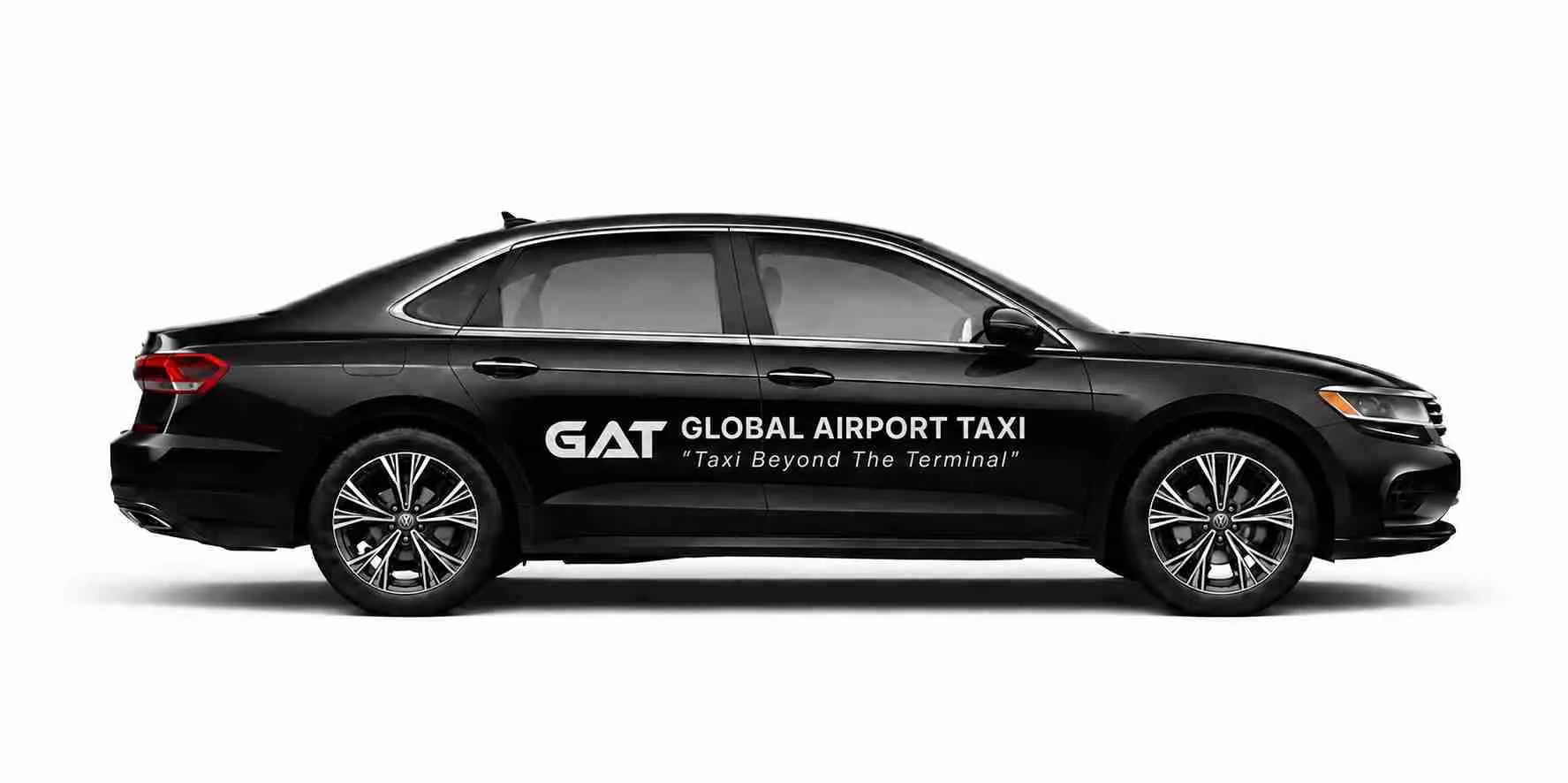 Shown above: Volkswagen Passat or similar
Saloon taxi
4 passengers, 2 large bags
A single traveller or a couple with normal cases.
View vehicle →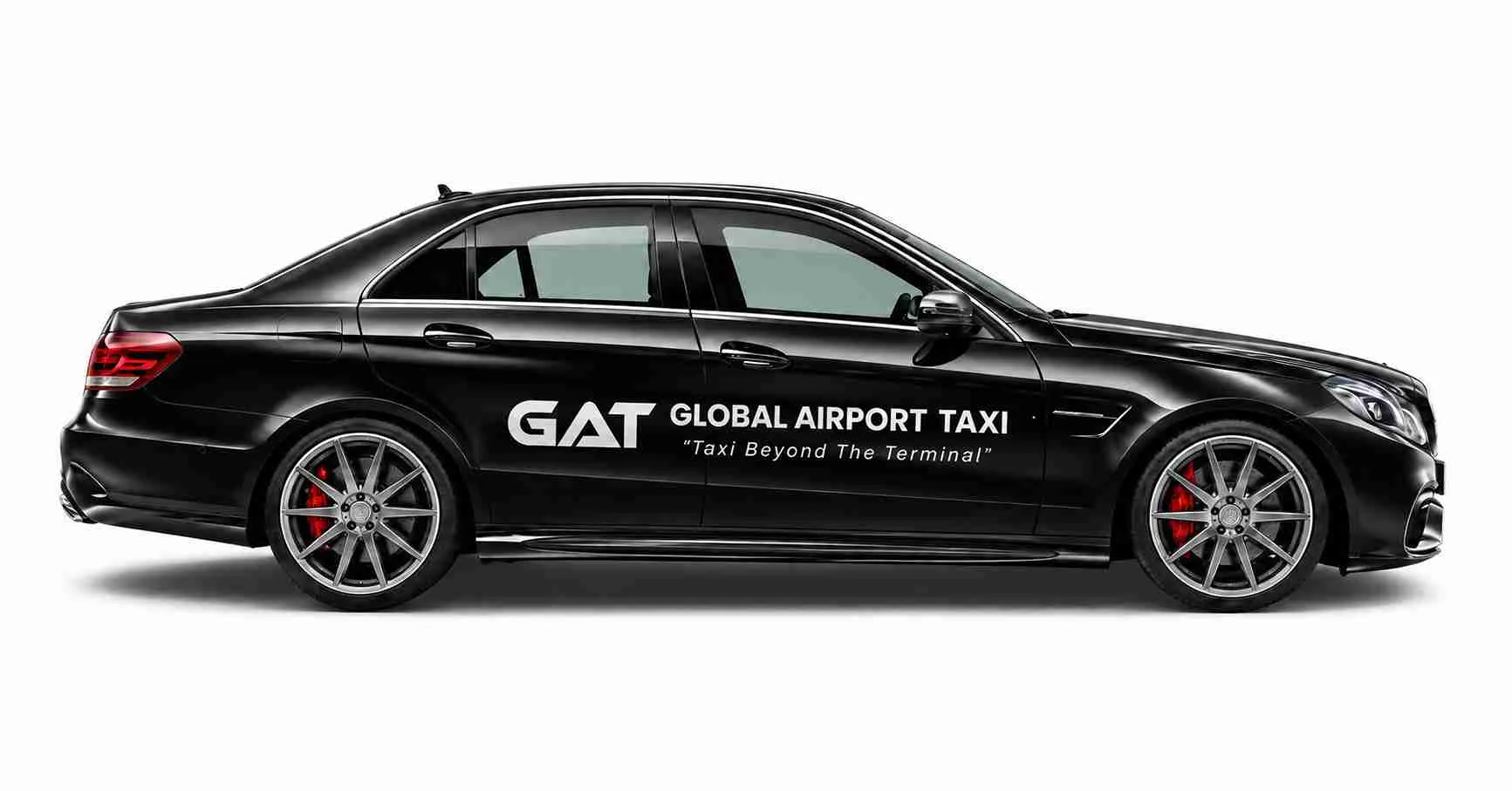 Shown above: Mercedes E-Class or similar
Executive car
3 passengers, 2 large bags
A better-appointed car when the arrival itself matters.
View vehicle →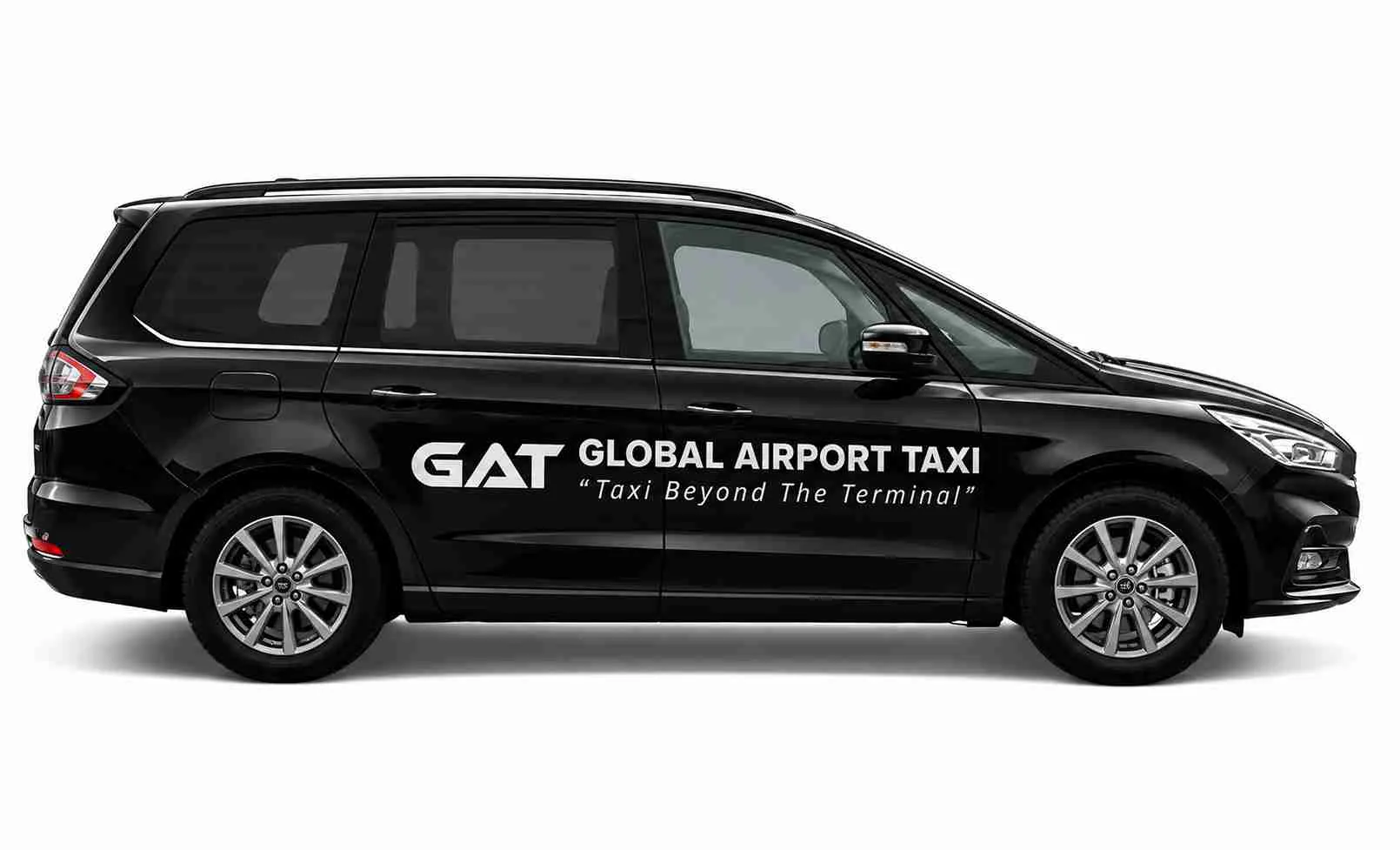 Shown above: An estate taxi
Estate taxi
4 passengers, 3 large bags
Four passengers whose boot requirement exceeds a saloon.
View vehicle →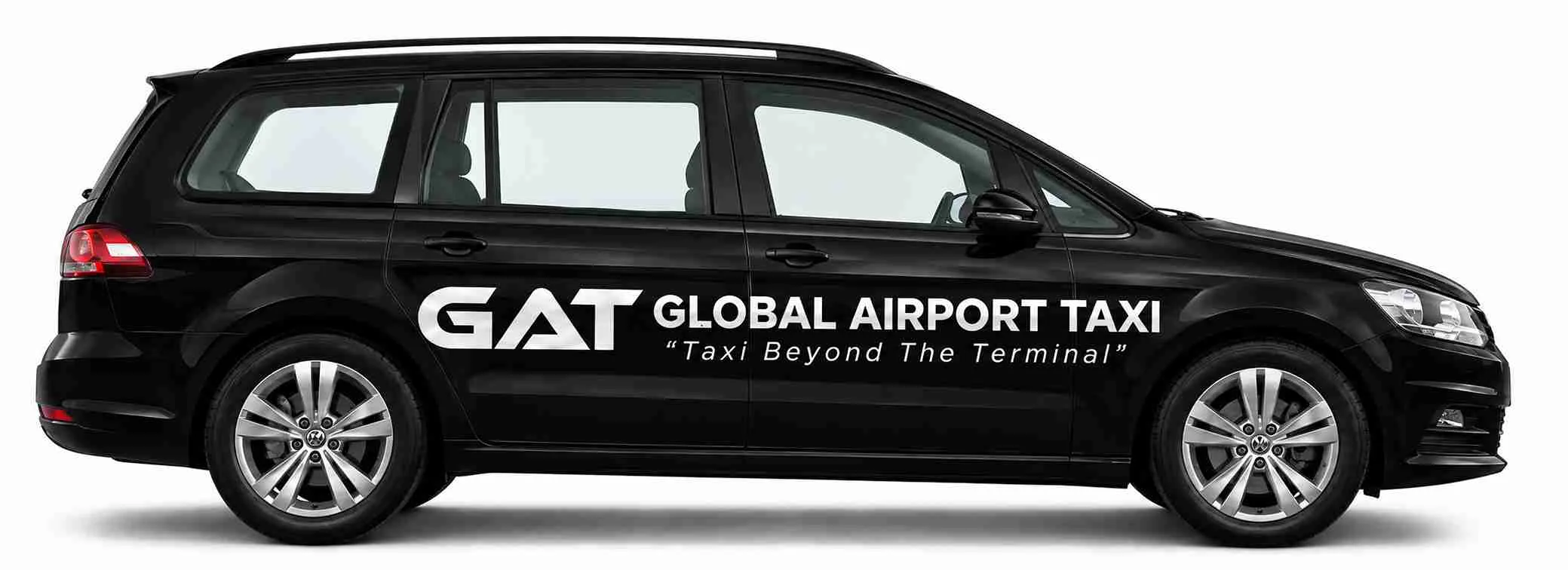 Shown above: 6-seater MPV people carrier
People carrier
Five or six seats, and 4 to 5 large bags
Five or six in a family, pram and all.
View vehicle →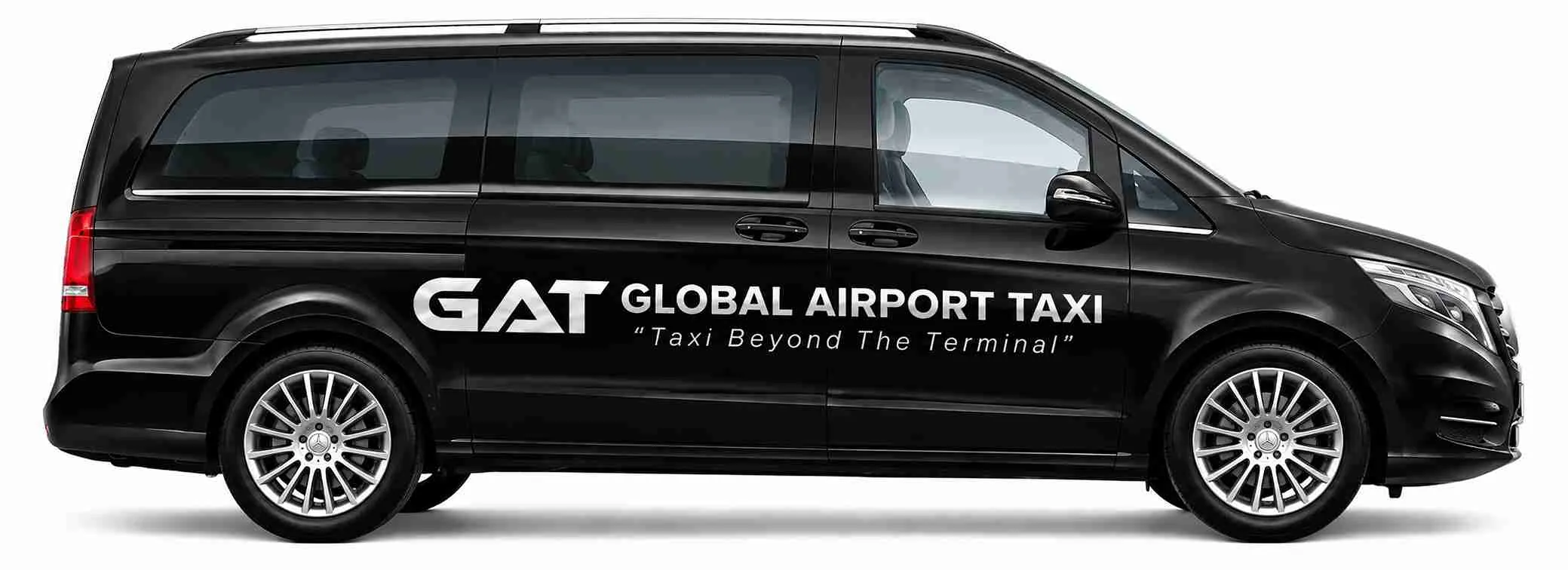 Shown above: A 7 seater taxi
7 seater taxi
7 passengers, 7 cabin bags
Seven people who travelled light.
View vehicle →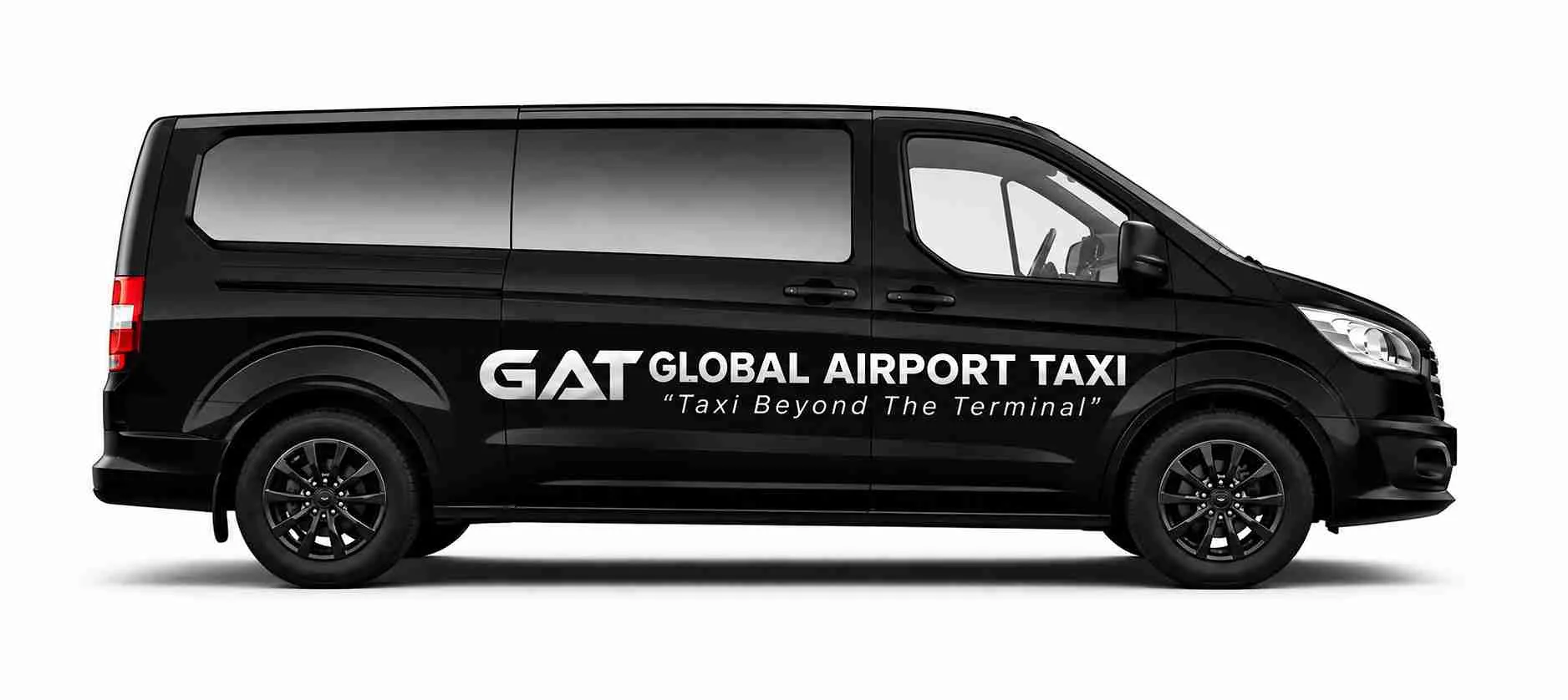 Shown above: An 8 seater taxi
8 seater taxi
Eight seats, and 6 to 8 large bags
Eight passengers, or fewer with a great deal of kit.
View vehicle →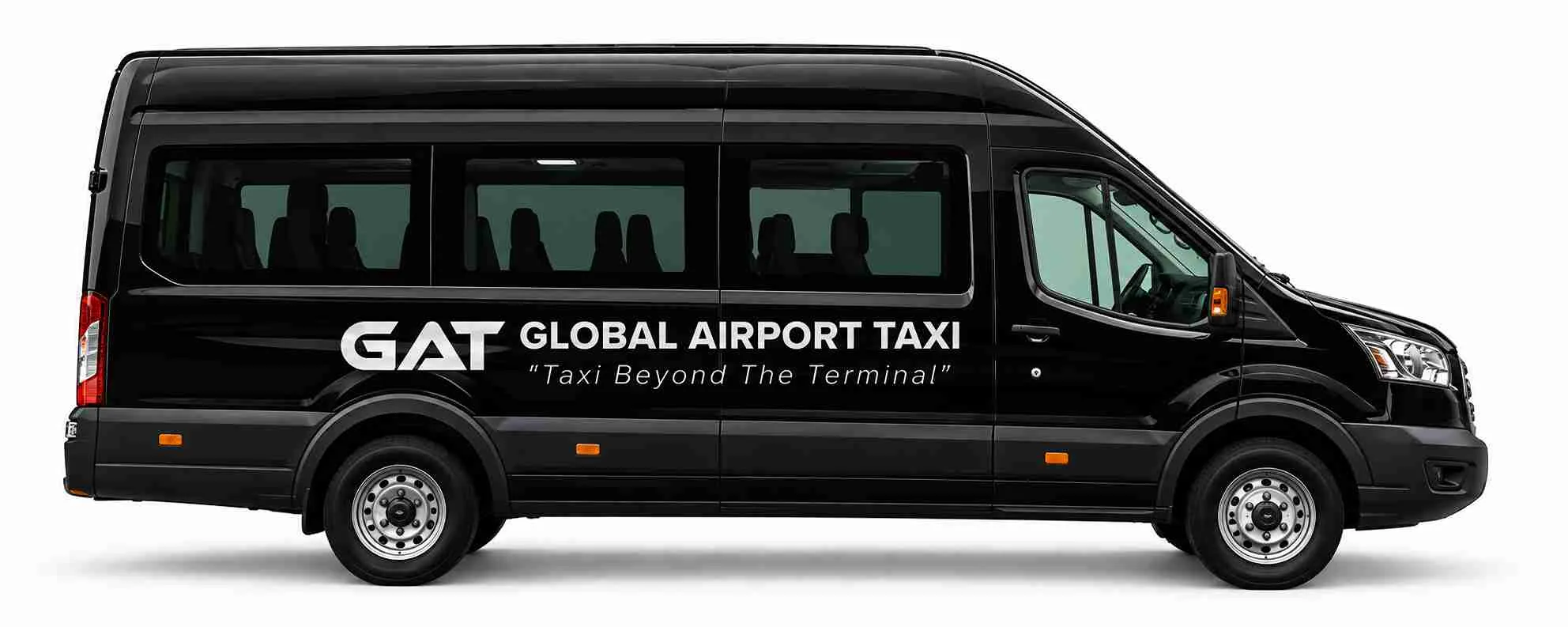 Shown above: A 16 seater minibus
16 seater minibus
Holds 16 passengers with roughly 14 large bags
Supporters, touring parties and wedding guests.
View vehicle →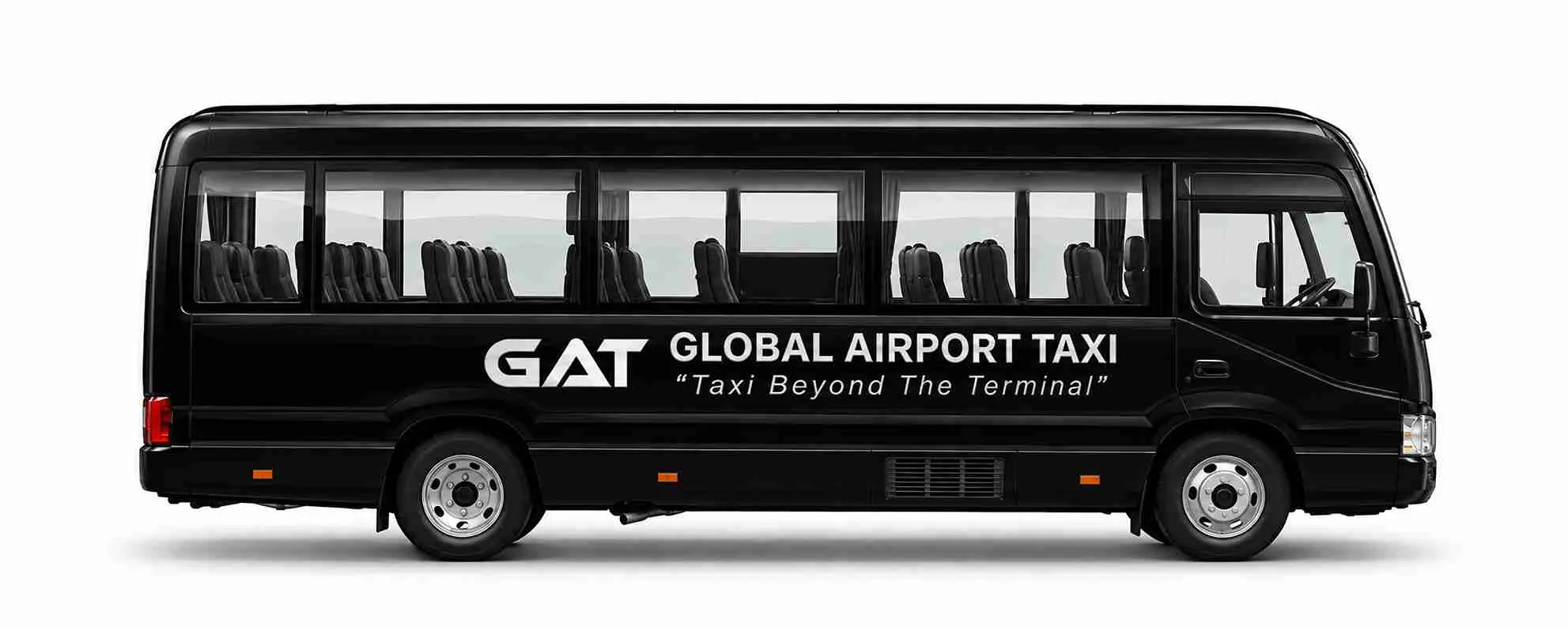 Shown above: A 30-seater coach
30-seater coach
30 seats
Delegates arriving for the same conference.
View vehicle →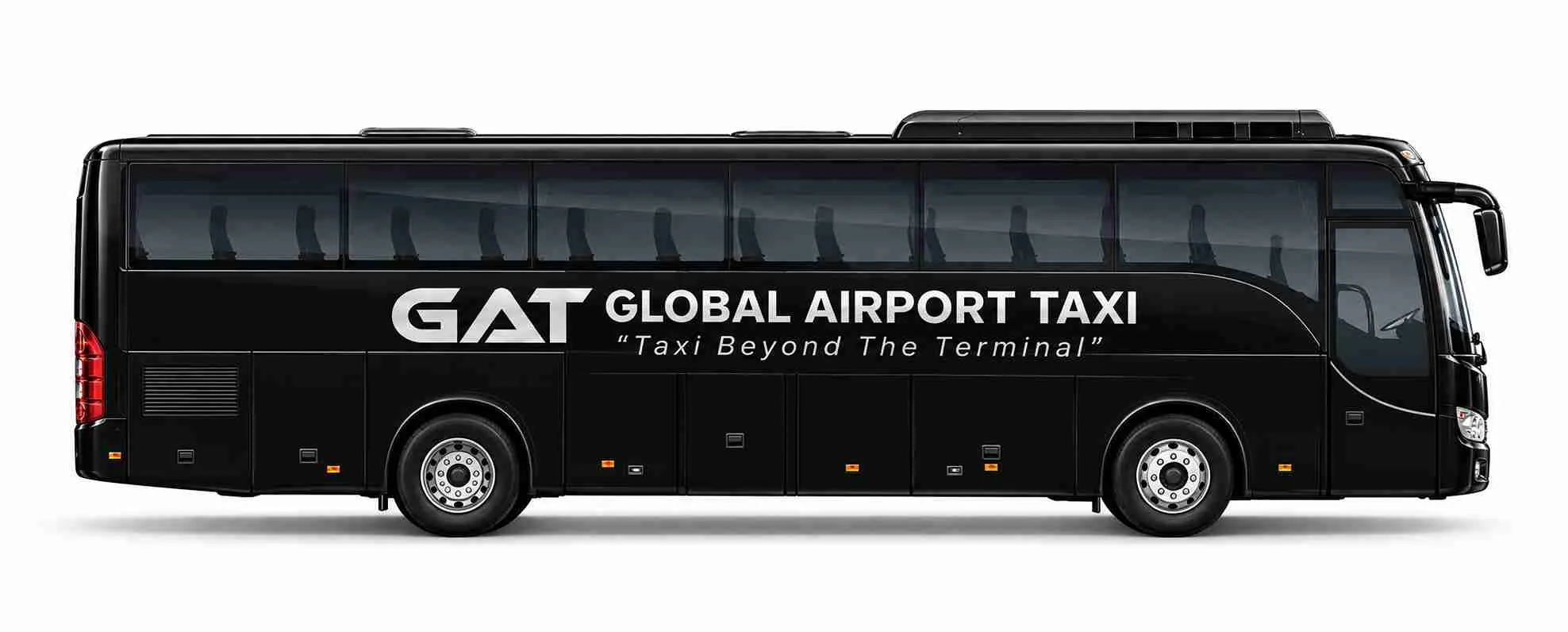 Shown above: A 50-seater coach
50-seater coach
50 seats
Big events and company trips arranged months ahead.
View vehicle →| Extra | What to know |
|---|---|
| Child seats | Infant, child and booster seats carry no charge when asked for. Britain looks for a child seat until a child turns 12 or reaches 135 cm, with limited exceptions for taxis and private hire, so put the ages on the form. |
| Golf clubs, bikes, band equipment | No difficulty at all, provided it is on the booking. Give the item and how long it is, and the vehicle allocated will have room for it. |
| Wheelchair-accessible vehicles | Put the request on the booking and we verify a suitable vehicle is available for that route and date. |
Every vehicle is shown on our fleet page. Each photograph is representative of its class, and the quote states what is on offer. Put the party size and the bag count on the booking so the correct vehicle arrives.
Reviews
Ratings and reviews as shown by our review widget on 29 September 2026. Each of these was written by somebody we carried at one of the airports on our network. What appears here is a selection, and every one of them remains published where its author left it.
Excellent4.9453 reviewsShowing all 10 reviews
Excellent service...arrived at terminal and driver was waiting...helped with luggage to the car...smooth drive...perfect overall
Very reliable and easy to get a hold of. I was very confused leaving the airport - user error haha - and they were super helpful. My flight was also delayed and the guy who picked me up was on top of it.
Super affordable and professional service! The pricing was very clear from the start, with no hidden charges, which I really appreciated. Everything went smoothly, and the professionalism of the global airport taxi service stood out. Highly recommended for anyone looking for a hassle-free and budget-friendly option.
Amazing taxi service to the airport! Our driver was friendly, on time, and made the whole trip so easy. The car was clean and comfortable, and we got to the airport right on time. Would definitely use this service again!
Excellent service , driver waited for us as flight was delayed, clean car and smooth ride
I would totally recommend Global Airport Taxi to anyone needing a taxi service for their airport commute. I decided on way to the airport that I was flying out of that I will need a cab service at LHR. They were quick to respond to and accommodated some of my last minute schedule change requests after I had landed at LHR. Totally reliable and willing to be flexible. Outstanding customer support provided by Jennifer and Root. Keep it up guys !!
This was a brilliant service our driver was excellent he was friendly and helpful. Used again for the return journey and driver was professional and ensured we made it to the airport on time with heavy traffic
The service was extremely reliable. My cab arrived exactly on time for my early morning flight, which was a huge relief. Everything went smoothly, and I felt confident choosing this service. Highly recommend global airport taxi for stress-free airport transfers!
Amazing customer service, on time driver helped with cases. A pleasant experience Thank you
Very clean car and on time very polite driver will use them again
These scores cover the whole network, not Manchester by itself. Trustindex supplies the widget and the reviews appear untouched.
The terminals
This is the question that has changed most recently at this airport, and the one a lot of pages still get wrong.
Short answer. Terminal 2 or Terminal 3. Terminal 1 closed permanently in 2026, its airlines moved to Terminal 2, and Ryanair moved to Terminal 3.
| Terminal | What it is now | More |
|---|---|---|
| Terminal 2 | The main terminal after a reported £1.3 billion rebuild, handling about three quarters of passengers. Its full footprint opened in December 2025. | Route page |
| Terminal 3 | The smaller terminal, which Ryanair uses. Improvement work has been announced to add space, shops and places to eat. | Route page |
| Terminal 1 | Closed permanently in 2026 after more than sixty years. Its airlines moved to Terminal 2, except Ryanair, which went to Terminal 3. | Closed — see Terminal 2 and Terminal 3 |
Manchester spent a decade rebuilding. Terminal 2 was extended in two phases at a reported cost of £1.3 billion, with the full footprint opening in December 2025, and Terminal 1 closed permanently in 2026 after more than sixty years. The airport now runs as a two-terminal operation, with Terminal 2 handling roughly three quarters of passengers and Terminal 3 serving Ryanair. Work has also been announced to improve and extend Terminal 3.
The terminals have separate forecourts, separate pick-up areas and a walk of several minutes between them. A driver standing in Terminal 3 cannot see you arrive in Terminal 2. Putting the right terminal on the booking is the single most useful thing you can do at this airport, and it is the field most often left wrong because people are working from an old memory of the place.
Give us the flight number instead. We can work the terminal out from it, and we are watching the flight anyway. Your boarding pass and your airline’s app are the other two reliable sources; a guide written before 2026 is not.
Terminal arrangements belong to the airport and are still being adjusted as the Terminal 3 work proceeds, so check your airline in the week you fly.
The airport
Short answer. Manchester Airport (MAN / EGCC) is the UK’s third busiest airport, with 32,088,626 passengers in 2025, two terminals, its own railway station and no Clean Air Zone charge.
Distances and journey times are typical road figures; traffic, match days and the Pennine weather all move them.
A journey is priced from the date, the hour and the vehicle you pick. The booking page does that arithmetic for your own trip and shows the figure before the payment step, where it stays once you accept it.
What it costs
One number would be a fiction, because the figure turns on details only your own booking holds. What this section can do is set out what moves it.
Short answer. There is no flat rate. A black cab is metered inside the Manchester licensed area, with guides putting the city centre run at roughly £25 to £35, while a booked car shows its own figure before you pay.
| What feeds in | What it changes | What to check |
|---|---|---|
| The two addresses | Mileage and the roads between them set the base | Street and number, not just the town |
| The day and the hour | A dawn departure, a Friday evening and a match day do not price alike | Enter the real collection time |
| The vehicle class | Each class carries its own rate, from saloon to minibus | Add up the cases before the people |
| The terminal | T2 and T3 have separate forecourts and separate pick-up areas | Put the right one on the booking |
| Airport charges | The forecourt carries a fee, listed on its own line in your summary | Check whether a competing quote has it inside or outside the figure |
| Waiting and extra stops | Sixty minutes from touchdown costs nothing; longer than that, or an added stop, is priced on request | Raise both at booking |
| Child seats and bulky bags | Seats are free; large items decide the vehicle | Ages for the children, and a count of the bulky items |
Inside the Manchester licensed area a black cab runs on the meter, and published guides put the city centre journey at roughly £25 to £35 depending on traffic and hour. Beyond Greater Manchester, or more than four miles outside the City of Manchester, the airport says a published maximum tariff applies and you may agree a lower fixed fare with the driver before setting off. That is a genuinely useful detail: on a long run the meter is a ceiling, not a quote.
The sequence is reversed. The figure is produced first, for the whole vehicle rather than per seat, and traffic on the M56 does not add to it afterwards. Two fixed quotes only become comparable once you know what each contains, which is why the checklist beside this is worth two minutes.
A single headline number would quietly assume a date, an hour, a terminal and a vehicle, and would therefore be wrong for most readers. Every row in the destination table instead opens the booking page, which calculates the figure for your own journey before you commit to it.
The metered figures above are taken from published guides and are not what we charge. Our own figure is produced for your journey on the booking page.
A journey is priced from the date, the hour and the vehicle you pick. The booking page does that arithmetic for your own trip and shows the figure before the payment step, where it stays once you accept it.
Arrivals and the forecourt
Two terminals, camera-read forecourts and a penalty for collecting in the wrong place. Manchester asks more of a passenger than most UK airports, so this section is worth the time.
Short answer. Your driver waits inside the Arrivals hall of the terminal on your booking, holding a board with your surname. Cars use that terminal’s forecourt drop-off zone, which is camera-read and paid online afterwards.
| At the airport | What to know |
|---|---|
| Which building | The terminal on your booking: T2 or T3. They have separate halls, separate forecourts and a walk between them. |
| Where the driver stands | In the Arrivals hall of whichever terminal you land at, surname on a board, landing time already known. |
| Getting to the car | Your driver leads you out with the luggage. The precise spot comes with your confirmation, since these forecourts are reorganised from time to time. |
| Departures | We stop in the forecourt drop-off zone of your terminal. There are no barriers; a camera reads the plate. |
| The drop-off charge | Reported at £5.50 for 5 minutes, £6.50 for 10 and £25 for 30. |
| The free drop-off | JetParks 1, M90 5AZ, with a shuttle reported at about 6 minutes, running around the clock. |
| Collecting a passenger | Never in a drop-off zone. Use the Express Pick Up areas or a multi-storey; the drop-off zones are reported to charge £100 for a collection. |
| The ranks | Two, one outside each terminal, plus black cab ranks at The Station. |
| Assistance | Arranged with your airline or the airport. Tell us what you have booked and the meeting point is set around it. |
Come out and scan the boards for your surname. Your landing time is already known to the driver, and if the belt is dragging, a message from inside the baggage hall is all that is required.
Bags in hand, the driver walks ahead, which saves you hunting for a bay number. Treat the spot on your confirmation as the live one, because the forecourts here have been rebuilt more than once.
The car pulls into your terminal’s drop-off zone, the cases come out and you walk in. At a reported £5.50 for the first 5 minutes there is no point lingering.
JetParks 1 has a free drop-off area with a shuttle reported at about 6 minutes, running around the clock with marshals on hand. Allow an extra 15 to 25 minutes. It is described as one-way, so it suits dropping off rather than collecting.
Assistance inside the building comes from the airline or the airport rather than from us. Let us know what is in place and we settle on a meeting point that spares you the long walk.
Every minute at the front of a Manchester terminal is charged and camera-read, and a collection in the wrong zone is penalised rather than billed. A driver who walks into the hall and brings you out avoids both problems, and removes the usual risk of an airport pickup, which is two people waiting in different buildings.
At a single-terminal airport a wrong assumption costs nothing. Here it costs a walk, a phone call and sometimes a charge, because the driver has to leave one forecourt and enter another. Take the terminal from your boarding pass, or give us the flight number and let us do it.
Charges and layout belong to the airport and change at short notice; look at its website in the week you travel.
The pick-up rule
Setting somebody down and collecting them are different things at this airport, in different places, with a penalty attached. Worth two minutes before you send anyone to meet you.
Short answer. Collecting a passenger from a forecourt drop-off zone at Manchester is reported to carry a £100 charge. Collections belong in the signed Express Pick Up areas or a multi-storey car park.
| Where | What it is for | What is reported |
|---|---|---|
| Forecourt drop-off, T2 and T3 | Setting a passenger down only | Reported at £5.50 for 5 minutes, £6.50 for 10, £25 for 30 |
| Express Pick Up areas | Collecting a passenger | Signed from each terminal; this is where a collection belongs |
| Multi-storey car parks | Collecting a passenger | The Terminal 2 West multi-storey is reported at £6.60 for up to 15 minutes |
| JetParks 1 free drop-off | Setting down, free | M90 5AZ, with a shuttle reported at about 6 minutes and described as one-way |
| Collecting in a drop-off zone | Not allowed | Reported to carry a £100 charge |
| Blue Badge holders | Setting down | Reported to use the forecourt drop-off areas free of charge, for drop-off only |
Manchester separates setting down from picking up, and enforces the difference. Waiting in a drop-off zone for an arriving passenger is reported to bring a £100 charge, and because the forecourts are camera-read there is no barrier to warn you and nobody to ask. It is the most expensive avoidable error at this airport, and almost no transfer page mentions it.
Follow the signs for Express Pick Up at your terminal, or use a multi-storey, where the Terminal 2 West is reported at £6.60 for up to 15 minutes. Both are short walks. The JetParks shuttle does not help here, because it is described as running one way.
None of this lands on you. The driver uses whichever area the airport requires, absorbs the charge as part of the arrangement, and meets you inside the building. Any airport charge that genuinely applies to your journey is itemised in the booking summary before payment, not added afterwards.
Figures are reported from published sources and the airport can change them. Confirm on its website before you travel.
A journey is priced from the date, the hour and the vehicle you pick. The booking page does that arithmetic for your own trip and shows the figure before the payment step, where it stays once you accept it.
Where we go
Thirty-one journeys, from Stockport eight miles away to York seventy miles east. These are our own road figures, and each row opens the price for your date.
Short answer. The shortest run is Stockport at about 8 miles; the city centre is about 10 miles and 25 minutes; Liverpool, the most asked-for long trip, is about 38 miles and 55 minutes.
Showing all 31 destinations
| Destination | Area | Distance and time | Your price |
|---|---|---|---|
| Manchester Piccadilly | Station · The main station, for London and the south | about 10 mi, 25 min | Get fare to Manchester Piccadilly |
| Manchester Victoria | Station · The northern station, beside the arena | about 11 mi, 30 min | Get fare to Manchester Victoria |
| Manchester Oxford Road | Station · The university and hospital station | about 10 mi, 25 min | Get fare to Manchester Oxford Road |
| Manchester city centre | Greater Manchester · Hotels, offices and the Northern Quarter | about 10 mi, 25 min | Get fare to Manchester city centre |
| Salford Quays and MediaCityUK | Greater Manchester · The BBC, ITV and the Lowry | about 11 mi, 30 min | Get fare to Salford Quays and MediaCityUK |
| The Trafford Centre | Greater Manchester · Shopping and cinemas off the M60 | about 10 mi, 25 min | Get fare to The Trafford Centre |
| Stockport | Greater Manchester · The nearest large town to the airport | about 8 mi, 20 min | Get fare to Stockport |
| Bolton | Greater Manchester · North-west of the city, off the M61 | about 20 mi, 35 min | Get fare to Bolton |
| Warrington | Greater Manchester · Between Manchester and Liverpool | about 18 mi, 30 min | Get fare to Warrington |
| Wigan | Greater Manchester · The town on the M6 corridor | about 25 mi, 40 min | Get fare to Wigan |
| Macclesfield | Greater Manchester · Cheshire, at the edge of the Peak District | about 13 mi, 25 min | Get fare to Macclesfield |
| Old Trafford | Venue · Manchester United and the cricket ground | about 9 mi, 20 min | Get fare to Old Trafford |
| Etihad Stadium | Venue · Manchester City, in the east of the city | about 12 mi, 25 min | Get fare to Etihad Stadium |
| Co-op Live arena | Venue · The arena beside the Etihad campus | about 12 mi, 25 min | Get fare to Co-op Live arena |
| Aintree Racecourse | Venue · The Grand National course, north of Liverpool | about 40 mi, 55 min | Get fare to Aintree Racecourse |
| Liverpool | City or town · The waterfront city, along the M62 | about 38 mi, 55 min | Get fare to Liverpool |
| Leeds | City or town · West Yorkshire, over the Pennines | about 45 mi, 70 min | Get fare to Leeds |
| Sheffield | City or town · South Yorkshire, past the Peak District | about 38 mi, 60 min | Get fare to Sheffield |
| Chester | City or town · The walled city on the Welsh border | about 40 mi, 50 min | Get fare to Chester |
| Preston | City or town · Lancashire, on the M6 | about 35 mi, 50 min | Get fare to Preston |
| York | City or town · The minster city, across the Pennines | about 70 mi, 90 min | Get fare to York |
| Blackpool | City or town · The Fylde coast and the Tower | about 55 mi, 75 min | Get fare to Blackpool |
| Stoke-on-Trent | City or town · The Potteries, south on the M6 | about 40 mi, 50 min | Get fare to Stoke-on-Trent |
| Bradford | City or town · West Yorkshire, beyond Leeds | about 50 mi, 70 min | Get fare to Bradford |
| Southport | City or town · The Sefton coast and its links courses | about 35 mi, 55 min | Get fare to Southport |
| Buxton | City or town · The spa town inside the Peak District | about 25 mi, 40 min | Get fare to Buxton |
| Liverpool cruise terminal | Port · Where the cruise ships berth on the Mersey | about 40 mi, 60 min | Get fare to Liverpool cruise terminal |
| Heysham ferry port | Port · The sailings to the Isle of Man and Ireland | about 55 mi, 75 min | Get fare to Heysham ferry port |
| The Peak District | Day out · The national park on the city’s doorstep | about 25 mi, 40 min | Get fare to The Peak District |
| Chester Zoo | Day out · One of the busiest attractions in Britain | about 40 mi, 50 min | Get fare to Chester Zoo |
| Birmingham Airport | Airport · A single page covers both directions | about 90 mi, 100 min | Get fare to Birmingham Airport |
Every name in the first column opens a page of its own. Anywhere missing can be priced by entering the address on the booking page; every Manchester Airport route lists the same set, and hotels sit on their own page.
A link sits in the last column instead of a number, because the number moves with your date, hour, terminal and vehicle. What each class holds is set out on the fleet page and the executive car page.
A journey is priced from the date, the hour and the vehicle you pick. The booking page does that arithmetic for your own trip and shows the figure before the payment step, where it stays once you accept it.
Greater Manchester
Most arrivals stay within about twenty miles. These are the places we are asked for by name, so the driver knows exactly where to stop.
Short answer. The city centre is about 10 miles and roughly 25 minutes. Stockport, at about 8 miles, is the shortest run on this page, and Salford Quays about 11 miles.
About 10 miles and roughly 25 minutes by the M56 and the Mancunian Way. Hotels, offices and the Northern Quarter all sit within a compact centre, but it is a centre with a lot of one-way streets, so give the driver the street rather than the district. Manchester Airport to the city centre.
Piccadilly and Oxford Road are about 10 miles and 25 minutes; Victoria about 11 and 30. Piccadilly handles the London and cross-country services, Victoria the north and the trams, Oxford Road the universities and hospitals. Say which one, and which entrance. Piccadilly taxi. Victoria taxi. Oxford Road taxi.
About 11 miles and half an hour, north-west of the centre, for the BBC, ITV, the Lowry and the Imperial War Museum North. The tram reaches it, but with equipment or luggage a car ends at the building. Salford Quays taxi.
About 8 miles and 20 minutes, which makes it the shortest run on this page and often quicker than the city centre. The viaduct town has its own station on the London line. Stockport taxi.
The Trafford Centre is about 10 miles, Warrington 18, Bolton 20 and Wigan 25. All four sit off the motorway ring, so the drive is usually faster than the mileage suggests outside the peaks. Trafford Centre taxi. Bolton taxi.
About 13 miles and 25 minutes south, at the edge of the Peak District, for the town, the business parks and the villages around Alderley Edge and Wilmslow. Macclesfield taxi.
Houses on the same street can come out at different figures, so enter the precise address.
A journey is priced from the date, the hour and the vehicle you pick. The booking page does that arithmetic for your own trip and shows the figure before the payment step, where it stays once you accept it.
Match days and arenas
Few airports sit this close to this much event traffic. Getting there is straightforward; getting away is the part that needs planning.
Short answer. Old Trafford is about 9 miles from the terminal, roughly 20 minutes. The Etihad Stadium and Co-op Live, which share a campus, are about 12 miles and 25 minutes.
| Venue | From the terminal | Worth knowing |
|---|---|---|
| Old Trafford | About 9 miles, roughly 20 minutes | Manchester United and the cricket ground sit close together; both fill the same roads |
| Etihad Stadium | About 12 miles, roughly 25 minutes | Manchester City, in the east of the city, on a campus with its own traffic plan |
| Co-op Live arena | About 12 miles, roughly 25 minutes | On the same campus as the Etihad, so an arena night and a match day compound each other |
| AO Arena and the city centre venues | About 11 miles, roughly 30 minutes | Beside Victoria station, in the middle of the centre’s one-way system |
| Aintree Racecourse | About 40 miles, roughly 55 minutes | North of Liverpool; Grand National week is the busiest road week in the north-west |
Manchester has two Premier League grounds and a Test cricket venue within a dozen miles of the airport. On a match day the roads around each close or crawl from well before kick-off. Book early, and agree a drop-off point with the driver rather than aiming for the nearest gate.
Co-op Live and the AO Arena both empty inside twenty minutes of the last song. A pick-up point a few streets from the main exit clears far faster, and arranging it before the show rather than during it is the difference between twenty minutes and an hour.
A great many visitors fly in for a fixture and out the next morning. Tell us the kick-off and the flight, and we plan both legs around them; the second leg is the one people forget until the roads are already full.
A journey is priced from the date, the hour and the vehicle you pick. The booking page does that arithmetic for your own trip and shows the figure before the payment step, where it stays once you accept it.
Clean Air Zone
This is a correction rather than a feature. A good deal of material online still implies a charge that was scrapped before it ever ran.
Short answer. Greater Manchester has no charging Clean Air Zone. The scheme was scrapped and replaced by an investment plan reported at about £86 million, so no daily charge applies to cars, taxis or private hire vehicles.
Greater Manchester spent years preparing a charging Clean Air Zone that would have billed non-compliant vehicles, taxis and private hire among them, for entering a large part of the conurbation. It was announced in 2019, paused, redesigned and then abandoned. Government approval for an investment-led plan instead was reported in January 2025, with funding of about £86 million.
Reported allocations include around £51 million for cleaner buses and charging infrastructure, about £8 million to help the taxi trade move to cleaner vehicles, and further sums for traffic measures and administration. The point for a passenger is simple: the money goes into vehicles and buses rather than into a daily charge at a camera.
Nothing is added to your journey for entering Manchester, because there is no charge to add. If you have read elsewhere that a Clean Air Zone charge applies here, that page has not been updated. Any charge that genuinely applied to your journey, such as an airport forecourt fee, is itemised in your booking summary before you pay.
The figures above are reported from published coverage of the decision rather than measured by us, and policy can change again. Check the current position before relying on it.
A journey is priced from the date, the hour and the vehicle you pick. The booking page does that arithmetic for your own trip and shows the figure before the payment step, where it stays once you accept it.
Across the north
Manchester is the arrival airport for most of northern England, and a large share of passengers never go into the city at all.
Short answer. Liverpool is about 38 miles and 55 minutes, Leeds about 45 miles and 70 minutes, Sheffield about 38 and an hour, and Chester about 40 and 50 minutes.
About 38 miles and roughly 55 minutes on the M56 and M62. The most requested long run from this airport, for the city, the waterfront and the cruise terminal. A car avoids changing trains with luggage at Piccadilly or Lime Street. Manchester Airport to Liverpool.
Leeds is about 45 miles and 70 minutes, Bradford 50, York 70. All cross the Pennines on the M62, one of the highest motorways in England, where the weather matters more than the distance. Leeds taxi. York taxi.
About 38 miles and an hour, skirting the Peak District. The route is shorter than Leeds but slower in bad weather, because the alternatives to the motorway run high. Sheffield taxi.
About 40 miles and 50 minutes west, for the walled city, the racecourse and the route into north Wales. Chester Zoo is a little beyond it. Chester taxi. Chester Zoo taxi.
Preston is about 35 miles and 50 minutes, Blackpool 55 and 75, Southport 35. The M6 and M55 carry most of it, and summer weekends on the coast are the slow ones. Preston taxi. Blackpool taxi.
Stoke-on-Trent is about 40 miles south on the M6. Anywhere else in England can be priced on the booking page; the long runs are drives rather than transfers, so we agree the plan with you beforehand. Stoke-on-Trent taxi.
Mileages are road distances and the times assume ordinary traffic. The M60 at the peaks and the M62 in winter are the two that stretch.
A journey is priced from the date, the hour and the vehicle you pick. The booking page does that arithmetic for your own trip and shows the figure before the payment step, where it stays once you accept it.
Days out
A good number of arrivals here are heading for countryside rather than a city, and the Peak District is closer than the city centre is to some of them.
Short answer. The Peak District starts about 25 miles from the terminal, roughly 40 minutes, and Chester Zoo is about 40 miles and 50 minutes.
The national park begins about 25 miles from the terminal, roughly 40 minutes, which makes Manchester one of the few major airports with a national park on its doorstep. Buxton sits inside it at about the same distance. Peak District taxi. Buxton taxi.
About 40 miles and 50 minutes. Among the busiest paid attractions in Britain, with timed entry, so tell us the slot and we work the collection back from it. Chester Zoo taxi.
Both are further out and priced on the booking page. They are also the two places where public transport thins out fastest once you leave the main line, which is why a car is usually the answer rather than a preference.
Each venue publishes its own hours and entry slots; check them before the collection time is fixed.
A journey is priced from the date, the hour and the vehicle you pick. The booking page does that arithmetic for your own trip and shows the figure before the payment step, where it stays once you accept it.
Cruise and ferry
Manchester is the nearest major airport to two sailing points, and both are an hour or more away, which makes the collection time the whole game.
Short answer. The Liverpool cruise terminal is about 40 miles from the airport, roughly an hour, and Heysham about 55 miles and 75 minutes.
About 40 miles, roughly an hour. A cruise line gives you a boarding window rather than a departure time, so send that window over and both the collection and the luggage space are planned around it. Liverpool cruise terminal taxi.
About 55 miles and roughly 75 minutes north, for the Isle of Man and Irish sailings. Ferry check-in deadlines are stricter than airline ones, so we count back from the one on your ticket. Heysham ferry port taxi.
A journey is priced from the date, the hour and the vehicle you pick. The booking page does that arithmetic for your own trip and shows the figure before the payment step, where it stays once you accept it.
Airport to airport
A missed connection or a split booking puts people in a car across the country. These are the runs we are asked for.
Short answer. Manchester Airport to Birmingham Airport is about 90 miles and roughly an hour and forty minutes. Liverpool John Lennon, the nearest alternative, is about 35 miles.
About 90 miles and roughly an hour and forty minutes down the M6. One page covers the run in both directions. People book it for a connection between the two, or when a flight leaves from the one they did not land at. Manchester Airport and Birmingham Airport taxi.
The nearest alternative airport, about 35 miles away. Priced on the booking page; it is a short enough run that a car is usually the sensible answer rather than a train with a change.
Also priced on the booking page. For anything beyond about two hours we will say plainly when a train or a connecting flight makes more sense than a car.
A journey is priced from the date, the hour and the vehicle you pick. The booking page does that arithmetic for your own trip and shows the figure before the payment step, where it stays once you accept it.
All routes
Below, each destination leads to a page carrying its distance, its journey time and a way through to the price.
Not on the list? Type the address into the booking page and it works out a figure. The destination table above holds the same routes with distances, and our team picks up anything neither covers.
A journey is priced from the date, the hour and the vehicle you pick. The booking page does that arithmetic for your own trip and shows the figure before the payment step, where it stays once you accept it.
Which kind of taxi
Three things are all called taxis here and they are regulated differently. At Manchester the difference shows up most on a long journey, where the meter is a ceiling rather than a quote.
Short answer. Black cabs work the ranks on a meter inside the Manchester licensed area, with a published maximum tariff beyond it. Private hire, including ours and any app, must be booked in advance.
They work the two ranks, one outside each terminal, plus the ranks at The Station, and need no booking. Inside the Manchester licensed area the meter sets the fare. The airport describes the fleet as 100% wheelchair accessible, which is unusual and genuinely useful.
For a journey beyond Greater Manchester, or more than four miles outside the City of Manchester, the airport says a published maximum tariff applies rather than a straight meter, and that you may agree a lower fixed fare with the driver before setting off. If you are going to Liverpool or Leeds from the rank, that conversation is worth having at the kerb.
What our transfers are. A private hire car cannot be hailed and cannot work a rank: the booking is what makes the journey lawful. In exchange the figure is agreed first and the driver is already inside your terminal.
App cars are private hire as well, so the same booking principle applies, and their prices move with demand rather than following a tariff. At the airport they use the same pick-up areas as everybody else, with the same rules about where a collection may happen.
Licensing and tariffs are set by the local council and the airport sets its own access rules; check the current position for your travel date.
Flights and traffic
The UK’s third busiest airport, freshly rebuilt, with the widest long-haul network outside London. That mix shapes the Arrivals hall.
Short answer. Manchester handled 32,088,626 passengers in 2025, its first year above 32 million and the UK’s third highest. December 2025 was its busiest December on record.
Ryanair, Jet2.com, easyJet and TUI carry much of the short-haul traffic, and the long-haul list is the widest outside London: Emirates, Qatar Airways, Singapore Airlines, Virgin Atlantic and Etihad among others. Reported additions include Pakistan International Airlines to Islamabad and IndiGo to Delhi, both from Terminal 2. Schedules change by season, so trust your own booking rather than any list.
A decade-long programme doubled Terminal 2 in two phases at a reported £1.3 billion, with the full footprint opening in December 2025 and Terminal 1 closing in 2026. The airport has reported that most December passengers reached security in ten minutes or less. For a transfer the practical effect is simpler: two terminals instead of three, and a different building for a lot of airlines than the one people remember.
You need do nothing when a flight runs late, since it is being followed. The exception worth a quick call is a diversion to a different airport.
Landing
What happens between the wheels touching down and the car pulling away, and the options if you arrived without a booking.
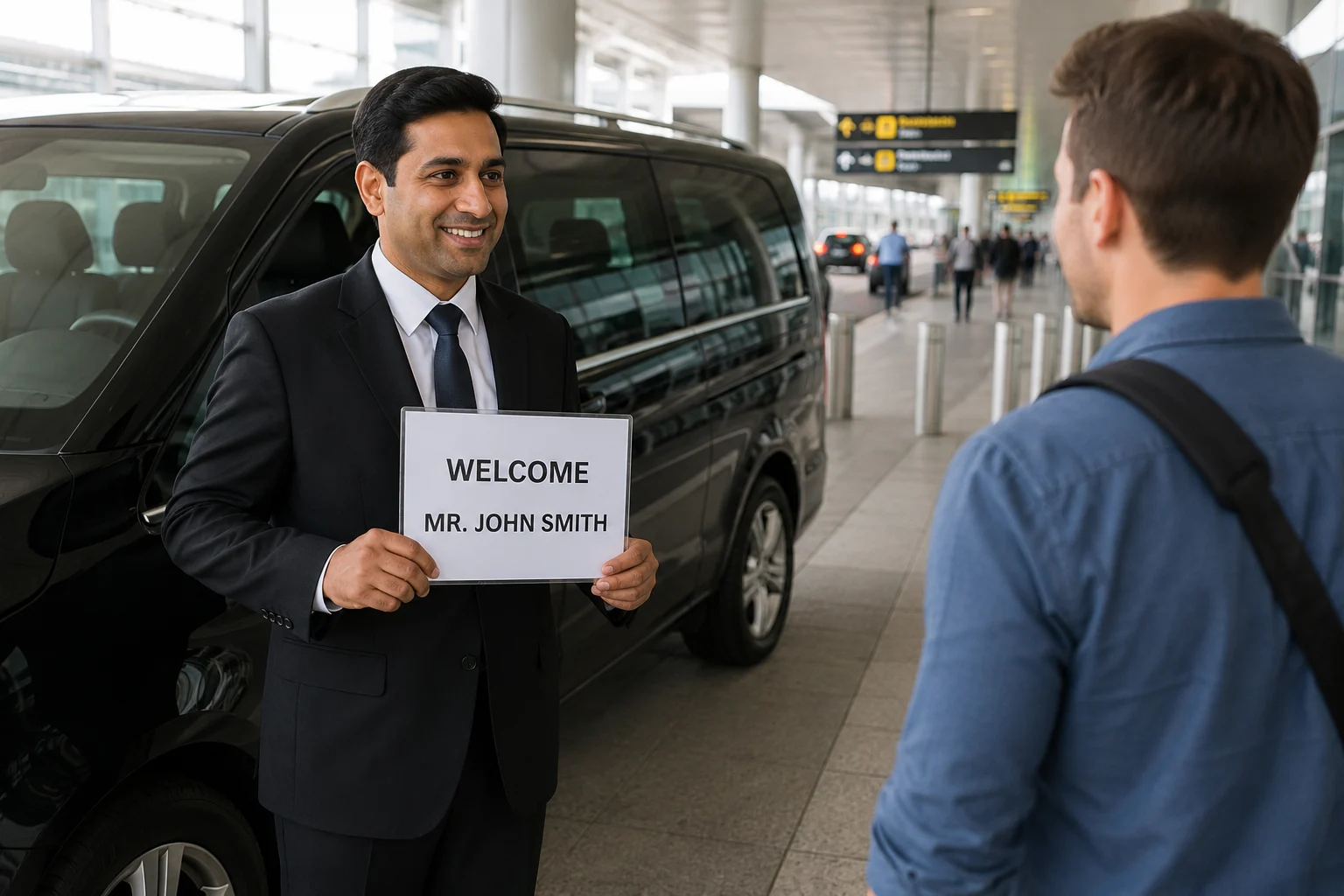
There is a rank outside each terminal and more at The Station, all metered and needing no booking. The railway station and the Metrolink stop are a covered walk away. What you cannot do is hail a private hire car on the spot, because the booking is what makes it lawful.
Council-issued plates are displayed on a licensed vehicle, and a private hire driver can show you the booking your name sits on. Anything that feels off is worth asking about on the pavement rather than in the back seat.
Someone who walks up to you inside offering a lift is outside the rules, however it is phrased. A polite no is the right answer: your own driver has your surname in his hands, and the ranks are signed.
There is a fuller description of how meeting works in our meet and greet guide.
Border control
Nothing about an international arrival is harder to predict than the border hall, and passengers tell us it is the bit they worry over. It has no bearing on when the driver appears.
| Your arrival | What you use | What to expect |
|---|---|---|
| A flight from within the UK | No border to cross | Collect the bags and walk out |
| A British or Irish passport, arriving from abroad | Gates or an officer | No ETA to arrange; the wait follows how many aircraft came in together |
| An overseas flight that needs an ETA | Gates if you qualify, otherwise an officer | Sort the authorisation before you board; it is tied to the passport it was issued against |
| A child with a parent or guardian | The gates only where age and passport permit | Failing that, an officer, with the adult present; GOV.UK carries the age threshold |
| A passport the readers reject | An officer, in person | The slowest of the routes, particularly in a long-haul arrival bank |
An Electronic Travel Authorisation or an eVisa is required before boarding by anyone without British or Irish nationality or UK immigration status, babies included. Apply through the GOV.UK ETA page or in the official app, where the current fee is published. None of this is particular to Manchester.
The gates serve eligible biometric passport holders, and who counts as eligible has been rewritten more than once, so the current list is worth a look even if you came through last year. Where a child does not share the adult’s surname, expect a question about the relationship; a birth certificate or a signed letter closes it immediately.
The rules are rewritten periodically. The GOV.UK ETA page is the authority, and the airline will tell you what it checks at the gate.
Flying out
Most of this page looks at arrivals. For a departure, here is how the journey works and how to settle on a collection time.
Short answer. Drive time, plus two hours inside the terminal, plus half an hour spare. From the city centre that comes to roughly 3 h 00 min ahead of departure, and long-haul adds another hour.
| From | Typical drive | Collect this long before departure |
|---|---|---|
| Stockport | about 20 min | 3 h 00 min |
| Old Trafford | about 20 min | 3 h 00 min |
| Manchester city centre | about 25 min | 3 h 00 min |
| Warrington | about 30 min | 3 h 00 min |
| Bolton | about 35 min | 3 h 15 min |
| Preston | about 50 min | 3 h 30 min |
| Liverpool | about 55 min | 3 h 30 min |
| Leeds | about 70 min | 3 h 45 min |
The drive, then two hours inside the terminal, then half an hour spare, rounded up to the next quarter hour. Long-haul adds an hour, and the school holiday changeovers add more again. The airport has reported short security queues since the rebuild, but a queue you did not plan for is still a queue.
Manchester runs a heavy early-morning bank, so collections between two and five in the morning are ordinary work rather than a special request. They are also the hours when the tram has stopped and the trains are thin.
Put it on the booking. Terminal 2 and Terminal 3 have separate forecourts, and arriving at the wrong one on a tight schedule costs a walk you have not budgeted for.
We pull into your terminal’s drop-off zone, reported at £5.50 for the first 5 minutes, and the bags are out quickly. If you are early and would rather not pay to wait, JetParks 1 is the free alternative, at the cost of a shuttle ride.
Every airline sets its own bag-drop cut-off. Drive times here are typical figures and the collection times are advice, not a guarantee.
Early and late
A heavy dawn departure bank and a tram that stops before the first flights leave. Those two facts shape most journeys made here outside normal hours.
Short answer. The buses are reported to run around the clock and the ranks stay open, but the tram stops before midnight and well before the first departures. Our cars run at every hour.
| Option | What is reported | What it means for you |
|---|---|---|
| Trains from the airport station | Reported from the early hours until around half past one | Check your operator for the first and last service; waits stretch early in the morning |
| Metrolink trams | Reported from about four in the morning until midnight | Later on some days than others, and not an option for a dawn departure |
| The 43 and 103 buses | Reported as running around the clock | The option that keeps going all night, though slower than the train |
| The taxi ranks | Outside each terminal | Metered and open to anyone, but thinner at three in the morning and busier when a late flight lands |
| Early departures | A heavy early-morning bank | Allowing two hours inside for a short-haul flight pushes many collections into the 02:00 to 05:00 window |
Four in the morning uses the same arithmetic as four in the afternoon. What differs is that the roads are clear and almost nothing else is running, so the spare half hour is insurance against the car rather than against the traffic.
With the flight number on the booking, the collection moves with the aircraft no matter how late it arrives, and the free hour is still measured from the wheels touching down. Arriving after midnight is ordinary work here.
The buses are reported to run around the clock and the ranks are open, so an unbooked late arrival is not stranded. It is simply slower, and more uncertain, than a car that was arranged in advance, which matters most when a long-haul flight lands with a full belt behind it.
These hours are reported figures rather than promises. The operator will give you the first and last service for your own date.
Train, tram and bus
Manchester has its own station, which few UK airports do. This is how each option works, including where it beats us.
Short answer. Manchester Airport has its own railway station, with Piccadilly reported at 15 to 20 minutes, Metrolink trams from the same interchange and the 43 and 103 buses running around the clock.
| Option | Goes to | What is reported | Best for |
|---|---|---|---|
| Train from Manchester Airport station | Piccadilly, and onward across the north | Reported at about 15 to 20 minutes to Piccadilly; the station is a covered walk of five to fifteen minutes from the terminals | The quickest way in for one person with a small bag |
| Metrolink tram | The city centre and the Metrolink network | Reported at about 45 to 60 minutes, roughly every 12 minutes, from the same interchange | A destination on the tram line rather than a dash to Piccadilly |
| The 43 and 103 buses | Piccadilly Gardens | Reported at about 40 to 45 minutes, running around the clock | The cheapest option, and the one that runs all night |
| Coaches | Across the north-west and beyond | Long-distance services stop here; timetables come from each operator | Budget journeys that can work around a timetable |
| Taxi rank | Anywhere | Metered inside the licensed area, with a published maximum tariff beyond it; two ranks, one per terminal | Arriving without a plan |
| Pre-booked car | Any address | Driver inside your terminal, price agreed before payment | Groups, luggage, late arrivals, match days, anywhere off the rail line |
Not every airport has its own railway station. Manchester does, at The Station interchange, with the trams from the same place and a covered walkway to the terminals reported at five to fifteen minutes. For one person with a cabin bag going to Piccadilly, the train is genuinely hard to beat, and we would say so.
That walkway is five to fifteen minutes depending on which terminal you start from, and it is not short with two large cases, a pushchair and a tired child. Add a destination that is not a station, a match day, or an arrival after the tram has stopped, and the calculation turns the other way.
Frequencies, hours and fares all belong to the operators and move; check them against your own travel date.
Compared honestly
Our interest here is hardly hidden, which is why the table names the journeys where rail wins outright. Put a railway station under the terminals and that list gets longer than operators like to admit.
One person, a cabin bag, the middle of the afternoon, going to Piccadilly: take the train. It leaves from the airport’s own station, it is reported at 15 to 20 minutes and it costs a fraction of a car. We sell transfers, so weigh that against our interest, but a comparison that never concedes anything is not a comparison.
Four people and four cases. A flight landing at one in the morning. A match at Old Trafford, a hotel in Cheshire, a cruise at Liverpool, an address in the Peak District. In each of those the question stops being about the fare and becomes whether the journey works at all.
| Option | Cost | Time | Best for | Our view |
|---|---|---|---|---|
| Pre-booked car Global Airport Taxi | Worked out for your trip, on screen before payment, covering the whole car | Roughly 25 min in, with nothing to queue for | Groups, luggage, late arrivals, match days, anywhere off the line | Our service A driver inside your terminal with your name, a vehicle sized to the party, and a figure agreed first. |
| Train from the airport station | The price of a rail ticket, lowest booked ahead | Reported at 15 to 20 min to Piccadilly | One or two people with small bags going to a station | Fastest Quick and cheap, but add the covered walk and it ends at a platform. |
| Metrolink tram | A tram ticket; check the Bee Network | Reported at 45 to 60 min | A destination on the tram line | Spread out More stops than the train, and slower for the centre. |
| The 43 and 103 buses | Whatever the operator charges that day | Reported at about 40 to 45 min | The tightest budgets, and the small hours | Cheapest Keeps going all night, unlike the tram. |
| Black cab from the rank | Metered inside the licensed area; a maximum tariff beyond it | About 25 min, stretching when the roads fill | Arriving with nothing booked | Varies Nothing to arrange, but the traffic decides what you pay. |
Rail, tram and bus fares are the operators’ to set, so confirm them. Our own comes from the booking page before you pay. Agreed fares against app pricing is covered at greater length in fixed-price taxis against ride-hailing apps.
The calendar
Manchester’s year is shaped by football and arena nights as much as by holidays. On these dates the roads and the terminal are busy together.
| What | When | Where it bites | What it means |
|---|---|---|---|
| Manchester United and Manchester City home games | August to May | Old Trafford and the Etihad | Roads around each ground close or crawl for hours. Plan an extra half hour each way. |
| Co-op Live and AO Arena nights | Through the year | East Manchester and the city centre | The whole crowd leaves inside twenty minutes of the encore, so settle the return in advance. |
| Test and international cricket | Summer | Old Trafford | The cricket ground shares its roads with the football ground. |
| Grand National week | April | Aintree, north of Liverpool | The busiest road week in the north-west, and about 40 miles from the terminal. |
| School holidays | From late July into September, and the half-terms | The terminal and every motorway around it | The Saturday changeovers are the heaviest days of the airport’s year. |
| Christmas and New Year | Mid-December to early January | Everywhere | The airport recorded its busiest ever December in 2025. |
| Pennine weather | November to March | The M62, the M60 and the high routes | Snow, ice and fog. For a Yorkshire start in winter, leave a wider margin. |
Fixture lists and event dates come from the clubs and the venues, so check before fixing a collection time.
Hotels
The address you are staying at shapes the journey more than the distance does, because an airport hotel, a city flat and a Cheshire village are three unrelated problems.
| Where | From the terminals | Worth knowing |
|---|---|---|
| Hotels on the airport site | A few minutes from either terminal | What most people pick before a dawn flight; check the shuttle hours rather than assuming |
| Wythenshawe, Styal and the M56 junctions | About 2 to 5 miles | Quieter and cheaper than the centre, and a short run in the morning |
| City centre hotels | About 10 miles, roughly 25 minutes | Give us the street: the centre has a lot of one-way systems |
| Salford Quays and MediaCityUK | About 11 miles | Handy for the BBC, ITV and the Lowry |
| Cheshire country hotels | 10 to 25 miles | Alderley Edge, Wilmslow, Knutsford and the villages; tell us the venue and arrival time |
Shuttle arrangements differ hotel by hotel and change without notice, so confirm yours directly.
With departures leaving as early as they do here, a night by the airport is the normal choice rather than an indulgence. Some hotel shuttles pause overnight, which is exactly when you would need one, so ask about the hours.
Hotel routes, whether by the airport, in the city or out in Cheshire, are collected on one page: the Manchester Airport hotels taxi page.
Beyond the ordinary run
Manchester is not mainly a holiday airport. A large part of what we carry is football, business and group traffic, and each has its own failure mode.
Supporters and concert parties are a large share of what we carry here. Give us the kick-off or the doors time rather than a vague evening, and book the return at the same time, because that is the leg people forget until the roads are already full.
Alongside the holiday traffic this airport carries a constant stream of business travel. A company flying regularly can ask about an account, with the billing and reporting settled with our team at the point it is opened.
Passengers land here and board at Liverpool, some forty miles off, or sail out of Heysham. Give us the boarding window and the berth, and both the timing and the luggage capacity follow from them.
Anything beyond a single run, whether a stop en route or waiting past the free hour, is priced rather than assumed. Mention it at the booking stage and the figure you agree already contains it.
A journey is priced from the date, the hour and the vehicle you pick. The booking page does that arithmetic for your own trip and shows the figure before the payment step, where it stays once you accept it.
Particular needs
None of this normally costs more, provided it reaches us before the vehicle is chosen. These four come up most often.
Infant, child and booster seats cost nothing when requested, and the ages you enter are what decide which ones are fitted. Great Britain looks for a child seat up to 12 years or 135 cm, with limited exceptions covering taxis and private hire.
Request an accessible vehicle and give us the measurements of the chair and whether it folds. Separately, the airport describes its licensed black cab fleet as 100% wheelchair accessible, so the rank is also an option.
Assistance dogs are carried free and licensed drivers must accept them under the law. Every other animal depends on the driver, so flag it when booking and travel with a lead or a carrier.
Golf clubs, skis, bikes, prams, instruments and flight cases all travel, provided the booking mentions them. Give the item and its dimensions and a vehicle with the capacity is reserved for you.
Party size and bags
A saloon takes four adults without complaint. Give those four adults a large case each and it does not, and that is where bookings come unstuck.
| Who is travelling | What to book | Worth knowing |
|---|---|---|
| A couple, or one person, with hand luggage | A saloon | Space will not be the problem |
| Three people, three large cases | An estate | Four seats and three large bags; run the load past the driver |
| Four people with four large cases or more | A people carrier | Four or five large bags fit; go a size up rather than hope |
| Five or six people | A people carrier | Five or six people, one vehicle, one figure |
| Seven or eight people | A seven-seat car or the eight-seat minibus | Tell us the bag total, not only the number of people |
| A group arriving on several flights | Vehicles spread across the arrivals | Send all the flight numbers and nobody waits for the others |
| A wheelchair user | An accessible vehicle, requested when booking | Put it on the form |
A pushchair, a set of clubs or a scooter each counts as one bag in the total you send us. For 10 to 16 people, see the 16-seater minibus.
Licensing
Regulation sits behind a licensed private hire journey in a way it never does behind an informal lift, and this airport layers its own access rules on top of that.
Three licences sit behind an English private hire journey: the operator’s, the driver’s and the vehicle’s, with the council writing and enforcing the conditions. Near this airport that is usually Manchester City Council. The driver and the car are both named on your confirmation.
Obtaining a private hire driver licence involves a criminal-record check, and the licence has to be renewed rather than kept for good. If you want to know which authority issued your driver’s, ask us.
A licensed vehicle is tested to its council’s standard and carries insurance covering paying passengers. Greater Manchester has no Clean Air Zone charge, but the airport sets its own access rules for vehicles using the forecourts.
We are contactable by phone, WhatsApp and email from booking through to arrival. Should the driver or the car go wrong, report it immediately with the booking reference to hand.
Licensing regimes vary between councils in their detail. Ask and we will give you the particulars that apply to your own journey.
What is included
Anything a meter adds as it ticks, or an app adds when demand climbs, sits inside the quoted figure. The conditions behind each line live in our terms and in the confirmation email.
At the meeting point in Arrivals your driver holds a board with your surname and takes the cases from you.
The inbound flight is tracked on the day, so a delay simply shifts the collection to whatever time you actually land.
On an airport arrival the first hour after touchdown is free, which usually covers passport control and the carousel between them (booking terms apply).
The figure is agreed at booking and pays for the vehicle rather than each passenger. VAT, airport charges and any road charge are listed individually in the summary.
Request a baby, toddler or booster seat and it is fitted. The British expectation runs to 12 years or 135 cm, with limited exceptions for taxis and private hire.
The driving is done by a licensed driver on every journey, and the confirmation names that driver and the car.
There is no charge to cancel until 24 hours before the collection; after that, and for a no-show, the terms govern.
Reach us on the phone, on WhatsApp or by email from the booking until the moment you arrive.
Luggage the vehicle can take is inside the agreed figure. An extra stop, or waiting past the included hour, is priced on request.
Trust
Who arranges the journey, what is undertaken and the document each undertaking appears in.
Global Airport Taxi is the trading name used by QMH Technologies Ltd, company number 13506378, VAT GB 469 6859 13, a company registered in England and Wales whose office is at 10-16 Tiller Road, London E14 8PX. Contact bookings@globalairporttaxi.com, or send a WhatsApp message.
The booking is arranged by us and the journey driven by a licensed local driver, with both named on your confirmation.
Card, PayPal and Google Pay payments pass through secure certified gateways, and personal data is handled in line with UK data protection law.
| Promise | What it means | Where to check |
|---|---|---|
| Fixed fare | The figure quoted on the booking page is the one charged. | Booking page |
| Flight following | The collection follows your flight number and moves with the landing. | Booking confirmation |
| Free waiting | Counted from touchdown, one hour, on any airport arrival. | Your booking terms |
| Child seats | No charge when requested, provided the age is recorded. | Booking notes |
| Licensed driver | Driven by a licence holder whose name is on the booking. | Booking confirmation |
| Free cancellation | At any point before the 24-hour mark. | Terms, “Cancellations & refunds” |
| Late cancellations and no-shows | Refunded where, and only where, the provider was at fault. | Terms, “Cancellations & refunds” |
| Right details | A wrong flight number, terminal, address or telephone number can bring extra charges. | Terms, “General booking terms” |
Where the confirmation differs from this page, the confirmation is what binds. All of the conditions appear in our terms and privacy policy.
How it works
A few minutes on the form. Here is the rest of it.
These two fields do the real work. The flight number tells us which aircraft to watch, so landing early or late asks nothing of you, and the terminal tells the driver which building to stand in.
Ahead of the collection you are sent a name, a mobile number and the meeting point. Switch the phone on as soon as the aircraft is on the ground.
Passport control and the baggage belt both overrun, and an hour from touchdown is included on airport arrivals for that reason. Anything longer, and a message to the driver settles it.
The secure booking page takes the payment and the confirmation lands in your inbox once it has cleared. Whatever that email says is what you have paid.
Questions
Elsewhere in Britain
Is another British airport part of the same journey? Each of these works in the way this page describes.
One of the executive cars: a Mercedes E-Class or equivalent. Picture by Global Airport Taxi.
Settle the figure before you fly and, whichever terminal takes your aircraft, somebody will be standing in that Arrivals hall with your surname on a board. Late landings move the collection and nothing else, the first hour after touchdown costs nothing, a child seat is free to add, and the booking can be cancelled at no charge until the 24-hour mark.