How much is a taxi from Alicante Airport to Alicante city?
A rank taxi is reported at about €33 on the published tariff; our own fixed fare is €27 in a saloon for up to four people, €39 in a minivan and €49 in an 8-seater, per vehicle.
Cheap airport transfers
Alicante-Elche (ALC) · One terminal, to and from
Alicante-Elche is one terminal, about 9 kilometres south-west of Alicante and about 10 from Elche, and it carried close to twenty million people last year. Two things make a transfer here different. The taxi meter is regulated and its fares are published, so you can compare honestly rather than guess. And the tariff jumps to its higher column from three on a Saturday afternoon, which is exactly when the holiday flights land. Benidorm, Torrevieja, Calpe, Javea, Denia, the Orihuela Costa urbanisations, Murcia or a villa with a gate code: one vehicle, one figure, either direction. Below: the published meter, the airport supplement, the rank, and where the bus stops being the answer.
 Every flight, around the clock
In brief
Each of these is taken further below. The last three are the ones almost no other page about this airport mentions.
The short answer Alicante-Elche is a single-terminal airport inside the Elche municipality, about 9 kilometres south-west of Alicante and about 11 by road from the city centre, where the taxi meter is regulated and its fares published, and where the higher tariff column begins at 15:00 on a Saturday rather than at night.
What a journey costs depends on the date, the hour and the vehicle. The booking page works yours out and shows it before the payment step, and it does not move once you accept it.
Quick answers
The answer itself, and nothing else. Each one is taken further in its own section below, and all nine are answered at length in the question list at the end.
A rank taxi is reported at about €33 on the published tariff; our own fixed fare is €27 in a saloon for up to four people, €39 in a minivan and €49 in an 8-seater, per vehicle.
No. It stands in the municipality of Elche, about 9 kilometres south-west of Alicante and about 10 kilometres east of Elche, which works out at about 11 kilometres by road to the city centre.
On the arrivals road at level P0, outside the terminal, staffed around the clock.
Because the tariff switches to its special column from 22:00 on weekdays, from 15:00 on a Saturday, and all day on Sunday and public holidays.
A reported €4.35 on the ordinary tariff and €5.65 on the special one, added to a metered journey that starts at the airport.
A rank taxi is reported at about €90 on the ordinary tariff and €98 at night or at the weekend; our fixed fare is €74 in a saloon for up to four, €92 in a minivan for up to six and €118 in an 8-seater for up to eight, per vehicle.
Reported at about €72 on the ordinary tariff and €79 on the special one.
No. Space for a railway station and a tram stop was built into the terminal in 2011 and neither has been connected since.
The C-6 runs to Alicante city 24 hours a day, reported every 15 to 20 minutes through the day and about hourly overnight, at a reported €4.60 a single.
Start here
Five steps, in order, and the first one is not the booking form. Get these right and the rest of the journey asks nothing of you.
The short answer To arrange a private taxi at Alicante Airport, settle the exact address first, then count the large bags including golf clubs, then put the flight number on the booking, ask for child seats or an accessible vehicle while you book, and accept the figure shown before the payment step.
Each step decides the next. The address sets the fare, the bag count sets the vehicle, the flight number sets the time, and the requests set the driver. Do them in that order and nothing is left to be improvised in an arrivals hall with a trolley and a tired child.
Nothing, beyond walking out. There is no rank to join, no app to open and no price to agree, because all of that happened before you flew. If the board is not where you expect it, ring the number in the confirmation while you are still inside the building.
The fares in this section are ours, per vehicle rather than per person, and they are what we hold you to once you accept them. They are reviewed from time to time and seasonal and out-of-hours work can differ, so the booking page settles your own journey before the payment step.
Our fares
Eleven routes with a standing figure, each one beside the published meter for the same journey so the comparison is yours to make rather than ours to assert.
The short answer A fixed-price taxi from Alicante Airport is €27 to Alicante city, €26 to Elche, €74 to Benidorm, €84 to Altea and €96 to Calpe in a saloon for up to four people, per vehicle rather than per person, with the airport supplement and any toll already inside the figure.
| Where | Saloon, up to 4 | Minivan, up to 6 | 8-seater, up to 8 | Rank taxi, reported | Distance |
|---|---|---|---|---|---|
| Arenales del Sol and Gran Alacant | €22 | €33 | €42 | reported €25 | about 7 km |
| Elche | €26 | €38 | €48 | reported €33 | about 12 km |
| Alicante city centre | €27 | €39 | €49 | reported €33 | about 11 km |
| Santa Pola | €27 | €39 | €49 | reported €31 | about 17 km |
| Playa de San Juan | €34 | €46 | €58 | reported €40 | about 18 km |
| El Campello | €48 | €53 | €66 | reported €46 | about 24 km |
| Villajoyosa | €62 | €78 | €94 | reported €79 | about 40 km |
| Benidorm | €74 | €92 | €118 | reported €90 | about 55 km |
| Albir | €80 | €99 | €118 | reported €97 | about 60 km |
| Altea | €84 | €104 | €124 | reported €99 | about 62 km |
| Calpe | €96 | €118 | €140 | reported €115 | about 75 km |
Four people in a saloon pay the saloon fare between them. It is why the bag count decides the booking as much as the head count: four adults fit a saloon and four adults with four large cases do not, and the vehicle rather than the number of passengers is what you are paying for.
Under it, on ten of the eleven. Benidorm is a reported €90 from the rank against €74 here, Calpe a reported €115 against €96, Elche a reported €33 against €26. The honest exception is El Campello, reported at €46 on the ordinary tariff against €48 of ours, so by day the rank is a couple of euros cheaper on that one run. On the special tariff it is reported at €53 and ours does not move, which is the whole point of a fixed figure.
The eleven above are the routes asked for most often. Torrevieja, Guardamar del Segura, La Zenia, Moraira, Javea, Denia and the rest of the 49 destinations on this page are priced the same way, against the address you type, because a fare to “Torrevieja” covers La Mata at one end and Punta Prima at the other and they are not the same journey.
The rank column is the reported public meter and belongs to the authorities, not to us. They are reviewed by the authorities and the page you are reading may be behind them.
The fares in this section are ours, per vehicle rather than per person, and they are what we hold you to once you accept them. They are reviewed from time to time and seasonal and out-of-hours work can differ, so the booking page settles your own journey before the payment step.
Our vehicles
Nine classes run from a saloon to a 50-seater coach. The figure buys the vehicle rather than a seat inside it, so on this coast the number that decides the choice is usually the golf bags.
 Example of the class: Volkswagen Passat or similar
Saloon taxi
4 passengers, 2 large bags
One or two people with ordinary cases.
View vehicle → Example of the class: Mercedes E-Class or similar
Executive car
3 passengers, 2 large bags
A better car when the arrival is the point.
View vehicle → Example of the class: An estate taxi
Estate taxi
4 passengers, 3 large bags
Four people whose luggage will not go in a saloon.
View vehicle →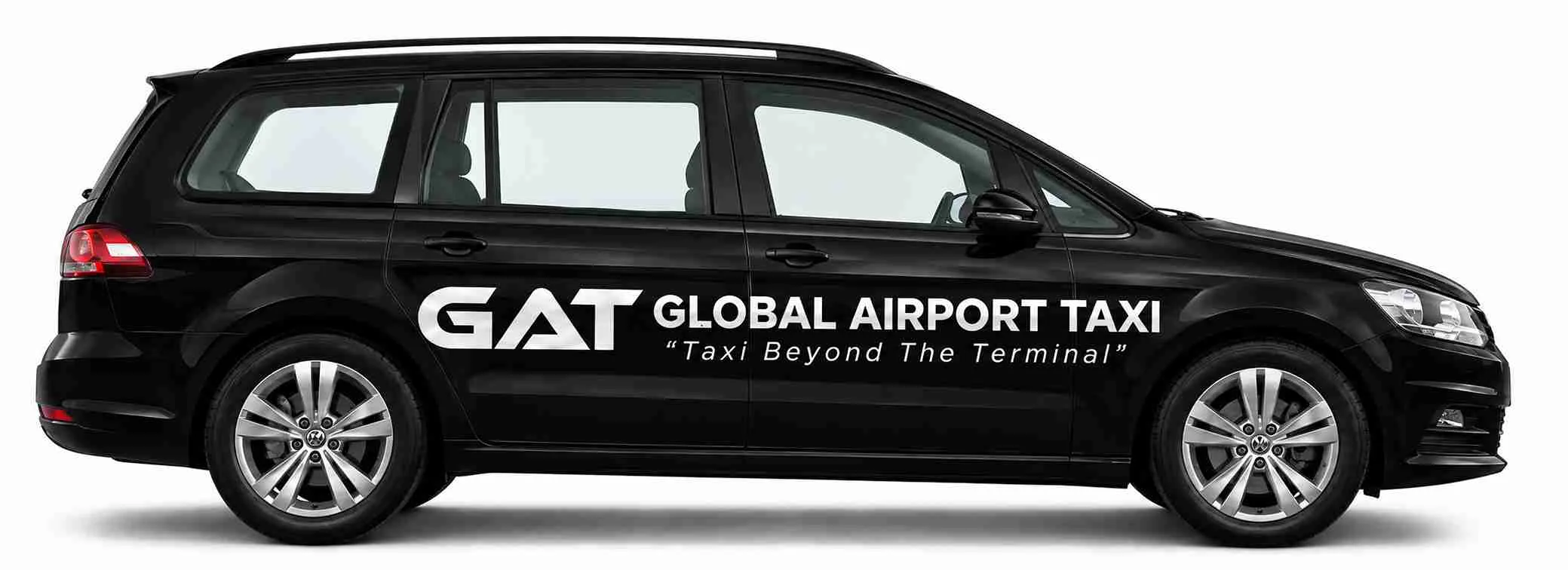 Example of the class: 6-seater MPV people carrier
People carrier
Carries 5 or 6, with 4 to 5 large bags
Five or six in one family, pushchair and all.
View vehicle → Example of the class: A 7 seater taxi
7 seater taxi
7 passengers, 7 cabin bags
Seven who packed sensibly.
View vehicle → Example of the class: An 8 seater taxi
8 seater taxi
Carries 8, with 6 to 8 large bags
Eight passengers, or six with clubs between them.
View vehicle →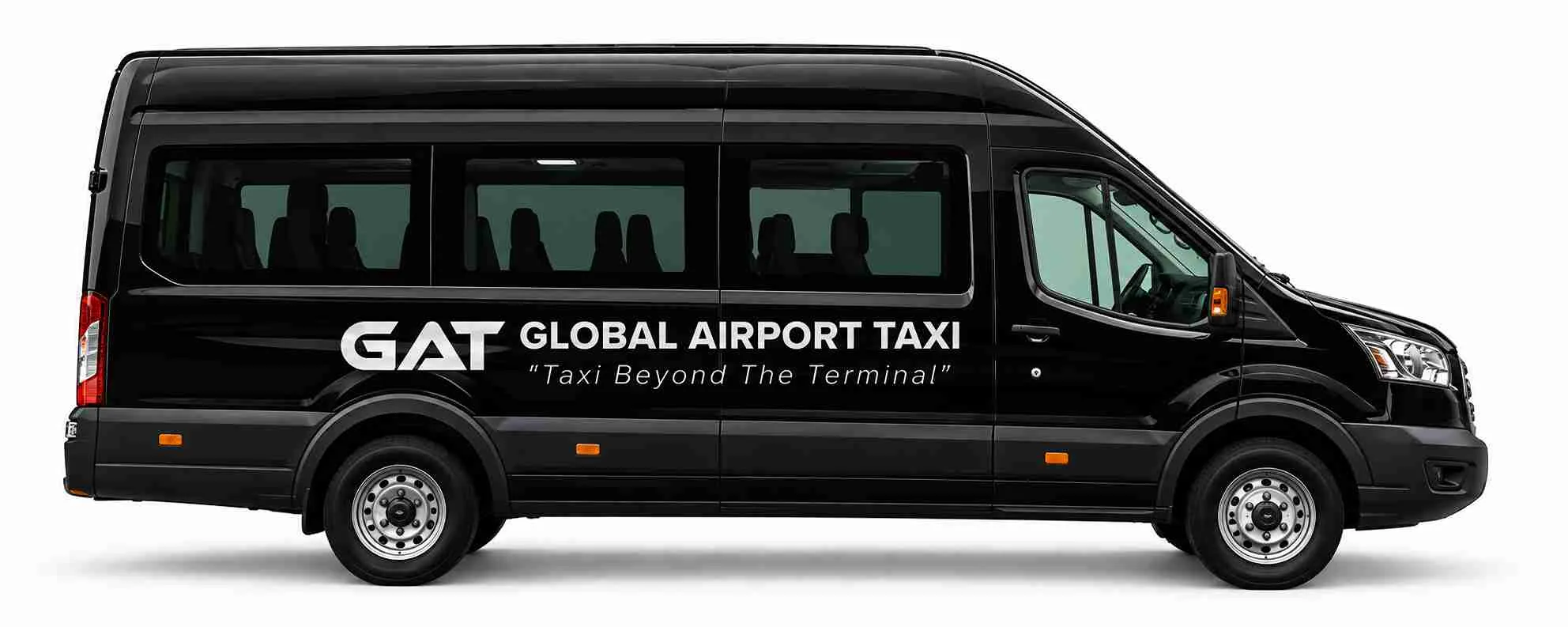 Example of the class: A 16 seater minibus
16 seater minibus
Sixteen aboard, and roughly 14 large bags
Wedding parties, golf societies and touring groups.
View vehicle →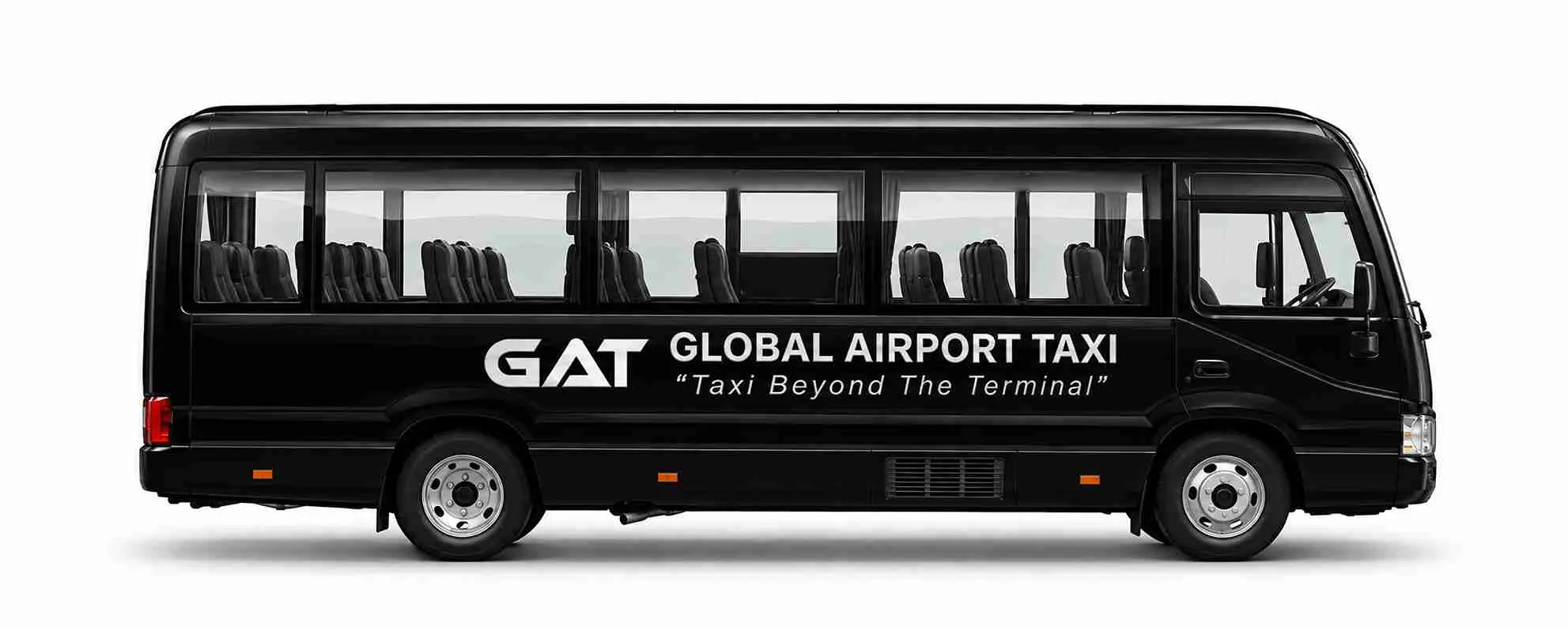 Example of the class: A 30-seater coach
30-seater coach
30 seats
Corporate parties arriving together.
View vehicle →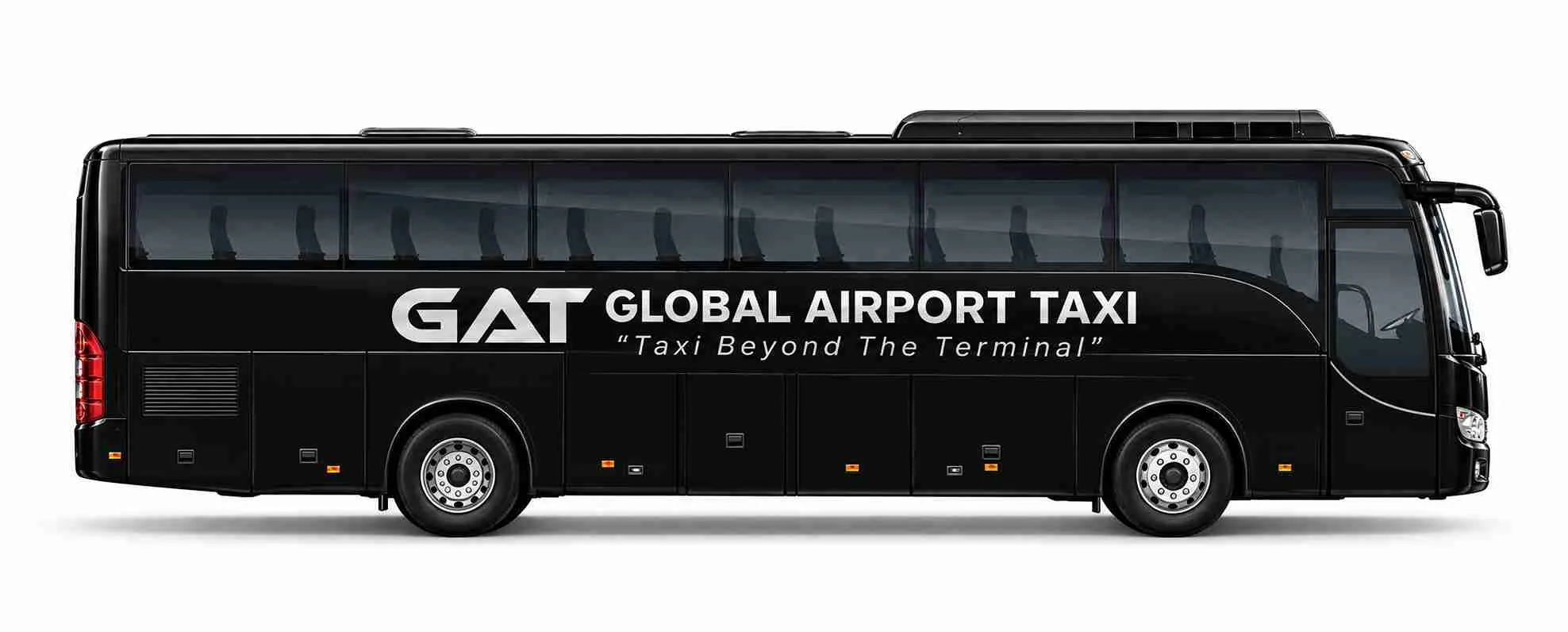 Example of the class: A 50-seater coach
50-seater coach
50 seats
Large groups and incentive trips settled months ahead.
View vehicle →| Extra | What to know |
|---|---|
| Child seats | Infant, child and booster seats are fitted on request without charge. Spain requires a seat for children under 135 cm, with a narrow exemption for taxis on urban journeys, so each child’s age belongs on the booking form. |
| Golf clubs, bikes, boards | No difficulty at all, so long as it appears on the booking. State the item and how long it is, and a vehicle with the load space is sent. |
| Wheelchair-accessible vehicles | Put it on the booking and we verify a suitable vehicle is free for that route on that date. |
Every vehicle is shown on our fleet page. Each photograph represents its class rather than naming the exact car, and the quote states what is on offer. Give the party size and the bag count on the booking.
Reviews
The scores below are the ones our review widget publishes, checked on 14 October 2026. Each of these came from somebody we carried at one of the airports on our network. A selection appears here, and every one stays published wherever its author left it.
Excellent4.9453 reviewsShowing all 10 reviews
Excellent service...arrived at terminal and driver was waiting...helped with luggage to the car...smooth drive...perfect overall
Very reliable and easy to get a hold of. I was very confused leaving the airport - user error haha - and they were super helpful. My flight was also delayed and the guy who picked me up was on top of it.
Super affordable and professional service! The pricing was very clear from the start, with no hidden charges, which I really appreciated. Everything went smoothly, and the professionalism of the global airport taxi service stood out. Highly recommended for anyone looking for a hassle-free and budget-friendly option.
Amazing taxi service to the airport! Our driver was friendly, on time, and made the whole trip so easy. The car was clean and comfortable, and we got to the airport right on time. Would definitely use this service again!
Excellent service , driver waited for us as flight was delayed, clean car and smooth ride
I would totally recommend Global Airport Taxi to anyone needing a taxi service for their airport commute. I decided on way to the airport that I was flying out of that I will need a cab service at LHR. They were quick to respond to and accommodated some of my last minute schedule change requests after I had landed at LHR. Totally reliable and willing to be flexible. Outstanding customer support provided by Jennifer and Root. Keep it up guys !!
This was a brilliant service our driver was excellent he was friendly and helpful. Used again for the return journey and driver was professional and ensured we made it to the airport on time with heavy traffic
The service was extremely reliable. My cab arrived exactly on time for my early morning flight, which was a huge relief. Everything went smoothly, and I felt confident choosing this service. Highly recommend global airport taxi for stress-free airport transfers!
Amazing customer service, on time driver helped with cases. A pleasant experience Thank you
Very clean car and on time very polite driver will use them again
These scores cover the whole network rather than Alicante by itself. Trustindex supplies the widget, and every review appears as its author wrote it.
The airport in numbers
The figures a transfer here actually turns on, with everything reported from a published source marked as such.
The short answer Alicante-Elche handled a reported 19,950,394 passengers in 2025 on 126,081 aircraft movements, from a single terminal of about 333,500 square metres that was built for 20 million passengers a year.
Published traffic is restated from time to time; check anything you are planning around on Aena’s own pages.
Who flies here
Nine in ten passengers in the peak months are international, and the shape of that traffic explains everything about the arrivals hall, the passport queue and the rank.
The short answer Alicante-Elche is overwhelmingly a leisure airport for British and northern European travellers: a reported 6,553,349 passengers from the United Kingdom in 2025, about a third of the total, then Germany at 1,242,657, the Netherlands at 1,235,605, Belgium at 1,035,375 and Poland at 1,023,583.
| Market | Passengers in 2025 | What it looks like here |
|---|---|---|
| United Kingdom | 6,553,349 | About a third of everyone who passed through in 2025 |
| Germany | 1,242,657 | The largest market after the British one |
| Netherlands | 1,235,605 | Amsterdam, Eindhoven and Rotterdam between them |
| Belgium | 1,035,375 | Brussels and Charleroi |
| Poland | 1,023,583 | Warsaw, Kraków and Katowice |
The largest single group by a distance, and the one the Saturday changeover is built around. A reported 6,553,349 British passengers came through in 2025, about a third of the whole airport. Benidorm, Torrevieja and the Orihuela Costa take most of them, in parties of four and five with a fortnight’s luggage.
This coast has one of the largest foreign resident populations in Spain, concentrated around Torrevieja, the Orihuela Costa, Elche’s beaches and the Alfaz and Albir side of the north. They fly out of season as much as in it, book both legs at once, and are the people for whom parking at the airport stops making arithmetic sense.
Germans, Dutch, Belgians, Poles and Nordic travellers, together comfortably more than a quarter of the traffic, and weighted towards the months the British are not here. They are why the terminal is busy in February at all.
Between autumn and spring this airport fills with four- to eight-person societies heading for Villamartín, Las Colinas, Font del Llop, La Finca and the Orihuela Costa courses. They come outside the holiday weeks, which is why the shoulder season here is nothing like as quiet as the beaches suggest.
The EUIPO, the European Union Intellectual Property Office, sits in Alicante; the Elche business park is on the airport’s doorstep at Torrellano; and the city has its own congress centre. Midweek mornings here are busier than any holidaymaker expects.
The University of Alicante is at San Vicente del Raspeig and the Universidad Miguel Hernández, named after the same poet as the airport, is in Elche. Term-time arrivals are the quiet, year-round half of this airport’s work.
Alicante and Cartagena both take cruise ships and Denia sails to the Balearics, so a share of the people who land here are not staying on this coast at all. They are crossing it, on somebody else’s timetable.
The quietest group and the steadiest. They arrive at odd hours, go to residential addresses rather than hotels, and need a vehicle that can find an urbanisation in the dark.
Traffic figures are reported from published annual data and are restated from time to time; treat them as the picture rather than the ledger.
Fares follow the date, the hour and the vehicle. Yours is worked out on the booking page and shown before the payment step, and it does not move after you accept it.
Airlines and routes
Eighteen named carriers, four of them based here, and a route list weighted towards Britain, Ireland and the Low Countries.
The short answer Ryanair, easyJet, Norwegian and Vueling base aircraft at Alicante and Jet2.com, TUI Airways and British Airways fly in alongside them; the busiest single route is Manchester, reported at 848,435 passengers, ahead of London Gatwick and Amsterdam.
| Route | Passengers, reported for 2023 | The transfer side of it |
|---|---|---|
| Manchester to Alicante | 848,435 | The single busiest route at this airport, and we cover the other end of it too. |
| London Gatwick to Alicante | 737,258 | Gatwick runs to Alicante all day and all year, and the same is true of our service at that end. |
| Amsterdam to Alicante | 519,059 | The largest non-British route, and the reason the Dutch and Belgian share of this airport is so high. |
Ryanair, easyJet, Norwegian and Vueling, with Ryanair much the largest and a reported 18 aircraft based at Alicante in the summer of 2025. A based fleet is what gives this airport a serious winter schedule as well as a summer one, and it is why the terminal never entirely empties.
Low-cost networks bank their flights. Aircraft come and go in clusters rather than evenly, so the hall alternates between echoing and overwhelmed within the same hour. That rhythm, more than the annual total, is what decides whether the rank is a two-minute wait or a forty-minute one.
Flights from inside the Schengen area and flights from outside it board from different parts of the building, and a British arrival meets a passport desk that a German arrival walks past. The expansion under way is adding a purpose-built non-Schengen boarding area, which tells you where the growth is. Read your gate letter off the screens on the day rather than off any page.
Airline schedules change every season and some of these routes are summer-only. Your own booking is the authority, not a list on a page.
The meter
The regulated tariff, published rather than guessed at, and the hours that decide which half of it you pay.
The short answer A rank taxi at Alicante runs on a regulated meter reported at €1.37 a kilometre between towns on the ordinary tariff and €1.59 on the special one, plus an airport supplement of €4.35 or €5.65; the special column starts at 15:00 on a Saturday.
| What | Ordinary | Special | The detail |
|---|---|---|---|
| Initial charge | €2 | €2 | Where the meter starts |
| Minimum journey | €4.35 | €5.60 | However short the trip is |
| Per kilometre, urban | €1.23 | €1.39 | Inside the urban area |
| Per kilometre, intercity | €1.37 | €1.59 | The rate that applies to the coast runs |
| Waiting, per hour | €22.35 | €26.04 | If the meter is held |
| Airport supplement | €4.35 | €5.65 | Added to a metered journey starting here |
| Column | When it applies |
|---|---|
| Ordinary | Monday to Friday 06:00 to 22:00, and Saturday 06:00 to 15:00 |
| Special | Monday to Friday 22:00 to 06:00, Saturday from 15:00, and all day Sunday and on public holidays |
| Column | When it applies, reported |
|---|---|
| Ordinary | Weekdays from 07:00 to 21:00 |
| Special | Nights from 21:00 to 07:00, all day on Saturday, Sunday and public holidays, and on the named special days |
Because at Alicante it is published. Spanish taxi tariffs are set by the authorities rather than by the driver, and the airport’s own guidance carries indicative figures for the main destinations. Most transfer pages hide that and show only their own price. Putting the meter beside our arrangement is the only way you can actually judge which suits you.
Read the hours carefully. The higher column does not simply mean night: it starts at three in the afternoon on a Saturday and runs all day Sunday. Saturday afternoon is the busiest arrival window of the week on this coast, so a very large number of holiday flights land straight onto the higher rate without their passengers knowing.
The indicative fares the airport publishes come from the Alicante tariff, but the terminal itself stands in Elche, and an Elche-licensed cab works to the Elche ordinance. Its special tariff is reported as running from 21:00 to 07:00, all day on Saturday, Sunday and public holidays, and on named special days: 5 January, 11 to 14 August, and 24, 25 and 31 December. You cannot tell from the kerb which licence the car at the front of the queue holds, and under either reading a Saturday is a higher-rate day. That is the one fact on this page we would most like a passenger to take away from it.
It has no columns, no supplement and no hours. The figure is calculated for your journey, your date and your vehicle, shown before the payment step, and does not move. Whether it beats the meter depends on the hour, the party and the distance, which is exactly why both sets of numbers belong on the same page.
The figures in this section are the regulated taxi meter, reported from published tariff guidance, not prices of ours. They are reviewed by the authorities and the page you are reading may be behind them.
What this journey costs you is settled on the booking page before you pay, against your own date and your own vehicle, and the figure is held from that point.
The published fares
Thirteen journeys with a published metered figure, set beside our own road distances so you can see whether the two agree.
The short answer Published metered fares from Alicante Airport are reported at about €33 to Alicante city, €90 to Benidorm, €72 to Torrevieja, €115 to Calpe and €149 to Denia on the ordinary tariff, with the special tariff higher again on every run except the city one itself.
| Where | Ordinary | Special | Distance |
|---|---|---|---|
| Alicante city centre | €33 | €33 | about 11 km |
| Elche | €33 | €40 | about 12 km |
| Arenales del Sol | €25 | €30 | about 7 km |
| Santa Pola | €31 | €36 | about 17 km |
| Playa de San Juan | €40 | €45 | about 18 km |
| El Campello | €46 | €53 | about 24 km |
| Torrevieja | €72 | €79 | about 45 km |
| Villajoyosa | €79 | €86 | about 40 km |
| Benidorm | €90 | €98 | about 55 km |
| Albir | €97 | €104 | about 60 km |
| Altea | €99 | €107 | about 62 km |
| Calpe | €115 | €124 | about 75 km |
| Denia | €149 | €168 | about 105 km |
They are indicative metered fares published in the airport’s own transport guidance, reported for the current tariff. They are not our prices and we do not control them. They exclude tolls. We publish them because a transfer page that shows only its own number is asking you to compare one figure against nothing.
Closely, which is a decent sign that both are sound. Benidorm at about 55 kilometres against a reported €90, Denia at about 105 against a reported €149: run those against the intercity rate of €1.37 a kilometre and the arithmetic holds. Where a figure looks out of step, the route rather than the distance is usually the reason.
On the longer runs, at the weekend, at night, and with more than two people or more than two cases. On a short weekday hop into Alicante city with hand luggage, the rank is perfectly sensible and we will not pretend otherwise.
The figures in this section are the regulated taxi meter, reported from published tariff guidance, not prices of ours. They are reviewed by the authorities and the page you are reading may be behind them.
Our fares are reviewed from time to time. The one that binds is the one the booking page shows you before the payment step, not the one on a page you read last month.
Which kind of car
Spain keeps these genuinely separate, and the separation is why only one of them can give you a figure in advance.
The short answer A rank taxi at Alicante charges a regulated meter plus an airport supplement, a pre-booked VTC carries a figure agreed beforehand, and an app recalculates its price when demand rises; only the booked option is settled before you travel.
White with a green stripe, waiting on the arrivals road at level P0, around the clock. You take the one at the front. The meter decides the figure and the airport supplement is added. Best when you have landed with nothing booked.
Vehículo de turismo con conductor: the legal form a private transfer takes in Spain. It must be booked beforehand and carries an agreed price rather than a meter. The regional rules were revised in the Comunidad Valenciana in 2026.
Uber and Cabify have had their own designated pick-up areas at this airport since 2024. The same legal form applies, but the price is recalculated when demand rises, which at a holiday airport is precisely when you need it.
| The question | Rank taxi | Booked transfer | App |
|---|---|---|---|
| Can it be taken from the rank? | Yes | No | No |
| How is the price set? | A regulated meter, plus the airport supplement | Agreed before the journey | Calculated by the app, and again when busy |
| Is it known before the journey starts? | An indicative figure is published | Yes, exactly | Only at the instant you book |
| Does the hour change it? | Yes: two tariff columns | No | Usually yes |
| What happens when the flight runs late? | You queue again | The flight number is tracked | Usually re-booked and re-priced |
Licensing and tariffs are set nationally and by region, and the Comunidad Valenciana revised its VTC rules in 2026. Applications change their terms often, so check the detail for your own date.
The terminal
Ten minutes of reading here saves twenty minutes of walking with a trolley, and settles which floor your driver is standing on.
The short answer Alicante-Elche has one terminal, the NAT, on three floors: arrivals, the taxi rank and the transfer bays on level P0, offices on the P1 mezzanine, and 96 check-in desks, security and every bus on level P2.
Baggage reclaim, customs, the public arrivals hall, the car hire desks, the taxi rank, the app and private-transfer bays, lost property and left luggage. Your driver waits on this floor.
Offices, airline ticket desks and the links between the two public floors. Few passengers have any business here.
Ninety-six check-in desks, security, and the departures roadway outside, which is where every bus leaves from and where cars drop off.
| Service | What to know |
|---|---|
| Left luggage | A staffed office in the terminal, for the bags you would rather not take round Alicante on a late-flight day. |
| Lost property | In the arrivals hall on level P0. Checked baggage that did not arrive is your airline’s handling agent, not the airport. |
| Fast Track | A priority lane at the security search, bought in advance. Worth it on a summer Saturday morning, pointless in February. |
| The VIP lounge | Sala VIP Costa Blanca, airside, reported open from 04:00 to 23:00 with a three-hour limit on a visit. |
| Wi-Fi | Free across the terminal. |
| Reduced mobility | Assistance is free and booked through your airline, reported as at least 48 hours ahead. Meeting points are signed at the doors and in the car parks. |
| Food and drink | Thin before security and plentiful after it, which is worth knowing if you are seeing somebody off. |
| Car parks | General P1 for short stays and for meeting somebody, and the long-stay car park for a holiday. Both are on site. |
The building is the NAT, the Nueva Área Terminal, open since 23 March 2011. The two terminals that came before it have been shut to passengers ever since, and are reported for demolition between 2027 and 2031. If a driver, a guidebook or an old booking refers to T1 or T2 at Alicante, ignore it: there is one terminal and one security search.
Past security the building opens into a single retail and dining floor, and the boarding areas branch off it. Some gates are a long way out, and the far end of the building is a genuine walk rather than a stroll. If your gate is called and you are still buying perfume, you have less time than you think.
A non-Schengen arrival passes a passport desk before baggage reclaim. In the peak of the summer that is the slowest part of the whole arrival, and it is the reason waiting time on a booking is counted from the landing rather than from the hour you wrote down.
Layout, services and opening hours are Aena’s and change, particularly while the expansion is under way. Check the airport’s own pages in the week you fly.
Where we meet
One terminal makes this simpler than most, and the part worth reading is which level each thing happens on.
The short answer Your driver waits inside the single arrivals hall at Alicante holding a board with your surname, the official taxi rank is on the arrivals road at level P0, and departures drop off on the level P2 lane above.
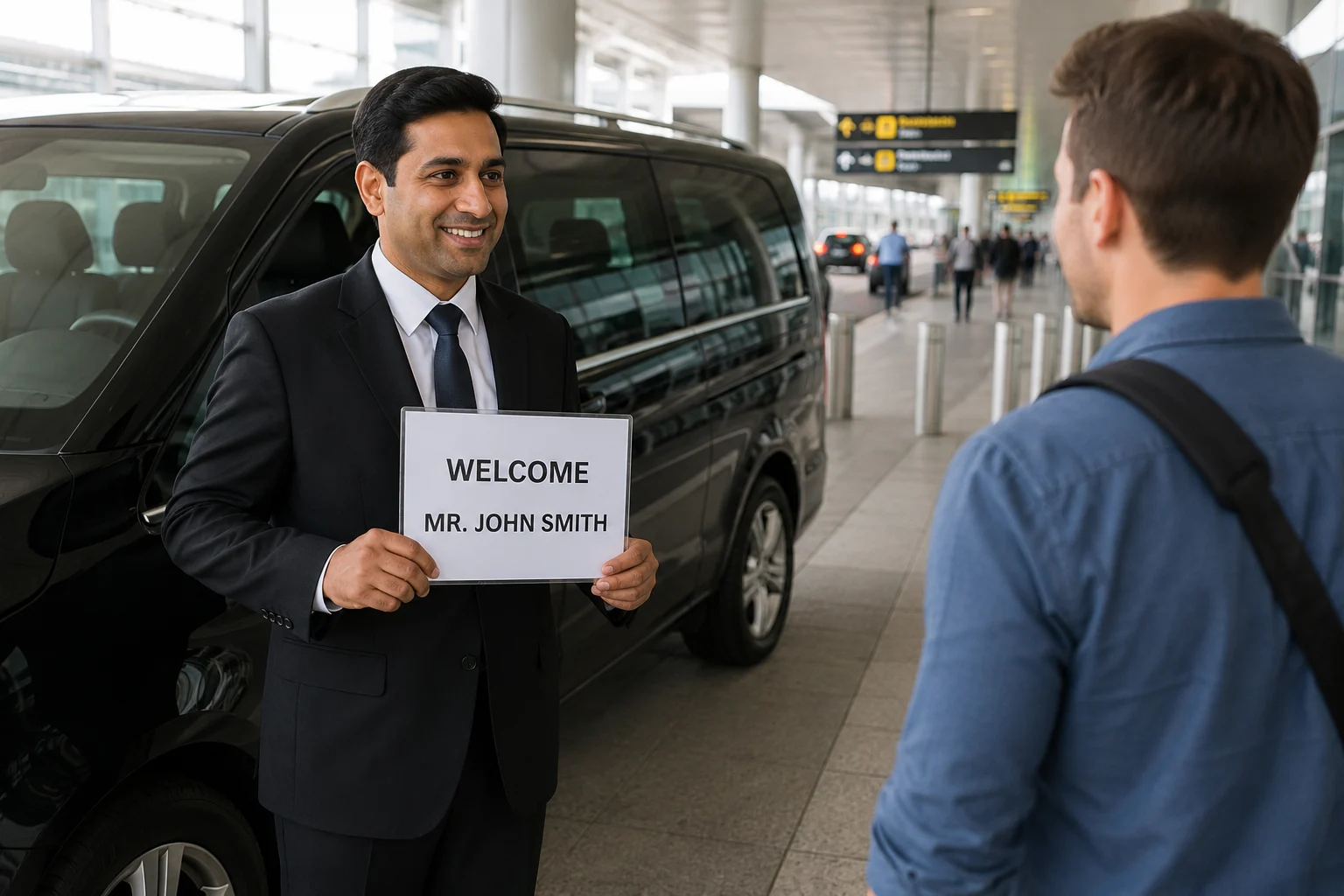
Inside the arrivals hall with a board carrying your surname. One terminal means one hall, which removes the commonest confusion at a larger airport, but this is a very busy hall in summer, so the confirmation carries the meeting point as well as a mobile number.
The official taxi rank is on the arrivals road at level P0, outside the terminal. Drop-offs for departures happen upstairs on the level P2 lane. Uber and Cabify have had their own designated areas since 2024. Knowing which is which saves a walk with a loaded trolley.
Ring the number on your confirmation while you are still inside. Stepping out to search is what makes it difficult, since you then end up looking for each other through a window.
How the forecourt works, and what stopping on it costs, is Aena’s to decide and has changed before. Look at the airport’s site in the week you fly.
Nothing here is a quote. Your own figure is calculated for your date, your party and your luggage, shown before you pay, and fixed from that moment.
Bus and rail
The C-6 is the real competition for a journey into the city, so this section says what it does well before saying where it stops.
The short answer The C-6 bus runs between Alicante Airport and the city 24 hours a day, reported every 15 to 20 minutes through the day at €4.60 a single, and leaves from the departures roadway on level P2; no train or tram reaches the terminal despite space for both having been built into it in 2011.
| Option | What runs | The detail |
|---|---|---|
| The C-6 bus to Alicante city | Reported every 15 to 20 minutes through the day and about hourly overnight, 24 hours a day | A single reported at €4.60. It leaves from the departures roadway on level P2, not from the arrivals floor, and reaches the city in roughly 25 to 35 minutes, calling at the station, the market and the port |
| Intercity coaches | Operator by operator, in the table below | Benidorm, Calpe, Denia, Javea, Torrevieja, Orihuela, Santa Pola, Almoradí, Cartagena and Murcia |
| Elche buses | Lines R10 and R11 | Elche city, Torrellano and the industrial park, and the El Altet beaches |
| Train | None at the airport | Space for a station was built into the terminal in 2011; nothing has been connected |
| Tram | None at the airport | A stop was allowed for in the same plan and has not been built |
| The rank | Level P0, around the clock | Metered, plus the airport supplement |
| Operator | Where it runs, reported |
|---|---|
| ALSA | Benidorm, Calpe, Denia and Javea, and Murcia |
| Avanza | Torrevieja on line L40, and Orihuela and Alicante station on line L630, where only some departures call at the airport |
| Vectalia | Santa Pola on line 8, which also serves San Vicente del Raspeig |
| Bus Sigüenza | Almoradí on line 3 and other Vega Baja towns |
| Busbam | Cartagena |
The C-6 runs to Alicante city around the clock, is reported every 15 to 20 minutes through the day and at a reported €4.60 a single it is excellent value for one or two people with light bags. A car on that trip is an indulgence. We sell transfers, so weigh that against our interest, but a comparison that concedes nothing is worth nothing.
It does not leave from arrivals. The stop is on the departures roadway on level P2, so you come off the belt on level P0 and then go up a level with your trolley to find it. The bay is marked for the C-6.
It goes to the city. The coast is a different problem: Benidorm, Torrevieja, Calpe, Javea, the Orihuela Costa urbanisations. A coach reaches some of them, to a bus station rather than to your door, which with two cases and a villa address at the end is the first leg of a journey rather than the journey.
The terminal opened in 2011 with space for a railway station and a tram stop. A feasibility study was funded in 2019 and a link has been tendered as part of the Cercanías plan. Neither has been built. For an airport approaching twenty million passengers that is the single most striking thing about getting away from it.
Timetables and fares belong to the operators and change, and only some line L630 departures call at the airport at all. Check the current timetable against your own date.
Figures move with the season and with the hour. Yours is the one you are shown ahead of the payment step, and accepting it is what fixes it.
Parking
Two car parks, one forecourt rule worth knowing, and one piece of arithmetic that catches residents out every summer.
The short answer Alicante Airport has General P1 for short stays and for meeting a flight, reported as about a minute from the terminal, and a long-stay car park for holidays; over a fortnight the long-stay total will usually exceed two return taxi transfers for a family.
| Car park | What it suits | What to know |
|---|---|---|
| General P1 | A short stay, or meeting somebody off a flight | Covered and open bays reported as about a minute from the terminal door, open around the clock, staffed, with spaces for reduced mobility. Motorcycles are not allowed in it; there is a free motorcycle area beside the long-stay car park. |
| Larga Estancia PL | A holiday | The long-stay car park, reported as covered. This is the one whose total surprises people on a fortnight away. |
| The level P2 departures lane | Putting somebody down and leaving | The lane closest to the building is for buses and coaches. Cars use the outer lane, and the police here do enforce it. |
| Booking ahead | Anything beyond a day or two | Aena sells its own car parks online, and the online figure is normally below the rate at the barrier. |
Not the taxi and not the coffee: the long-stay car park on a fortnight’s holiday. Two weeks of it will comfortably pass two return transfers for a family, and the car sits in the sun the whole time. For anybody who lives on this coast and flies several times a year, running that arithmetic honestly is usually the end of driving themselves to the airport.
On the level P2 departures roadway the lane closest to the building is reserved for buses and coaches. Cars pull into it, get moved on, and occasionally get a ticket. Use the outer lane, which is signed, a few metres further out.
Use General P1 rather than circling. It is reported as about a minute from the terminal door, it is staffed and it runs around the clock, which is the difference between waiting inside the hall and waiting in a queue of cars at a kerb where you cannot stop.
Car park products, tariffs and the forecourt rules are Aena’s and are revised; read the airport’s own parking pages for the figures that apply to your dates.
Treat the numbers here as the shape of it. The booking page prices your journey against the address, the date and the vehicle, and that is the figure we hold you to.
Where we go
49 journeys, from Torrellano four kilometres away to Valencia Airport at the far end. These are our own road figures, and each row opens the price for your date.
The short answer The shortest journey on this list is Torrellano at about 4 kilometres; Alicante city is about 11 kilometres and 15 minutes; Benidorm, the most-asked-for resort run, is about 55 kilometres and 45 minutes.
Showing all 49 destinations
| Destination | Area | Distance and time | Rank taxi, reported | Our saloon fare |
|---|---|---|---|---|
| Alicante city centre | Alicante · The Explanada, the old town and the hotels | about 11 km, 15 min | reported €33 | €27 to Alicante city centre |
| Alicante railway station | Alicante · Estación de Alicante, for the AVE to Madrid | about 12 km, 18 min | — | Get price to Alicante railway station |
| Playa de San Juan | Alicante · The long city beach north of Alicante | about 18 km, 22 min | reported €40 | €34 to Playa de San Juan |
| El Campello | Alicante · The fishing town at the end of the tram line | about 24 km, 25 min | reported €46 | €48 to El Campello |
| San Vicente del Raspeig | Alicante · The university town inland of the city | about 18 km, 20 min | — | Get price to San Vicente del Raspeig |
| Elche | Elche area · The palm groves, and the city the airport sits in | about 12 km, 15 min | reported €33 | €26 to Elche |
| Torrellano | Elche area · The business park on the airport doorstep | about 4 km, 7 min | — | Get price to Torrellano |
| Arenales del Sol | Elche area · The nearest beach to the runway | about 7 km, 10 min | reported €25 | €22 to Arenales del Sol |
| Gran Alacant | Elche area · The hillside resort above the dunes | about 10 km, 12 min | reported €25 | €22 to Gran Alacant |
| Santa Pola | Elche area · The fishing port and the Tabarca boats | about 17 km, 20 min | reported €31 | €27 to Santa Pola |
| Villajoyosa | North · The painted houses and the chocolate town | about 40 km, 35 min | reported €79 | €62 to Villajoyosa |
| Benidorm | North · The towers, the two beaches and the old town | about 55 km, 45 min | reported €90 | €74 to Benidorm |
| Finestrat | North · Above Benidorm, with the villas and the Cala | about 52 km, 45 min | — | Get price to Finestrat |
| La Nucia | North · The hill town behind the coast | about 58 km, 50 min | — | Get price to La Nucia |
| Polop | North · Inland of Benidorm, under the Ponoch | about 60 km, 52 min | — | Get price to Polop |
| Albir | North · The quieter end of the Alfaz bay | about 60 km, 50 min | reported €97 | €80 to Albir |
| Altea | North · The blue dome and the stepped old town | about 62 km, 50 min | reported €99 | €84 to Altea |
| Benissa | North · The coast road between Calpe and Moraira | about 80 km, 65 min | — | Get price to Benissa |
| Calpe | North · The Peñón de Ifach and the two bays | about 75 km, 60 min | reported €115 | €96 to Calpe |
| Moraira | North · The marina and the villa country around it | about 90 km, 70 min | — | Get price to Moraira |
| Javea | North · Xàbia: the arenal, the port and the Montgó | about 95 km, 75 min | — | Get price to Javea |
| Denia | North · The castle town and the Balearic ferries | about 105 km, 80 min | reported €149 | Get price to Denia |
| Oliva | North · The long beach at the Valencia border | about 120 km, 90 min | — | Get price to Oliva |
| Guardamar del Segura | South · The pine dunes and the river mouth | about 30 km, 25 min | — | Get price to Guardamar del Segura |
| La Mata | South · The quiet beach north of Torrevieja | about 40 km, 32 min | — | Get price to La Mata |
| Torrevieja | South · The salt lakes and the seafront | about 45 km, 35 min | reported €72 | Get price to Torrevieja |
| Villamartin | South · The golf course and the plaza | about 56 km, 45 min | — | Get price to Villamartin |
| La Zenia | South · Orihuela Costa, and the boulevard | about 55 km, 45 min | — | Get price to La Zenia |
| Playa Flamenca | South · The Saturday market and the coves | about 57 km, 46 min | — | Get price to Playa Flamenca |
| Cabo Roig | South · The strip, the marina and the cliff path | about 58 km, 47 min | — | Get price to Cabo Roig |
| Campoamor | South · Dehesa de Campoamor and its golf | about 60 km, 48 min | — | Get price to Campoamor |
| Mil Palmeras | South · The last beach before Murcia | about 63 km, 50 min | — | Get price to Mil Palmeras |
| Pilar de la Horadada | South · The town at the provincial line | about 68 km, 52 min | — | Get price to Pilar de la Horadada |
| San Pedro del Pinatar | Murcia · The mud baths and the Mar Menor shore | about 75 km, 55 min | — | Get price to San Pedro del Pinatar |
| Los Alcázares | Murcia · The Mar Menor beaches and the air base | about 85 km, 60 min | — | Get price to Los Alcázares |
| La Manga del Mar Menor | Murcia · The strip between two seas | about 100 km, 75 min | — | Get price to La Manga del Mar Menor |
| Cartagena | Murcia · The Roman theatre and the cruise port | about 105 km, 70 min | — | Get price to Cartagena |
| Murcia | Murcia · The cathedral city and the Segura | about 70 km, 50 min | — | Get price to Murcia |
| Orihuela | Inland · The old city inland of its own costa | about 45 km, 40 min | — | Get price to Orihuela |
| Ciudad Quesada | Inland · Rojales, the urbanisations and the golf | about 38 km, 32 min | — | Get price to Ciudad Quesada |
| Alcoy | Inland · The mountain town of the Moors and Christians | about 60 km, 50 min | — | Get price to Alcoy |
| Villena | Inland · The castle and the wine country | about 65 km, 50 min | — | Get price to Villena |
| Terra Mítica | Day out · The theme park above Benidorm | about 53 km, 44 min | — | Get price to Terra Mítica |
| Guadalest | Day out · The castle village and the reservoir | about 70 km, 65 min | — | Get price to Guadalest |
| Tabarca ferry at Santa Pola | Port or ferry · The crossing to the island | about 17 km, 20 min | — | Get price to Tabarca ferry at Santa Pola |
| Alicante cruise terminal | Port or ferry · Where the ships berth in the city port | about 12 km, 18 min | — | Get price to Alicante cruise terminal |
| Denia ferry port | Port or ferry · The sailings to Ibiza, Formentera and Mallorca | about 105 km, 80 min | — | Get price to Denia ferry port |
| Murcia Airport | Airport · Corvera (RMU): one page serves either direction | about 75 km, 55 min | — | Get price to Murcia Airport |
| Valencia Airport | Airport · The long run north, booked rather than metered | about 175 km, 110 min | — | Get price to Valencia Airport |
Every destination here is priced in both directions, and the last column opens the booking page with that journey already filled in. Anywhere missing can be priced by typing the address; every Alicante Airport route gathers the same list.
The fourth column is the reported public meter where the airport publishes one, for comparison only. The last column is our own fixed saloon fare where there is a standing one, in a vehicle for up to four people, and a link on the routes we price against the address instead. Minivan and minibus figures are in the fares section above, and what each class holds is on the fleet page and the executive car page.
Fares follow the date, the hour and the vehicle. Yours is worked out on the booking page and shown before the payment step, and it does not move after you accept it.
In Alicante
The shortest and most frequent journeys at this airport, and the ones where the bus is a real alternative.
The short answer Alicante city centre is about 11 kilometres from the terminal and roughly 15 minutes, the railway station about 12 kilometres, and Playa de San Juan about 18.
About 11 km, roughly 15 minutes. The Explanada, the old town below the castle and most of the city hotels sit in a small area, so the booking wants the street rather than the district.
About 12 km, roughly 18 minutes. The AVE to Madrid leaves from here, which makes this a common onward leg for people who flew into Alicante and are going inland.
About 18 and 24 km. The long city beach and the town at the end of the tram line, both popular for longer stays within reach of Alicante itself.
About 18 km, roughly 20 minutes. The university town, and a steady source of term-time journeys rather than holiday ones.
Two addresses on the same street can price differently, so give the booking page the address itself rather than the quarter.
What this journey costs you is settled on the booking page before you pay, against your own date and your own vehicle, and the figure is held from that point.
Elche and the near coast
The journeys measured in minutes rather than hours, and the reason the airport carries two city names.
The short answer Torrellano is about 4 kilometres from the terminal, Arenales del Sol about 7, Gran Alacant about 10, Elche about 12 and Santa Pola about 17, which makes these the shortest transfers at this airport.
| Where | Distance | Time | Worth knowing |
|---|---|---|---|
| Torrellano | about 4 km | about 7 min | The business park on the airport doorstep, and the shortest run on this page |
| Arenales del Sol | about 7 km | about 10 min | The nearest beach to the runway |
| Gran Alacant | about 10 km | about 12 min | The hillside resort above the dunes |
| Elche | about 12 km | about 15 min | The palm groves, and the city the airport legally sits in |
| Santa Pola | about 17 km | about 20 min | The fishing port, the salt flats and the Tabarca boats |
This surprises people every week. The terminal stands inside the Elche municipality, which is why the full name is Alicante-Elche. It has a practical consequence: a booking that says only “Alicante” is ambiguous between a city, a province and an airport, and the address is what resolves it.
Torrellano at about 4 kilometres and Arenales at about 7 are the shortest journeys here. On a trip that short a metered fare runs into the minimum charge rather than the distance, reported at €4.35 on the ordinary tariff and €5.60 on the special one, before the airport supplement is added.
Every distance and time here is our own road estimate under ordinary conditions.
Our fares are reviewed from time to time. The one that binds is the one the booking page shows you before the payment step, not the one on a page you read last month.
Costa Blanca north
The resorts north of the city, where most of the long transfers at this airport are heading.
The short answer Benidorm is about 55 kilometres from Alicante Airport and roughly 45 minutes, Altea about 62, Calpe about 75, Javea about 95 and Denia about 105 at the far end of the Costa Blanca north.
| Where | Distance | Time | Worth knowing |
|---|---|---|---|
| Villajoyosa | about 40 km | about 35 min | The painted houses, and the chocolate |
| Benidorm | about 55 km | about 45 min | The busiest single destination at this airport |
| Finestrat | about 52 km | about 45 min | The villas above Benidorm and the Cala |
| Albir | about 60 km | about 50 min | The quieter end of the Alfaz bay |
| Altea | about 62 km | about 50 min | The blue dome and the stepped old town |
| La Nucia | about 58 km | about 50 min | The hill town behind the coast |
| Polop | about 60 km | about 52 min | Inland of Benidorm, under the Ponoch |
| Calpe | about 75 km | about 60 min | Under the Peñón de Ifach, between two bays |
| Benissa | about 80 km | about 65 min | The coast road between Calpe and Moraira |
| Moraira | about 90 km | about 70 min | The marina and the villa country around it |
| Javea | about 95 km | about 75 min | Xàbia: the arenal, the port and the Montgó |
| Denia | about 105 km | about 80 min | The castle town, and the Balearic ferries |
| Oliva | about 120 km | about 90 min | The long beach at the Valencia border |
About 55 kilometres and roughly 45 minutes, with a metered fare reported at €90 by day and €98 on the special tariff. More of our Alicante work goes there than anywhere else, and the Saturday changeover is the heaviest single movement of the week.
Calpe at about 75 kilometres, Javea at about 95 and Denia at about 105 are an hour or more each way. A metered fare to Denia is reported at €149 on the ordinary tariff and €168 on the special one, which is where an agreed figure stops being a nicety.
The hillsides above Benidorm, Altea and Moraira are villa country, and many urbanisations share a name with a road, a plaza and a commercial centre. Give the urbanisation, the street and the number, and say if there is a gate code.
Distances and times are our own road estimates. The coast road in August is not an ordinary condition.
Nothing here is a quote. Your own figure is calculated for your date, your party and your luggage, shown before you pay, and fixed from that moment.
Costa Blanca south
The southern strip, where the addresses are harder than the distances and the booking goes wrong more often than anywhere else on this coast.
The short answer Torrevieja is about 45 kilometres from Alicante Airport and roughly 35 minutes, with the Orihuela Costa urbanisations from La Zenia to Mil Palmeras a further ten to twenty minutes beyond it.
| Where | Distance | Time | Worth knowing |
|---|---|---|---|
| Guardamar del Segura | about 30 km | about 25 min | The pine dunes and the river mouth |
| La Mata | about 40 km | about 32 min | The quiet beach north of Torrevieja |
| Torrevieja | about 45 km | about 35 min | The salt lakes and the seafront |
| La Zenia | about 55 km | about 45 min | Orihuela Costa, and the boulevard |
| Villamartin | about 56 km | about 45 min | The golf course, the plaza and the urbanisations |
| Playa Flamenca | about 57 km | about 46 min | The Saturday market and the coves |
| Cabo Roig | about 58 km | about 47 min | The strip, the marina and the cliff path |
| Campoamor | about 60 km | about 48 min | Dehesa de Campoamor and its golf |
| Mil Palmeras | about 63 km | about 50 min | The last beach before the Murcia line |
| Pilar de la Horadada | about 68 km | about 52 min | The town at the provincial boundary |
South of Torrevieja the map is a lattice of urbanisations, many of them built at the same time by the same developers and named after the same golf courses. A resort name on its own is not an address here. Give the urbanisation, the street and the number, and if the property is managed by a key-holder office, name it: the collection can then be set around their hours rather than around a guess.
It is the part of this coast with the most self-catering and the most golf, which means parties of four to eight with more luggage than seats. Torrevieja is about 45 kilometres from the terminal with a metered fare reported at €72 by day, and the strip beyond it adds ten to twenty minutes.
These are our own road figures, taken under ordinary conditions rather than at a summer changeover.
Figures move with the season and with the hour. Yours is the one you are shown ahead of the payment step, and accepting it is what fixes it.
Murcia and the Mar Menor
A second region served from the same terminal, and the one destination on this page where the last few kilometres take the longest.
The short answer Murcia is about 70 kilometres from Alicante Airport and roughly 50 minutes, Cartagena about 105, La Manga about 100 and Los Alcázares about 85.
| Where | Distance | Time | Worth knowing |
|---|---|---|---|
| San Pedro del Pinatar | about 75 km | about 55 min | The mud baths and the northern Mar Menor |
| Los Alcázares | about 85 km | about 60 min | The Mar Menor beaches and the air base |
| La Manga del Mar Menor | about 100 km | about 75 min | The strip between two seas |
| Cartagena | about 105 km | about 70 min | The Roman theatre and the cruise port |
| Murcia | about 70 km | about 50 min | The cathedral city on the Segura |
The Region of Murcia has its own airport at Corvera, but a great many of its visitors fly into Alicante because the schedule is better. Murcia city is about 70 kilometres from this terminal and La Manga about 100.
The strip is long and there is one road down it. An address at the far end can add twenty minutes to what the map promises, so give the kilometre marker or the complex name rather than just La Manga.
Treat the numbers here as the shape of it. The booking page prices your journey against the address, the date and the vehicle, and that is the figure we hold you to.
Inland
Three journeys that leave the coast behind, and the one fiesta large enough to close a town.
The short answer Orihuela is about 45 kilometres from Alicante Airport, Ciudad Quesada about 38, Alcoy about 60 and Villena about 65, all of them inland of the coast strip.
Orihuela is about 45 km, with Ciudad Quesada and Rojales at about 38. Inland of the costa that carries the same name, and a steady source of year-round journeys rather than holiday ones.
About 60 km, roughly 50 minutes into the mountains. Its Moors and Christians fiesta is among the largest in Spain and closes the town for days at a time.
About 65 km. The castle, and the vineyards of the Alto Vinalopó behind it.
Fiesta dates are the towns’ own and move between years. Check before fixing a collection time.
Fares follow the date, the hour and the vehicle. Yours is worked out on the booking page and shown before the payment step, and it does not move after you accept it.
Days out
Three places people head for straight off the aircraft, and all three are easier with somebody driving.
The short answer Terra Mítica is about 53 kilometres from Alicante Airport, Guadalest about 70, and Tabarca is reached by boat from Santa Pola, about 17 kilometres from the terminal.
About 53 km, roughly 44 minutes, above Benidorm. The park empties all at once at closing, so the return leg wants booking rather than hoping.
About 70 km, roughly 65 minutes. The castle village above the reservoir, on a road that is slow by design rather than by traffic.
The island is reached by boat from Santa Pola, about 17 km from the terminal. The crossing times rather than the distance decide the collection.
Opening and sailing times belong to the attractions and operators and change by season.
What this journey costs you is settled on the booking page before you pay, against your own date and your own vehicle, and the figure is held from that point.
Ports and ferries
Three journeys where the thing at the far end leaves on a schedule of its own, which changes how the collection should be set.
The short answer The Alicante cruise terminal is about 12 kilometres from the airport and roughly 18 minutes, and Denia, for the ferries to Ibiza, Formentera and Mallorca, about 105 kilometres.
About 12 km, roughly 18 minutes. The ships berth in the city port below the castle. A ship will not wait, so on a sailing day take the earlier collection and give us the vessel name.
About 105 km, roughly 80 minutes. The sailings from here reach Ibiza, Formentera and Mallorca, and we cover those islands at the other end as well.
About 105 km. A cruise port as well as a city, so say which one the booking means.
Operators set their own sailing times and change them with the season and the weather. Fix yours first, then count backwards.
Our fares are reviewed from time to time. The one that binds is the one the booking page shows you before the payment step, not the one on a page you read last month.
Airport to airport
There is no slack in a journey between two airports, which is why nobody should improvise one.
The short answer Murcia Airport at Corvera is about 75 kilometres from Alicante-Elche and roughly 55 minutes, and Valencia Airport about 175 kilometres, a journey of close to two hours.
About 75 km, roughly 55 minutes to Corvera. A single page covers the journey either way, which is the booking most often made when a flight left from, or landed at, the wrong one of the two.
About 175 km, roughly 110 minutes. A long drive rather than a transfer in the ordinary sense, and one where an agreed figure matters more than anywhere else on this page.
Nothing here is a quote. Your own figure is calculated for your date, your party and your luggage, shown before you pay, and fixed from that moment.
All routes
Every name below opens the booking page with that journey already in it, so a figure for your date takes one click. Each one is booked the same way in reverse for the journey back, and the table above carries the distance and the time for all of them.
Not on the list? The booking page prices any address you type into it. The destination table above carries the same names with their distances, and our team will answer whatever it leaves out. Pages of their own for each of these destinations are being built; until they are, the names here go straight to the price rather than to a page that does not yet exist.
Figures move with the season and with the hour. Yours is the one you are shown ahead of the payment step, and accepting it is what fixes it.
The bad hours
A single terminal running at the capacity it was designed for has one reliably bad day a week in summer. It is predictable, which means it can be planned around.
The short answer The worst hours at Alicante-Elche are the Saturday changeovers of July and August, when the rank queue is reported at twenty to forty minutes against under five out of season, and a terminal built for 20 million passengers a year handles its heaviest arrival and departure waves at once.
The holiday week on this coast runs Saturday to Saturday, which puts the heaviest arrivals and the heaviest departures of the week into the same hours of the same day. In July and August a terminal built for 20 million a year is handling close to that, and the queue at the rank on a Saturday evening in August is the single best argument for having something booked.
It is reported at under five minutes out of season and anywhere from twenty to forty at a July or August evening peak. Nothing about the airport changes between those two states except how many aircraft have just parked, which is why the hour of your landing predicts the wait better than the month does.
An expansion reported at €868 million is due to complete in 2031, adding a boarding area for flights from outside the Schengen area, which is where a large share of this airport’s traffic now comes from. The closed Terminals 1 and 2 are reported for demolition between 2027 and 2031 as part of the same work, so expect hoardings and changed walking routes in the meantime.
A late flight asks nothing of you, because it is being watched. The single case worth a message is a diversion, which no flight number will tell us about.
Arriving
Five steps, and the one worth noticing is which of them the included hour is measured from.
The short answer After landing at Alicante you pass passport control only if the flight came from outside the Schengen area, collect your bags from one of sixteen carousels, and walk into the single arrivals hall where the driver is already waiting.
There is a wider description of how all this works in our guide to airport meet and greet.
Border checks
Nothing on an international arrival is harder to forecast, and nothing worries passengers more. It makes no difference whatever to the car.
The short answer Only flights from outside the Schengen area pass through passport control at Alicante, which since Brexit means most British arrivals; however long that queue takes, the collection does not move, because the included hour is counted from touchdown.
| Your flight | What happens | The detail |
|---|---|---|
| Arriving from inside the Schengen area | No passport desk | Germany, the Netherlands, Belgium, France and most of the EU |
| Arriving from outside it | A passport desk | The United Kingdom, Ireland on some routes, Norway outside Schengen rules in places, Morocco |
| EU and Schengen passports | Separate lanes, usually quicker | Electronic gates, where they are working |
| Everyone else | The all-passports lane | Ninety days in any 180 across the Schengen area, for most short-stay visitors |
| Whatever the queue does | The collection does not move | The hour began at the landing, so a slow desk eats into it and not into your evening |
Alicante carries a very large British traffic, and since the United Kingdom left the EU those passengers queue at a passport desk that Schengen arrivals walk past. The expansion now under way is specifically adding capacity for exactly this, which tells you how much of it there is.
New entry and exit checks are being introduced across the member states and the detail has been redrawn more than once. Last year’s trip is not a guide: read the current official guidance and ask your airline.
Entry requirements are set by Spain and the EU and are revised periodically; read the airport’s own guidance and check with your airline before you travel.
Flying out
Most of this page is about arriving. This is the outbound half, and how the collection time actually gets decided. Every destination in the table is priced in this direction too.
The short answer Set a collection for a flight from Alicante by working back from the airline’s bag-drop deadline: two hours inside the terminal, then the drive, then a margin, with extra for any summer Saturday.
| Starting from | The drive | Collect this long before departure |
|---|---|---|
| Torrellano | about 7 min | 2 h 45 min |
| Arenales del Sol | about 10 min | 2 h 45 min |
| Alicante city centre | about 15 min | 2 h 45 min |
| Santa Pola | about 20 min | 3 h 00 min |
| Guardamar del Segura | about 25 min | 3 h 00 min |
| Torrevieja | about 35 min | 3 h 15 min |
| Benidorm | about 45 min | 3 h 15 min |
| Calpe | about 60 min | 3 h 30 min |
| Denia | about 80 min | 4 h 00 min |
The drive, then two hours inside the terminal, then half an hour of margin, rounded up to the next quarter hour. Add an hour for a long-haul connection, and add more again for a Saturday in August, when the check-in hall is at its worst and the coast road is carrying every other departing family at the same time.
Onto the N-332 and the AP-7 in summer, and into the terminal itself. Ninety-six check-in desks sound like plenty until a dozen charter flights are called within the same hour.
Bag-drop deadlines differ by airline. Treat the drive column as typical rather than guaranteed, and the collection column as a recommendation.
Treat the numbers here as the shape of it. The booking page prices your journey against the address, the date and the vehicle, and that is the figure we hold you to.
Lounges and Fast Track
One lounge, one priority lane, and a straightforward rule about which departures justify either.
The short answer Alicante has one lounge, the Sala VIP Costa Blanca, airside and reported open from 04:00 to 23:00 with a three-hour limit, plus a separately sold Fast Track lane at security; both are worth buying for a summer Saturday departure.
The airport’s own lounge, airside, after the security search, reported open from 04:00 to 23:00 with a three-hour limit on any one visit. It takes both Schengen and non-Schengen passengers. Access is bought from the airport directly, and comes with some bank cards and some airline tickets.
A priority lane at the search, bought in advance and sold separately from the lounge. The case for it is a summer Saturday morning, when every charter departure is called inside the same two hours. In February it buys you nothing.
Everything, on the way out. If you are paying for a lounge you want to be inside the building in time to use it, and that is decided by the collection time rather than by the departure time. Tell us you have lounge access and the collection is set earlier rather than tighter.
The dining is almost all airside, so a long wait is more comfortable after security than before it. Wi-Fi is free throughout, and the left-luggage office means a late flight does not have to be spent sitting on your cases.
Lounge and Fast Track access, hours and prices are set by the airport and by the card and airline programmes, and all of them change. Confirm yours before you count on it.
Early and late
An airport with no curfew and a summer charter schedule produces a great many journeys at hours nobody chooses.
The short answer Alicante has no night curfew, so arrivals in the small hours and departures before dawn are ordinary bookings; what changes after 22:00 is the taxi tariff column and the thinning of both the rank and the airport bus.
Alicante runs around the clock, which is why the summer schedule produces arrivals at two in the morning and departures before five. Both are ordinary bookings at this airport rather than exceptions, and the rank is staffed at those hours too, if thinly.
The tariff, for one: the special column runs from 22:00 on a weekday and all day Sunday. The supply of cars at the rank, for another. And the C-6 bus drops to hourly overnight, which turns a missed connection into a long wait on a bench.
It watches the aircraft rather than the clock. A collection pinned to a booked time is the only arrangement that cannot absorb a delay, and a 01:30 landing that becomes 02:40 is exactly where that shows.
Operating hours and tariffs are set by the authorities and the operators and are revised. Confirm the current position for your date.
Compared honestly
Our interest here is not hidden, which is why the table names the journeys where the bus wins outright and the rank is perfectly reasonable.
The short answer For one or two people with light bags going into Alicante city the C-6 bus is hard to beat; a car wins on luggage, on groups, on any coast resort or urbanisation, and on a landing in the small hours.
One or two people with cabin bags going into Alicante city on a weekday afternoon: take the C-6. It runs around the clock, it costs a fraction of a car, and a transfer is an indulgence on that trip. We sell transfers, so weigh that against our interest, but a comparison that concedes nothing is worth nothing.
A villa on the Orihuela Costa with a gate code. Four people and four cases plus clubs. A 01:40 landing. Benidorm, Calpe, Javea, Denia, La Manga. In each of those the question stops being what it costs and becomes whether the journey works at all.
| Option | Cost | Directness | Best for | Our view |
|---|---|---|---|---|
| Pre-booked transfer | Fixed per vehicle, from €22, agreed before you pay | Direct to the address | Groups, luggage, urbanisations, late landings, either direction | Our service A driver in the hall with your name, a vehicle sized to the party, and the figure settled first. |
| Rank taxi | The regulated meter, plus the €4.35 airport supplement | Direct, once you reach the front | Arriving with nothing booked | Published Honest and regulated, but the hour and the day decide the total. |
| The C-6 bus | A reported €4.60 a single | Reported every 15 to 20 minutes into the city | One or two people with light bags going into Alicante | Cheapest Excellent into the city. It does not go to the coast. |
| Intercity coach | A coach fare, per person | Operator by operator | Benidorm, Torrevieja, Murcia on a budget | Slow Station to station, with the last leg still to solve. |
| An app | Recalculated when demand rises | From the marked pick-up area, once one accepts | A short off-peak run into the city | Variable Often cheapest off-peak, and the first thing to fail in a flight bank. |
| Hire car | A daily rate plus fuel and parking | Add the desk queue at both ends | Touring the Costa Blanca over a week or more | Depends Sensible for a fortnight in a villa, poor for three nights in a hotel. |
Bus, coach and hire fares belong to their operators, and the taxi meter to the authorities. Ours are reviewed from time to time, and the booking page settles your own journey before you pay. Agreed fares against app pricing are covered at greater length in fixed-price taxis against ride-hailing apps.
The calendar
Eleven dated pressures, from the Three Kings in January to the Vuelta in October, and the fiestas large enough to shut a city centre to cars.
The short answer The dates that matter most at Alicante are Hogueras de San Juan in Alicante from 24 to 29 June, the Nit de l’Albà and Misteri d’Elx in Elche from 13 to 15 August, the second and third weeks of August, Benidorm Fest in late winter and the Moors and Christians at Alcoy in late April.
| What | When | Where it bites | What it means for the drive |
|---|---|---|---|
| Cabalgata de Reyes | 5 and 6 January | Alicante, Elche and every town on the coast | The Three Kings parades close town centres to traffic in the early evening, and the airport takes a heavy return wave on the 6th and 7th. |
| Benidorm Fest | Late January or February | Benidorm | Spain’s Eurovision selection fills Benidorm in what used to be a dead month, on the one road in. |
| Fallas, in Valencia | 15 to 19 March | The AP-7 north | Valencia’s festival pulls visitors north and a good many of them fly into Alicante instead, which loads the northbound motorway. |
| Semana Santa | March or April | Alicante, Elche, Orihuela and Crevillent | Orihuela’s Holy Week is among the most important in Spain. Old-town streets close for hours and a drop-off moves to the nearest open avenue. |
| Moors and Christians, Alcoy | Late April | Alcoy, about 60 km inland | The largest fiesta of its kind in the country. The run from the airport takes about 50 minutes on an ordinary day and longer during it. |
| Hogueras de San Juan | 24 to 29 June | Alicante city | Alicante’s own festival: the monuments, the daily mascletas, and everything burnt on the Nit de la Crema. The centre is effectively closed to cars. |
| The festival summer | June to September | Benidorm and the Vega Baja coast | Low Festival in Benidorm, Medusa on the southern coast and a long run of open-air concerts, which fill the late-night arrivals when the rank is thinnest. |
| Nit de l’Albà and the Misteri d’Elx | 13 to 15 August | Elche, 15 minutes from the terminal | Fireworks over the palm groves on the 13th, then the UNESCO-listed mystery play on the 14th and 15th. The busiest civic night of Elche’s year, and the closest one to the runway. |
| The peak of the peak | The second and third weeks of August | The terminal and the whole coast | The hardest days of the year to leave this airport without a booking. Flights bank up, the rank drains and the shared shuttles run full. |
| Road races and the Vuelta | September and October | Alicante, Benidorm and the coast road | Coastal roads close in blocks on race mornings, which matters more for a departure than for an arrival. |
| Business and conference travel | All year, midweek | Alicante and Elche | The EUIPO is based in Alicante, the Elche business park sits on the airport doorstep and the city has its own congress centre, so midweek mornings are busier than holidaymakers expect. |
Send the nearest large landmark or hotel as well as the street address. A driver can plan around a closed street if he knows about it before he sets out, and cannot improvise once he is inside a road-closure box with a boot full of cases.
Hogueras de San Juan effectively pedestrianises central Alicante around the June solstice, and the Nit de l’Albà does the same to Elche in the middle of August, fifteen minutes from the runway. For an address inside either, the drop-off moves to the ring road side and the walk is the last part of the journey.
Fiesta dates are the towns’ own and move between years. Check with the organisers before fixing a collection time.
What people go to see
Transfers are the job, but a good share of what we drive is day trips, harbour runs and inland excursions, which are miserable by bus and expensive by hire car for a single day.
The short answer The main things people are driven to from Alicante Airport are Santa Bárbara castle and the Explanada in Alicante, the UNESCO palm grove at Elche, Benidorm and its parks, the pink lagoon at Torrevieja, the Peñón de Ifach at Calpe, Guadalest and the Algar falls inland, and Denia for the Balearic ferries.
Santa Bárbara castle on Mount Benacantil, reached by a lift cut up through the rock from Postiguet beach, the palm-lined Explanada, the tiled Santa Cruz quarter, the MARQ archaeology museum and the Mercado Central.
The largest palm grove in Europe and a UNESCO World Heritage site, planted under the Moors and still watered by the original channels, with the Huerto del Cura garden and the blue-domed basilica beside it. Closer to the terminal than Alicante is.
Levante and Poniente, the old town between them, and the parks around the edge: Terra Mítica, Terra Natura, Aqualandia and Mundomar.
Two lagoons in the natural park at La Mata, one green and one an improbable pink from the algae and the salt works, with trails round both and flamingos that are entirely real.
The Peñón de Ifach, a limestone monolith rising straight out of the sea and climbable with a permit, above an old town, salt flats and a working fishing port.
The classic inland day: a castle village of a few dozen residents on a crag above a turquoise reservoir, reached through a tunnel in the rock, paired with the swimmable cascades at Les Fonts de l’Algar. Difficult without a car.
Rows of fishermen’s houses painted every colour along the seafront, and a chocolate-making tradition that goes back to the cacao trade.
A whitewashed hillside town under a blue-tiled dome, an artists’ quarter and a pebble seafront, with the lighthouse walk along the Sierra Helada next door.
A castle above a working port, ferries to Ibiza, Formentera and Mallorca, the Montgó behind the town, and a UNESCO City of Gastronomy title the red prawn earned. Javea’s coves and Moraira’s bays are on the same run.
The only inhabited island off this coast and a marine reserve, with a walled village, clear water and a handful of restaurants. The boat goes from Santa Pola or from Alicante harbour.
Opening hours, sailings, permits for the Peñón and park access are each operator’s own and change by season.
Fares follow the date, the hour and the vehicle. Yours is worked out on the booking page and shown before the payment step, and it does not move after you accept it.
Hotels and areas
Twelve areas, from the airport hotels four kilometres out to a villa at a hundred and five, which is why the address matters as much as the resort.
The short answer The airport hotels at Torrellano are about 4 kilometres from the terminal, Arenales del Sol and Gran Alacant about 7 to 10, Elche about 12, Alicante city about 11, Benidorm about 55, the Orihuela Costa from about 55 and Denia about 105.
| Where | From the terminal | Worth knowing |
|---|---|---|
| Torrellano and the El Altet side | About 4 km, roughly 7 min | The airport hotels proper. Business stock rather than holiday stock, and the right answer for a flight out before six |
| Arenales del Sol and Gran Alacant | About 7 to 10 km | The nearest beaches to the runway, apartments more than hotels, and short enough that a dawn departure is bearable |
| Elche | About 12 km, roughly 15 min | A small, good hotel stock beside the palm groves, in the city the airport actually stands in. Quieter and cheaper than the coast |
| Alicante city | About 11 km, roughly 15 min | Most of the city hotel stock, around the Explanada, the port and the old town, and the one area the airport bus reaches |
| Playa de San Juan and El Campello | About 18 to 24 km | The long city beach and the town at the end of the tram line: resort hotels within reach of Alicante itself |
| Benidorm | About 55 km, roughly 45 min | By far the largest concentration of hotel beds on this coast, and our single busiest destination. Give the hotel name and the street: several share a name |
| Albir, Altea and Villajoyosa | About 40 to 60 km | Quieter hotels and a large year-round resident population, with the Alfaz and Albir side busy out of season |
| Calpe, Moraira, Javea and Denia | From about 75 to 105 km | Villas and apartments as much as hotels, and the longest common runs at this airport. An hour or more each way |
| Torrevieja and La Mata | About 40 to 45 km | Apartments, long-stay lets and one of the biggest foreign resident communities in Spain |
| The Orihuela Costa | From about 55 km | La Zenia, Playa Flamenca, Cabo Roig, Campoamor and Mil Palmeras: almost all self-catering, which is why the address matters far more than the resort name |
| The golf resorts | From about 56 km | Villamartín, Las Colinas, Font del Llop, La Finca and the Orihuela Costa courses, where the hotel, the clubhouse and the urbanisation often share one name |
| Murcia and the Mar Menor | From about 75 km | Los Alcázares, San Pedro and La Manga, plus the Murcia and Cartagena city hotels, all served from this terminal |
City and resort hotels are straightforward: the name and the street are enough. Self-catering is where bookings go wrong, because a great many developments on this coast share a name with a road, a plaza, a commercial centre and a golf course. Give the urbanisation, the street and the number, plus the gate code if there is one.
If the keys come from a management office rather than a reception desk, say so on the booking and give the office’s hours. The collection can then be arranged around them, including a stop on the way, instead of being discovered at eleven at night outside a locked door.
For a flight out before six, or a landing after midnight with children, a night at Torrellano, Arenales or Gran Alacant turns a brutal journey into a short one. Several of our Alicante bookings are exactly that: airport to a nearby bed, then back the next morning.
Hotel and key-holder arrangements are each property’s own and change, so none is named here. Give us the property and the address when you book and the collection is set around it.
What this journey costs you is settled on the booking page before you pay, against your own date and your own vehicle, and the figure is held from that point.
Beyond the standard run
Four kinds of Alicante journey that need a vehicle chosen rather than assumed.
The short answer Golf parties with clubs, villa arrivals on the Orihuela Costa, Saturday changeovers and cruise or ferry passengers are the four Alicante journeys that most often need something other than a standard saloon.
The Orihuela Costa and the inland courses bring four to eight people with clubs on a very large share of our Alicante bookings. A set of clubs is luggage, not hand baggage, and it decides the vehicle. Put the number of bags on the booking.
Self-catering is the norm south of Torrevieja and on the hillsides north of Benidorm. Give the urbanisation, the street and the number, plus any gate code or key-holder office, and the collection is set around them.
The week runs Saturday to Saturday on much of this coast, which concentrates arrivals and departures into the same hours. Book both legs together; the homeward one is what cannot be arranged on the day.
Alicante and Cartagena both take cruise ships, and Denia sails to the Balearics. None of them waits, so on a sailing day take the earlier collection and send the vessel name with the booking.
Our fares are reviewed from time to time. The one that binds is the one the booking page shows you before the payment step, not the one on a page you read last month.
Special requirements
Not one of these adds to the figure. Every one of them has to be on the booking, because the request is what sends the right vehicle and the right driver. An English-speaking driver sits on the same list: ask for one and it is confirmed before the day.
The short answer Child seats, an accessible vehicle, an animal, golf clubs and an English-speaking driver all cost nothing extra on an Alicante booking, but each has to be requested on it, because the request is what decides the vehicle.
Infant, child and booster seats cost nothing when they are on the booking. Spain requires a seat for children under 135 cm, with a narrow exemption for taxis on urban journeys, so every age belongs on the form.
Ask for an accessible vehicle on the booking and give the chair’s dimensions and whether it folds. Assistance inside the terminal is arranged through your airline or the airport, and the meeting point is set around whatever you have booked with them.
No licensed driver may refuse an assistance dog or charge for one. Every other animal depends on the driver agreeing, so put it on the booking and bring a carrier or a lead.
Clubs, bikes, boards, instruments and pushchairs all travel, provided they are on the booking. Give the item and how long it is and a vehicle with the room is allocated.
Groups and luggage
Four adults fit a saloon. Four adults, four large cases and two sets of clubs do not, and that is the Alicante booking that goes wrong.
The short answer Vehicles here are chosen by the boot rather than the seat count: a saloon manages four people and two or three large bags, a people carrier five or six, an 8-seater takes golf clubs as well, and a minibus carries sixteen with about fourteen bags.
| Class | Seats and bags | Suits |
|---|---|---|
| Saloon | Four aboard, two or three large bags | Two people with ordinary cases |
| Estate | Four aboard, three or four large bags | Four whose luggage defeats a saloon boot |
| People carrier | Five or six aboard, four or five large bags | A family with a pushchair still aboard |
| 8-seater | Eight aboard, six to eight large bags | Eight, or six with golf clubs between them |
| 16-seater minibus | Sixteen aboard, about fourteen large bags | A golf society or a touring group |
Five of the nine classes are here, which are the five these journeys use; the executive car, the 7-seater and the two coaches are on the fleet pages. Count a pushchair, a set of clubs, a bike or a mobility scooter as one bag each and include them in the total. Parties of 10 to 16 belong in the 16-seater minibus.
Safety and licensing
Spain regulates this closely, and the regulation only helps if you know what to look for.
The short answer Taxis at Alicante are white with a green stripe and licensed, VTCs must be pre-booked, and a booked transfer names the driver, the vehicle and a mobile number on your confirmation before the day.
Every taxi and VTC working legally in Spain holds a licence, and the vehicle carries the corresponding plate. A licensed cab at this airport is white with a green stripe along the body and carries the municipal crest on the door, and it is taken from the rank rather than arranged with somebody indoors.
Before the day you already hold the driver’s name, the vehicle and a number to ring. No informal arrangement puts that in your hand.
Payments by card, PayPal or Google Pay pass through certified gateways, so no money is owed when the car stops.
A licensed driver holds a board with your name and can produce the booking. Anyone touting for a fare in the arrivals hall is doing something else, and the moment to decline is there rather than in the car park.
Licensing runs through national and regional authorities. Ask us before the day if you want the licence particulars for your own journey.
What is included
Everything a meter adds as it runs, and everything an app adds when demand climbs, sits inside the quoted figure. The conditions behind each line are in our terms and in your confirmation email.
At the arrivals meeting point your driver holds a board with your surname and takes the cases.
Your inbound flight is followed on the day, so a delay moves the collection to the hour the aircraft lands.
The first hour after touchdown costs nothing on an airport arrival, which covers the walk through a large terminal and the baggage belt (booking terms apply).
What you agree at booking buys the car itself, not a seat in it. VAT, airport charges and any road toll each appear as their own line in the summary.
Ask and a baby, toddler or booster seat is fitted. Spain requires a seat below 135 cm, with a narrow exemption for taxis on urban journeys.
Every journey has a licensed driver at the wheel, and your confirmation carries both the driver and the vehicle.
There is no charge to cancel while you are more than a day out; inside that, and for a no-show, the terms apply.
By phone, by WhatsApp or by email, from the booking to the moment you arrive.
Luggage up to the vehicle’s capacity is already paid for. An additional stop, or time beyond the free hour, is priced separately on request.
Trust
Who arranges the journey, the undertakings that come with it, and where each one is set down.
Bookings are arranged by QMH Technologies Ltd, trading as Global Airport Taxi: company number 13506378, VAT GB 469 6859 13, registered in England and Wales, offices at 10-16 Tiller Road, London E14 8PX. Email bookings@globalairporttaxi.com or use WhatsApp.
We arrange the booking; a driver licensed in Spain carries out the journey, and both are named on the confirmation.
Card, PayPal and Google Pay all pass through certified gateways, and personal data is processed under the GDPR.
| Promise | What it means | Where to check |
|---|---|---|
| Fixed fare | Whatever the booking page quotes is what leaves your account. | Booking page |
| Flight following | Your flight number steers the collection, which shifts with the aircraft. | Booking confirmation |
| Free waiting | Sixty minutes, measured from the wheels touching down. | Your booking terms |
| Child seats | No charge when asked for, provided the age is on the form. | Booking notes |
| Licensed driver | Licensed in Spain, and named on your confirmation before the day. | Booking confirmation |
| Free cancellation | Any time while you are still more than a day away. | Terms, “Cancellations & refunds” |
| Late cancellations and no-shows | Refunded in the case, and only the case, where the provider was at fault. | Terms, “Cancellations & refunds” |
| Right details | An incorrect flight number, address or phone number can attract extra charges. | Terms, “General booking terms” |
Should this page and your confirmation ever disagree, the confirmation is what counts. All of the conditions appear in our terms and privacy policy.
How it works
A few minutes on the form. This is the rest of it.
Nothing else on the form earns its place so thoroughly. It identifies the aircraft to follow, which is why neither an early landing nor a late one needs anything from you.
Shortly before the collection you are sent a name, a mobile number and the meeting point. Switch the phone on the moment the wheels are down.
Passport desks and baggage belts both run over, and the included hour from touchdown exists for exactly that. Beyond it, a single message to the driver is enough.
The secure booking page takes the payment and the confirmation follows once it clears. That email is final: no meter runs and nothing is owed at the kerb.
Everything else
65 of them, phrased the way passengers phrase them, and each answer leads with the answer.
Across Spain
Flying on from another Spanish airport? The same arrangement runs at each of these.
The island, San Antonio and Santa Eulalia.
Mallorca, the bays and the Tramuntana.
The city, Sitges and the Costa Brava.
The capital and the centre of Spain.
Marbella, the Costa del Sol and Granada.
The Canary resorts and the north of the island.
An executive car from the fleet, a Mercedes E-Class or equivalent. Photographed for Global Airport Taxi.
Agree the figure now and, when the aircraft lands at Alicante, somebody will be in the arrivals hall holding your surname. A late landing shifts the collection and nothing else, the hour after touchdown is free, a child seat adds nothing, and you can cancel at no cost while you are still a day out.