At the terminal
A meter, or a queue
Almost no port publishes a transfer fare, and several publish taxi waits instead.
Cheap airport transfers
Almost nothing about an airport-to-ship transfer is standard. A handful of authorities publish a fare for it and the rest leave it to a meter; one port lets a taxi stop outside the terminal door while the next admits no cars at all; and the single most expensive mistake is arriving at the right port on the wrong side of it.
.webp)
At the terminal
Almost no port publishes a transfer fare, and several publish taxi waits instead.
Booked ahead
Per vehicle, settled before you fly, tied to the terminal on your ticket.
Your transfer, in three
Start here
Six questions that decide an embarkation day, answered in full before the page goes port by port. Nothing below contradicts anything here.
Our vehicles
From a saloon up to a 50-seater coach. On an embarkation morning the sentence to read twice is the second one: the fare is for the vehicle, and cruise luggage — not the head count — is what decides which class you need.
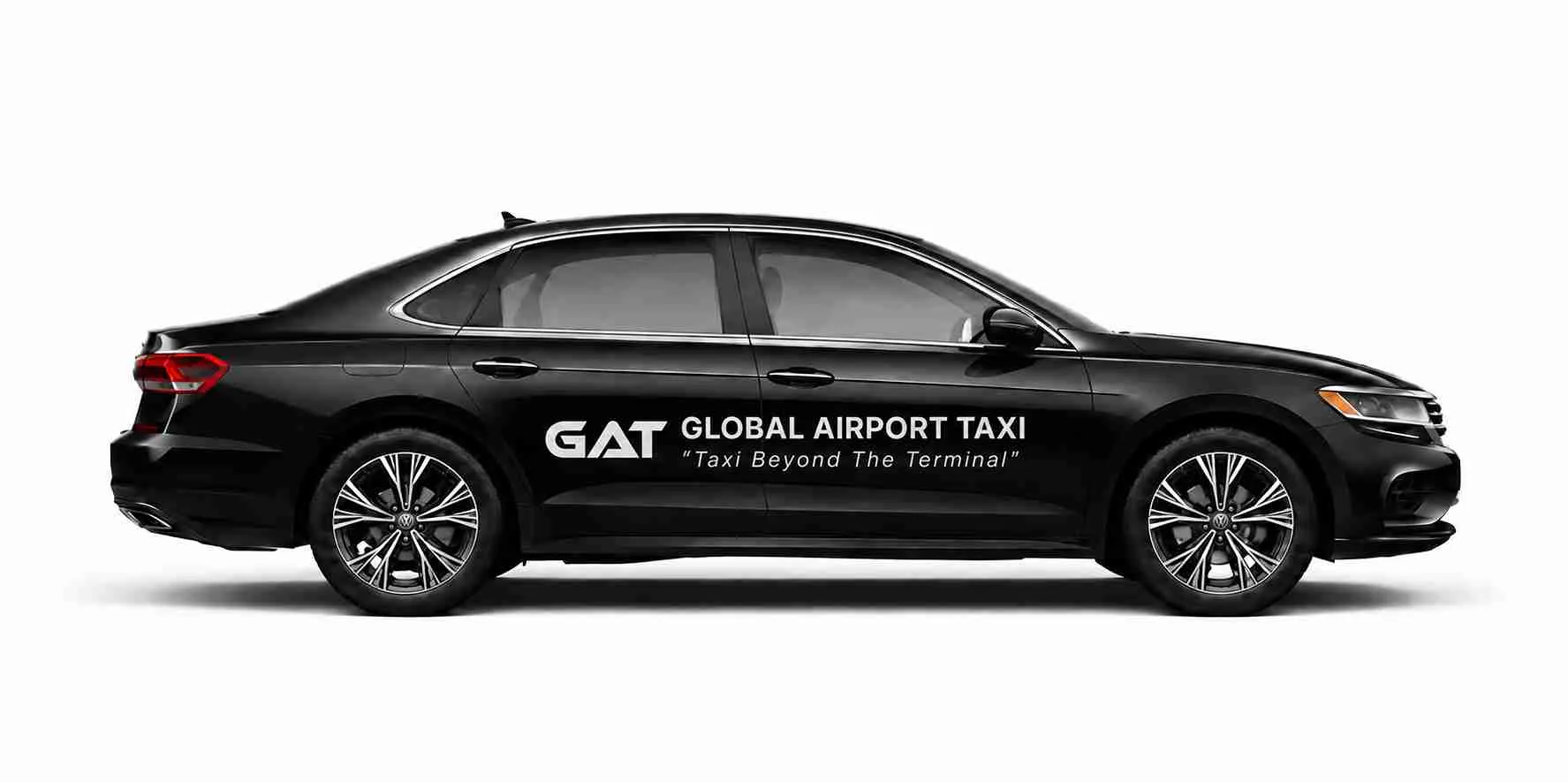 Normally a Volkswagen Passat or similar
Saloon taxi
4 passengers, 2 large bags
Two people with a case each. Rarer than you would think on a sailing day.
View vehicle →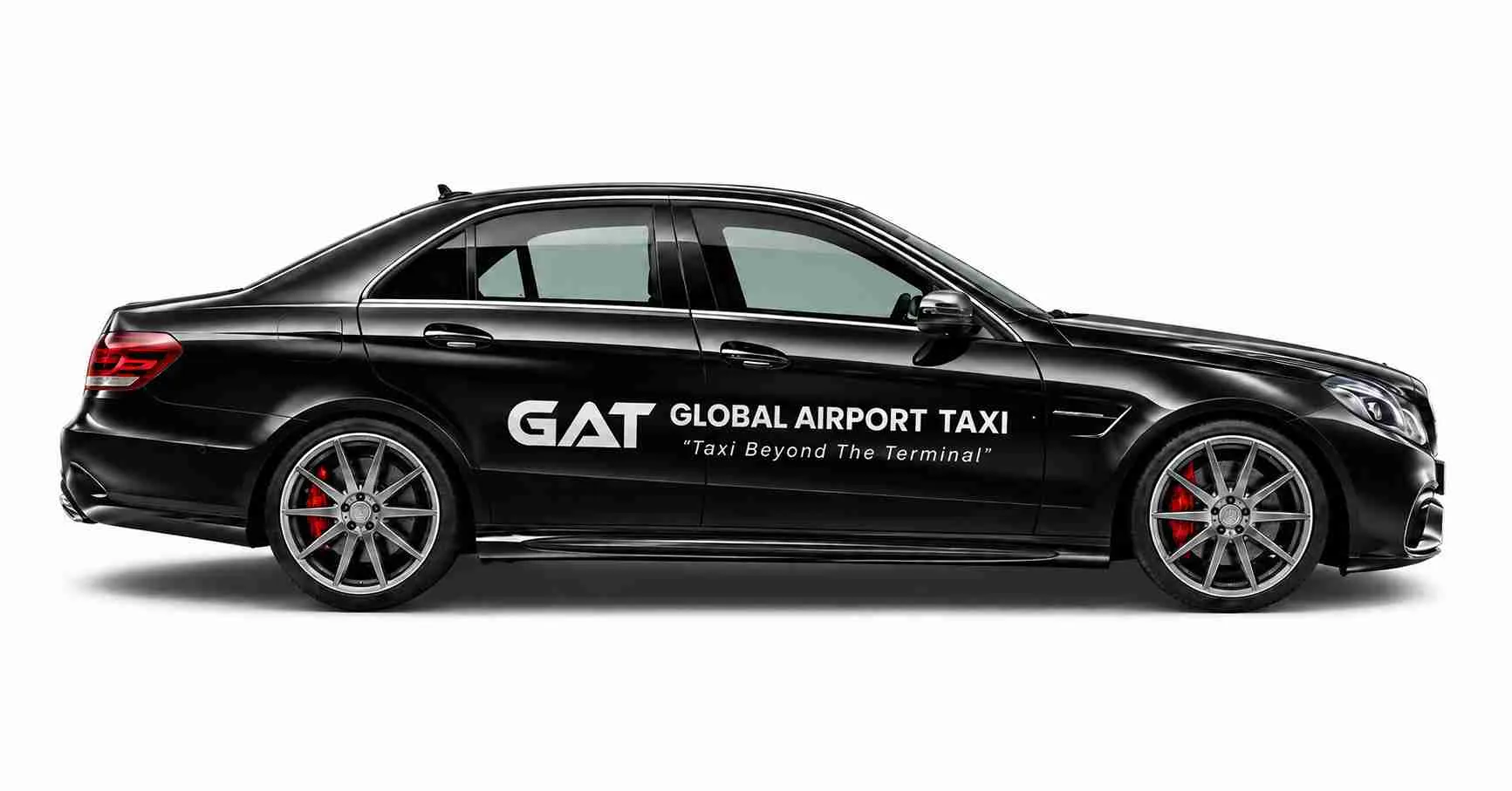 Normally a Mercedes E-Class or similar
Executive car
3 passengers, 2 large bags
Up to three, when the arrival is part of the business and not just the getting there.
View vehicle →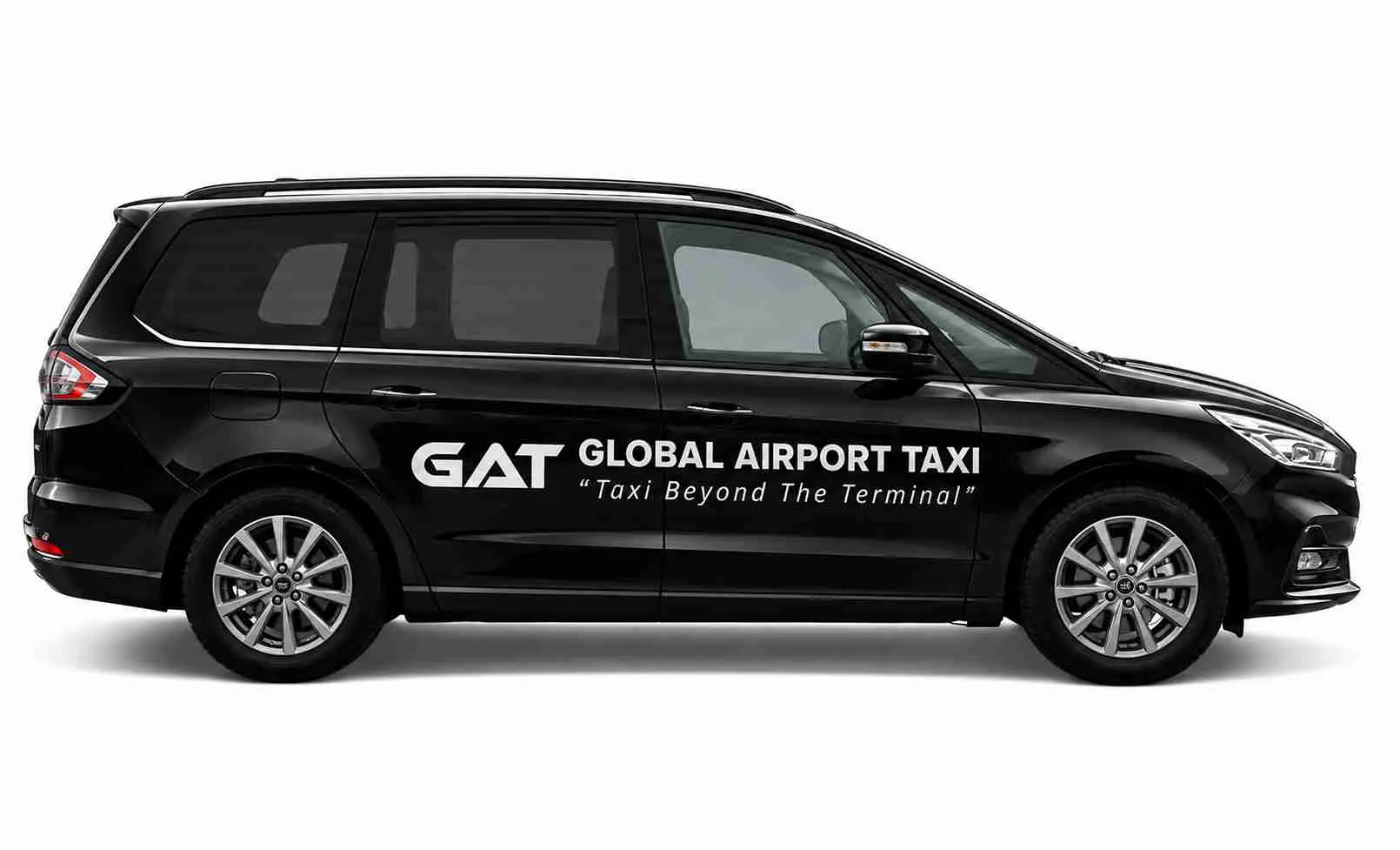 Normally an estate taxi
Estate taxi
4 passengers, 3 large bags
Four people whose cruise cases will not close a saloon boot.
View vehicle →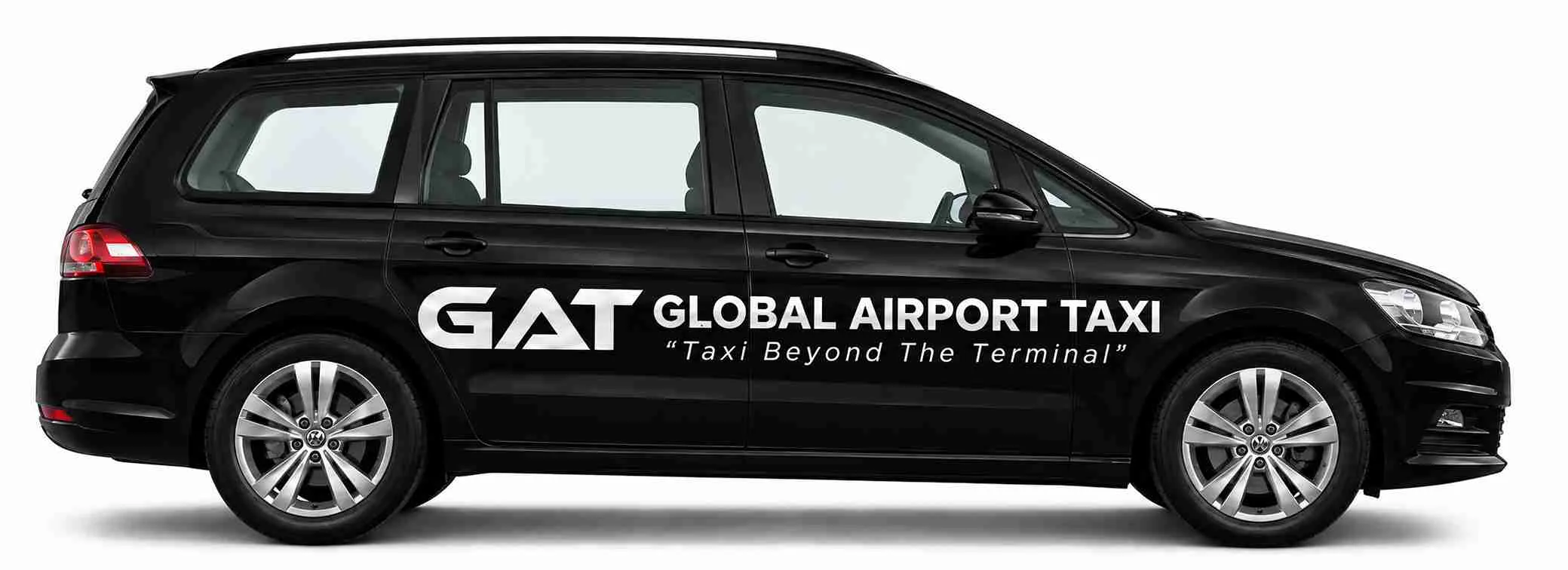 Normally a 6-seater MPV people carrier
People carrier
5 to 6 passengers, 4 to 5 large bags
Five or six with a pushchair and a fortnight of formal nights.
View vehicle →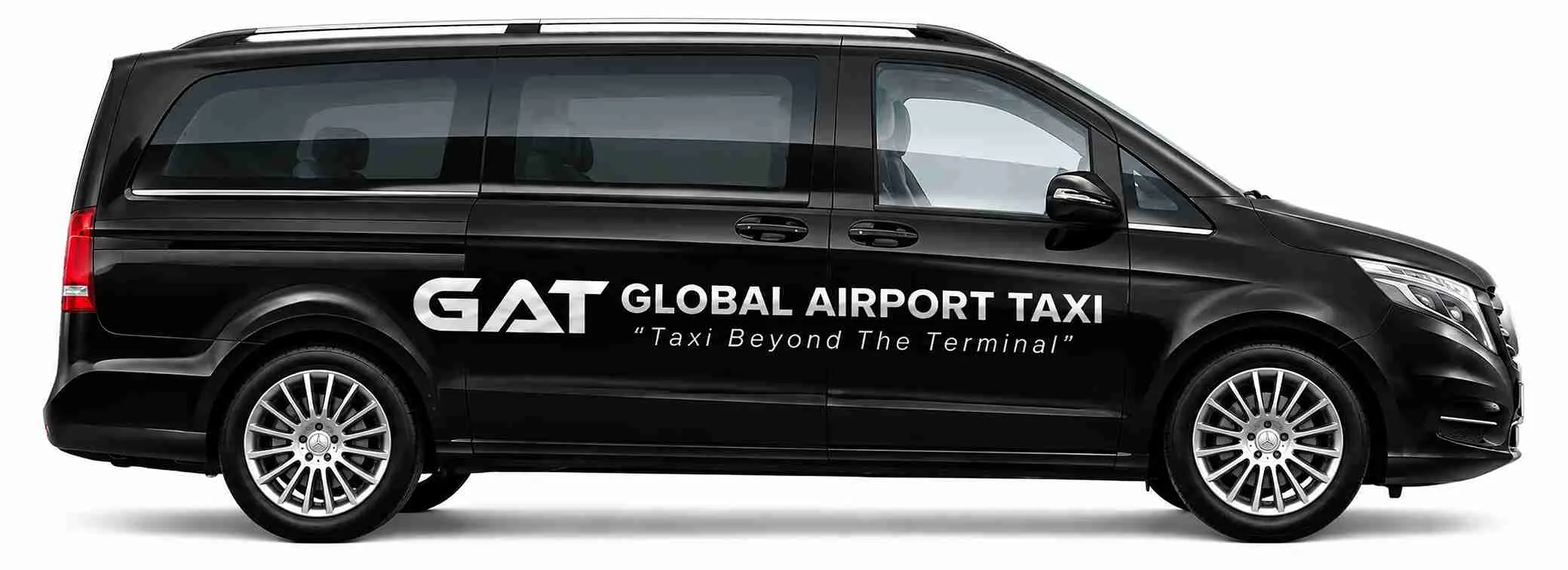 Normally a 7 seater taxi
7 seater taxi
7 passengers, 7 cabin bags
Seven travelling light, which on a cruise means cabin bags only.
View vehicle → Normally an 8 seater taxi
8 seater taxi
8 passengers, 6 to 8 large bags
Eight people and six large cases — the shape most cruise parties actually arrive in.
View vehicle →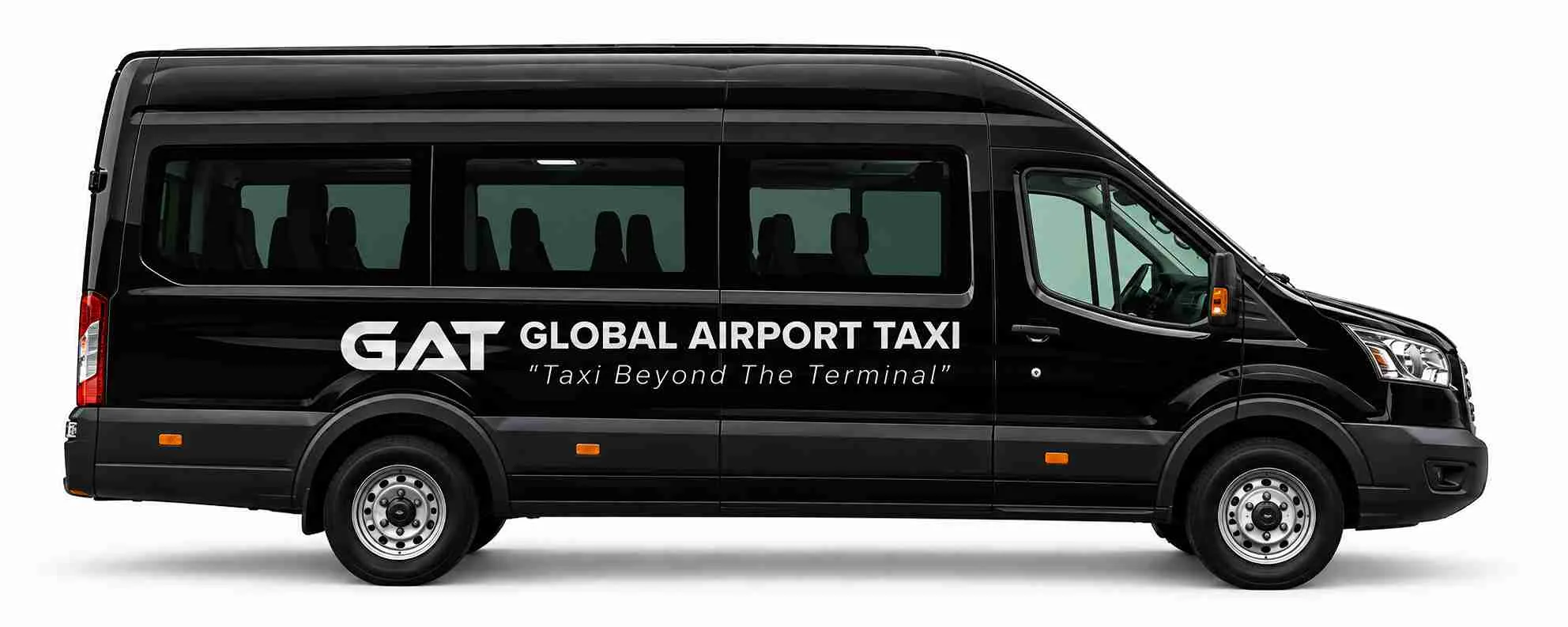 Normally a 16 seater minibus
16 seater minibus
16 passengers, about 14 large bags
An extended family off one flight, kept together to one gate.
View vehicle →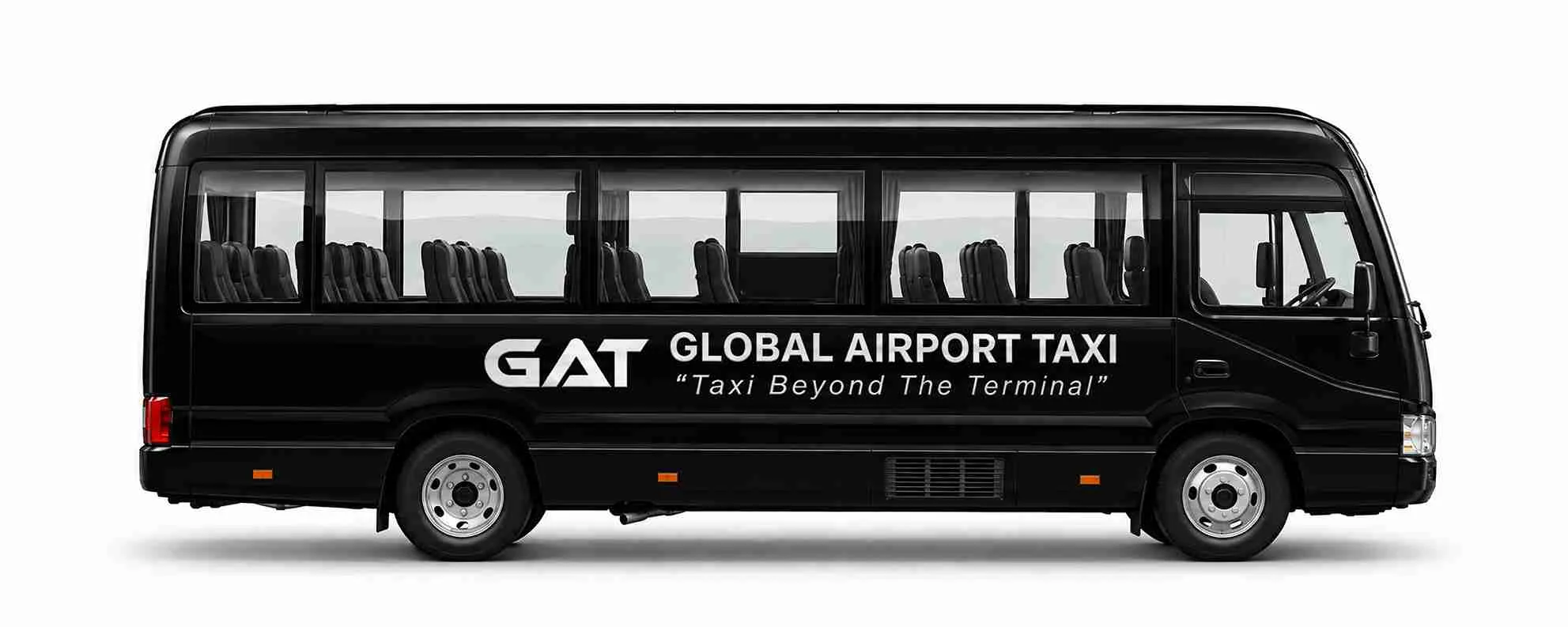 Normally a 30-seater coach
30-seater coach
30 seats
Charter groups and incentive parties past minibus size.
View vehicle →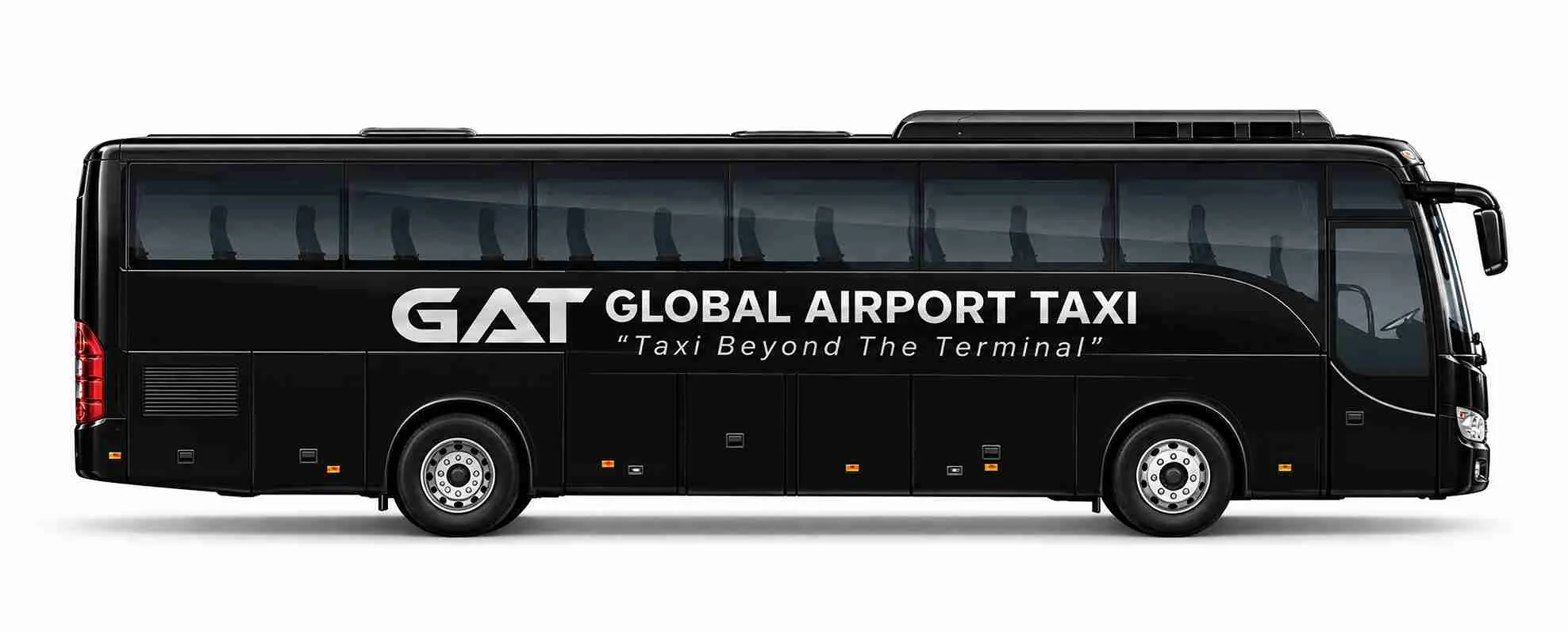 Normally a 50-seater coach
50-seater coach
50 seats
Full-ship charters and group embarkations, booked well ahead.
View vehicle →| Extra | What to know |
|---|---|
| Child seats | Infant, child and booster seats are available on request at no extra cost. In Spain a seat is needed for children under 135 cm, with a narrow exemption for taxis on urban journeys, so give us the children’s ages when you book. |
| Golf clubs, skis, bikes, dive gear | Fine with notice. Tell us the item and its length at booking so a vehicle with the right load space is allocated. |
| Wheelchair-accessible vehicles | Request one at booking so we can confirm a suitable vehicle for your route and date. |
Every vehicle is shown on our fleet page. Models are typical for each class, so your quote confirms what is offered. Tell us your party size and bag count so the right vehicle is allocated.
Reviews
The scores below are the ones our review widget publishes, checked on 14 October 2026. They come from travellers at airports across our network, and we show a selection of passenger reviews about airport transfers. Every review stays on the platform where it was written.
Excellent4.9453 reviewsShowing all 10 reviews
Excellent service...arrived at terminal and driver was waiting...helped with luggage to the car...smooth drive...perfect overall
Very reliable and easy to get a hold of. I was very confused leaving the airport - user error haha - and they were super helpful. My flight was also delayed and the guy who picked me up was on top of it.
Super affordable and professional service! The pricing was very clear from the start, with no hidden charges, which I really appreciated. Everything went smoothly, and the professionalism of the global airport taxi service stood out. Highly recommended for anyone looking for a hassle-free and budget-friendly option.
Amazing taxi service to the airport! Our driver was friendly, on time, and made the whole trip so easy. The car was clean and comfortable, and we got to the airport right on time. Would definitely use this service again!
Excellent service , driver waited for us as flight was delayed, clean car and smooth ride
I would totally recommend Global Airport Taxi to anyone needing a taxi service for their airport commute. I decided on way to the airport that I was flying out of that I will need a cab service at LHR. They were quick to respond to and accommodated some of my last minute schedule change requests after I had landed at LHR. Totally reliable and willing to be flexible. Outstanding customer support provided by Jennifer and Root. Keep it up guys !!
This was a brilliant service our driver was excellent he was friendly and helpful. Used again for the return journey and driver was professional and ensured we made it to the airport on time with heavy traffic
The service was extremely reliable. My cab arrived exactly on time for my early morning flight, which was a huge relief. Everything went smoothly, and I felt confident choosing this service. Highly recommend global airport taxi for stress-free airport transfers!
Amazing customer service, on time driver helped with cases. A pleasant experience Thank you
Very clean car and on time very polite driver will use them again
These scores cover the whole network rather than cruise transfers alone. Trustindex supplies the widget, and every review appears exactly as its author wrote it. Nothing on this page is a review we wrote.
The service
A private vehicle between an airport and a named cruise terminal, priced per vehicle before travel, with the terminal taken off your cruise documents rather than guessed.
The short answer A private, pre-booked vehicle from your arrivals hall to the cruise terminal your ship is actually using. The fare is agreed per vehicle before you fly, the booking is tied to your flight number so a delay moves it rather than breaking it, and the vehicle class is set by your luggage rather than your head count.
One vehicle for your party, door to door from the arrivals hall to the terminal your ship is at. No other passengers, no circuit of hotels, and no waiting for a coach to fill.
The booking follows your flight number. A late inbound moves the pickup with it, which on an embarkation morning is the part that matters most, because the ship will not wait.
Cruise cases are bigger and there are more of them. The vehicle class is set from the bag count, so four people with a fortnight of luggage get an estate or a people carrier rather than a saloon that cannot close its boot.
Per vehicle, in the currency of the booking, settled before you fly. Traffic, a diversion or a slow carousel do not change it, because there is no meter running.
A licensed professional driver, the vehicle class you booked, flight tracking against your inbound, the driver meeting you inside the arrivals hall of the terminal you actually landed in with a name board, help with the luggage, child seats if you asked for them, and 60 minutes of waiting from the moment you touch down. On a pickup from the ship the included waiting is 90 minutes instead, because disembarkation runs to the ship’s schedule rather than yours.
Airport to ship on embarkation morning, ship to airport on disembarkation day, and the version most people actually need: airport to a hotel the night before, then hotel to the terminal in the morning. A cruise port to airport leg at the end books the same way, and a return transfer priced with the outbound usually beats two separate bookings. That is two bookings or one with an extra stop, and it is worth pricing both ways because at several ports the terminal does not open early enough to go straight there.
A line transfer is simple and it is usually priced per person, so a couple often does well and a family of five rarely does. The conditions are the real difference. Carnival will only run its Long Beach transfers if your flight lands at Los Angeles by 12:00 or Long Beach by 12:30, on embarkation and debarkation days only, and publishes no price at all. Miss the window and there is no transfer, which is a worse problem than a higher fare.
The money
Nine published fare positions, each read at the authority that sets or records it. Four are real fixed fares, one covers half the journey people need, one is an average the port is careful not to call a tariff, and one is a flat fare that has been abolished.
The short answer Four authorities in the world publish a fixed airport to cruise terminal fare: Barcelona at €46, Vancouver at $42, New Orleans at $36 into the district its terminals sit in, and the New South Wales trial at $60 from a Sydney Airport rank. Miami used to and abolished it. Everywhere else, an official fare does not exist.
| Place | What it covers | The figure | Kind | Published by |
|---|---|---|---|---|
| Barcelona | Airport to the Moll Adossat cruise terminals | €46 fixed | Fixed | Àrea Metropolitana de Barcelona |
| Vancouver | Airport to Canada Place | $42 flat | Fixed | Vancouver Fraser Port Authority |
| New Orleans | Airport to the Central Business District and French Quarter | $36 for up to two | Fixed | Louis Armstrong New Orleans International Airport |
| Sydney | Airport rank to the central business district trial area | $60 fixed, $80 for a maxi | Fixed | New South Wales Government |
| New York | JFK to Manhattan only | $70 flat | Partial | New York City Taxi and Limousine Commission |
| Fort Lauderdale | Airport to Port Everglades | $18 to $21, as an average | Average | Port Everglades |
| Miami | Airport or seaport, any destination | No flat fare exists | None | Miami-Dade County |
| Singapore | Trips starting at Changi | Surcharges, not a fare | None | Changi Airport Group |
| Shanghai | Wusongkou terminal to the airports | About ¥200 and ¥150 | Dated | Shanghai municipal government |
Prices move. Port authorities, airport operators and taxi regulators each reset on their own calendar, and we review ours, so treat every figure on this page as a guide and read your quote as the price.
Because the fare is almost never the port’s to set. A port authority publishes directions, gates and berths; the price is set by whichever taxi regulator covers the city, and regulators publish tariffs rather than point-to-point fares. Barcelona is the exception that proves it: the metropolitan authority there sets a named fixed fare for the cruise dock, which is why Barcelona is the only European port on this page with a real number against it. Vancouver is unusual in the other direction — the port authority itself publishes the taxi fare.
Where there is no fixed fare, the add-ons decide the bill. Changi loads S$8 on a trip starting at the airport between 17:00 and 23:59, 25 per cent at peak and 50 per cent between midnight and 05:59. Sydney charges a $5.45 toll on every taxi taken from a rank. Barcelona charges €4.60 for the airport and another €4.60 for the Moll Adossat cruise dock, which is most of the reason its fixed fare sits where it does. A metered estimate that ignores these is not an estimate.
New York. The Taxi and Limousine Commission’s $70 JFK flat fare reaches Manhattan and stops at the state line. Cape Liberty is in Bayonne, New Jersey, so a yellow cab from JFK or LaGuardia runs on the meter under out-of-city rules and you pay the driver’s return tolls as well as your own. Newark is the near airport at about nine miles. Plenty of passengers book JFK for a cruise that sails from New Jersey.
Coverage, honestly
The network publishes airport pages for 81 countries. A cruise transfer follows that footprint rather than a separate one, so this section says plainly which cruise regions are inside it and which are not.
The short answer Coverage follows the airport network, not a separate cruise network: the transfer works wherever the airport you land at is one of the 81 countries with a published airport page, which includes every port in the tables on this page. It does not include Iceland, Hong Kong, Thailand, Puerto Rico, Aruba or the Bahamas, and the German pages do not credibly reach the northern German cruise ports.
We are an airport transfer operator, and a cruise terminal is an address. So the question is never whether we have a cruise network — it is whether the airport you fly into is one of the 81 countries the network publishes pages for. Where it is, the terminal is simply a destination on the booking, and that covers every port in the three tables below. Where it is not, no amount of willingness makes a car appear, and we would rather tell you that before you book a flight than after.
Because a worldwide page that implies worldwide coverage is the single most common piece of dishonesty in this market, and it does real damage: a passenger books a flight to Keflavík or Kai Tak on the strength of a page like this one and finds out at the airport. The list below is the ports people ask us about that the published network does not reach.
Europe
12 homeports, from the one port in Europe with a real fixed transfer fare to the one the port authority routes you to by three trains. Every terminal name below is the name the port or its operator uses for itself.
The short answer Barcelona is the only European port with an official fixed airport to cruise terminal fare, at €46 either way. Civitavecchia is the hardest transfer, at about 60 km from Fiumicino with no rail link and one vehicle gate. Southampton is the most mistaken, with five terminals behind four dock gates and no walking route between the Eastern and Western Docks.
| Port | Authority or operator | Airports | Terminals | Published fare |
|---|---|---|---|---|
| Southampton, England | Port of Southampton | London Heathrow LHR, London Gatwick LGW, Southampton SOU | 5 | None published |
| Dover, England | Port of Dover | London Gatwick LGW, London Heathrow LHR | 2 | None published |
| Barcelona, Spain | Port de Barcelona | Josep Tarradellas Barcelona-El Prat BCN | 5 | A fixed €46 either way between the Moll Adossat terminals and the airport, all supplements included — tariff T-4 in the metropolitan schedule. |
| Civitavecchia, for Rome, Italy | Port of Civitavecchia | Rome Fiumicino FCO, Rome Ciampino CIA | 3 | None published |
| Piraeus, for Athens, Greece | Piraeus Port Authority | Athens International ATH | 1 | None published |
| Lisbon, Portugal | Porto de Lisboa | Lisbon Humberto Delgado LIS | 3 | None published |
| Valletta, Malta | Valletta Cruise Port | Malta International MLA | 2 | None published |
| Palma de Mallorca, Spain | Autoritat Portúaria de Balears | Palma de Mallorca PMI | 2 | None published |
| Amsterdam, Netherlands | Passenger Terminal Amsterdam | Amsterdam Schiphol AMS | 1 | None published |
| Copenhagen, Denmark | Copenhagen Malmö Port | Copenhagen CPH | 1 | None published |
| Genoa, Italy | Stazioni Marittime S.p.A., Ports of Genoa | Milan Malpensa MXP | 2 | None published |
| Santa Cruz de Tenerife, Canary Islands | Puertos de Tenerife | Tenerife North TFN, Tenerife South TFS | 2 | None published |
None of these are final prices. The bodies that publish them change them on their own schedules, so the figure that binds is the one on your quote.
SOUTHAMPTON
Port of Southampton
DOVER
Port of Dover
BARCELONA
Port de Barcelona
CIVITAVECCHIA
Port of Civitavecchia
PIRAEUS
Piraeus Port Authority
LISBON
Porto de Lisboa
VALLETTA
Valletta Cruise Port
PALMA
Autoritat Portúaria de Balears
AMSTERDAM
Passenger Terminal Amsterdam
COPENHAGEN
Copenhagen Malmö Port
GENOA
Stazioni Marittime S.p.A., Ports of Genoa
TENERIFE
Puertos de Tenerife
The Americas
14 homeports, including the three with published flat fares, the one whose flat fare was abolished, and the pair that sit in two different states under one marketing name.
The short answer Vancouver and New Orleans publish flat fares of $42 and $36; Miami abolished its flat fare and is now metered with a $15 minimum; and New York’s $70 JFK flat fare does not reach Cape Liberty, which is in New Jersey. Galveston is the longest mainstream transfer in the region, at about an hour and a half from Houston Intercontinental by the port’s own figure.
| Port | Authority or operator | Airports | Terminals | Published fare |
|---|---|---|---|---|
| Miami, Florida | PortMiami | Miami International MIA, Fort Lauderdale-Hollywood International FLL | 7 | There is no longer a flat fare. |
| Fort Lauderdale, Florida | Port Everglades | Fort Lauderdale-Hollywood International FLL, Miami International MIA | 3 | The port publishes an average rather than a tariff: a taxi from Fort Lauderdale airport to Port Everglades averages $18 to $21, subject to change. |
| Port Canaveral, Florida | Canaveral Port Authority | Orlando International MCO, Orlando Melbourne MLB, Orlando Sanford SFB | 2 | None published |
| Galveston, Texas | Port of Galveston | Houston William P. Hobby HOU, Houston George Bush Intercontinental IAH | 4 | None published |
| Tampa, Florida | Port Tampa Bay | Tampa International TPA | 3 | None published |
| New Orleans, Louisiana | Port of New Orleans | Louis Armstrong New Orleans International MSY | 2 | The airport publishes a flat fare of $36. |
| Charleston, South Carolina | South Carolina Ports Authority | Charleston International CHS | 1 | None published |
| Baltimore, Maryland | Maryland Port Administration | Baltimore/Washington International BWI, Washington Dulles IAD, Washington Reagan National DCA | 1 | None published |
| New York and New Jersey | Manhattan Cruise Terminal and Cape Liberty | Newark Liberty EWR, New York JFK JFK, New York LaGuardia LGA | 2 | New York’s regulated fares only reach Manhattan. |
| Seattle, Washington | Port of Seattle | Seattle-Tacoma International SEA | 2 | None published |
| San Pedro and Long Beach, California | Port of Los Angeles and Port of Long Beach | Los Angeles International LAX, Long Beach LGB | 2 | None published |
| Boston, Massachusetts | Flynn Cruiseport Boston | Boston Logan International BOS | 1 | None published |
| Vancouver, British Columbia | Vancouver Fraser Port Authority | Vancouver International YVR | 1 | The port authority publishes a flat $42. |
| Bridgetown, Barbados | Barbados Port Inc. | Grantley Adams International BGI | 1 | None published |
Figures drift. A tariff reset, a currency move or a new supplement can all overtake a page like this one, so the quote is the number to go by.

MIAMI
PortMiami
EVERGLADES
Port Everglades
CANAVERAL
Canaveral Port Authority
GALVESTON
Port of Galveston
TAMPA
Port Tampa Bay
NEWORLEANS
Port of New Orleans
CHARLESTON
South Carolina Ports Authority
BALTIMORE
Maryland Port Administration
NYC
Manhattan Cruise Terminal and Cape Liberty
SEATTLE
Port of Seattle
LOSANGELES
Port of Los Angeles and Port of Long Beach
BOSTON
Flynn Cruiseport Boston
VANCOUVER
Vancouver Fraser Port Authority
BARBADOS
Barbados Port Inc.
Asia and beyond
12 homeports, including the best-documented transfer anywhere, the terminal where you can check in for your flight before leaving the ship, and the two Japanese ports 65 km apart that are both sold as Tokyo.
The short answer Brisbane publishes the clearest figures of any port on this page, at 12 km and about 15 minutes from the airport with no public transport to the terminal at all. Abu Dhabi’s Zayed Port has airline check-in desks inside the cruise terminal. A cruise sold as Tokyo usually sails from Yokohama, which is 79 km from Haneda against Tokyo’s own 14 km.
| Port | Authority or operator | Airports | Terminals | Published fare |
|---|---|---|---|---|
| Singapore | Singapore Cruise Centre and Marina Bay Cruise Centre | Singapore Changi SIN | 2 | Changi Airport Group publishes surcharges rather than a flat fare: S$8 on trips starting at the airport between 17:00 and 23:59, S$6 at other times, with a 25 per cent peak-hour surcharge and a 50 per cent surcharge between midnight and 05:59. |
| Yokohama, for Tokyo, Japan | Port of Yokohama | Tokyo Haneda HND, Tokyo Narita NRT | 3 | None published |
| Tokyo, Japan | Port of Tokyo | Tokyo Haneda HND, Tokyo Narita NRT | 1 | None published |
| Shanghai, China | Shanghai Wusongkou International Cruise Terminal | Shanghai Pudong PVG, Shanghai Hongqiao SHA | 1 | The municipal service page puts a taxi from the terminal at about ¥200 to Pudong and ¥150 to Hongqiao, with the city centre at about ¥100. |
| Dubai, United Arab Emirates | Mina Rashid and Dubai Harbour | Dubai International DXB | 2 | None published |
| Abu Dhabi, United Arab Emirates | Zayed Port | Zayed International AUH | 1 | None published |
| Doha, Qatar | Doha Port | Hamad International DOH | 1 | None published |
| Sydney, Australia | Port Authority of New South Wales | Sydney Kingsford Smith SYD, Sydney Kingsford Smith SYD | 2 | Two official figures apply. |
| Melbourne, Australia | Ports Victoria | Melbourne Tullamarine MEL | 1 | None published |
| Brisbane, Australia | Port of Brisbane | Brisbane BNE | 1 | None published |
| Auckland, New Zealand | Queens Wharf and Princes Wharf | Auckland AKL | 2 | None published |
| Cape Town, South Africa | Cape Town Cruise Terminal | Cape Town International CPT | 1 | None published |
Treat the amounts above as indicative. Each belongs to the body that publishes it and can change without this page hearing about it; your quote is what you pay.

SINGAPORE
Singapore Cruise Centre and Marina Bay Cruise Centre
YOKOHAMA
Port of Yokohama
TOKYO
Port of Tokyo
SHANGHAI
Shanghai Wusongkou International Cruise Terminal
DUBAI
Mina Rashid and Dubai Harbour
ABUDHABI
Zayed Port
DOHA
Doha Port
SYDNEY
Port Authority of New South Wales
MELBOURNE
Ports Victoria
BRISBANE
Port of Brisbane
AUCKLAND
Queens Wharf and Princes Wharf
CAPETOWN
Cape Town Cruise Terminal
What goes wrong
None of these is a driver being late. They are all information failures, and every one of them is preventable with a field on a booking form.
The short answer The six real failure modes are the wrong terminal in the right port, the wrong port in the right city, the wrong gate at the right terminal, a fare that has been abolished, a flight booked against the sailing time instead of the port’s own published deadline, and ride-hailing that is allowed to drop off but not to pick up.
Southampton has five terminals behind four dock gates, with no walking route between the Eastern and Western Docks. Seattle has two piers about 8 km apart used by different lines. Sydney has two on opposite sides of the harbour. Piraeus has three the authority does not name. A terminal read off the ticket costs nothing; a terminal guessed can cost the sailing.
Carnival sails from Long Beach while Princess, Norwegian, Royal Caribbean and Virgin sail from San Pedro — two ports, two cities, one marketing name. Cape Liberty and the Manhattan Cruise Terminal are in different states. A cruise sold as Tokyo very often sails from Yokohama, 65 km away.
At Charleston cars use Gate 2 and taxis, limousines and coaches use Gate 1. At Civitavecchia the only vehicle entrance is Varco Vespucci. At Port Canaveral the motorway exit splits before the port, 54A for the A terminals and 54B for the B terminals. A driver who learns this at the barrier learns it too late.
Miami-Dade eliminated its airport to seaport flat rate, yet a great many pages still quote one. In New York the JFK flat fare stops at the Manhattan line. Quoting a fare that no longer exists is how a transfer ends in an argument at the kerb.
Port Everglades asks for at least 45 minutes between a flight landing and terminal check-in. Charleston accepts vehicles and luggage between 11:30 and 15:00. Sydney closes bag drop about 90 minutes before departure. Port Canaveral does not open its lots to embarking passengers before 10:00. These are published figures, and they decide which flight is bookable.
At Canada Place in Vancouver taxis may drop at the terminal while ride-hailing must use level P2 of the parkade — and cannot pick up at the terminal at all, so those passengers walk to a street-level zone with their cases. At Auckland ride-hailing is not allowed in the taxi zones.
The difficult ones
Ranked by how much goes wrong rather than by distance. Every figure is the port’s own, or the cruise line’s where the port publishes nothing.
The short answer Civitavecchia for Rome is the hardest: about 60 km from Fiumicino with no rail link, one vehicle gate and a shuttle inside the estate. Galveston is the longest, at about an hour and a half from Houston Intercontinental. Cape Liberty is the worst for price, because New York’s flat fare stops at the state line. Daikoku Pier at Yokohama publishes no airport distance at all.
Timing
Ports publish more about timing than most passengers ever see, and those figures — not the sailing time — are what a flight has to be booked against.
The short answer Work backwards from the terminal’s published cut-off, not the sailing time. Port Everglades wants 45 minutes between landing and check-in, Sydney closes bag drop about 90 minutes before departure, and Charleston stops accepting vehicles at 15:00. Add the ground transfer, which at Galveston is about an hour and a half from Houston Intercontinental.
| Port | On embarkation day | On disembarkation day | Source of the figure |
|---|---|---|---|
| Port Everglades | At least 45 minutes between a flight landing and terminal check-in | Disembarkation typically 07:00 to 09:00 | The port publishes both |
| Charleston | Vehicles and luggage typically accepted 11:30 to 15:00, with early luggage drop-off 09:00 to 11:00 at Gate 2 | Not published | The ports authority publishes the arrival window |
| Sydney | Bag drop generally opens around 09:00 and closes about 90 minutes before departure; arrive at least an hour before | Generally begins about 30 minutes after arrival | The port authority publishes both |
| Port Canaveral | Garages and surface lots do not open to embarking passengers before 10:00 | Not published | The port publishes the lot opening time |
| Singapore, Marina Bay | Check in no later than 90 minutes before sailing | Not published | Published by the cruise line |
| Melbourne, Station Pier | Public access 07:00 to 17:00, extending to 06:00 to 20:00 from 4 October 2026 to 4 April 2027 | Not published | Ports Victoria publishes the pier hours |
| Brisbane, Singapore, Daikoku | The terminal opens only on days a ship is at berth | Not published | Each operator publishes this of its own terminal |
The sailing time is the least useful number on your ticket. What decides whether a flight works is the terminal’s own cut-off, then the ground transfer on top of it. Port Everglades asks for 45 minutes between landing and check-in; Sydney closes bag drop about 90 minutes before departure; Charleston stops accepting vehicles at 15:00. Add Galveston’s hour and a half from Intercontinental to a 15:00 cut-off and a flight landing at 13:00 is already late.
At several ports the arithmetic simply does not close on the day. Civitavecchia is three legs from Fiumicino by the port’s own route. Galveston is ninety minutes from the airport the long-haul uses. Port Canaveral will not open its lots before 10:00. And a terminal that opens only on ship days, as Brisbane, Marina Bay and Daikoku all do, offers nowhere to wait if you land early. A hotel the night before plus a short morning transfer is both cheaper to insure and far less exposed.
Disembarkation runs to the ship’s schedule, not yours, which is why the included waiting on a port pickup is 90 minutes rather than the 60 minutes on an airport arrival. Where a port publishes a window we book against it: Port Everglades gives 07:00 to 09:00, Sydney says about 30 minutes after arrival. Where it does not, the line’s own disembarkation letter is the figure to send us.
Gates and rules
Port security is the part of an embarkation day nobody plans for, and it is also the part that is published in the most detail. Six things that differ port by port.
The short answer It varies more than anywhere else. Some ports let a taxi stop outside the terminal door — Associated British Ports publishes exactly that for every Southampton terminal. Others admit no passenger cars past one gate and run a shuttle, as Civitavecchia does. Several require photo identification and cruise documents from every adult at the gate itself, and several cap a drop-off at two minutes.
Port Everglades requires government photo identification plus cruise documents from everyone aged 18 or over at any checkpoint, and its own checkpoints keep different hours: Checkpoint 1 at Eller Drive is open around the clock, Checkpoints 2 and 3 only 06:00 to 18:00. Charleston requires cruise documents, photo identification and proof of citizenship. Nassau checks at the Arrivals Terminal security desk. Sydney x-rays bags and asks passengers to declare hip or knee replacements and pacemakers.
Charleston sends cars to Gate 2 and taxis, limousines and coaches to Gate 1. Civitavecchia admits passenger vehicles only at Varco Vespucci, with Varco Nord reserved for heavy traffic. Southampton spreads five terminals across Dock Gates 4, 8, 10 and 20. Sydney closes Robert Street to public vehicles at White Bay on ship days and routes everyone via James Craig Road.
Associated British Ports states in each Southampton terminal’s own passenger directions that private taxis can drop off directly outside the cruise terminal. Port Canaveral tells you to drive straight to the terminal. At the other end of the range, Civitavecchia needs a shuttle from the gate and Bergen does not publish whether a taxi may reach the ship at all.
Sydney’s Overseas Passenger Terminal allows two minutes on the lower roadway and you may not leave the vehicle, with no parking or waiting bays at all on cruise days. Canada Place allows 15 minutes or less in the parkade. Brisbane has a two-minute set-down loop that vehicles over 6.5 m or towing a trailer may not enter.
Valletta lets visitors go no further than the public areas of the Valletta Waterfront. Nassau allows non-sailing family and friends as far as the Arrivals Terminal and no further. Daikoku Pier does not let passengers into the terminal building at all. Plan the farewell for the kerb.
At Canada Place taxis may drop at the terminal, ride-hailing must use level P2 of the parkade, and ride-hailing may not pick up at the terminal at any time — those passengers walk to a city street zone with their cases. At Auckland ride-hailing is not allowed in the taxi zones. Where a port draws that distinction, a pre-booked car is on the right side of it.
Luggage
The bag count, not the head count, is what decides the vehicle on an embarkation morning — and at most ports the port’s own porters take over at the kerb.
The short answer Book by the suitcase count rather than the seat count: cruise cases are larger and there are more of them, so four adults usually need an estate or a people carrier and eight need the 8-seater. The driver loads and unloads, and at most ports the port’s porters take checked bags from the kerb to the ship.
This is the most common sizing mistake on an embarkation booking. A fortnight at sea with formal nights is a large case each plus a cabin bag each, and often a suit carrier on top. Four adults who would share an estate on a city break need a people carrier here. Eight people with cruise luggage need the 8-seater, not the 7. The fare is per vehicle, so the class is decided by the suitcase count, and getting it right at booking costs nothing while getting it wrong on the morning costs a second vehicle.
Our driver loads and unloads. At the terminal the port’s own porters usually take checked bags from the kerb to the ship — Port Canaveral, Galveston and New Orleans all publish that arrangement, and New Orleans names its SeaCaps specifically. That is why the drop-off point matters so much: hand the bags over at the right kerb and they are the port’s problem from there, which is the single biggest practical difference between a terminal drop and a station drop.
Barbados Port Inc. publishes something no other port on this page does: baggage transfer between the airport and the seaport under customs seal, alongside airport-to-seaport transfers, special assistance vehicles on request and pre-boarding security screening of guests and baggage. It states that its arrangement with designated port agency providers supports customs and immigration processing between the two. If you are homeporting out of Bridgetown that is worth knowing about before you plan the day.
Golf clubs, skis, bicycles and dive gear all travel, with notice, and the figure we need is the length of the item rather than its weight, because length is what decides the load space. For a wheelchair or a scooter, send the measurements and weight at booking and the vehicle is confirmed against your date and route before you pay. Child seats — carriers, forward-facing seats and boosters — are free on request, and worth asking for, because the law differs by country and a rank taxi will rarely carry one.
On the day
Five steps each way. The order matters more than it looks, because two of the ten are fields on a booking form and the other eight depend on them.
The short answer On embarkation morning the driver meets you inside the arrivals hall of the terminal you land in, with a name board, and the first 60 minutes after touchdown are included. On disembarkation day the car is booked against the port’s published window with 90 minutes of waiting, and the pickup point is the one the port allows rather than the terminal door.
Booking
The waiting allowances, the cancellation window and the payment terms, stated as numbers. The marked lines are the ones awaiting the operator’s own confirmed figures.
The short answer The fare is per vehicle, paid in full at booking, cancellable free up to 24 hours before pickup. Included waiting is 60 minutes from landing on an airport pickup and 90 minutes on a cruise terminal pickup. Child seats are free, there is no deposit, and a group or accessible vehicle wants 48 hours’ notice.
The vehicle, in the currency of the booking, before you travel. There is no per-person multiplier, no meter and no surge, so the figure does not move because the traffic did. At the four ports where an official fare exists we will tell you what it is, because on a clean off-peak run a rank taxi in Barcelona or Vancouver may well be the better deal and we would rather say so here than have you find out afterwards.
A turnaround day concentrates several thousand arrivals into a few hours, at ports that often have one road in. Brisbane has no public transport to the terminal at all, so every passenger is on that road. Book at least 12 hours ahead, and further out for a coach or an accessible vehicle, which are allocated against your specific date and route rather than held in a pool.
A confirmation naming the licensed operator, the driver, the vehicle and the meeting point, with the fare and any charges itemised rather than presented as one figure — which is what an expenses team needs. The figure printed on it is the figure you pay.
A reminder that applies to every amount here: these are published reference figures, not our prices, and they are not guaranteed to be current. The quote is.
Vehicles
Nine classes, from a saloon to a 50-seater coach. The fare is for the vehicle rather than the seat, so the suitcase count is what decides which one.
| Class | Seats | Large cases | Cabin bags | Who it is for |
|---|---|---|---|---|
| Saloon | 4 | 2 | 2 | Two of you with a case each. Rare on an embarkation morning, because cruise luggage is not cabin luggage. |
| Estate | 4 | 3 | 3 | Four people whose cases will not close a saloon boot — the usual answer for a fortnight at sea. |
| Executive | 3 | 2 | 2 | Up to three, when the arrival is part of the business rather than just the getting there. |
| People carrier | 6 | 4 | 4 | Six seats, four large cases. The usual answer for a family sailing with a pushchair. |
| 7-seater | 7 | 4 | 5 | Seven people, but only four large cases: the extra belt comes out of the load space. |
| 8-seater | 8 | 6 | 8 | Eight people and six large cases, which is the shape most cruise parties actually arrive in. |
| 16-seater | 16 | 14 | 16 | An extended family or a group off one flight, kept in a single vehicle to one gate. |
| 30-seater coach | 30 | 30 | 30 | Charter groups and incentive parties past minibus size. |
| 50-seater coach | 50 | 50 | 50 | Full-ship charters and group embarkations, booked well ahead. |
What is included
Every extra that a meter or an app might add is covered in the fare you are quoted. The conditions behind each line are in our terms and in your confirmation.
Inside the arrivals hall of the terminal you actually land in, name board up, and the cases are the driver’s job from there to the terminal kerb.
The booking is tied to your flight number, so a late inbound drags the pickup along behind it — which on an embarkation morning is the whole point.
For airport arrivals the first 60 minutes after landing cost nothing, enough for the border and the carousel (see your booking terms).
Agreed at booking for the whole vehicle rather than per head, which is where a private transfer usually beats a cruise line’s per-person coach. Charges are broken out on the summary rather than buried in it.
Baby, toddler and booster seats on request. In Spain a seat is needed for children under 135 cm, with a narrow exemption for taxis on urban journeys, so ask for one.
Every journey is run by a licensed local operator, and the driver and vehicle are named on your confirmation before you travel.
Free to cancel until 24 hours ahead of the pickup time. Inside that, and on a no-show, the booking terms govern.
Phone, WhatsApp or email, from booking until you reach your cruise terminal.
Luggage up to the class capacity is inside the fare. A hotel stop on the way, or waiting past the included time, is priced onto the booking first and never improvised at the kerb.
Trust
Here is who arranges your booking, what we commit to and where the full wording lives.
Global Airport Taxi is a trading name of QMH Technologies Ltd: company no. 13506378, VAT GB 469 6859 13, registered in England and Wales, 10-16 Tiller Road, London E14 8PX. Contact: bookings@globalairporttaxi.com or WhatsApp.
We handle the booking; a licensed local driver does the trip, and your confirmation names the driver and the vehicle.
You can pay by card, PayPal or Google Pay via secure, certified gateways. Personal data follows UK data protection law and the GDPR.
| Promise | What it means | Where to check |
|---|---|---|
| Fixed fare | The fare on the booking page is the one you confirm. | Booking page |
| Flight following | The pickup tracks your flight number and landing. | Booking confirmation |
| Free waiting | Up to 60 minutes after landing at airport arrivals. | Your booking terms |
| Child seats | Free if asked for, with the child’s age noted. | Booking notes |
| Licensed driver | A licensed local driver, named in your confirmation. | Booking confirmation |
| Free cancellation | Until 24 hours before pickup. | Terms, “Cancellations & refunds” |
| Late cancellations and no-shows | Not refunded unless the transport provider is at fault. | Terms, “Cancellations & refunds” |
| Right details | Flight, pickup and contact details must be correct, or extra charges may follow. | Terms, “General booking terms” |
If your confirmation says something different from this page, follow the confirmation. The complete conditions are in our terms and privacy policy.
How it works
Booking takes a few minutes. These are the four things that happen afterwards, in order.
The most useful field on the form. It ties the pickup to the real landing time, so a delayed inbound on an embarkation morning moves the car rather than losing it — and the ship will not wait.
Ahead of the pickup you get the driver’s name, a mobile number and the exact spot inside your arrivals hall. Turn the phone back on before you leave the aircraft, not after you leave the building.
The border and the carousel both run slower than anyone plans for, which is why 60 minutes of waiting from landing is included on an airport pickup. Held up beyond that, message the driver from inside the hall.
Payment is taken online at booking through a certified gateway, and the confirmation is mailed the moment it clears. Whatever figure is printed on that confirmation is the figure, start to finish.
Who we are
The registered details, who actually drives, and an honest list of what is not finished on this page yet.
Because we already sell this journey in the United Kingdom and could see what the rest of the market publishes about it. The pattern is consistent: invented distances, flat fares that were abolished years ago, terminal names no port uses, and worldwide coverage claims that collapse the moment you name a port. So this page was built the other way round — every figure read at the authority that publishes it, every gap left visible, and the ports we cannot reach listed by name.
Four photograph slots are marked and waiting on images, and the booking-policy lines marked CONFIRM are waiting on the operator’s own confirmed figures for waiting charges, cancellation inside the free window, no-shows and extra stops. They are shown as markers rather than filled with plausible numbers, because a plausible number in a policy table is worse than a visible gap.
Everything else
37 questions in 7 groups. Start with the group that matches what is worrying you. Each answer leads with the answer, and names the port, the authority or the policy figure wherever one governs.
Book it
One form, one figure, for the vehicle rather than the head count — and the terminal confirmed before the driver is dispatched.
The short answer Pricing a cruise port transfer takes three fields: the flight number, which ties the pickup to your real landing time; the cruise terminal as your documents name it, which fixes the gate; and the bag count, which fixes the vehicle. The total covers the vehicle rather than each passenger and cancels free until 24 hours before pickup.
The flight number ties the pickup to your real landing time. The terminal name, copied off your cruise documents, tells the driver which gate to use — and at a five-terminal port that is the difference between a transfer and a missed sailing. The bag count picks the class. The total for the whole vehicle is on screen before any payment page is.
Get an instant quoteBook your transfer
Paid by Visa, Mastercard, American Express and more, in full at booking, with 24 hours of free cancellation behind it. And the standing caveat of this page: at the four ports where an official fare exists, a rank taxi on a clean off-peak run may be the better deal, and we would rather tell you that here.
Regulators revise these. Nothing above is a quotation, and nothing above is promised to hold until you travel.
An executive car from the network fleet, a Mercedes E-Class or similar. Photograph: Global Airport Taxi.
The figure is settled before you leave home, for the vehicle rather than per person, and a driver is standing in the arrivals hall of whichever building you actually land in with a name board up. The booking follows the aircraft, so a late inbound moves the pickup and costs nothing, with 60 minutes of waiting from touchdown included. Give us the terminal name off your cruise documents and the gate follows from it. Child seats are free for the asking, and the whole thing cancels free up to 24 hours out.