Dover Cruise Terminal 1
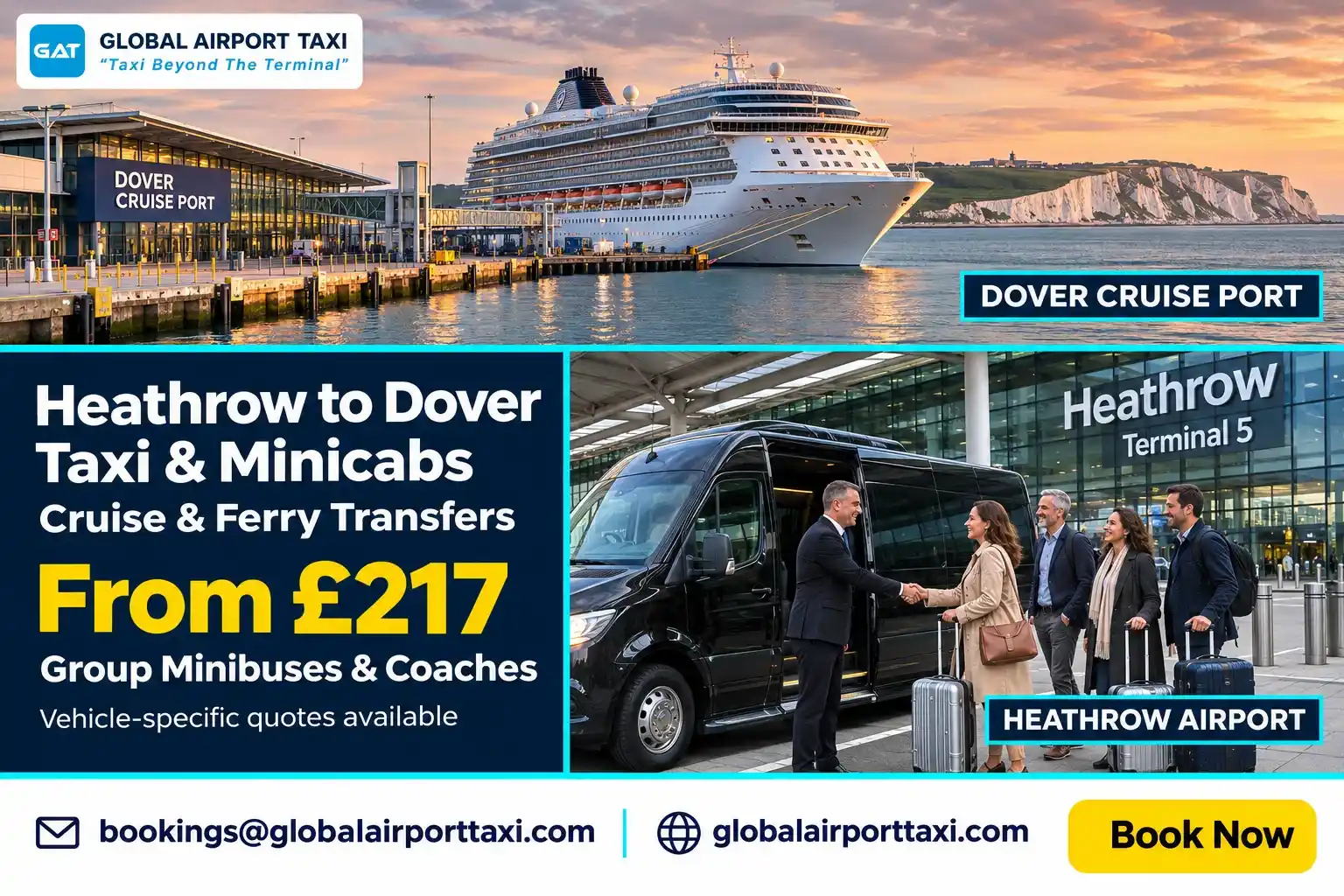
What is there. The converted Dover Marine station in the Western Docks, CT17 9DQ. A port gate with check-in, baggage handling and a taxi rank outside.
Cheap airport transfers
One vehicle, booked against your flight number, carrying you from the terminal door to a port gate or a doorstep in Dover for a sum settled before you leave home. Below: which five classes the quotation screen priced and which five it left blank, how a car collects at each of the four terminals, the Kent corridor with a planning window rather than a promise, the Western Docks and the Eastern Docks told properly apart, the nine stages that sit between a landing and a boarding deadline, and what the railway and the coach genuinely offer against a car.
Vehicles
Five classes priced, five left open, and one note about the pence.
£217 was the figure returned for the standard car, with four larger classes above it. Those five amounts are what the quotation screen supplied for this build returned, each printed to the pound.
Sedan — Toyota Prius or similar
4 passengers · 2 bags and 2 suitcases
Quotation, to the pound
£217
Executive Sedan — Mercedes E-Class or similar
3 passengers · 4 bags and 2 suitcases
Quotation, to the pound
£290
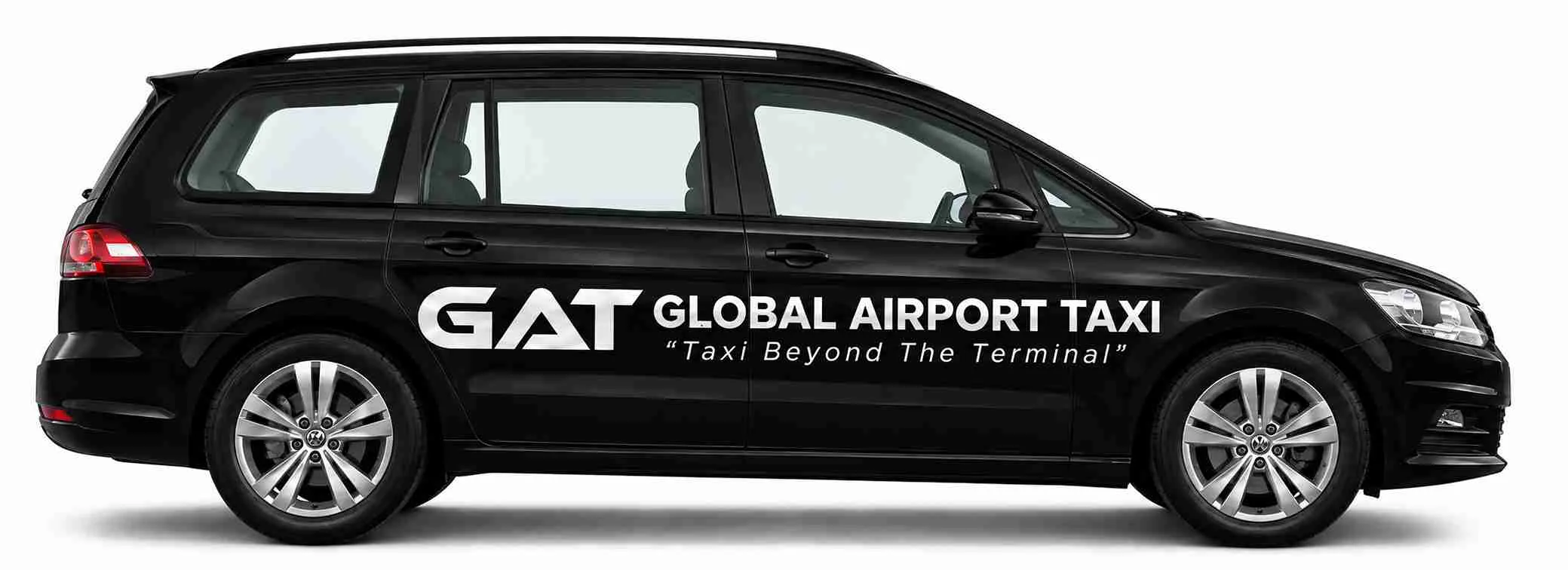
MPV — Ford Galaxy or similar
5 passengers · 4 bags and 3 suitcases
Quotation, to the pound
£307
Van — Ford Tourneo or similar
7 passengers · 7 bags and 6 suitcases
Quotation, to the pound
£352
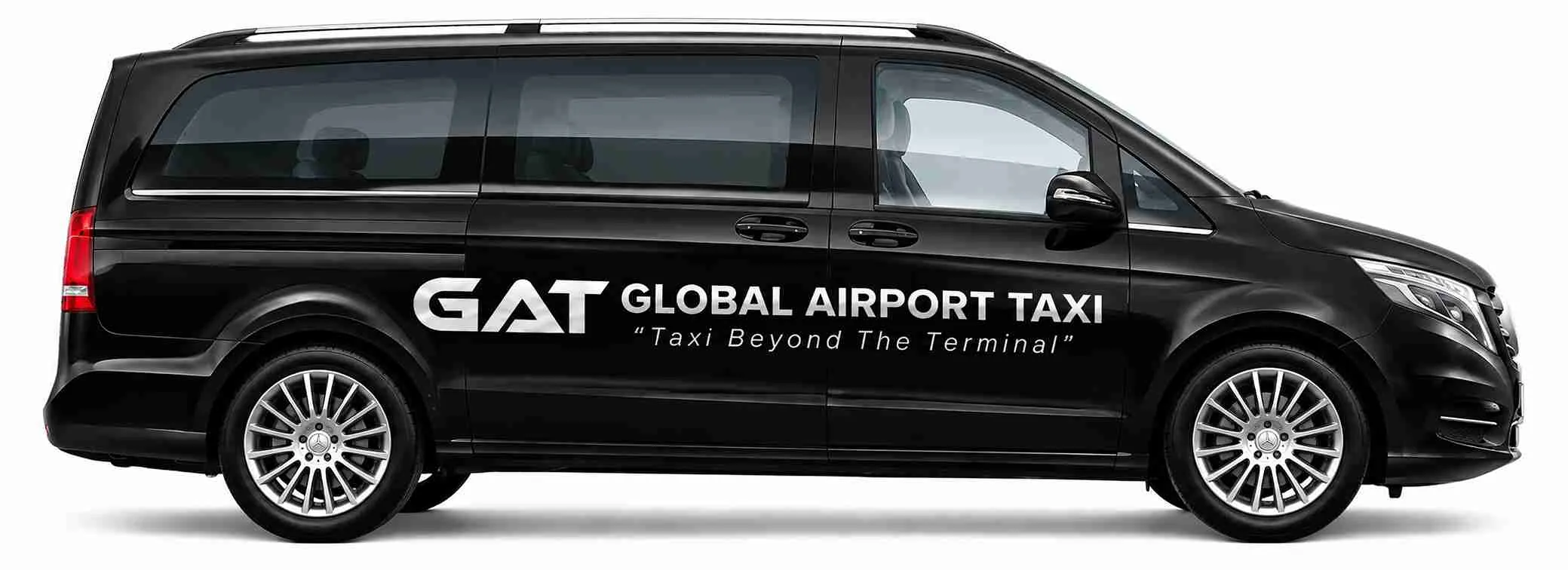
Executive MPV — Mercedes V-Class or similar
8 passengers · 7 bags and 7 suitcases
Quotation, to the pound
£428
Those are the five that carry a figure. The five beneath them in the table do not, and each explains the blank rather than borrowing the row above.
| Vehicle | Passengers | Luggage | Fare | What the figure is |
|---|---|---|---|---|
| Sedan — Toyota Prius or similar | 4 passengers | 2 bags and 2 suitcases | £217 | Quotation, to the pound |
| Executive Sedan — Mercedes E-Class or similar | 3 passengers | 4 bags and 2 suitcases | £290 | Quotation, to the pound |
| MPV — Ford Galaxy or similar | 5 passengers | 4 bags and 3 suitcases | £307 | Quotation, to the pound |
| Van — Ford Tourneo or similar | 7 passengers | 7 bags and 6 suitcases | £352 | Quotation, to the pound |
| Executive MPV — Mercedes V-Class or similar | 8 passengers | 7 bags and 7 suitcases | £428 | Quotation, to the pound |
| Estate car | Up to 4 | 3 large and 3 hand bags | Check Live Fixed Fare | Nothing came back for this class |
| MPV, 6-seater | Up to 6 | 4 bags and 4 suitcases | Check Live Fixed Fare | Nothing came back for this class |
| MPV, 7-seater | Up to 7 | 7 bags and 6 suitcases | Check Live Fixed Fare | Nothing came back for this class |
| 16-seat minicoach | Up to 16 | 14 bags | Check Live Fixed Fare | Built around the party and the sailing |
| 30-seat coach | Up to 30 | 30 bags | Check Live Fixed Fare | Subject to a vehicle being free that day |
Four passengers, two bags and two suitcases is what the sedan publishes, and the screen marks it as the recommended class on this route. A Heathrow to Dover Sedan Taxi Price of £217 is the figure it returned. For two travellers with ordinary luggage a Heathrow to Dover minicab in that class is the booking most people want. For a cruise departure it is frequently the wrong one, and the luggage line below explains why.
Three passengers, four bags and two suitcases, at £290. Set against the standard car that is one seat traded for two more bags, and the Heathrow to Dover Executive Taxi Price sits on the page instead of behind a form. What the step up actually buys is the two hours inside the car: the road is the same length whichever class is sent.
A Heathrow to Dover 5 Seater Taxi is this class, and the five-passenger MPV was quoted at £307 with four bags and three suitcases. It is not the same class as the six-passenger MPV the existing site advertises, and the brief is explicit that the two must not be run together. A Heathrow to Dover 6 Seater Taxi was not priced at all, so that row reads Check Live Fixed Fare instead of taking this one.
The van carries seven passengers, not eight; the eight-passenger class is the executive MPV, and the two are confused often enough that the brief insists on the distinction. A Heathrow to Dover 7 Seater Taxi and a Heathrow to Dover Van Transfer are the same booking, and it was quoted at £352 with seven seats, seven bags and six suitcases; the executive MPV came back at £428 for eight passengers with seven bags and seven suitcases. A Heathrow to Dover 8 Seater Taxi is therefore the Heathrow to Dover Executive MPV — and it carries seven cases, not eight.
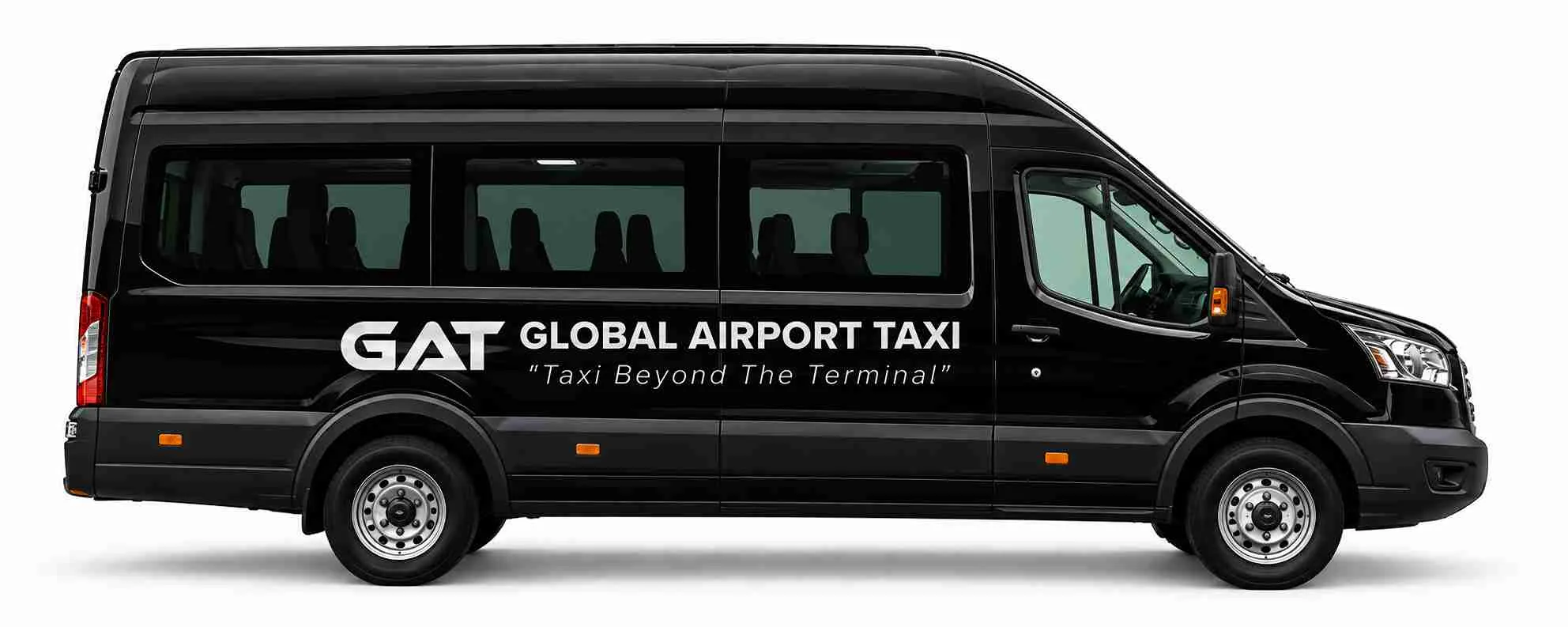
Above eight passengers this becomes group work, and a Heathrow to Dover Private Minibus or a Heathrow to Dover Group Airport Transfer is built around the party, the sailing and whatever vehicle is free on the date rather than taken from a published row. That is why those rows carry no figure. The group transfers page sets out how they are arranged, and the cruise port transfers page covers sailings generally.




Half the rows below were priced and half were not, and the ones that were not say so instead of inheriting a figure.
The direct answer
The figure, and the three published guides it sits beside.
A Heathrow to Dover private transfer in a standard car was quoted at £217, with the executive sedan at £290, the five-seat MPV at £307, the seven-seat van at £352 and the eight-seat executive MPV at £428. A quotation is produced for one journey on one day, so the figure for your own terminal, hour and Dover address is the one the form gives back.
One cruise line publishing its own Dover port guide puts a taxi from Heathrow at about £225 and the drive at roughly 105 miles and two and a half hours, which is a useful outside check on the figures here. That is an outside opinion rather than a competitor’s price list, and it is quoted because it places the quoted sedan where a cruise passenger would expect to find it: a little under what the ship’s own guide tells them to budget.
The screen settles none of the surrounding detail — the date, the hour, the terminal, which Dover address, or what the label covers contractually — so each figure is presented as a quotation rather than a tariff. So the figures appear as quotations rather than as a tariff, and the page is written so that one confirmation turns them into approved fares without changing a sentence.
The Heathrow to Dover Taxi Cost for a particular journey is whatever the form returns for your own date, hour, terminal and destination. The five figures above are the Heathrow to Dover Transfer Prices that came back for one journey on one day, printed to the pound, and they are on the page so that nobody has to fill in a form to find out roughly where this route sits.
Why the distance is given as a range. The company’s existing page gives roughly 105 miles and the Heathrow hub about 100, while the cruise line’s own guide also says 105; the figure driven depends on which Dover address is being reached. A cruise terminal in the Western Docks, a hotel in the town and a village inland are three different endings to the same drive.
Why the time is a range too. Two to two and a half hours is the existing page’s guide and the hub gives 105 to 150 minutes, with the cruise line quoting two and a half — all of them planning figures rather than promises. No arrival time is promised anywhere here, because the road to Dover is shared with the busiest freight route in the country.
The pounds-only figures are from-prices. The quotation behind them ran to the penny, and the client is choosing which of the two to publish.
What is included
Inside the quotation, and the list still being settled.
One vehicle, from the Heathrow terminal the aircraft reaches to the Dover address on the booking, at a figure agreed beforehand. What it is not is a meter, an extra invented on the A20, or a single rate pretending the town centre and the cruise terminal are the same arrival.
A Heathrow to Dover airport transfer is quoted for the vehicle and not per passenger, which is the first thing to hold on to when any of this is compared with a railway ticket. Every total on that screen carries an All-Inclusive, no hidden fees label, which is the checkout describing itself rather than an additional promise made here.
A better interior, and in the sedan’s case two extra bags for the price of a seat. Two hours each way is long enough for that to be a real choice rather than a flourish, particularly at the start of a holiday that begins with a ship. The business class transfers page sets out what the class includes.
What a checkout label covers beyond the drive itself is a question the client is still answering, and nothing here assumes the generous reading.
The road
The M20 and the A20, with the M2 held in reserve.
The drive runs out of the airport to the M25, round to the M20 and then down through Kent on the M20 and the A20 into Dover, with the M2 and the A2 the alternative when the first is blocked. The company’s existing page gives roughly 105 miles and the Heathrow hub about 100, while the cruise line’s own guide also says 105; the figure driven depends on which Dover address is being reached, and two to two and a half hours is the existing page’s guide and the hub gives 105 to 150 minutes, with the cruise line quoting two and a half — all of them planning figures rather than promises.
Three published figures, and they agree within about five miles: the company’s own page says roughly 105, the Heathrow hub about 100, and a cruise line quoting its own Dover guide also says 105. What moves inside that range is the Dover end — a port gate, a hotel on the seafront and a village inland are not the same arrival.
Two to two and a half hours is the planning window, and the upper end is the one to work from on a sailing day. The hub puts it at 105 to 150 minutes and a cruise line’s own Dover guide says two and a half; none of the three is a promise, and the stage list further down explains why the drive is only part of the answer.
This corridor carries the country’s busiest freight route to the Continent, and when the port or the tunnel backs up the traffic schemes that follow — lorry queuing on the motorway and the holding arrangements on the Dover approach — change the journey for everybody else as well. That is the honest reason this route carries a planning window instead of an arrival time. Most days the M20 behaves perfectly well. On the days it does not, the queue is measured in miles rather than minutes, and no transfer company can promise its way around it.
No page can promise which way a driver will come: the M20 and the A20 are the usual line, the M2 and the A2 the alternative, and the decision belongs to the hour and the conditions. A driver watching the traffic will sometimes take the M2 and the A2 down through Canterbury instead, which is longer on paper and shorter in practice when the first route is blocked. That judgement belongs to the day, and nothing written here pretends otherwise.
The first few miles off the airport, which belong to the M25 and its moods. Freight building at the port before a busy sailing. Roadworks, which on a single corridor are felt for hours. And weather on the coast, which closes crossings more often than people expect and fills the approach roads when it does.
Mileage and minutes here come from three published guides, each of them credited and none of them a promise about your afternoon.
Heathrow terminals
Where a car is allowed to stand, building by building — and what the airport takes for it.
Terminals 2, 3, 4 and 5 are the four the airport still operates, and a car can be sent to any of them. Which one you walk out of changes nothing about the sum agreed and everything about where the car waiting for you is allowed to be. The airport permits no collection from a terminal forecourt at all, so every pickup happens under one of the arrangements it does allow.
Every terminal runs the same order of events, and by the time you are through it the confirmation has already named the meeting point for that building. On a cruise morning the luggage stage is the one that stretches, which is why the included hour of waiting is counted from the landing rather than from the schedule.
The newest building, in the middle of the airport. Out into the public hall and on to whichever meeting point your confirmation gives. The car itself is in Terminal Parking — two minutes away by the airport’s own reckoning — and the clock on it runs while it waits. The terminal 2 page covers collections there in general.
Its neighbour on the same central site. Arrivals comes out at street level and nothing about the parking changes from next door. Trolleys are the slow part here on a busy sailing morning, so build a little time in for them. The terminal 3 page covers collections there in general.
On the far side of the runways, and run differently from the other three since its multi-storey closed. There are two arrangements and nothing else. The Priority Pick-Up bays sit outside the doors and are charged by how long the car stays, from £7.00; Zone A out at the Park and Ride publishes two hours free. The terminal 4 page covers collections there in general.
At the western end of the airport, on a road of its own. Terminal Parking once more. Starting from the western end adds a few minutes to a drive whose length is settled in Kent rather than at the airport. The terminal 5 page covers collections there in general.
Terminals 2, 3 and 5 collect from Terminal Parking, which the airport calls about a two-minute walk from the doors, with the standing charge paid at the machine. The bands below are the airport’s own charges to the car, published by the airport, rather than an addition this company makes to your quotation.
| Time in the car park | Charge |
|---|---|
| Up to 29 minutes | £8.50 |
| 30 to 44 minutes | £12.50 |
| 45 to 59 minutes | £16.00 |
| Each further hour or part hour | £8.50 |
| Length of stay | Charge |
|---|---|
| Up to 10 minutes | £7.00 |
| 11 to 29 minutes | £14.00 |
| 30 to 60 minutes | £25.00 |
| Each further hour | £25.00 |
| Daily maximum | £200.00 |
Every Park and Ride gives half an hour at no charge and a bus runs to the terminal doors about every quarter of an hour, with Zone A at Terminal 4 publishing two hours free rather than thirty minutes. That free half hour is the reason a collection sometimes starts on a bus instead of on foot: when an aircraft is late enough that a car waiting in the multi-storey would be running up a bill, the shuttle is simply the sane way round it.
The terminal settles where a car may stand and what the airport takes for it; the sum agreed at the booking does not move.
Cruise terminals
Two terminals, one port-of-call berth, and a ship that decides which.
The postcode published for the cruise terminals is CT17 9DQ, and a cruise line quoting its own Dover guide gives the address as Cruise Terminal 2, Western Dock, Dover CT17 9DQ. Both cruise terminals sit in the Western Docks, so a Heathrow Airport to Dover Cruise Port Transfer and a Heathrow to Dover Western Docks Transfer are the same journey under two names, and either is quoted to the sailing rather than to the town.
Cruise Terminal 1
CT17 9DQ · Western Docks
The former Dover Marine railway station, converted for cruise use, with check-in, baggage handling, a waiting area and parking on site.
What a driver needsA port gate rather than a street door. Give the ship and the sailing date, because access is controlled on the day.
Cruise Terminal 2
CT17 9DQ · Admiralty Pier
Further out along the pier and used by the largest ships sailing from Dover.
What a driver needsThe two terminals are not interchangeable: the sailing decides which one you are checking in at.
The WD4 berth
Marina Curve
A port-of-call berth used by ships calling at Dover rather than sailing from it, with a pedestrian route towards the seafront.
What a driver needsOnly in use on call days, and worth naming explicitly if your ticket does.
Dover Ferry Port
Eastern Docks
The ferry operation, on the opposite side of the harbour from the cruise terminals.
What a driver needsA separate road and a separate gate. The car sets you down; it does not drive on to the ship.
Cruise Terminal 1 is the converted Dover Marine railway station in the Western Docks, with a check-in desk, baggage handling, a waiting area and secure parking on site. A Heathrow to Dover Cruise Terminal 1 Taxi ends at its gate. It is the older of the two and the one with the most history in it — the platforms are still visible in the structure — but for a passenger arriving by car what matters is simpler: it is a controlled gate with a check-in hall behind it, and the sailing decides whether it is yours. A Heathrow T5 to Dover Cruise Terminal Taxi is the same booking made from the western end of the airport.
Cruise Terminal 2 stands further out along Admiralty Pier, also in the Western Docks, and takes the largest ships calling at Dover. It stands further out along the pier, which means a longer run inside the port estate once a vehicle is through the gate. A Heathrow to Dover Cruise Terminal 2 Taxi is priced the same as one to Terminal 1; what changes is where the driver is directed on arrival.
WD4 is a separate port-of-call berth beside Marina Curve, used by ships calling rather than sailing from Dover, with a pedestrian route from it towards the seafront. It appears on tickets for ships calling at Dover rather than sailing from it, and it is worth naming explicitly when your paperwork does, because it is not where a departing cruise passenger would otherwise be taken.
A Heathrow to Dover Cruise Port 8 Seater Taxi carries eight passengers and seven hold cases, which on a cruise departure is the binding number; above that, a Heathrow to Dover Cruise Ship Transfer for a whole party is arranged as group work, and a Heathrow to Dover Cruise Port Minicab for two or three is an ordinary booking to the same gate.
The terminals are about thirty to forty minutes on foot from the town and from Dover Priory station, which is why so few cruise passengers walk anywhere with their luggage. There are taxi ranks outside Terminals 1 and 2, and a shuttle bus operates on the days a ship calls, and the cruise line’s own guide puts the port shuttle at about £7.50 a head and warns that it does not call at the railway station, which is worth knowing before anybody plans an arrival around it. All of which is a long way of saying that a cruise terminal is not somewhere to be dropped near.
No arrangement of any kind exists between this company and the port, a cruise line or a ferry operator; the terminals are named because that is where passengers are going.

Everything about the last mile here is decided by the sailing rather than by the postcode. The gate is manned, the check-in hall is behind it, and the ship on your ticket is what tells a driver which of the two terminals to head for.
Which is why the booking wants the ship and the date as well as the address: CT17 9DQ covers both terminals, and only the schedule separates them.
A cruise terminal is a port gate rather than a street address, and it is quoted to the sailing rather than to the town.
Ferry port
A different side of the harbour, and a different set of rules.
The ferry operation is at the Eastern Docks, on the other side of the harbour from the cruise terminals, and the two are routinely confused by people booking transfers. A Heathrow to Dover Ferry Port Taxi and a Heathrow to Dover Cruise Terminal Taxi are two different bookings to two different gates, and getting them confused is the commonest mistake on this route. A Heathrow to Dover Ferry Terminal Taxi, a Heathrow to Dover Ferry Port Transfer and a Heathrow Airport to Dover Eastern Docks Taxi all mean the same arrival.
Foot passengers are a limited proposition at Dover: one operator restored a small number of foot-passenger sailings on the Calais route, and the arrangements vary by operator and by season, so the position for your own crossing is the operator’s to confirm. Anybody planning to cross as a foot passenger should settle that with the operator before booking a transfer, because a terminal that will not take you on foot is an expensive place to discover it. A Heathrow to Dover Ferry Passenger Transfer is a road journey to the gate and nothing more.
A transfer vehicle does not drive on to a ferry with you; the car sets you down at the terminal and your crossing is the operator’s business from there. That is worth stating plainly because the question is asked often: a transfer is a road journey to the port, and the crossing is a separate arrangement with the shipping company. Vehicles that do board are travelling on their own ferry bookings.
Every crossing has a time by which you must be checked in, and it is set by the operator rather than by the port or by anybody arranging a car. Work backwards from it, give the booking the deadline rather than the sailing time, and treat the two as different numbers — because they are.
A Dover Ferry Port to Heathrow Taxi is the same journey in reverse, quoted from the Eastern Docks at the hour the crossing actually lands rather than the hour it was scheduled to. Give the operator and the sailing on the booking.
The ferry operation sits on the other side of the harbour from the cruise terminals, and the two are quoted as the different places they are.
How early to leave
Nine stages between a landing and a boarding deadline. The drive is one.
The gap between a landing time and a sailing time contains nine separate stages, and only one of them is the drive. Setting them out is the most useful thing that can be set out for a cruise passenger, because the stage people underestimate is almost never the one they worry about.
The aircraft lands
The time on your ticket. Nothing has happened yet.
Disembarkation
Ten minutes on a good day, longer from a full long-haul aircraft at a busy stand.
Passport control
Unpredictable by design. A quiet hall and a queued one are different journeys.
Baggage reclaim
The stage most often underestimated, and the one nobody can hurry.
Finding the vehicle
A short walk to Terminal Parking, or a shuttle at Terminal 4. The included hour of waiting is being used here.
The drive
Two to two and a half hours by the published guides, and the only stage this company influences at all.
Arriving at the port
Western Docks for a cruise, Eastern Docks for a ferry, and they are not the same gate.
Check-in
The operator’s own process, with its own queue and its own paperwork.
The boarding deadline
Set by the ship, published on your ticket, and not negotiable by anybody on either side of the booking.
The time printed on your flight is the time the wheels touch, not the time the vehicle leaves the airport: immigration, the carousel and the walk to the car all sit in between. On a good day that gap is forty minutes; on a bad one it is twice that, and the included hour of waiting exists precisely because nobody can tell in advance which sort of day it will be.
No same-day connection between a flight and a sailing is guaranteed here, and on a cruise departure the sensible arrangement is often a night in Dover beforehand. A hotel in Dover the night before turns a tense morning into an ordinary one, and for a long-haul arrival it is frequently the difference between making a sailing and watching it leave. The hotel transfers page covers that half of the arrangement.
Time, not money, is what this section is about: the figure is settled in advance precisely so that the hour does not have to be.
Town, hotels and station
The town is not the port, and neither is quoted as the other.
The town centre, the castle, the hotels on the seafront and the villages inland are separate addresses with separate quotations, and a town-centre figure does not cover the port any more than a port figure covers the town. It is worth saying because the distances are short and the arrivals are nothing alike: one ends at a controlled gate inside a working harbour, the other at a door on an ordinary street.
What is there. The converted Dover Marine station in the Western Docks, CT17 9DQ. A port gate with check-in, baggage handling and a taxi rank outside.
What is there. Further along Admiralty Pier, in the same docks, for the largest ships. Set down at the terminal the sailing names, not the one nearest the road.
What is there. A port-of-call berth by Marina Curve, used by ships calling rather than sailing. A different approach again, and only in use on call days.
What is there. The ferry operation on the eastern side of the harbour. Its own road and its own gate; a vehicle sets you down and does not board.
What is there. The shops, Pencester Road and the streets behind the seafront. An ordinary arrival at an ordinary address, and a separate quotation from the port.
What is there. The town’s railway station, about two and a half kilometres from the terminals. Set-down at the station entrance; the walk to a cruise terminal from here is thirty to forty minutes.
What is there. The hotels along the front and up the hill behind it. Priced to the hotel’s own address, which on a cruise eve is usually the sensible destination.
What is there. Above the town, reached by the hill roads. A visitor arrival rather than a port one, and quoted as such.
What is there. The settlements north of the town along the A2 corridor. Outside Dover proper, with their own distances.
What is there. The towns north along the coast. Separate journeys entirely, not a Dover fare with a few miles added.
A Heathrow to Dover Town Centre Taxi ends at the address on the booking like any other city arrival, and a Heathrow to Dover Hotels Taxi is quoted to the hotel’s own door. Both are a Heathrow to Dover CT16 Taxi in postcode terms, where a Heathrow to Dover Port Taxi and a Heathrow to Dover CT17 Taxi end at a gate in the Western Docks. The hotels divide between the seafront and the hill behind it, and on a cruise eve the seafront ones are the obvious choice — close enough to the Western Docks that the morning stops being a logistical problem.
Dover Priory is the town’s railway station, roughly two and a half kilometres from the cruise terminals, with a journey of about sixty-six minutes to London St Pancras. A Heathrow to Dover Priory Station Taxi is an ordinary set-down at the station entrance. What it is not is a cruise arrival: the walk from the station to a terminal is the thirty to forty minutes described above, with your cases.
Both sit above the town on the hill roads, and both are visitor arrivals rather than port ones. A Heathrow to Dover Castle Taxi is quoted to the castle’s own address and a Heathrow to White Cliffs of Dover Taxi to the visitor car park above the harbour, and a party planning to see the cliffs before a sailing should say so on the booking rather than ask the driver on the day.
Whitfield and the settlements along the A2 corridor sit outside the town with their own distances; Deal and the coast road north are separate journeys entirely rather than a Dover fare with a few miles added. Each is priced from its own address.
Those places appear because people ask for them by name, and for no other reason. Nothing in the list implies a tie of any kind with a hotel, an attraction or the harbour authority.
A town address is quoted to its own postcode, because the last mile to a hotel and the last mile to a port gate have nothing in common.
Families and groups
On a cruise booking the cases decide, not the seats.
Every priced class publishes two numbers, and this is the route where the second one bites. Cruise passengers travel with the largest luggage they own, and a party that fits a vehicle on seats can miss it comfortably on hold cases.
A child takes a place and is counted like anybody else, and the age decides which seat is right. A child or infant seat costs nothing to add and is fitted whenever a booking asks for one. A pushchair swallows about a hold case of space and is wanted at both ends, so it belongs on the booking. The family transfers guide goes through the choice and the child seat guide covers the seats themselves.
Three hold cases and five travelling is the MPV as it is published. Seven travelling moves up to the van, at seven bags and six suitcases. Eight needs the executive MPV — and that class publishes seven cases rather than eight, so eight people each with a big one is two cars or a minicoach. Far better a conversation now than at a port gate.
Formal wear in suit carriers, a folding wheelchair, a mobility scooter, golf clubs for the ports of call: each one is a shape rather than a weight, and shape is what defeats a boot. Name them on the booking. Room for a wheelchair or a walking frame is arranged in advance rather than assumed, and the earlier the request arrives the better the chance of the right vehicle being free. The accessible transport guide sets out what can be organised.
Book each arrival separately with its own tracked flight number. Holding one vehicle for a late second landing costs more than two properly timed collections, and on a sailing day it puts the whole party on the later clock. Above sixteen seats everything depends on what is free that day, and those are arranged through the group airport transfers page.
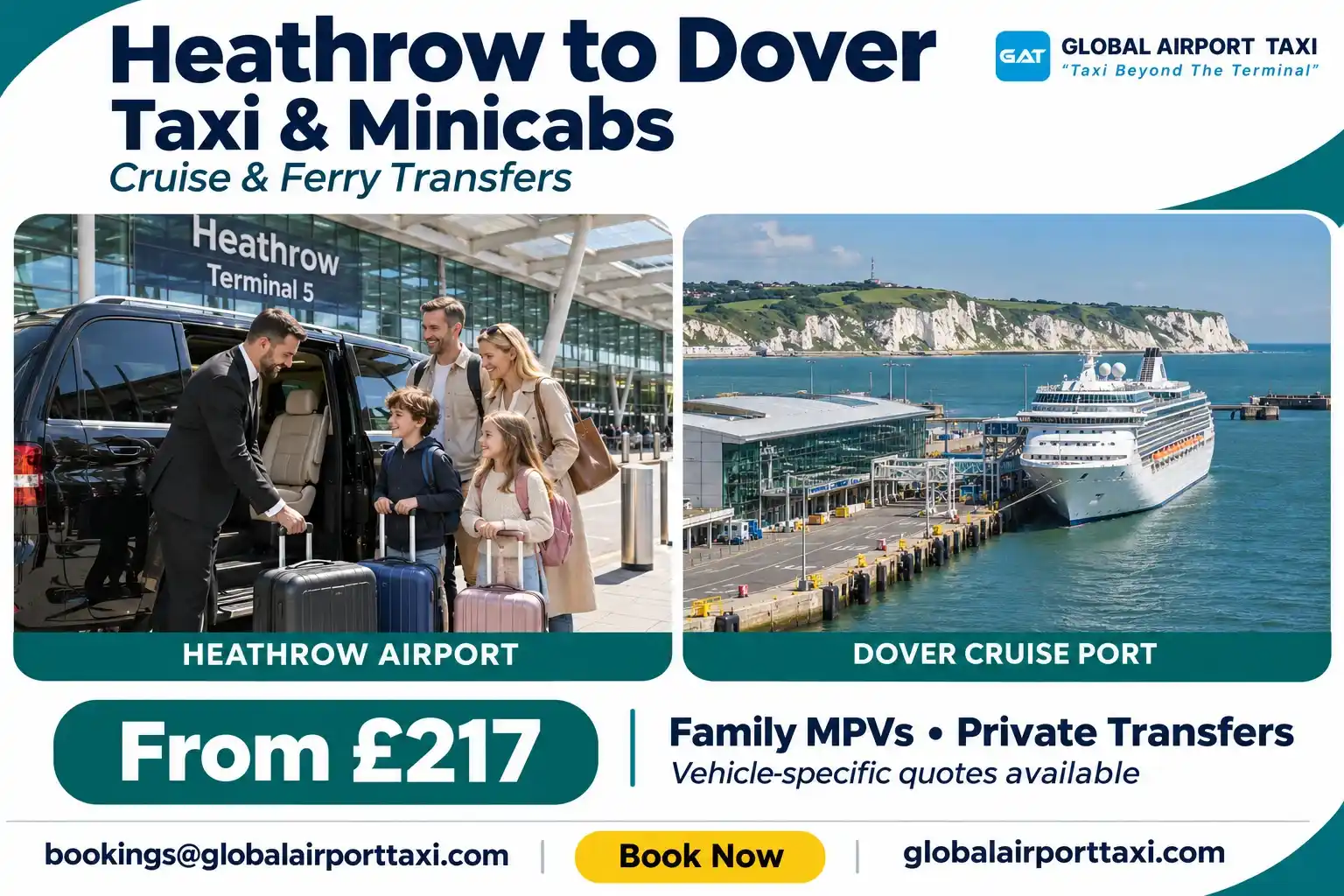
A family of four divides a single amount between them rather than buying four tickets, which is most of the argument for a car on a journey of this length.
What decides which car arrives is the luggage. Count the hold cases first, add the pushchair, add anything with an awkward shape, and only then look at how many of you there are.
Seats are the easy number on a cruise booking; the cases are the one that decides which vehicle arrives.
Going back
The same corridor northbound, with a desk closing at the end of it.
A Dover to Heathrow Airport Taxi is quoted on its own, and the two directions are nothing like each other. Coming down, a late aircraft simply drags the collection with it. Going back, a check-in desk closes at a fixed hour and the M20 has no view on the matter.
The Dover to Heathrow Taxi Cost is built from the pickup address, the date and the hour, exactly as the outbound figure was, and a Dover to Heathrow Fixed Fare Taxi is agreed before anything is committed in the same way. A Dover to Heathrow Executive Transfer is the same journey in the better cabin. Nobody produced a Dover to Heathrow Taxi Price for this build, so none is printed here.
A Dover Cruise Terminal to Heathrow Taxi is timed from the hour the ship is alongside and cleared, which is not the hour printed on the itinerary. Disembarkation runs in groups, and a party leaving in the last group can be two hours behind one leaving in the first. Give the ship, the date and the terminal, and say which flight is being met.
Count backwards from the desk closing, and take the generous end of every figure rather than the hopeful one. Two and a half hours on the road; whatever the airline wants of you once you are there; and then the hour of the day, because meeting the M25 at eight in the morning is not the journey that meets it at two in the afternoon. The sum comes out earlier than anybody enjoys, which is the right way round for it to be wrong.
The same guide states plainly that Uber is not available in Dover and that taxis are limited, particularly in the morning — which is the strongest argument anywhere here for booking a transfer rather than arriving and hoping. A Dover to Heathrow Early Morning Taxi is therefore a booking rather than a hope, and what an unsociable hour involves is set out on the late-night and early-morning page. Whether the hour changes the figure has not been established for this build, so nothing is claimed either way.
Put the departure terminal on the booking as well: what a car may do at the kerb is not the same at all four buildings, and the drop-off charges are published here. A Dover to Heathrow Terminal 5 Taxi and the same booking for Terminal 2 drive the identical road and part company only in the last few minutes.
The homeward journey is a separate quotation from a separate address, and a ship that berths late changes the hour rather than the figure.
No northbound quotation was produced for this build, which is why the return carries no figure of its own above. It is priced by the same form that returned the five outbound amounts, and no reduction for taking both directions is suggested anywhere on this site.
Train or coach
Neither the train nor the coach runs from the airport. That is the whole comparison.
There is no direct train either: a rail journey means crossing London first and then about sixty-six minutes from St Pancras to Dover Priory, with the walk or the taxi to the terminal still to come. National Express route 007 runs from London Victoria to Dover and sets down at Pencester Road in the town centre, taking somewhere between three hours and four; it does not call at Heathrow at all. So every published alternative begins with a journey across London before the journey to Dover starts.
| How you travel | Where it starts | What it involves | What it costs | Where it leaves you |
|---|---|---|---|---|
| Private transfer | The terminal your aircraft reaches | One vehicle, one driver, the flight watched, and the cases loaded once. | A quoted figure for the vehicle, from £217 for the standard car | The address on the booking — a port gate, a hotel door or a village lane |
| Rail, via central London | A Heathrow station, then across London | Airport train or Underground into town, a transfer across London with your cases, then about sixty-six minutes from St Pancras to Dover Priory. | Bought per passenger, so it multiplies with the party | Dover Priory, with the cruise terminals still thirty to forty minutes away on foot |
| Coach, via London Victoria | Not the airport at all | Reach Victoria first, then route 007 to Pencester Road in the town centre, somewhere between three hours and four. | Bought per passenger, and usually the cheapest single ticket | The town centre, which is not the port |
| Hired car | An airport desk | Paperwork, the same M20, and then somewhere to leave it while you are at sea. | A daily rate plus fuel, plus parking for the length of the cruise | Wherever you park it, which on a sailing day is its own problem |
Not a direct one. The rail option means getting into central London from the airport, crossing to St Pancras, and then running down to Dover Priory in a little over an hour. Dover Priory is the town’s railway station, roughly two and a half kilometres from the cruise terminals, with a journey of about sixty-six minutes to London St Pancras. For a cruise that last detail is the one that matters: the station is not the terminal.
National Express route 007 runs from London Victoria to Dover and sets down at Pencester Road in the town centre, taking somewhere between three hours and four; it does not call at Heathrow at all. It is a genuine option for somebody already in London and a poor one for somebody standing in a Heathrow arrivals hall with a sailing to catch, because the journey to Victoria has to happen first and the coach sets down in the town rather than at a port gate.
The same guide states plainly that Uber is not available in Dover and that taxis are limited, particularly in the morning — which is the strongest argument anywhere here for booking a transfer rather than arriving and hoping. The cruise line’s own guide puts the port shuttle at about £7.50 a head and warns that it does not call at the railway station, which is worth knowing before anybody plans an arrival around it. Both are reasons to arrive with a vehicle already arranged rather than to arrive and look for one, and both come from a cruise line’s own guidance to its passengers rather than from anybody selling transfers.
A car is not automatically the cheapest way to Dover; what decides it is the party size, the luggage, the hour and whether the destination is the port or the town. A single traveller on a budget with time to spare will beat any car by rail or coach. Four travellers with cruise luggage, measured door to gate rather than station to station, usually will not — and on a sailing morning the arithmetic stops being only about money.
For a sailing, the honest answer is the one that ends at the gate with your cases still in the boot. Among the Heathrow to Dover Cruise Terminal Transport Options, that is a car: the rail and coach routes both end in the town, and the walk from either to a cruise terminal is thirty to forty minutes. For a hotel in the town with a day in hand, the arithmetic is much more open.
Nothing above is a recommendation of a railway, a coach operator or a hire company, and no fare for any of them is quoted here: those belong to their publishers and change without notice.
One ticket a head against one figure for the whole vehicle: that single difference does most of the work in the table below.
Tracking and changes
A delayed aircraft, a long wait, a plan that changes: who carries what.
The arriving flight number goes on the booking and is watched from then on, which is what lets a delayed landing drag the collection with it. On a route where the far end may be a boarding deadline, that is the single most useful thing a pre-booked transfer does.
Sixty minutes of waiting are included at the airport, timed from the landing rather than from the scheduled arrival, and fifteen minutes at any other address. Counting from touchdown rather than from the schedule is the part that matters: an aircraft two hours late has not spent a minute of the allowance when it finally lands. Past the included hour, waiting is charged as your confirmation sets out, and no unlimited free waiting is promised here.
On the bookings that carry it, a name board is held at the meeting point the confirmation gives, inside the hall rather than beyond the doors. Your confirmation shows the driver and vehicle details. The existing page implies it happens on every booking; nothing seen for this build establishes that, so it is written as a feature of the bookings that include it. The meet and greet page sets out what the service covers, and the Heathrow pickup guide goes through the terminals one by one.
Cancel a day ahead or more and the published policy returns a qualifying booking in full on its own terms; the twelve hours the existing page talks about is out of date and is not used anywhere here. Moving a date, an address, a terminal or a class amends the booking instead of replacing it, and the sooner the company hears the less there is to sort out. The refund and cancellation policy is what governs both, and somebody who neither turns up nor telephones is not in the same position as somebody who cancelled.
Tell the company as soon as you know. A diversion to another airport is a different journey and is quoted as one. A sailing missed for reasons on the water is between you and the shipping line, and nothing here insures against it. We are a booking platform. Your transfer is carried out by a licensed operator under the arrangements in your confirmation.
Delay moves the hour a driver turns up and leaves the agreed sum exactly where it was; what your confirmation says about the time after the included hour is what governs it.
Why book here
Only the things that can be checked.
Each line here has a source behind it, and that was the only test it had to pass. Nothing about the size of a fleet, a star rating, journeys completed, prizes won or what is waiting inside the car, because none of it could be checked for this build.
What hour you will reach the port. What an unpriced class costs. That the Eastern Docks and the Western Docks are the same arrival. That a particular ship always uses a particular terminal. That a transfer car boards the ferry with you. That every crossing takes foot passengers. That a flight and a sailing can be connected on the same day with confidence. Each of those is a claim a competing page will make without pausing, and not one of them could be stood behind here.
What is still unanswered has been written down instead of quietly dropped, and the figure at the head of the page leads that list: either a round number somebody can actually book, or the pence put back on. One decision from the client closes it.
Every figure above carries its source, and every blank row explains itself rather than being filled from the one above.
Questions
Twenty answers, each leading with the answer.
Answer first and explanation second, twenty times over. Every figure below has already appeared further up with its source beside it: the quotation screen, the airport itself, or what the railway, the coach operator and a cruise line publish for themselves.
Five figures came off the screen: £217 for the standard car, £290 for the executive sedan, £307 for the five-seat MPV, £352 for the seven-seat van and £428 for the eight-seat executive MPV. One journey on one day produced all five, which is why the form rather than this list is what gives you yours.
That is the first question the audit delivered with this build asks the company to settle. The quotation behind the heading ran to the penny; the pounds-only amount is a from-price and is never described as an exact checkout total.
Because they do, and pretending otherwise would be worse. The existing route card advertises an executive saloon from £210, a six-passenger MPV from £297 and an eight-passenger minibus from £338, while the Heathrow hub puts a standard car at £205 to £215. The screen prices the ordinary sedan above the whole of that hub range and above the card’s executive saloon, which means the site is quoting a better class for less than its own standard car. What the quotation screen returned is what appears here, and the conflict is recorded for the company to resolve rather than smoothed over.
Yes, for the journey the form was asked to price: one vehicle at one agreed amount, with no meter. What sits outside it is whatever you add afterwards — a second address, time beyond the included hour — each set out in your confirmation.
£290 for three travelling, with four bags and two suitcases behind them. A seat given up in exchange for two more bags and a better two hours, which on a drive of this length is worth weighing rather than dismissing.
The five-passenger MPV was quoted at £307 with four bags and three suitcases. The six-seat class the site advertises separately was not priced at all, so that row asks for a live fixed fare rather than borrowing this one.
£352 for seven travelling, with seven bags and six suitcases behind them. The badge on the tailgate is no guide here: count the seats, and there are seven of them.
The executive MPV, quoted at £428. It publishes seven bags and seven suitcases, so eight travellers each with a large hold case are a minicoach or a pair of cars rather than one vehicle.
Three published guides put it between about 100 and 105 miles: the company’s own page says roughly 105, the Heathrow hub about 100, and a cruise line’s Dover guide also 105. Which Dover address you are reaching moves the figure inside that range.
Two to two and a half hours under the existing guidance, with the hub giving 105 to 150 minutes. None of them is a promise: this corridor carries the country’s heaviest freight traffic to the Continent and no transfer company can plan around a port backlog.
No, and this is the mistake that costs people sailings. The ferry operation is at the Eastern Docks, on the other side of the harbour from the cruise terminals, and the two are routinely confused by people booking transfers. Book to the one your ticket names.
The postcode published for the cruise terminals is CT17 9DQ, and a cruise line quoting its own Dover guide gives the address as Cruise Terminal 2, Western Dock, Dover CT17 9DQ. Give the ship and the sailing date as well, because the schedule rather than the postcode decides which of the two terminals you are checking in at.
Which terminal or berth a particular ship uses is set by the sailing schedule rather than by the cruise line, so the booking wants the ship, the date and the terminal as the ticket gives them. Nothing on this site assigns a line permanently to Terminal 1 or Terminal 2, because the published schedule moves and a guess would eventually send somebody to the wrong gate.
WD4 is a separate port-of-call berth beside Marina Curve, used by ships calling rather than sailing from Dover, with a pedestrian route from it towards the seafront. If your paperwork names it, name it on the booking: a departing cruise passenger would not otherwise be taken there.
Plan backwards from the boarding deadline on your ticket rather than from the sailing time, and count all nine stages between the landing and that deadline — only one of them is the drive. No same-day connection between a flight and a sailing is guaranteed here, and on a cruise departure the sensible arrangement is often a night in Dover beforehand.
No. A transfer vehicle does not drive on to a ferry with you; the car sets you down at the terminal and your crossing is the operator’s business from there. And on foot passengers: foot passengers are a limited proposition at Dover: one operator restored a small number of foot-passenger sailings on the Calais route, and the arrangements vary by operator and by season, so the position for your own crossing is the operator’s to confirm.
In the Priority Pick-Up bays at the doors, from £7.00 for ten minutes, or out in Zone A of the Park and Ride, where two hours are published free: the multi-storey at Terminal 4 has closed, leaving the Priority Pick-Up bays at the doors and Zone A of the Park and Ride as the two arrangements that replaced it. Whatever older guidance says, the pods have never served Terminal 4; they run between Terminal 5 and its own car parks, and any instruction to take one to Terminal 4 is wrong.
Yes, and each is quoted to its own address rather than at the port figure. The town centre, the castle, the hotels on the seafront and the villages inland are separate addresses with separate quotations, and a town-centre figure does not cover the port any more than a port figure covers the town.
The same guide states plainly that Uber is not available in Dover and that taxis are limited, particularly in the morning — which is the strongest argument anywhere here for booking a transfer rather than arriving and hoping. There are ranks outside the cruise terminals and a paid shuttle on port-of-call days, but arriving and hoping is a poor plan on a morning with a flight to meet.
The arriving flight number goes on the booking and is watched from then on, which is what lets a delayed landing drag the collection with it, and sixty minutes of waiting are included at the airport, timed from the landing rather than from the scheduled arrival, and fifteen minutes at any other address. A long delay moves the collection rather than the figure. What it cannot do is move a sailing, which is why an overnight stay before a cruise is so often the right arrangement.
If yours is not among them, the general questions page may have it; otherwise a short conversation is quicker, and the contact page goes to the people who arrange these sailings.
Twenty answers, and every figure in them has already appeared above: rounded the same way, described the same way, with no new number introduced down here.
Book
Eleven answers, beginning with the two that decide everything else.
A quotation is free and arrives long before any commitment. The Dover address, the date and hour, and the class produce the figure between them, and it is on screen before anything is committed. The fields carrying the weight on this route are the Dover address and, for a cruise, the ship: the Western Docks, the Eastern Docks, the town and the villages are four different arrivals, and the sailing decides which gate is yours.
To Book Heathrow to Dover Taxi journeys in either direction, the form takes both at once. A Heathrow to Dover Fixed Price Minicab and a Heathrow to Dover Door-to-Door Taxi are the same thing described two ways: one vehicle, one agreed amount, from the terminal a Heathrow Arrivals to Dover Taxi collects at to the gate or the door on the booking.
A quotation costs nothing, binds nobody, and arrives well before any of this is agreed.
Say which Dover you mean first — a cruise terminal in the Western Docks, the ferry port at the Eastern Docks, a hotel on the seafront or an address in the town — and if it is a sailing, give the ship and the date so the right gate goes on the booking. The rest is quick: the terminal you land at, the date in British time, the flight number, and honest counts of travellers and hold cases, which on a cruise departure is the count that decides the vehicle. Ask for the journey home at the same time.