On the meter
Open ended
A figure that keeps moving for as long as the traffic does, over several hours.
Cheap airport transfers
A transfer of four hundred miles is not a long short journey — it is a different product, and almost nothing written about it says so. This page covers what changes once a run passes roughly an hour: what the road itself charges in 6 countries and which of those charges must be bought before you drive, who is legally allowed to keep driving and for how long, what happens to the empty leg home that somebody has to pay for, and when the honest answer is that you should take the train instead.

On the meter
A figure that keeps moving for as long as the traffic does, over several hours.
Booked ahead
Per vehicle, settled before you travel, with the road charges named in it.
Your transfer, in three
Start here
Six questions that decide a long-distance transfer, answered in full before the page works through them. Nothing below contradicts anything here.
Our vehicles
From a saloon up to a 50-seater coach, and every one priced for the vehicle rather than per passenger — which is the structural difference between this and a hotel’s own car. Count the large cases first; the seats almost always follow.
 Normally a Volkswagen Passat or similar
Saloon taxi
4 passengers, 2 large bags
Two guests with a case each. The standard city-hotel arrival.
View vehicle → Normally a Mercedes E-Class or similar
Executive car
3 passengers, 2 large bags
Up to three, where the arrival at the entrance is part of the point.
View vehicle → Normally an estate taxi
Estate taxi
4 passengers, 3 large bags
Four guests and three large cases, which a saloon boot will not take.
View vehicle →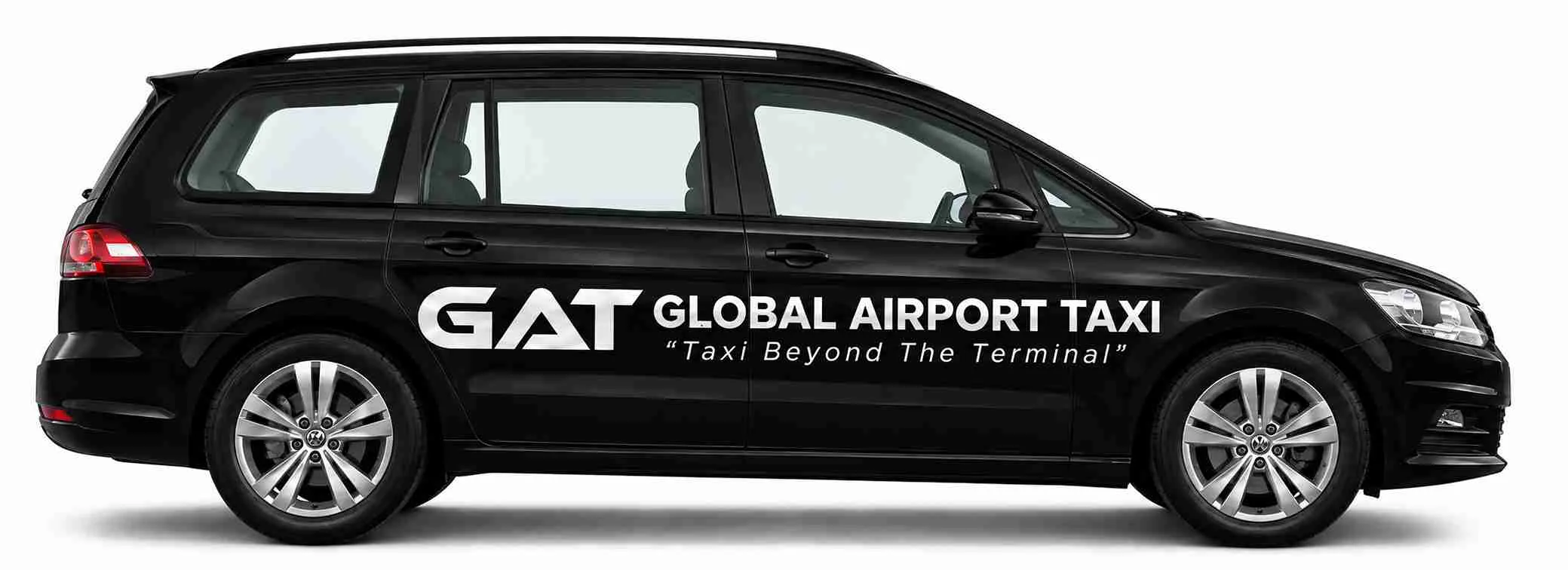 Normally a 6-seater MPV people carrier
People carrier
5 to 6 passengers, 4 to 5 large bags
A family of five or six checking in together, pushchair included.
View vehicle →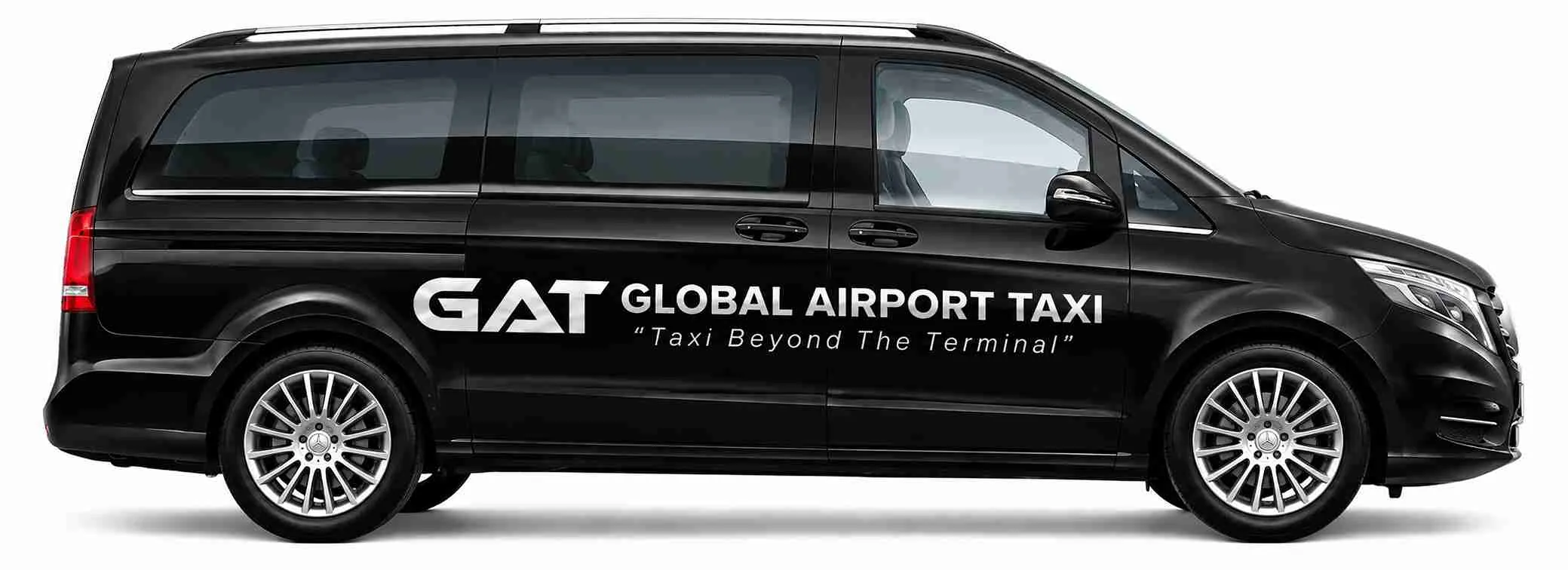 Normally a 7 seater taxi
7 seater taxi
7 passengers, 7 cabin bags
Seven guests travelling light, to one entrance.
View vehicle → Normally an 8 seater taxi
8 seater taxi
8 passengers, 6 to 8 large bags
Eight guests and six large cases, in one vehicle rather than two.
View vehicle →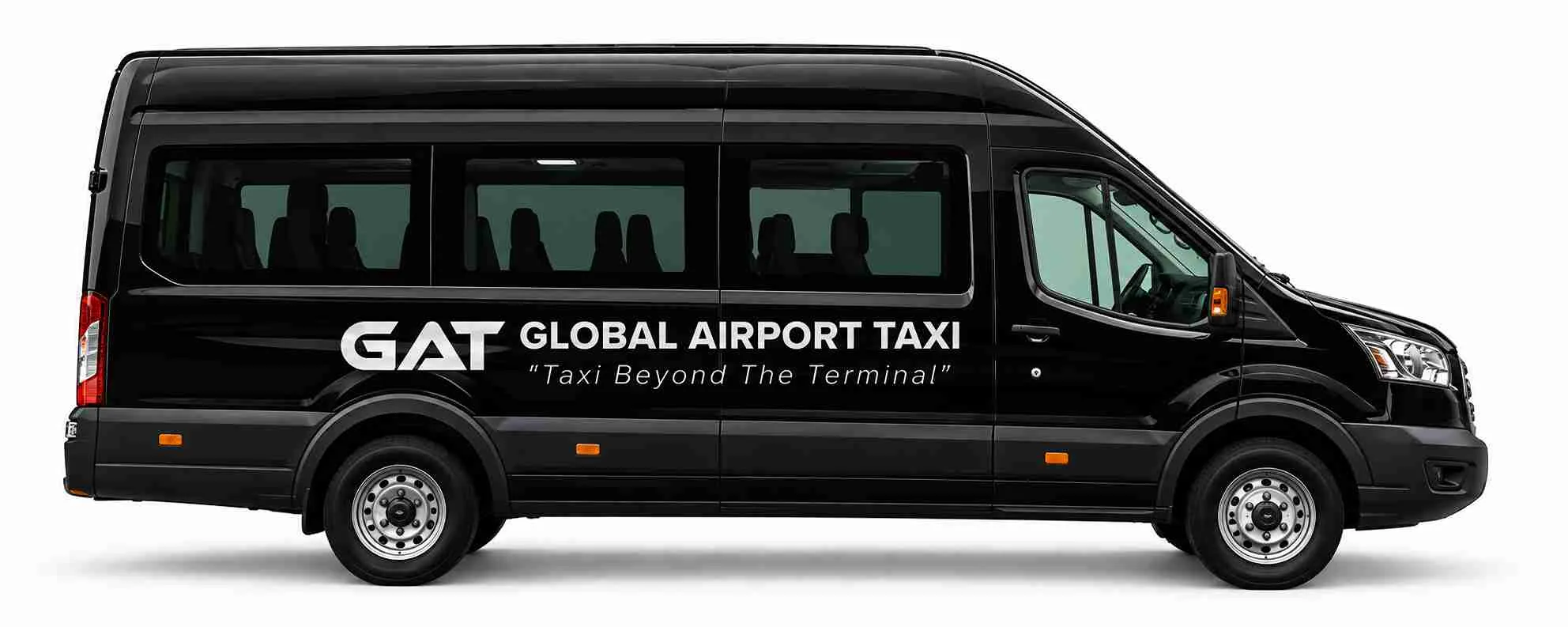 Normally a 16 seater minibus
16 seater minibus
16 passengers, about 14 large bags
A wedding party or a delegation arriving on one flight.
View vehicle →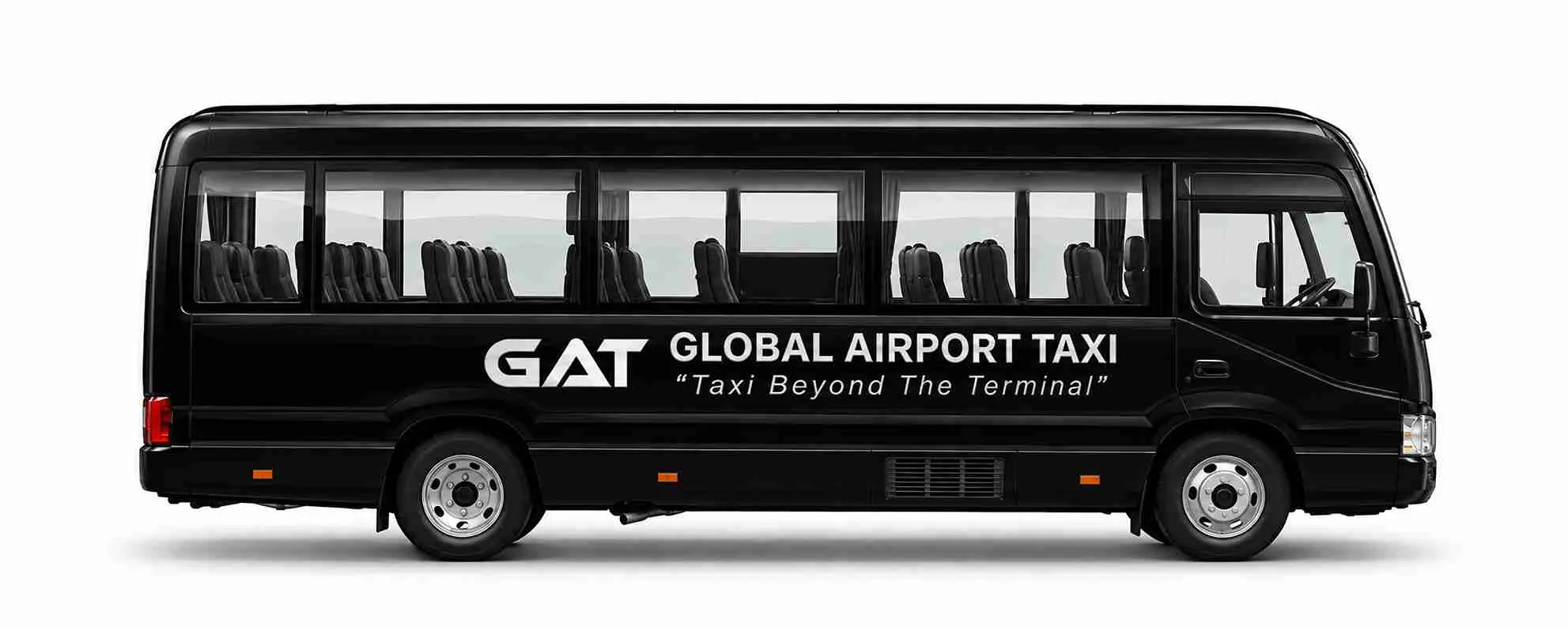 Normally a 30-seater coach
30-seater coach
30 seats
Conference intakes checking in at the same hour.
View vehicle →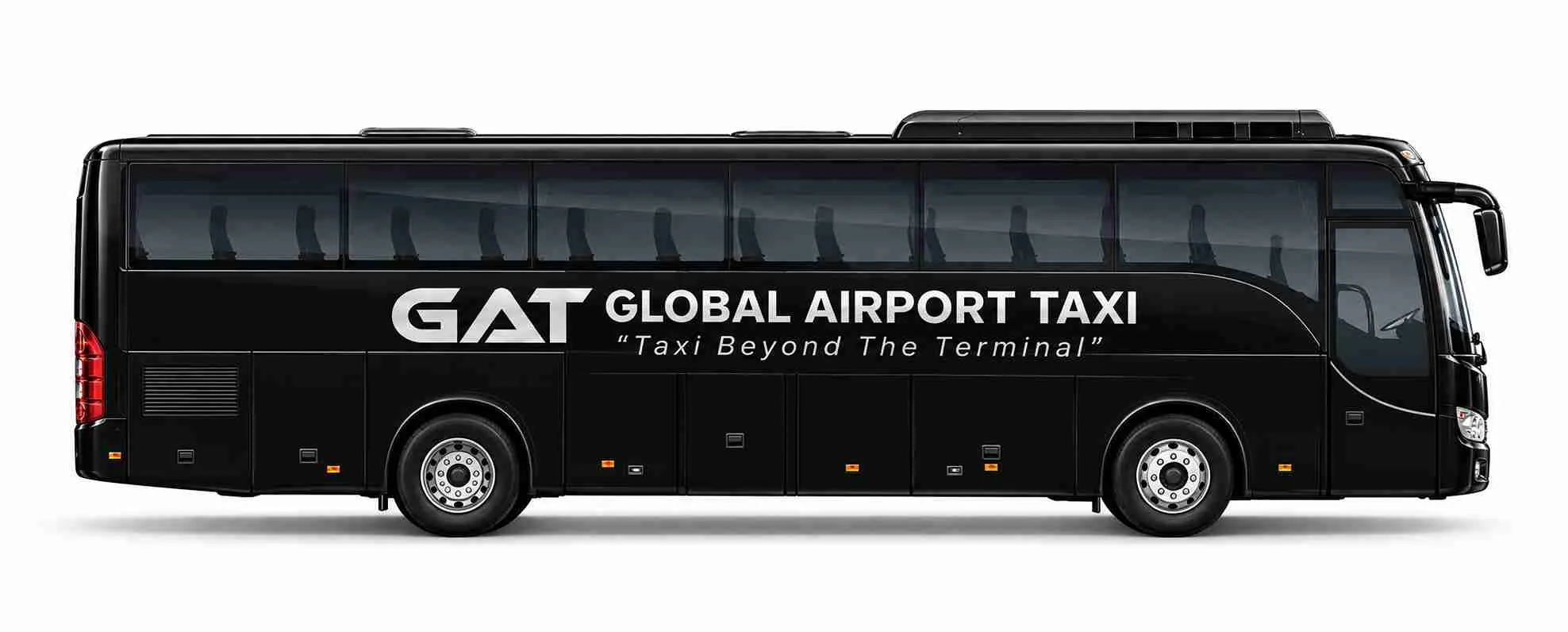 Normally a 50-seater coach
50-seater coach
50 seats
Large group arrivals, booked well in advance.
View vehicle →| Extra | What to know |
|---|---|
| Child seats | Infant, child and booster seats are available on request at no extra cost. In Spain a seat is needed for children under 135 cm, with a narrow exemption for taxis on urban journeys, so give us the children’s ages when you book. |
| Golf clubs, skis, bikes, trade equipment | Fine with notice. Tell us the item and its length at booking so a vehicle with the right load space is allocated. |
| Wheelchair-accessible vehicles | Request one at booking so we can confirm a suitable vehicle for your route and date. |
Every vehicle is shown on our fleet page. Models are typical for each class, so your quote confirms what is offered. Tell us your party size and bag count so the right vehicle is allocated.
Reviews
The scores below are the ones our review widget publishes, checked on 14 October 2026. They come from travellers at airports across our network, and we show a selection of passenger reviews about airport transfers. Every review stays on the platform where it was written.
Excellent4.9453 reviewsShowing all 10 reviews
Excellent service...arrived at terminal and driver was waiting...helped with luggage to the car...smooth drive...perfect overall
Very reliable and easy to get a hold of. I was very confused leaving the airport - user error haha - and they were super helpful. My flight was also delayed and the guy who picked me up was on top of it.
Super affordable and professional service! The pricing was very clear from the start, with no hidden charges, which I really appreciated. Everything went smoothly, and the professionalism of the global airport taxi service stood out. Highly recommended for anyone looking for a hassle-free and budget-friendly option.
Amazing taxi service to the airport! Our driver was friendly, on time, and made the whole trip so easy. The car was clean and comfortable, and we got to the airport right on time. Would definitely use this service again!
Excellent service , driver waited for us as flight was delayed, clean car and smooth ride
I would totally recommend Global Airport Taxi to anyone needing a taxi service for their airport commute. I decided on way to the airport that I was flying out of that I will need a cab service at LHR. They were quick to respond to and accommodated some of my last minute schedule change requests after I had landed at LHR. Totally reliable and willing to be flexible. Outstanding customer support provided by Jennifer and Root. Keep it up guys !!
This was a brilliant service our driver was excellent he was friendly and helpful. Used again for the return journey and driver was professional and ensured we made it to the airport on time with heavy traffic
The service was extremely reliable. My cab arrived exactly on time for my early morning flight, which was a huge relief. Everything went smoothly, and I felt confident choosing this service. Highly recommend global airport taxi for stress-free airport transfers!
Amazing customer service, on time driver helped with cases. A pleasant experience Thank you
Very clean car and on time very polite driver will use them again
These scores cover the whole network rather than long-distance work alone. Trustindex supplies the widget and every review appears exactly as its author wrote it. None of it was written by us.
The service
A private vehicle hired for a distance rather than for a drop-off, priced per vehicle before travel, with the road charges and the driver’s hours worked out before you book rather than discovered on the day.
The short answer A pre-booked private vehicle taken for a long distance, priced per vehicle rather than per passenger and agreed before you travel. One car and normally one driver for the whole route, tied to your flight number at the airport end, with tolls and vignettes accounted for in the quote rather than added at the kerb.

The same car and, on almost every journey, the same driver from the airport to the address — not a relay, not a handover at a county line, and not a shared circuit picking other people up on the way.
The booking follows your flight number, so a delayed inbound moves the pickup rather than losing it, with 60 minutes of waiting from the moment you actually land. After that the journey is governed by the road rather than by a timetable.
Per vehicle rather than per passenger, and it does not move because the traffic did. On a long run that is the whole argument: a meter running for six hours is an open question, and a fixed figure is not.
Over a long distance the vehicle has to hold the luggage and be tolerable to sit in. Those are two different questions and most booking forms only ask the first.
Four things, and they are why this is a different product rather than a longer version of the same one. The road starts charging, in ways that differ by country and some of which have to be paid before you set off. The driver becomes a legal question rather than a logistical one. The return leg stops being trivial, because somebody has to pay for the car to get home. And the alternatives get better — on some routes a train is simply the right answer, and this page says which.
Airport to a distant address on arrival, the same in reverse on departure, and the leg people forget to price: a one-way drop far from where the vehicle is based. The outbound is the easy one because it is tied to a flight number. The return is the one that needs thought, because you are working back from a check-in deadline across a distance where an hour of traffic is an ordinary event rather than a disaster.
A route with a fast, frequent train and no luggage worth the name. A journey where a cheap domestic flight saves most of a day. A distance one person is happy to drive themselves in a hire car they wanted anyway. Send us the route and if it is one of those we will say so, because a company that cannot name the cases where it loses is not worth believing on the cases where it wins.
How far is far
Nobody defines long distance, so here is the definition that is actually useful: the four points at which a journey stops being the same product.
The short answer There is no legal definition. We draw the line in four places by what changes: under an hour is an ordinary transfer; one to three hours is where road charges and borders start to matter; three to six hours is where a 45-minute break becomes a legal requirement for vehicles built for more than nine people; and beyond six hours you are buying a working day plus the vehicle’s journey home.
Up to about an hour
Nothing on this page applies yet. This is the airport run every other page describes: one hop, one driver, no road charges worth naming in most countries, and no question about anybody’s hours. If this is your journey, the ordinary airport pages cover it better than this one does.
One to three hours
Far enough to cross a toll road, a low-emission zone or a national border, and far enough that the difference between a meter and a fixed figure becomes real money. Still one driver, still no statutory break, but the first point at which what the road costs should be in the quote rather than a surprise.
Three to six hours
In a vehicle built for more than nine people including the driver, a break of at least 45 minutes is now legally required after four and a half hours of driving. In a car it is not required by that law at all — which is a fact about the law rather than about human beings, and we say more about that below.
Six hours and beyond
Now you are buying most of somebody’s working day, plus the journey the vehicle has to make afterwards. This is where the empty return leg stops being a detail and starts being a large part of what you are paying for, and where a second driver or an overnight may genuinely be the right answer rather than an upsell.

No regulator anywhere defines it, so every operator draws its own line and most draw it where their pricing changes. Our own UK guide treats roughly 30 to 40 miles, or anything over about an hour, as the point at which a journey stops being an ordinary transfer — and that is a commercial boundary rather than a legal one. The bands above are drawn differently, by what changes in kind: when the road starts charging, when a break becomes a legal requirement, and when the leg home becomes a real cost. Those are the lines worth knowing.
Four hundred miles of empty motorway and two hundred miles of mountain road are not the same journey, and only one of them is long. What you are actually hiring is a vehicle and a person for a block of time, which is why a quote built on distance alone tends to be wrong in both directions. Give us the route rather than the mileage and the figure will be the one that holds.
Our long-distance taxi price guide sets out the UK fare bands in pounds per mile; this page is about what changes on the road rather than what it costs in one country.
The driver
Two separate regimes decide this and they are routinely confused. One turns on how many seats the vehicle was built for. The other turns on which city you are in. Between them sits the counting trap below.
The short answer European drivers’ hours law binds vehicles built for more than nine persons including the driver, so a saloon through to an 8-seater sits outside it with no statutory limit and no tachograph, while a 16-seater or coach sits inside it at nine hours a day with a 45-minute break after four and a half. In a car the only thing that applies is a Highway Code recommendation of a 15-minute break every two hours, which is advice rather than law. Separately, some authorities cap the private hire driver’s day directly: New York City allows 10 hours of carrying passengers in any 24.
European drivers’ hours law — Regulation 561/2006, which applies across the EU and is retained in United Kingdom law — does not ask how far you are going. It asks what you are going in. For passenger work it binds vehicles “constructed or permanently adapted for carrying more than nine persons including the driver, and are intended for that purpose”. That is the whole test.
Nine or fewer persons including the driver, so outside the Regulation. No statutory driving limit from it, no break required by it, and — because tachograph law uses the same test — no device recording the hours at all.
More than nine persons including the driver, so inside it. The limits below are not guidance for these vehicles, they are law, and they are recorded. On a long group journey they decide whether the route is possible in a day.
| Limit | What the Regulation sets |
|---|---|
| Maximum daily driving | Nine hours, which may be extended to ten not more than twice in a week |
| Maximum weekly driving | Fifty-six hours |
| Maximum over two consecutive weeks | Ninety hours |
| Break | At least 45 minutes after four and a half hours of driving, or a 15-minute break followed by a 30-minute one |
| Daily rest | A new daily rest period within each 24 hours. Eleven hours is a regular rest; nine to eleven is a reduced one, and only three reduced rests are allowed between weekly rests |
| Recorded by | A tachograph, which is required in exactly the vehicles this Regulation covers and in no others |
A recommendation. The Highway Code’s rule on tiredness says that “a minimum break of at least 15 minutes after every two hours of driving is recommended”, along with “do not begin a journey if you are tired” and advice to avoid long journeys between midnight and six in the morning. We checked the wording for this page: that rule carries no MUST or MUST NOT and cites no Act of Parliament. It is advice. What is enforceable is the ordinary offence of driving carelessly or dangerously, which is dealt with after something has gone wrong rather than before.
There is no statutory limit on how long the driver of an ordinary licensed private hire car may drive in a day in the United Kingdom or the European Union, and no tachograph recording it. That is an uncomfortable thing for a transfer company to publish about its own product, and it is true, and you would not learn it anywhere else in this market. It makes the right question to ask any operator quoting a very long run not “how much” but “who is driving, for how long, and what is your own limit”.
Falling outside the European regulation does not mean falling outside every rule. Some authorities regulate the taxi and private hire driver’s day directly, whatever the vehicle seats, and those rules reach an ordinary car.
New York City’s Taxi and Limousine Commission states that “both taxi and FHV drivers are prohibited from transporting passengers for more than 10 hours in any 24-hour period”, and for more than 60 hours in a calendar week running Monday to Sunday. It is enforced on the company as well as the driver: a base faces a $200 fine for each dispatched trip that begins over the limit. For-hire vehicles are covered in the same terms as yellow cabs, so this is a real statutory cap on an ordinary private hire car.
There is no single worldwide rule. On a European route in a car the Regulation sets your driver no limit; in a 16-seater on the same road it sets a strict one; in New York the city sets one directly and the seat count is beside the point. We also saw a national scheme of this second kind reported for Switzerland, but we could not read the ordinance itself, so we do not print its figures here.
Crossing a border
The framework that lets a coach operator work across Europe is drawn at exactly the same nine-person line as the drivers’ hours rules — and a car falls below it.
The short answer The Interbus Agreement, which governs international coach work, applies to vehicles suitable for carrying more than nine persons including the driver, so a private hire car falls below it and takes neither rights nor obligations from it. A cross-border transfer by car is therefore governed by each country’s own national law rather than by one international instrument, and a driver who has taken you abroad often may not pick up a new fare there.
This is the part of the subject with the least written about it and the most confusion in what is written. The Interbus Agreement — the international framework under which a coach operator works across borders — applies to vehicles “suitable for carrying more than nine persons, including the driver”. The identical line, again. A private hire car sits below it, which means the car takes no rights from that framework and no obligations under it either. Its cross-border position comes from the national law of each country it drives through.
A long cross-border transfer by car is not covered by one international instrument that makes it lawful everywhere. It is a country-by-country question. The related principle that is clear is the one against cabotage: the Interbus Agreement expressly cannot be read as allowing an operator from one country to run domestic services inside another. The practical shape of that, which several operators describe, is that a driver who has taken you abroad frequently may not pick up a new fare there — which is also the structural reason the empty return leg exists on cross-border work.
The booking is placed with a licensed operator in the country the journey starts in, named on your confirmation. Where a route crosses a border we settle before you book which road charges apply and what the vehicle needs to carry. What we will not do is tell you that one agreement makes every cross-border car transfer lawful everywhere, because we could not verify that and it is not what the instruments say.
The road charges
Read at the authority that levies it, in six countries so far. Each record says which kind of scheme it is, what it costs a car, how it is bought, and what going without costs — and leaves blank what we have not verified.
The short answer There are two mechanisms and the difference matters. A barrier toll is paid as you go and cannot be got wrong. A vignette is permission bought before you drive, usually camera-enforced, and in several countries the first you know of a mistake is the penalty. Switzerland charges CHF 40 with no short-stay option at all; Austria sells a ten-day vignette for €12.80; Slovenia classes vehicles by height so a people carrier can pay the wrong rate while holding a valid vignette.
A toll with a barrier cannot be got wrong: you take a ticket, you pay on the way out, and nothing had to be arranged beforehand. A vignette is the opposite. It is permission bought in advance, usually enforced by camera, and in several countries there is no moment at which anybody stops you and offers you the chance to pay. The first contact is the penalty. Every record below says which kind it is, because that is the field that decides whether a mistake is possible at all.

Vignette
The most straightforward scheme on this page, and the one most likely to be in transition when you travel: the physical sticker is on its way out.
Vignette, annual only
The one country here where a twenty-minute transit costs the same as a year of them. There is no short-stay option and there is no way to buy your way out of that.
Vignette, electronic
Cheap, entirely digital, and carrying the one trap on this page that can double your bill without anyone mentioning it.
Vignette, electronic
Repriced from the first of January 2026 and banded by emissions, which introduced a free category that is not free for everyone who assumes it is.
Vignette, electronic
On what we were able to verify, the country most likely to catch out a driver who thought they had done everything right — because here you can buy a vignette and still be non-compliant.
Distance tolls
The easy one, and the reason it is easy is worth saying: where there is a barrier, there is nothing to prepare.
Six records is not a survey of Europe, and showing six without naming the rest would read as though it were. These are the countries whose levying authorities we have not yet read at source, so this page prints nothing for them:
Not published and not verified are different claims. Nothing above means those countries do not publish their tolls — they do. It means we have not read them at the authority yet, and we would rather say which it is than blur the two. Where a figure is missing inside a record above, the same distinction applies.
Every toll, vignette and penalty on this page is set by a national authority, not by us, and each of them revises on its own calendar. They are here as background. The figure that applies to your journey is the one on your quote.
The leg home
The vehicle has to come back, that journey earns nothing, and on cross-border work the driver often may not sell it. Here is how that works and what we do about it.
The short answer Every long-distance price contains the vehicle’s empty return, because the car has to come back and that leg earns nothing. It is why a return fare is a little under double a one-way rather than exactly double. In our quotes it is already inside the one-way figure and is never added afterwards; on a metered journey, by contrast, the empty return can be charged on top.
This is the largest single thing that makes a long transfer cost what it does, and it is almost never explained. We would rather explain it than let you find it in the number and wonder what it was for.
A car that takes you four hundred miles does not stay there. It has to return to the city it works out of, and that return journey carries nobody and earns nothing. On a cross-border route the driver frequently may not even sell it, because an operator licensed in one country generally cannot pick up a new fare inside another. The cost of that leg is real, it is unavoidable, and it is in every long-distance price that has ever been quoted to you.
Take any long-distance price list that shows both a one-way figure and a return figure for the same journey. The return is never double the one-way — it is a little under double. If a one-way price really covered only the outbound journey, two of them would cost exactly what a return costs. They never do, and the gap is the small amount the vehicle genuinely saves by having a passenger in both directions. Everything else was already in the one-way price.
The figure we give you already carries it. You are not asked for it afterwards, there is no repositioning line added at the end, and the number does not change because the driver happened to find no return fare. It also means a return booking is usually better value than two separate singles, so if your dates are known it is worth asking for both legs at once.
None of it holds on a metered journey. A meter prices the outbound, and the empty return can be charged on top — in at least one country we read, at a higher night rate. That is how a journey of a few hundred kilometres can acquire a substantial sum nobody mentioned at the start. It is not a scandal; it is simply how metered long-distance work is allowed to be priced, and it is the clearest argument there is for agreeing a figure in advance.
Road charges are revised on national calendars, usually at the turn of a year. Nothing above is a quotation.
The gaps
We read the pages that sell long-distance transfers, including their terms and conditions. These are the questions they leave open, and what we say instead.
The short answer The questions most often left unanswered are whether one driver takes you the whole way, where the car stops and whether the clock runs, who pays the tolls and vignettes, whether the price is per person or per vehicle, whether the car can reach the door, what a very long delay does to the journey, and how a transfer really compares with hiring a car. This page answers all seven.
What this market publishes Of every page we read selling long-distance transfers, not one addressed it — not in the copy, not in the terms, not in the FAQs. On a journey that can exceed a legal working day in some jurisdictions, whether there is a handover is simply absent from the published record.
Our answer Normally one driver for the whole route, and where a route needs more hours than one driver should reasonably do, we propose a second driver or an overnight at the quoting stage rather than arranging it quietly. Our own maximum is marked above as something the operator still owes you in writing, and we have left that marker visible rather than removing the question.
What this market publishes Four of the pages we read mention stops at all. Two give a figure — fifteen minutes free, then an hourly rate — and one says breaks are included without saying how many or how long. Nobody publishes a cadence for a long drive. Nobody explains the thing that actually matters: on a fixed quote the clock does not run, and on a meter it does.
Our answer Stops are part of the journey rather than an extra, and the figure we quoted does not move because the car stopped. On a long run expect the driver to break roughly every two hours — which is what the Highway Code recommends for any driver — and longer after about four and a half. If you need a specific stop, a meal or a particular service area, say so at booking and it goes on the itinerary rather than being negotiated at the roadside.
What this market publishes Tolls are a mixed picture: some operators state they are included and one even quantifies them, others exclude them, and several pages that promise “the price you see is the price you pay” never mention them at all. Vignettes are a blind spot across the entire sample — not one page mentioned one, including operators selling routes into Switzerland and Austria, where a vignette is compulsory and sold before you reach the motorway.
Our answer The road charges the route needs are inside the quote and itemised on the summary. Where a route crosses a country with a pre-paid vignette we settle it before you travel, because it is not the kind of thing that can be fixed at the barrier — in several countries there is no barrier. The country records above set out which is which.
What this market publishes The hardest thing to compare in this market. Some large sites quote long journeys per person; at least one operator states plainly that its price is per vehicle; and several of the biggest never say either way. On a 300 km journey the difference between those two readings is most of the price.
Our answer Per vehicle, stated here and on your quote. Adding a passenger does not change the figure; changing class does. Where we have quoted anyone else’s price on this page we have said which basis it was published on, because that is the only way the numbers can be read side by side.
What this market publishes The same conditionality that applies to hotel arrivals applies here and is just as absent. Pages sell transfers into historic city centres without mentioning that a restricted traffic zone stands between the vehicle and the address, or that a brief drop-off inside one is penalised like any other entry.
Our answer If your destination sits inside a restricted zone we tell you before you book. Our worldwide hotel transfer page sets out how those zones work city by city, including which of them require your hotel to register the vehicle in advance — fourteen cities, read at the authority that runs each scheme.
What this market publishes Most operators publish a free waiting allowance at the airport, typically an hour, and most track the inbound. What almost none address is the knock-on for a very long journey: a four o’clock arrival that becomes an eight o’clock one turns a day drive into a night drive, which is a different proposition for the person at the wheel.
Our answer The booking follows the flight number, so the pickup moves rather than being lost, and 60 minutes of waiting from the actual landing time are included. On a long route a very large delay is a conversation rather than an automatic start: we would rather talk about whether the journey still makes sense that night than set off because a booking said so.
What this market publishes Rarely compared honestly. The pages that raise it tend to compare a transfer with a rental day rate and stop there, leaving out fuel, tolls, one-way drop-off fees and parking at the far end — which on a long one-way route are most of the cost.
Our answer For one or two people who wanted a car at the destination anyway, hiring is often the better answer and we would say so. It stops being the better answer when the one-way drop-off fee appears, when nobody in the party wants to drive for six hours, or when the destination charges to park. The honest test is whether you want a car when you arrive, or only a journey.
If it goes wrong
A breakdown, an ill driver, a change of plan and a journey ended early. We read the pages that sell long-distance transfers and found no answer to any of these, anywhere. Here are ours.
The short answer Your booking is with the operator rather than the driver, which the licensing Act sets out expressly, so a breakdown or an ill driver is ours to solve: recovery and a relief vehicle at no extra charge. A mid-journey change of destination is priced rather than refused, and a pre-booked private hire journey may lawfully run anywhere in England and Wales. Ending a journey part-way is possible, and you pay for what has been performed.
What happens Your booking is with us, not with the car. A licensed private hire vehicle cannot be licensed at all without insurance in force — the council may not grant the licence otherwise — and the hire contract itself is deemed by law to be made with the operator who accepted the booking, “whether or not he himself provided the vehicle”. That is not a technicality: it is the reason a mechanical failure is our problem to solve rather than a conversation between you and a driver at the roadside. What should happen next is recovery for the vehicle and a relief vehicle for you, arranged by the operator, at no additional charge to you. Where a flight is at the end of the journey, tell us that at booking so the margin is built in before it is needed rather than hunted for afterwards.
What happens The honest answer begins with what the driver should do, which is stop safely as soon as it is safe to do so rather than press on. The Highway Code is explicit that a driver must make sure they are fit to drive, and carries a MUST to notify the licensing agency of any health condition likely to affect driving. From there it is the same principle as a breakdown: the booking is with the operator, so a relief driver and vehicle are ours to dispatch. Of every page we read while building this one, not one addressed this at all — which we think says more about the category than about how rarely it happens.
What happens Tell the driver, and expect us to confirm it rather than wave it through. A genuine diversion can change the distance, the road charges and sometimes the legality of the drop-off, so it is priced rather than absorbed. One thing worth knowing, because it is the real answer to “can a taxi take me to another city”: a pre-booked private hire journey may lawfully be carried anywhere in England and Wales, well beyond the area the vehicle is licensed in. A hackney carriage flagged in the street is a different matter and can decline a job ending outside its district. Pre-booking is what makes a long journey straightforward.
What happens You can, and you should expect to pay for the part of the job that has already been performed and for the vehicle’s position at the point you stop — which, three hours from our base, is most of it. We would rather set that out here than have it discovered at the roadside. If the reason you want to stop is something we have done, that is a different conversation and the consumer remedies for a service not carried out with reasonable care and skill apply in the ordinary way: putting it right, or a reduction in price.
Travelling with
Four questions where the law and the courtesy are different things, and where mixing them up is how people end up at the kerb with a problem.
The short answer There is no legal duty to carry a pet, so ask at booking and expect an honest answer; an assistance dog is the opposite, with an absolute duty to carry it, allow it to stay with its owner and charge nothing extra. Disabled passengers and their mobility aids must be carried with reasonable assistance at no extra charge. Child seats are free on request, and the legal exemption that lets a child travel without one is an exemption from an offence rather than a recommendation.
Ask first, and expect an honest answer rather than an automatic one. There is no legal duty on any driver to carry a pet, so it is a matter of consent, notice and the right vehicle — and on a long journey it is also a matter of restraint, because the Highway Code requires animals to be suitably restrained so they cannot distract the driver, naming a harness, a carrier, a cage or a dog guard. Tell us at booking what the animal is and how it travels.
Here there is a duty, and it is absolute. The Equality Act requires a taxi driver to “carry the disabled person’s dog and allow it to remain with that person” and to “not make, or propose to make, any additional charge for doing so”, with failure an offence carrying a fine up to level 3 on the standard scale. Equivalent duties fall on private hire drivers and on operators. No notice is required and none should be asked for.
Drivers must carry disabled passengers and their mobility aids, give reasonable mobility assistance and charge nothing extra for it. On a pre-booked journey there is a further duty to take reasonable steps to help a passenger identify and find the vehicle, if we are told in advance — which on a long journey is worth doing, because the pickup is the part that goes wrong. Send the measurements and weight of a chair or scooter and the vehicle is confirmed against your route before you pay.
Child seats are free on request and we would rather fit the right one than rely on the exemption. The exemption is real: in a taxi or minicab, if the driver does not provide the correct seat a child may travel without one, but only on a rear seat, wearing an adult belt if they are three or older and without one if under three. That is an exemption from an offence, not a recommendation, and the longer the journey the worse a trade it is. Give ages and rough weights at booking.
Our routes
Twenty route pages, most of them airport to seaport, each with its own distances and detail. This hub is the argument; those are the journeys.
The short answer We publish route pages for twenty long transfers, mostly from Heathrow, Gatwick, Luton and London City to the UK ports at Southampton, Portsmouth, Dover and Harwich, plus three from Paris Orly. Any other long route is priced on request wherever the pickup airport is in the published network.

The airport-to-seaport run is the classic long transfer: a fixed sailing time at the far end, luggage that defeats a train, and a group travelling together. It is the journey where every argument on this page applies at once — the distance, the deadline, the bags and the leg home. If you are joining a ship, our worldwide cruise port transfer page covers what happens at the other end, terminal by terminal.
The list above is what we have written a page for, not what we can drive. A long transfer works wherever the pickup airport is in the published network, which runs to 81 countries. Send the route and we will price it, and tell you if the train is the better answer.
Three of these journeys get a page of their own, because each one has a problem at the far end that a distance alone does not describe.
On the day
What decides a long-distance quote, and what the journey itself looks like once it starts.
The short answer Before booking, give the full destination address rather than a city, say whether the route crosses a border, count the hours as well as the cases, put the flight number on the booking and ask what the operator’s own driving limit is. On the day, meet the driver inside arrivals, expect a stop roughly every two hours at no extra cost, keep what you need in the cabin, and leave the road charges to the driver.
Overnight and multi-day
Where the driver sleeps, who pays for it, and how a second day is priced. Of the long-distance pages we read, not one covered any of this.
The short answer Beyond about a day’s driving you are buying availability rather than distance, so the sensible structure is a daily rate from day two. On a multi-day booking the hirer customarily covers the driver’s accommodation and meals — a single room, reasonable meals, receipts, no alcohol — and we put all of it in the quote in writing before you commit.
Past a certain distance you are no longer buying a journey, you are buying a vehicle and a person for more than one working day. Nothing in this market is written about that, and the questions it raises are entirely practical: where does the driver sleep, who pays for it, what happens to the vehicle overnight, and is the second day priced like the first. We would rather answer those in advance than improvise them.
Day one is priced as a journey. Beyond that the sensible structure is a daily rate rather than a distance one, because what you are holding is somebody’s availability rather than their mileage. Accommodation and meals for the driver sit with the hirer on a multi-day booking, which is the ordinary convention for chartered work — a single room, reasonable meals, receipts, no alcohol. We will put the whole of that in the quote in writing before you commit, because an unpriced overnight is the fastest way for a long booking to turn into a dispute.
It comes back to the seat count. A vehicle built for more than nine persons including the driver is inside the European drivers’ hours regime, and in Great Britain the domestic rules for passenger vehicles that fall outside it cap driving at ten hours within a sixteen-hour duty window with a continuous break and a daily rest requirement. For a car-sized private hire vehicle the position is less settled, and we have said so plainly further up this page rather than inventing a limit. Either way, a multi-day itinerary should be built around the driver’s day, not around the map.
These came off the levying authorities’ own pages on the day this was written, and are not promised to hold until you travel.
Luggage and comfort
What decides the vehicle over a long distance is not only whether the luggage fits, but whether the party fits comfortably for the number of hours involved.
The short answer The case count picks the minimum vehicle, but on a long journey the hours pick the sensible one, and those are often not the same class. Keep whatever you will need during the drive in the cabin rather than the boot, and give ages and weights at booking so child seats are fitted before the car leaves.
A booking form asks how many of you there are and how many cases you have. On a six-hour journey there is a third question nobody asks: whether the vehicle that technically fits you is one you want to be sitting in at hour five. Eight people and six cases will go in an 8-seater. Eight people, six cases and four hundred miles is a different conversation, and it is worth having it at the quoting stage.
On a long run the cabin matters. Anything you will want during the journey — medication, a laptop, a coat, whatever a child needs — should be reachable rather than buried under the cases at the bottom of a loaded boot. Tell us at booking if something has to stay accessible and the loading is planned around it instead of being rearranged at a service station.
Carriers, forward-facing seats and boosters are free on request, and on a long journey the thing to get right is the fit rather than the fact of having one. Give the ages and rough weights at booking so the right restraint is fitted before the car leaves. For a wheelchair or a scooter, send the measurements and weight and the vehicle is confirmed against your date and route before you pay.
The limits
A short list, published for the same reason as everything else here: it is cheaper for both of us if you know before you ask.
The short answer We will not take a very long route at a few hours’ notice, a distance one driver cannot reasonably cover in a day without a second driver or an overnight agreed first, a multi-stop tour priced as a transfer, a route we cannot verify we can lawfully complete, or any booking sold on a guaranteed arrival time over a long drive, which nobody controls.
Booking
Everything that moves the number, including the three lines this market normally leaves out: the road charges, the driver’s stops and the leg home. Markers show where the operator still owes a figure.
The short answer The fare is per vehicle, agreed before you travel and paid in full at booking, cancellable free up to 24 hours before pickup. It already includes the road charges the route needs, the driver’s stops and the vehicle’s journey home, so a one-way quote is not topped up afterwards. An airport pickup includes 60 minutes of waiting from the actual landing time.
On a twenty-minute airport hop the difference between a meter and a fixed price is small enough to shrug at. On a six-hour journey it is the difference between a number and a question. Traffic, a diversion, a closed motorway and a slow border are all ordinary events over that distance, and on a meter you pay for every one of them. The figure we quote does not move because the road did.
The licensed operator, the vehicle class you booked, flight tracking against your inbound, the driver meeting you inside arrivals, help with the luggage, child seats if asked for, the waiting allowances above, the road charges the route needs, the stops the driver takes, and the journey the vehicle makes afterwards. What is outside it is anything you add on the day, and we would rather price that onto the booking first than improvise it at a service station.
A confirmation naming the operator, the driver, the vehicle, the meeting point and the route as quoted. On a long or cross-border run it also says which road charges are accounted for, so there is a written answer to the question before the journey rather than a conversation about it afterwards.
Vignette prices in particular are reset annually. Read the table as orientation, not as a price list.
Vehicles
Saloon up to a 50-seater coach, each priced for the vehicle rather than the seat — and split by a legal boundary most tables do not show.
| Class | Seats | Large cases | Cabin bags | Who it is for |
|---|---|---|---|---|
| Saloon | 4 | 2 | 2 | Two travelling a long way with a case each. Comfortable for hours, not for six of you. |
| Estate | 4 | 3 | 3 | Four and three large cases. The boot is what makes this a distance vehicle. |
| Executive | 3 | 2 | 2 | Up to three, where the hours in the car are the reason for the upgrade. |
| People carrier | 6 | 4 | 4 | Six seats and four large cases, with room to move on a long run. |
| 7-seater | 7 | 4 | 5 | Seven, four large cases. On a long journey the seventh seat is the tight one. |
| 8-seater | 8 | 6 | 8 | Eight and six large cases in one vehicle — and still under the nine-seat line. |
| 16-seater | 16 | 14 | 16 | Over nine seats, which changes the legal position of the driver as well as the price. |
| 30-seater coach | 30 | 30 | 30 | Group travel over distance, booked well ahead. |
| 50-seater coach | 50 | 50 | 50 | Large groups, where the planning matters more than the vehicle. |
What is included
Every extra that a meter or an app might add is covered in the fare you are quoted. The conditions behind each line are in our terms and in your confirmation.
Inside the arrivals hall of the terminal you actually land in, name board up, and the cases are the driver’s job at both ends of a long journey.
The booking follows your flight number, so a delayed inbound moves the pickup rather than losing it. This is the half of the journey that can be tracked, and it is tracked.
For airport arrivals the first 60 minutes after landing cost nothing, enough for the border and the carousel (see your booking terms).
Agreed at booking for the whole vehicle rather than per head, and it already carries the road charges the route needs, the driver’s stops and the vehicle’s journey home. Those are itemised on the summary rather than buried in the total.
Baby, toddler and booster seats on request. In Spain a seat is needed for children under 135 cm, with a narrow exemption for taxis on urban journeys, so ask for one.
Every journey is run by a licensed local operator, and the driver and vehicle are named on your confirmation before you travel.
Free to cancel until 24 hours ahead of the pickup time. Inside that, and on a no-show, the booking terms govern.
Phone, WhatsApp or email, from booking until you reach your hotel.
Luggage up to the class capacity is inside the fare. A second address, or waiting past the included time, is priced onto the booking first rather than settled at the kerb.
Trust
Here is who arranges your booking, what we commit to and where the full wording lives.
Global Airport Taxi is a trading name of QMH Technologies Ltd: company no. 13506378, VAT GB 469 6859 13, registered in England and Wales, 10-16 Tiller Road, London E14 8PX. Contact: bookings@globalairporttaxi.com or WhatsApp.
We handle the booking; a licensed local driver does the trip, and your confirmation names the driver and the vehicle.
You can pay by card, PayPal or Google Pay via secure, certified gateways. Personal data follows UK data protection law and the GDPR.
| Promise | What it means | Where to check |
|---|---|---|
| Fixed fare | The fare on the booking page is the one you confirm. | Booking page |
| Flight following | The pickup tracks your flight number and landing. | Booking confirmation |
| Free waiting | Up to 60 minutes after landing at airport arrivals. | Your booking terms |
| Child seats | Free if asked for, with the child’s age noted. | Booking notes |
| Licensed driver | A licensed local driver, named in your confirmation. | Booking confirmation |
| Free cancellation | Until 24 hours before pickup. | Terms, “Cancellations & refunds” |
| Late cancellations and no-shows | Not refunded unless the transport provider is at fault. | Terms, “Cancellations & refunds” |
| Right details | Flight, pickup and contact details must be correct, or extra charges may follow. | Terms, “General booking terms” |
If your confirmation says something different from this page, follow the confirmation. The complete conditions are in our terms and privacy policy.
How it works
Booking takes a few minutes. These are the four things that happen afterwards, in order.
The field that does the most work: it ties the pickup to the real landing time, so arriving late or early changes nothing you have to manage. On a long run the second most useful field is the full destination address, because the route decides which road charges apply and we would rather settle that before you book.
Ahead of the pickup you get the driver’s name, a mobile number and the exact meeting point inside your terminal — and, on a long journey, confirmation of the route as quoted.
The border and the carousel both run slower than anyone plans for, which is why 60 minutes of waiting from landing is included on an airport pickup. Held up beyond that, message the driver from inside the hall.
Payment is taken online at booking through a certified gateway, and the confirmation is mailed the moment it clears. Whatever figure is printed on that confirmation is the figure, however long the road turns out to take.
Who we are
Who you are contracting with, who is actually at the wheel, and the question this page raises that we cannot yet answer about ourselves.
Because on a long journey they are what actually decides whether the thing you booked can happen. A toll that had to be bought before the motorway, a break the driver is legally required to take, a border that wants paperwork — none of these are our rules, all of them are somebody’s, and every one of them is easier to deal with before you book than at the roadside. A page about long-distance transfers that only talks about the car is describing the easy part.
Four photograph slots are marked and waiting on images. The booking-policy lines marked CONFIRM are waiting on the operator’s own figures for waiting charges, cancellation inside the free window, no-shows and extra stops — and, particular to this page, the operator’s own maximum hours for a single driver and the point at which a second one is assigned. That last is the most important marker on the page, because it is the one a reader of the driver section will go looking for.
Everything else
36 questions in 9 groups, starting with the two this market leaves alone: the driver’s hours, and who pays for the car to get home.
Book it
One form, one figure for the whole car, and the road charges settled before you go rather than argued about at a barrier.
The short answer Pricing a long-distance transfer takes three things: the full destination address, the flight number and the head and bag count. The total covers the vehicle rather than each passenger and already contains the road charges, the driver’s stops and the empty return leg, and it cancels free until 24 hours before pickup.
The full destination address rather than a city name, because on a long run the route decides which roads you are on and therefore what they charge. The flight number, which ties the pickup to the real landing time. The bag count and the head count, which together pick a vehicle you can sit in for the duration rather than one you merely fit into. Tell us if the route crosses a border and we will settle the road charges before you book rather than after.
Get an instant quoteBook your long distance transfer
Paid by Visa, Mastercard, American Express and more, in full at booking, with 24 hours of free cancellation behind it. And the standing caveat of this page: on a long route with a fast, frequent train and no luggage worth the name, the train is usually the better answer, and we will say so when you ask. Booking a car you did not need is not a result either of us wants.
Each amount belongs to the country that charges it. We publish them so you are not surprised, not as a commitment on our part.
An executive car from the network fleet, a Mercedes E-Class or similar. Photograph: Global Airport Taxi.
The figure is settled before you travel, for the whole vehicle rather than per person, and it does not move because the traffic did. A driver is standing in the arrivals hall of whichever building you actually land in with a name board up, and the booking follows the aircraft, so a late inbound moves the pickup and costs nothing. On a long route the quote already carries the road charges, the driver’s stops and the vehicle’s journey home. Child seats are free for the asking, and the whole thing cancels free up to 24 hours out.