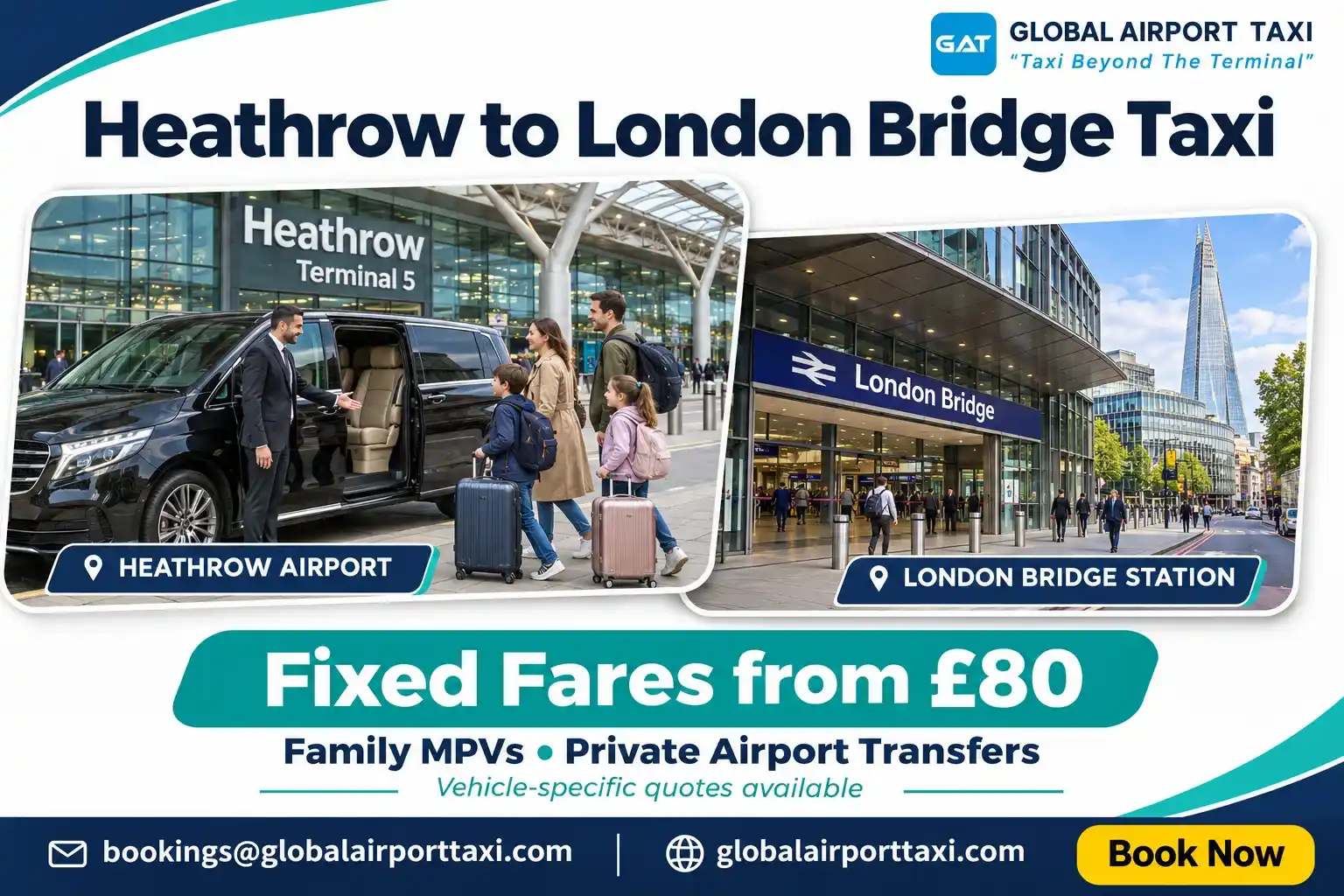
Heathrow to London Bridge Taxi & Minicabs – SE1 Fixed Fares from £80
One car, booked against your flight number, from the terminal door to the SE1 address on the booking for a sum agreed before you leave home. What follows: the five classes the quotation screen priced and the five it left blank, collections at Terminals 2 to 5, the road across London with a planning window rather than a promise, the station’s own entrances and ranks, the Shard’s five separate doors, the market and the riverside, both road charges set out with their hours, and an honest account of what the Elizabeth line and the Underground do better.
Heathrow to London Bridge Taxi Prices – Fixed Fares by Vehicle
Five classes priced, five left open, and a word about the pence.
The standard car came back at £80, and four larger classes came back above it. Those five amounts are what the quotation screen supplied for this build returned, each printed here to the pound. The screen marked the sedan as its recommended class for this journey, which is the engine’s own label rather than advice offered here.
£80
Sedan — Toyota Prius or similar
4 passengers · 2 bags and 2 suitcases
Quotation, pounds only
£108
Executive Sedan — Mercedes E-Class or similar
3 passengers · 4 bags and 2 suitcases
Quotation, pounds only
£118
MPV — Ford Galaxy or similar
5 passengers · 4 bags and 3 suitcases
Quotation, pounds only
£148
Van — Ford Tourneo or similar
7 passengers · 7 bags and 6 suitcases
Quotation, pounds only
£181
Executive MPV — Mercedes V-Class or similar
8 passengers · 7 bags and 7 suitcases
Quotation, pounds only
Five classes, five figures. The other five in the table below came back empty, and each of them says why instead of quietly adopting the amount above it.
Heathrow to London Bridge fares by vehicle class, as the quotation screen returned them
Vehicle
Passengers
Luggage
Fare
What the figure is
Sedan — Toyota Prius or similar
4 passengers
2 bags and 2 suitcases
£80
Quotation, pounds only
Executive Sedan — Mercedes E-Class or similar
3 passengers
4 bags and 2 suitcases
£108
Quotation, pounds only
MPV — Ford Galaxy or similar
5 passengers
4 bags and 3 suitcases
£118
Quotation, pounds only
Van — Ford Tourneo or similar
7 passengers
7 bags and 6 suitcases
£148
Quotation, pounds only
Executive MPV — Mercedes V-Class or similar
8 passengers
7 bags and 7 suitcases
£181
Quotation, pounds only
Estate car
Up to 4
3 large and 3 hand bags
Check Live Fixed Fare
The screen returned nothing
MPV, 6-seater
Up to 6
4 bags and 4 suitcases
Check Live Fixed Fare
The screen returned nothing
MPV, 7-seater
Up to 7
7 bags and 6 suitcases
Check Live Fixed Fare
The screen returned nothing
16-seat minicoach
Up to 16
14 bags
Check Live Fixed Fare
Built around the party and the date
30-seat coach
Up to 30
30 bags
Check Live Fixed Fare
Subject to a vehicle being free that day
About the pence.The lowest class came back at eighty pounds and ninety-eight pence; the pounds-only figure used in the heading is a from-price, the brief forbids turning that total into an exact eighty pounds, and the client is being asked to approve either a genuine round rate or the quotation to the penny. Nowhere here is the rounded figure called an exact total, a checkout price or what you will pay, because the brief rules that out and because it would not be true.
Heathrow to London Bridge Sedan Taxi fares
Four passengers, two bags and two suitcases is what the sedan publishes, and the screen marked it as the recommended class for this journey. A Heathrow to London Bridge Sedan Taxi Price of £80 is what came back. For two travellers with ordinary luggage a Heathrow to London Bridge minicab in that class is the booking most people want; the suitcase line below is where it stops being the right one.
Heathrow to London Bridge Executive Sedan fares
Three passengers, four bags and two suitcases, at £108. Against the standard car that is one seat traded for two more bags, and the Heathrow to London Bridge Executive Taxi Price sits on the page rather than behind a form. What the step up buys is the cabin for an hour of London traffic, not a shorter road: both cars take the same route across the same city.
Heathrow to London Bridge MPV Taxi and five-passenger transfers
This is the class behind a Heathrow to London Bridge 5 Seater Taxi: five places, four bags and three suitcases, quoted at £118. No six-seat figure was returned, and the brief rules out inventing one, so the six-seat row in the table says Check Live Fixed Fare and leaves it there.
Seven-passenger van and executive MPV
The van carries seven passengers, not eight; the eight-passenger class is the executive MPV, and the brief is explicit that the two must not be run together. Ask for a Heathrow to London Bridge 7 Seater Taxi or a Heathrow to London Bridge Van Transfer and the same vehicle arrives: £148, seven places, seven bags and six suitcases. Above it sits the Heathrow to London Bridge Executive MPV at £181, which is what a Heathrow to London Bridge 8 Seater Taxi actually means — eight places, and seven suitcases rather than eight.
An SE1 arrival is a kerb question as well as a seat question.A fifty-seat coach and a station entrance on a main road do not combine easily, and neither do eight passengers and a pedestrianised market lane. The larger the vehicle, the more the exact door on the booking decides whether the arrival works.
Minicoaches and coaches
Past eight travellers the booking stops being a fare and starts being an arrangement. A Heathrow to London Bridge Group Airport Transfer is put together around the party, the date and whatever is free, which is why no row above it carries an amount. The group transfers page explains how those are handled, and the train station transfers page covers arrivals at a station in general.
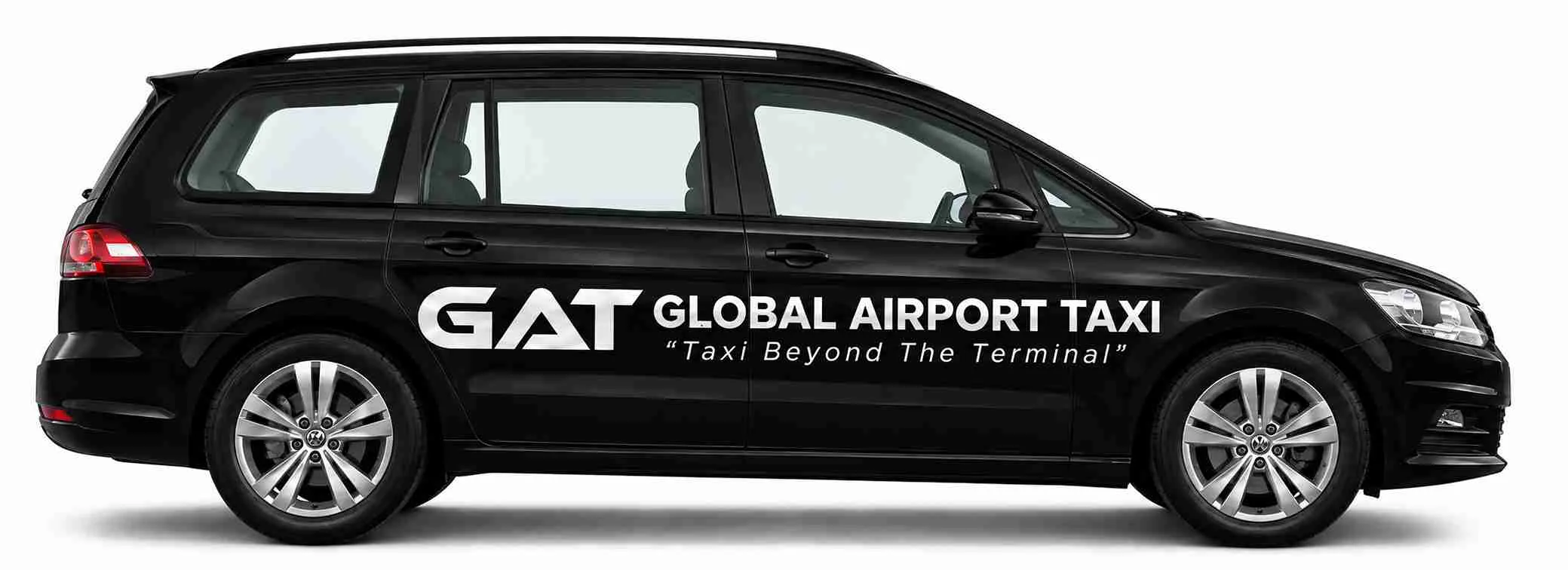
SedanFour seats, two cases, two bags.
EstateThe same four places, a far deeper boot.
Executive sedanOne seat fewer, two bags more, better inside.
MPVFive seats, three cases, one deep well.
Seven-seat MPVSeven travelling with the boot intact.
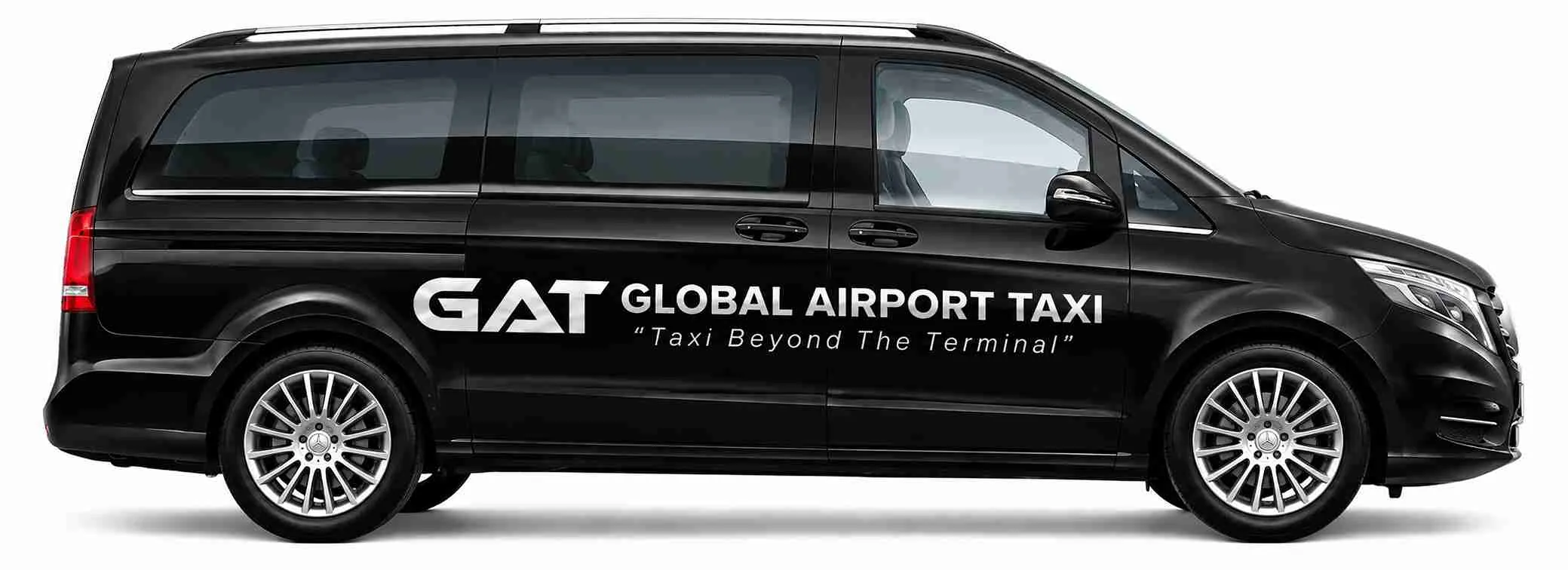
Executive MPVEight aboard; seven cases, not eight.
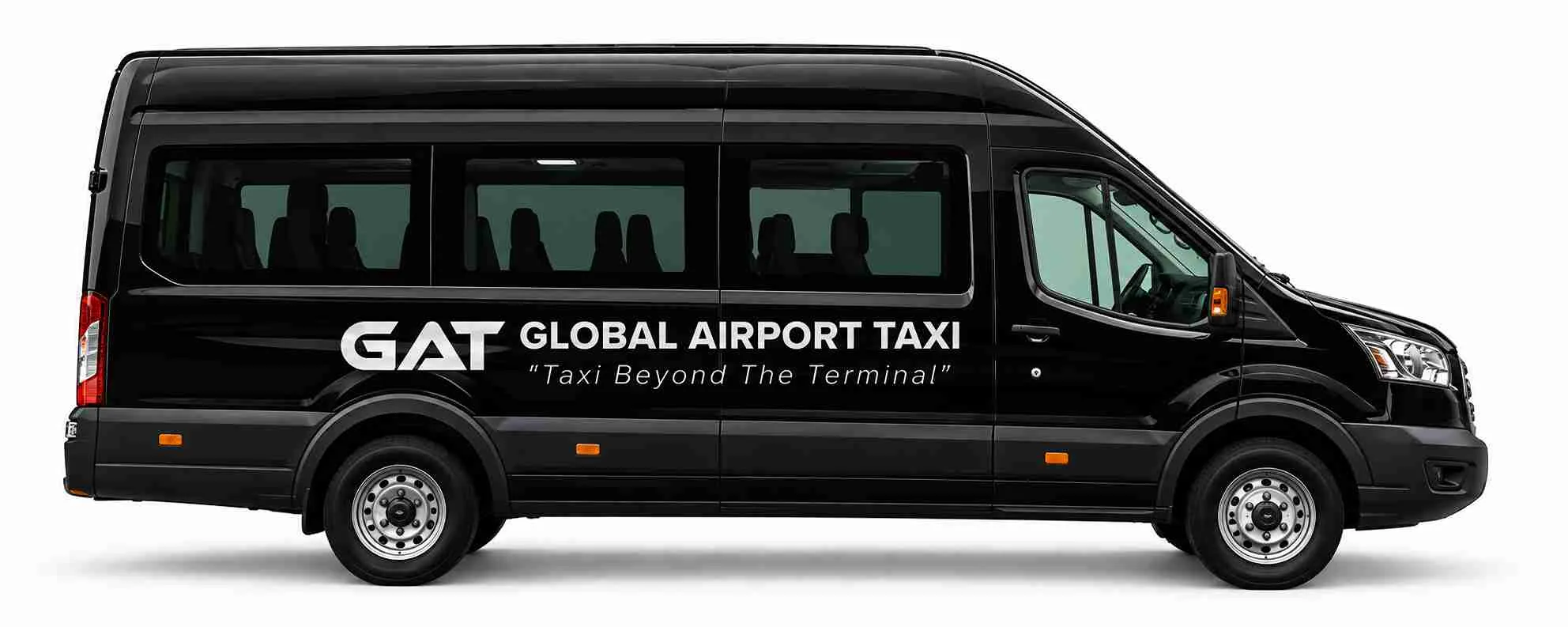
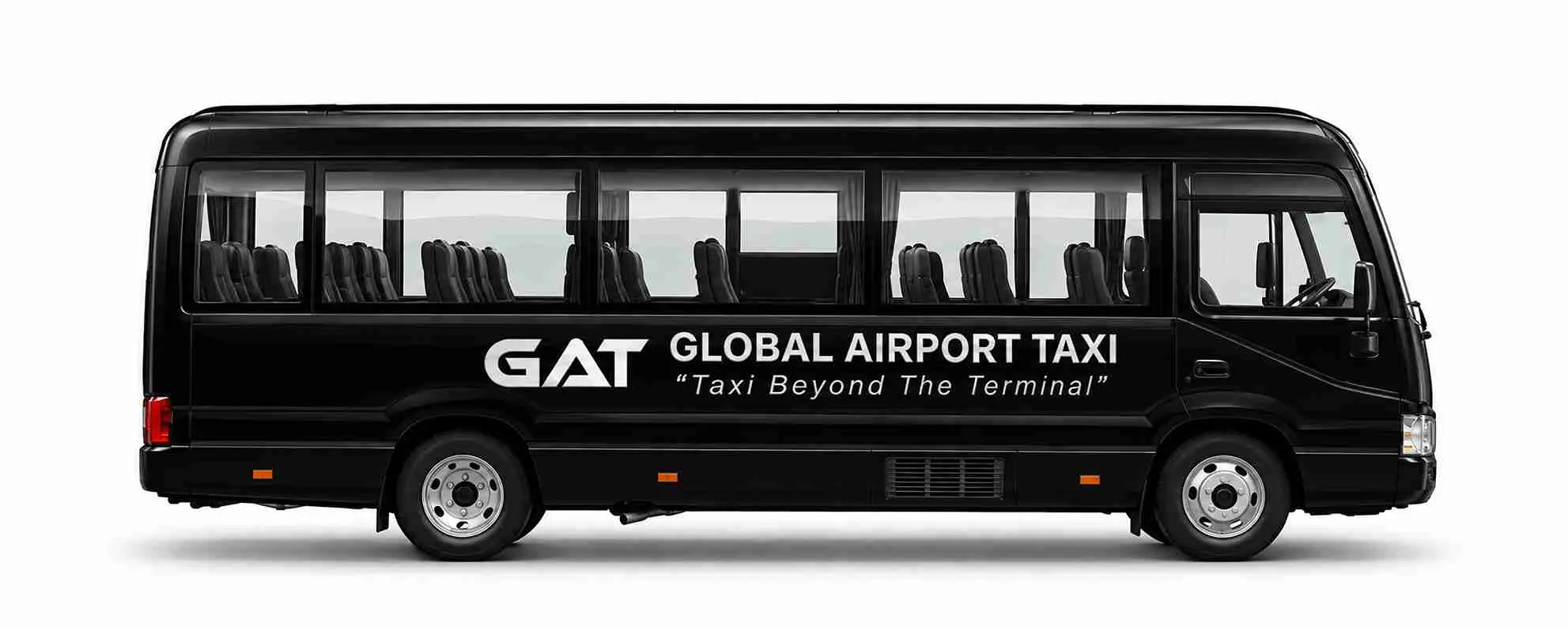
Minicoach, sixteen seatsA whole party in one vehicle.
Coach, thirty seatsLuggage travels under the deck, not inside.
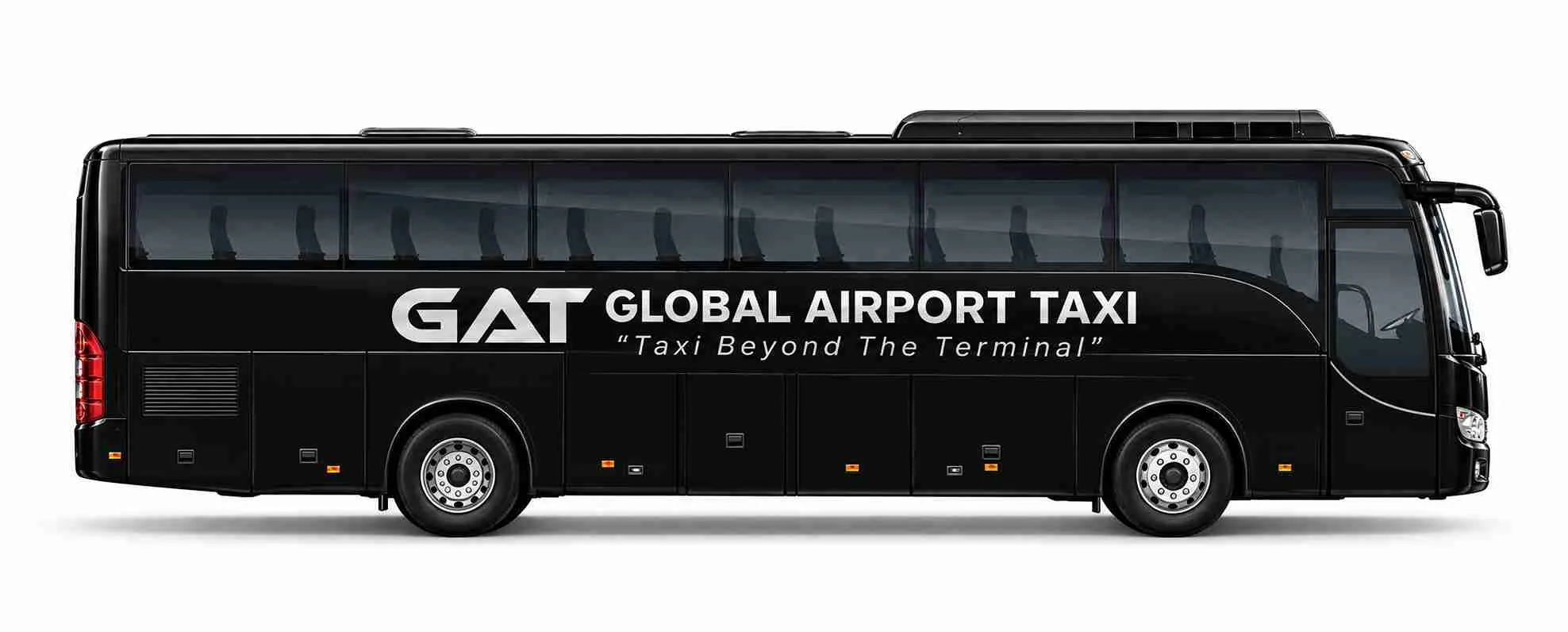
Coach, fifty seatsThe biggest bookable; the street has to suit it.
Five classes were priced and five were not. The five that were not say so, and none of them borrows the figure above it.
How Much Is a Taxi from Heathrow Airport to London Bridge?
The figure, and the published numbers sitting either side of it.
A Heathrow Airport to London Bridge Taxi in a standard car was quoted at £80, with the executive sedan at £108, the five-seat MPV at £118, the seven-seat van at £148 and the eight-seat executive MPV at £181. A quotation belongs to one journey on one day, so the amount for your own terminal, hour and SE1 address is whatever the form gives back when you ask it.
A Heathrow to London Bridge Private Transfer is quoted for the vehicle rather than per head, which is what makes those five figures comparable with anything else quoted here.
A comparable operator publishing a full tariff for this journey lists a saloon at £77, an executive at £102, a five-seat MPV at £93, a seven-passenger eight-seat MPV at £132 and an eight-passenger executive MPV at £162, with 20 miles and one hour ten minutes by the A4. That is one reachable operator publishing a full tariff for the same journey rather than a competitor price list, and it is quoted because it puts the figures above in a context a reader can check.
The brief records five competing pages advertising starting fares of £89, £110, £115, £119 and £143, none of which could be reached from this build and none of which is reproduced as a current price anywhere in what follows. They are recorded in the audit delivered with this build as supplied rather than verified, which is the only honest way to carry a number nobody could re-read.
The screen settles none of the surrounding detail — the date, the hour, the terminal, which SE1 postcode, the direction, or what the label covers contractually — so each figure appears as a quotation rather than as a tariff. Everything here is therefore written so that a single confirmation from the company turns these quotations into approved fares without a sentence of it needing to change.
What a Heathrow to London Bridge Taxi costs
Your own Heathrow to London Bridge Taxi Cost is whatever the form gives back for your date, your hour, your terminal and your SE1 door. The Heathrow to London Bridge Transfer Prices above belong to one journey on one day and are published in whole pounds, so that nobody has to complete a form simply to discover roughly where this route sits.
Pickup
Heathrow (LHR), at the terminal building your own flight is sent to
Terminals served
Terminal 2, 3, 4 and 5, which are the four Heathrow still operates
Destination
London Bridge, SE1 — the station, the Shard, Borough, Bankside, Bermondsey and the riverside
Station
Fifteen platforms, three train operators, and the Jubilee and Northern lines beneath
Distance
About 18 to 21 miles by the existing page, and 20 by a comparable operator
Journey time
About 45 to 70 minutes, with an hour and ten published elsewhere, traffic permitting
Road route
The M4 and the A4 towards central London, then across the river
Congestion Charge
London Bridge is inside the zone; the hours and the amount are set out below
Fare
A fixed quotation shown before anything is agreed
Why the distance is a range. The company’s existing page gives roughly 18 to 21 miles, and a comparable operator publishing the same journey says 20; which SE1 door you are reaching moves the figure inside that range. A tower entrance, a market and a riverside walk are three different endings to the same drive.
Why the time is a range too. The existing page gives about 45 to 70 minutes and the comparable operator one hour ten, and every one of those is a planning figure rather than a promise. No arrival time is promised anywhere here, because the last five miles of this journey belong to central London traffic.
The amounts here are shown in whole pounds as a starting point; the quotation they came from ran to the penny, and which of the two is published is the client’s decision.
What is included
What’s Included in Your Heathrow to London Bridge Fixed Fare?
Inside the quotation, and the eight claims that are not.
A single vehicle carrying you from the terminal your aircraft reaches to the SE1 door written on the booking, for a sum settled in advance. What it is not: a meter, an extra invented on the Old Kent Road, or one SE1 rate pretending the office reception and the viewing gallery are the same arrival.
A Heathrow to London Bridge airport transfer is quoted for the vehicle rather than per passenger, which is the first thing to hold on to when any of this is set against a rail ticket. Each total on that screen carries a TOTAL FARE heading and an All-Inclusive, no hidden fees line, which is the checkout describing itself and not a further promise made here.
What is confirmed
One vehicle, one agreed figure, terminal to the SE1 door on the booking — what is quoted is the car, not the seat, so four people arriving together share a single amount between them.
Put the inbound flight number on the booking and it is followed from that point, which is the mechanism by which a late landing moves the car rather than losing it.
An hour of waiting comes with an airport collection, counted from the moment the wheels touch rather than from the time on the schedule, and a quarter of an hour comes with a pickup at any other address.
A qualifying booking cancelled twenty-four hours or more before the pickup is refunded in full under the published policy and on that policy’s own terms, which are what govern it rather than anything written here.
Child and infant seats are fitted on request and nothing is charged for them.
Where a booking includes the service, somebody stands at the meeting point named in the confirmation holding a board with your name on it.
Space for a wheelchair or a walking frame is something to arrange when the booking is made rather than to assume on the day, and an early request has the best chance of finding the right vehicle free.
The eight claims the brief asked to be checked
The existing page makes eight promises that this build was asked to verify. Not one of them could be, so not one of them is repeated here, and each is on the list the client is being asked to settle.
No hidden charges, as a blanket statement. The screen’s own All-Inclusive label is quoted as the screen’s wording; what it covers contractually is still open.
Wi-Fi in every vehicle. Unverified for this build, so unclaimed.
Identical amenities across the fleet. Nine classes from saloon to fifty-seat coach are not identical in anything, and nothing establishes that they are.
A driver always inside arrivals. The existing page says the driver is always inside arrivals, which nothing seen for this build establishes; the honest version is that the meeting point your confirmation names is the meeting point.
Every late flight carried without extra charge. The existing page promises that every late flight is carried without extra charge; what can be stood behind is an hour of waiting from touchdown and whatever the confirmation says about the time after it.
A return journey at the same amount. No return quotation was produced for this build, so none is published.
Extra luggage never charged. The capacities are published class by class; what happens past them is a question for the booking rather than a promise here.
No card fee under any booking. Unverified, so unclaimed.
Why a page gains from saying this out loud.Every one of those eight sentences is cheap to write and expensive to be wrong about. A quotation that holds, an hour of waiting counted from touchdown and a published cancellation policy are worth more at the kerb than a row of promises nobody has stood behind.
What the executive classes actually buy
A better cabin, and in the executive sedan’s case two additional bags in exchange for one seat. Sitting in London traffic for an hour at each end is long enough to make that a genuine decision rather than an indulgence. The business class transfers page sets out what the class includes.
A checkout label is the checkout describing itself. What it covers contractually is still being established, and the generous reading of it is not assumed anywhere here.
The road
Heathrow to London Bridge – Distance, Route and Travel Time
Twenty miles, one river crossing, and an hour that belongs to the traffic.
The drive leaves the airport for the M4 and the A4, crosses central London or skirts it depending on the hour, and finishes on the south bank at the streets around the station. The company’s existing page gives roughly 18 to 21 miles, and a comparable operator publishing the same journey says 20; which SE1 door you are reaching moves the figure inside that range, and the existing page gives about 45 to 70 minutes and the comparable operator one hour ten, and every one of those is a planning figure rather than a promise.
How Far Is London Bridge from Heathrow Airport?
Two published figures and they agree: the company’s own page gives roughly 18 to 21 miles, and an operator publishing the same journey says 20. What moves inside that range is the SE1 end — the station frontage, a tower entrance and a street behind the market are not the same arrival, and the last half-mile of a central London journey is rarely the straight one.
How Long Does the Road Journey Take?
The existing page gives about 45 to 70 minutes and the comparable operator one hour ten, and every one of those is a planning figure rather than a promise. Treat the top of that range as the planning figure for a weekday afternoon and the bottom of it as what a Sunday morning can do. This is a central London arrival, so the hour decides far more than the mileage: the same twenty miles can be fifty minutes at six in the morning and twice that at five in the afternoon.
Why this journey ends with a river crossing
London Bridge is one of only two mainline terminals south of the river, Waterloo being the other, which is why a journey from a west London airport ends with a river crossing however it is driven. Heathrow is west of the city and London Bridge is on the south bank, so every version of this drive finishes by crossing the Thames. Which bridge it uses is the driver’s judgement on the day and not something a page can promise in advance.
Which way a driver will come
No page can promise which way a driver will come — the M4 and the A4 are the usual line, with the A40, the A406 and the river crossings all in play — and the decision belongs to the hour and the conditions. The M4 and the A4 are the usual line into town; the A40 and the A406 are both in play when something is wrong with it. None of that changes the figure agreed at the booking, which is the entire reason a quotation is settled in advance.
The hour matters more than the mileage.Twenty miles into central London is a different journey at six in the morning and at five in the afternoon, and nothing about the road can be promised around a London rush hour. What can be settled beforehand is the amount.
Miles and minutes below come from the existing page and from an operator publishing the same run, both credited, neither of them a promise about your afternoon.
Heathrow terminals
Heathrow Terminal 2, 3, 4 and 5 Taxi Pickups
The building you land at decides where the car can be, and nothing else.
Four terminals are open at Heathrow and they are numbered 2, 3, 4 and 5; a booking can name any of them. Which one you walk out of changes nothing about the sum agreed and everything about where the car waiting for you is allowed to be. Nothing may collect from a terminal forecourt, because the airport does not permit it; what it does permit is set out building by building below.
The sequence is identical wherever you land — aircraft, immigration, carousel, concourse — and by the time you reach the end of it your confirmation has already told you where to walk. Reclaim is the stage that stretches, and that is precisely why the hour of waiting is counted from the wheels touching rather than from the timetable.
Terminal 2 to London Bridge
The newest of the four, on the central site. You come through into the public hall and walk to the point your confirmation names. The vehicle is waiting in Terminal Parking, a couple of minutes away on the airport’s own measure, paying for every minute it stands. The terminal 2 page covers collections there in general.
Terminal 3 to London Bridge
Its neighbour on the same central site. Arrivals comes out at street level and the parking arrangement does not change from next door. Long-haul landings bunch here, so the reclaim hall is where the hour of waiting usually goes. The terminal 3 page covers collections there in general.
Terminal 4 to London Bridge
Across the runways from the rest, and the odd one out since its multi-storey went. A choice of two and no third option: the Priority Pick-Up bays by the doors, billed on how long the car stands and opening at £7.00, or Zone A at the Park and Ride, where the first two hours are published free. The terminal 4 page covers collections there in general.
Terminal 5 to London Bridge
Out at the western edge, approached on its own road. Terminal Parking again. Leaving from this end of the airport puts a few minutes on the start of the drive, and the traffic somewhere between here and the river usually takes them back. The terminal 5 page covers collections there in general.
Two things the older guidance still gets wrong.There is no Terminal 1 at Heathrow, so anything describing pickups from five terminals is describing an airport that closed years ago. And no pod has ever run to Terminal 4; the pods belong to Terminal 5 and its own car parks, so guidance telling a Terminal 4 passenger to take one is simply wrong.
Terminal 4, which works unlike the rest
Terminal 4 lost its multi-storey, and what replaced it is a choice of two: the Priority Pick-Up bays immediately outside the doors, or Zone A of the Park and Ride further out. The bays are billed by how long a car stays, from £7.00 for ten minutes, and the Park and Ride alternative publishes two hours free. Neither is a charge this company adds: both are the airport’s own, published by the airport.
What the airport charges a vehicle to collect you
At Terminals 2, 3 and 5 the car waits in Terminal Parking, which the airport puts about two minutes from the doors on foot, and pays the airport for the time it stands there. What follows is the airport’s published tariff for that standing time. It is charged to the vehicle by Heathrow, and it is not an addition made here to anything quoted.
Heathrow Terminal Parking, as the airport publishes it for a pick-up
Time in the car park
Charge
Up to 29 minutes
£8.50
30 to 44 minutes
£12.50
45 to 59 minutes
£16.00
Each further hour or part hour
£8.50
Heathrow Terminal 4 Priority Pick-Up, as the airport publishes it
Length of stay
Charge
Up to 10 minutes
£7.00
11 to 29 minutes
£14.00
30 to 60 minutes
£25.00
Each further hour
£25.00
Daily maximum
£200.00
Thirty minutes come free at a Park and Ride, with a bus to the doors roughly four times an hour, and the Terminal 4 arrangement in Zone A publishes two free hours instead of the thirty minutes. Those free minutes explain why a collection occasionally begins with a short bus ride rather than a walk. When a flight is late enough that standing in the car park would run up a bill, the shuttle is the sensible arrangement rather than a downgrade.
Which building you walk out of settles where a car may stand and what the airport takes for standing there. It leaves the agreed sum alone.
The station
London Bridge Station Taxi Drop-Off – Entrances, Ranks and Platforms
The station has more than one kerb, and the booking should say which.
Which entrance you name decides where a car can reasonably stop, and on a station with this many doors that is the single most useful line on the booking. A Heathrow to London Bridge Station Taxi ends at a kerb, and this station has more kerbs than most.
Tooley Street
Main frontage · covered rank
The station’s principal entrance, with the north concourse and ticket machines behind it.
What a driver needsThe busiest kerb on the station and the one most arrivals mean. Network Rail lists the rank here as partially covered.
St Thomas Street
Reception · ticket barrier
The southern side of the concourse, with station reception and a barrier, and the Shard’s hotel and restaurant doors on the same street.
What a driver needsThe right answer for the hotel, the restaurants and the healthcare entrance, and a quieter stop than Tooley Street.
Borough High Street
Western entrance · Underground
The entrance at the western end, giving on to the Underground ticket hall and the Borough High Street traffic.
What a driver needsA main road with its own restrictions; say so on the booking rather than assuming the driver will guess this side.
Station Approach
Uncovered rank · cycle storage
The approach road beside the station, where the bicycle storage is.
What a driver needsOne of the four ranks Network Rail lists, and uncovered.
Bermondsey Street
Uncovered rank
The rank on the Bermondsey Street side, away from the main frontage.
What a driver needsUseful when the Tooley Street kerb is at its worst, and a short walk from the concourse.
The bus station
Covered rank · controlled crossing
The bus station in front of the Shard, used by a long list of London routes.
What a driver needsPartially covered, and reached across a controlled road crossing rather than directly from the concourse.
The platforms, and why the station is a destination
The station has fifteen platforms: nine through platforms numbered 1 to 9 and six terminating platforms numbered 10 to 15. Southeastern, Southern and Thameslink all serve it, which is why it is a destination in its own right rather than only a stop on the way somewhere, and the Underground station beneath it is on the Jubilee line and the Bank branch of the Northern line. A London Bridge Station Taxi Drop-Off is therefore an interchange arrival as often as a final one: people come here to leave again, with the luggage they landed with.
The entrances
The main frontage is on Tooley Street, with further entrances on Borough High Street and St Thomas Street and a station reception at the St Thomas Street barrier. Tooley Street is what most people mean by the station, St Thomas Street is the quieter southern side with the reception on it, and Borough High Street is the western end. A Tooley Street Taxi Drop-Off and a St Thomas Street Taxi Drop-Off are a two-minute walk apart and a different proposition for a driver.
The taxi ranks
Network Rail lists four taxi ranks at the station: a partially covered one on Tooley Street, uncovered ranks on Bermondsey Street and Station Approach, and a partially covered one by the bus station reached across a controlled crossing. A London Bridge Station Taxi Rank is therefore not one place either. For a pre-booked car the rank matters less than the kerb your driver is told to use, which is why the booking asks for the entrance.
Step-free access
The station is step-free category A, with level access to every platform by lift and ramps for boarding trains. That is the station’s own arrangement rather than this company’s, and it is worth knowing before a journey that ends with a connection. Space for a wheelchair or a walking frame is something to arrange when the booking is made rather than to assume on the day, and an early request has the best chance of finding the right vehicle free. The accessible transport guide sets out what can be organised at the car end.
The bus station, and why the kerb is busy
The bus station sits in front of the Shard and is used by a long list of London routes, which is part of why the kerb outside the main entrance is busy at almost any hour. Add the taxi ranks, the coaches and the pedestrian flow between the concourse and the river, and the area immediately outside the main entrance is one of the busier set-down points in south London at almost any hour.
The station is named because that is where passengers are going. Nothing here implies an arrangement with Network Rail, a train operator or Transport for London.
The booking decides the kerb, not the driver.
Four ranks and three main entrances mean the words on the booking do real work here. Tooley Street is what most people picture; St Thomas Street is quieter and closer to the tower; Borough High Street is a main road at the western end.
Name one of them and the last two minutes of the journey stop being guesswork — which matters more at this station than at almost any other in London.
A station with several doors is several arrivals, and the door on the booking is what the figure is built around.
The Shard
Heathrow to The Shard Taxi – Five Entrances, Five Postcodes
One tower, five doors, five postcodes. Pick the right one.
The Shard publishes a separate address for each of its five entrances: the office reception at 32 London Bridge Street SE1 9SG, the viewing gallery on Joiner Street SE1 9QU, the hotel on St Thomas Street SE1 9QU, the restaurants at 31 St Thomas Street SE1 9RY and the healthcare entrance at 32 St Thomas Street SE1 9BS. A Heathrow to The Shard Taxi that arrives at the wrong one of those has arrived at the wrong building as far as the evening is concerned.
The Shard stands immediately beside the station and opened next to it, which is why so many arrivals here are really arrivals at one of its five doors. Which is why so many SE1 bookings that say "the station" actually mean one of these five doors, and why the address line on the form is worth thirty seconds of thought.
The office reception
The London Bridge Street reception is described by the building as strictly for offices, so a visitor arriving for the viewing gallery or a restaurant wants a different door and a different postcode. 32 London Bridge Street, SE1 9SG is the address for a meeting in the tower and for very little else. If the booking says the Shard and nothing more, this is the door a driver will reasonably assume.
The viewing gallery
Joiner Street, SE1 9QU, under the tower beside the station. A visitor arrival with its own postcode and its own queue, and not the office reception. Say "viewing gallery" on the booking and the whole last minute of the journey changes.
The hotel and the restaurants
The hotel entrance is on St Thomas Street at SE1 9QU and the restaurants are at 31 St Thomas Street, SE1 9RY — the same street, different doors. For a late arrival with luggage this is the useful distinction: a hotel door and a restaurant door are not somewhere to be dropped "near".
The healthcare entrance
32 St Thomas Street, SE1 9BS is the fifth published address. An appointment is not an office meeting and not a dinner, and a passenger who names it is set down where they actually need to be.
The amount does not change; the address does.All five doors are the same journey as far as the quotation is concerned. What changes is whether the last two minutes work, and that is settled by what is written on the booking rather than by what the driver guesses at the kerb.
Five entrances, five postcodes, one tower: the amount does not change between them, but the address on the booking certainly does.
SE1 destinations
Borough, Bankside, Bermondsey and the SE1 Addresses Around the Station
SE1 is a district, not an address.
The market, the riverside and the Bermondsey Street side are separate arrivals inside one postcode district. Each is quoted to its own door, and each has a different answer to the only question a driver has: where can the car actually stop?
SE1 9The station itself, the Shard’s office, hotel, restaurant and healthcare doors, St Thomas Street and Joiner Street
What that means here. The tightest arrival on the route. Four of the Shard’s five entrances carry an SE1 9 postcode and they are not interchangeable, so the door belongs on the booking.
SE1 1Borough Market, Southwark Street and Borough High Street
What that means here. Market ground, and the streets around it are pedestrianised in parts and loaded with deliveries in others. The market publishes cab set-down points all around its edge.
SE1 2The Queen’s Walk, London Bridge City Pier, HMS Belfast and the riverside
What that means here. A walking address rather than a driving one: the riverside walk is reached on foot from Tooley Street, and the pier is about five minutes from the Underground station.
Bermondsey Street and the Tower Bridge Road sideThe streets south-east of the station, towards the zone boundary
What that means here. Still an SE1 arrival but a different approach entirely, and the Congestion Charge boundary runs along Tower Bridge Road beside it.
Borough Market
Borough Market gives its address as 8 Southwark Street SE1 1TL and describes itself as right next to London Bridge station, with cab pick-up and drop-off points all around it. A Heathrow to Borough Market Taxi therefore ends on one of those edges rather than inside the market, because the lanes through it are not driveable and were never meant to be. Southwark Street and Borough High Street are the usual answers.
Bankside, Southwark and the riverside
A Heathrow to Bankside Taxi and a Heathrow to Southwark Taxi are both ordinary street arrivals; what catches people out is the riverside itself. The Queen’s Walk is a walking route from end to end, so a booking for anything along it is quoted to the nearest driveable street and the last part is done on foot.
London Bridge City Pier
London Bridge City Pier is on The Queen’s Walk at SE1 2QP, beside HMS Belfast, and its operator calls it a five-minute walk from the Underground station. A Heathrow to London Bridge City Pier Taxi is a useful booking for anybody carrying on by river — but the operator states plainly that the pier is not accessible: there is no ramp for prams, wheelchairs or mobility scooters, and those passengers are directed to Bankside Pier instead, which is the sort of detail that decides a journey rather than decorating it.
What else is within a short walk
The pier’s own page names HMS Belfast, the View from the Shard, Borough Market, City Hall, Southwark Cathedral, Tower Bridge, the Golden Hinde and the London Bridge Experience as its neighbours. That is the pier’s own list rather than a recommendation from anybody here, and it is a fair description of what sits within a few minutes of the station on foot.
Bermondsey Street and the Tower Bridge Road side
A Heathrow to Bermondsey Taxi approaches from a different direction entirely and is worth naming as such. It is also the side of the station where the Congestion Charge boundary runs, which the next section deals with properly.
These places are named because travellers ask for them by name. Nothing in the list implies a tie of any kind with a market, a hotel, an attraction or a river operator.
An SE1 postcode is not one place. The market, the riverside and the Bermondsey Street side are quoted to their own doors.
Road charges
Congestion Charge and ULEZ for a London Bridge Arrival
An SE1 arrival is inside the zone. Here is what that means.
The Congestion Charge zone is bounded south of the river by Tower Bridge Road, New Kent Road, Elephant and Castle, Kennington Lane and the Vauxhall one-way system, and London Bridge sits inside that ring. This is the part of a London Bridge arrival that a transfer page owes its readers, because the address is inside the boundary rather than comfortably outside it.
£18
Congestion Charge, per day
07:00 to 18:00 Monday to Friday, 12:00 to 18:00 at weekends and on bank holidays, and nothing at all between Christmas Day and the New Year bank holiday. Paying after travel raises it to £21.
Where it appliesLondon Bridge is inside the zone. The boundary south of the river runs Tower Bridge Road, New Kent Road, Elephant and Castle and Kennington Lane, and the boundary roads themselves are not charged.
£12.50
Ultra Low Emission Zone, per day
Twenty-four hours a day, every day of the year except Christmas Day, for a car or van that does not meet the emissions standard.
Where it appliesEvery London borough is inside it, so this one is not about where in London you are going but about which vehicle is sent.
Is London Bridge Inside the Congestion Charge Zone?
Yes. The ring road forming the boundary is not itself part of the zone, so a vehicle can drive the boundary without entering it — but an SE1 address north of New Kent Road and west of Tower Bridge Road is inside. The station, the tower, the market and the riverside are all north and west of those roads, so a car reaching any of them in charging hours has entered the zone.
The hours, and the amount
It runs from 07:00 to 18:00 Monday to Friday and from 12:00 to 18:00 at weekends and on bank holidays, with no charge at all between Christmas Day and the New Year bank holiday. The charge is £18 for the day when it is paid in advance or on the day of travel, rising to £21 if it is paid by midnight on the third day afterwards. An arrival at eleven on a Saturday morning is outside the hours; the same arrival at one in the afternoon is inside them, which is the sort of thing worth knowing before a bill rather than after one.
The Ultra Low Emission Zone
The Ultra Low Emission Zone covers every London borough, operates twenty-four hours a day every day except Christmas Day, and costs £12.50 a day for a car or van that does not meet the standard. This one is not about where in London you are going at all: every borough is inside it, so the question is which vehicle is sent rather than which address it is sent to.
What is not claimed about either charge.Whether either charge is ever added to a quotation on this route is not something this build could establish, so nothing is claimed in either direction and the question is on the list the client is being asked to settle. Both are set out here with their publishers because an arriving passenger should know they exist; neither is described as included in, or added to, anything quoted.
Neither road charge is part of a figure quoted here until the company says so in writing, which is why this section states both and claims neither.
Families and groups
Heathrow to London Bridge Family and Group Minicabs
Count the cases first, then the seats.
Every priced class publishes two numbers, and the second one is the one that catches people. A party that fits a vehicle on seats can miss it comfortably on hold cases, and a central London kerb is a poor place to discover that.
Families with children and pushchairs
Children are counted like everybody else, and their ages decide which seats are correct. Child and infant seats are fitted on request and nothing is charged for them. A pushchair takes roughly the space of a hold case and is wanted at both ends of the journey, so it belongs on the booking rather than in the boot as a surprise. The family transfers guide works through the choice, and the child seat guide deals with the seats themselves.
Five, seven and eight travelling
Five people and three hold cases is the MPV exactly as it is published. Add two more travellers and the van takes over, at seven bags and six suitcases. At eight the executive MPV is the only single vehicle — and it publishes seven suitcases, not eight, so a party of eight each with a large one needs two cars or a minicoach. Settle that at the booking rather than on a pavement in SE1.
Hotel arrivals and the awkward items
A folding wheelchair, a mobility scooter, a cello, a pair of golf bags: each one is a shape rather than a weight, and shape is what defeats a boot. Name them on the booking. Space for a wheelchair or a walking frame is something to arrange when the booking is made rather than to assume on the day, and an early request has the best chance of finding the right vehicle free. The hotel transfers page covers arrivals at an SE1 hotel door, which on this route is a large share of them.
Parties arriving on different flights
Give each arrival its own booking and its own flight number. Keeping one vehicle standing for a second landing is dearer than two collections timed properly, and it drags everybody on to the later of the two clocks. Past sixteen seats the answer depends entirely on what is free on the date, which is what the group airport transfers page is for.
One amount for the car, however many of you share it.
Where a rail ticket is bought per head, this is bought once. For a party of four landing together that is the whole argument, and it holds for a journey that finishes in the middle of London.
Which car arrives is settled by the luggage. Count the hold cases first, add the pushchair and anything with an awkward shape, and treat the number of passengers as the second question rather than the first.
Counting heads is the straightforward part of a family booking. Counting the suitcases is what actually determines which vehicle turns up.
Going back
London Bridge to Heathrow Airport Taxi – The Return Journey
Westbound, with a check-in desk waiting at the far end of it.
The westbound journey carries its own quotation, and it is not the inbound one reversed. Arriving, the clock belongs to the aircraft and a late landing simply pulls the collection along with it. Departing, the clock belongs to an airline desk that closes when it closes, and the traffic on the A4 is not consulted.
What a London Bridge to Heathrow Minicab is quoted on
The London Bridge to Heathrow Taxi Cost is built from the pickup address, the date and the hour, exactly as the inbound figure was, and a London Bridge to Heathrow Fixed Fare Taxi is agreed before anything is committed in the same way. A London Bridge to Heathrow Executive Transfer is the same journey in the better cabin. No westbound quotation was produced for this build, so no London Bridge to Heathrow Taxi Price is printed here — and the claim on the existing page that the return costs the same amount is one of the eight this build could not verify.
What time to leave SE1 for a flight
Start at the desk closing and count backwards, taking the unkind end of every figure. Seventy minutes of road on a bad morning, plus whatever your airline wants of you once you are inside the terminal. A car leaving SE1 at eight in the morning is not making the same journey as one leaving at two in the afternoon, and the sum almost always lands earlier than anybody would like.
Early departures from a station hotel
A London Bridge to Heathrow Early Morning Taxi is a booking rather than a hope: a pre-dawn departure from an SE1 hotel is before the Underground opens and well before the charging hours start. The late-night and early-morning page sets out what an unsociable hour involves. Whether the hour changes the figure has not been established for this build, so nothing is claimed either way.
Which terminal you are flying from
The departure terminal belongs on a westbound booking too. Four buildings do not treat a kerb the same way, and the airport publishes its drop-off charges here. A London Bridge to Heathrow Terminal 5 Taxi follows the same road as one to Terminal 2 and separates from it only at the airport boundary.
The journey home is quoted on its own from its own address, and an early departure is a booking rather than something to arrange on the night.
Train or Tube
Heathrow to London Bridge by Taxi, Elizabeth Line and Underground
The railway is quick to London. It is not quick to this station.
No train runs from Heathrow to London Bridge without a change: the Elizabeth line does not call there at all, and the usual rail answer is the Elizabeth line to Bond Street and then five stops on the Jubilee line through Green Park, Westminster, Waterloo and Southwark. That is the whole comparison in one sentence, and it is the reason this route is a car journey more often than the map suggests.
Heathrow to London Bridge by car, Elizabeth line and Underground
How you travel
Where it starts
What it involves
What it costs
Where it leaves you
Private transfer
The terminal your aircraft reaches
A car held for your flight, one driver, and the luggage handled once at each end.
A quoted figure for the vehicle, from £80 for the standard car
The SE1 door on the booking — a station entrance, a tower door or a hotel
Elizabeth line, then the Jubilee
A Heathrow rail station
Elizabeth line to Bond Street, then five stops on the Jubilee line through Green Park, Westminster, Waterloo and Southwark. One change, with the luggage.
A ticket each, so the cost rises with the party
The Underground station beneath London Bridge, and the walk up to whichever door you wanted
Piccadilly, District and Jubilee
The Underground station at the terminal
Piccadilly line to Hammersmith, District line to Westminster, Jubilee from there. Three trains.
Bought per traveller, and usually the cheapest ticket
The same Underground station, after the longest of the three journeys
Hired car
An airport desk
Paperwork, the same roads, and then somewhere to leave it in SE1.
A day rate, the fuel, and somewhere to leave it in SE1
Wherever you can park it, which near this station is its own problem
Is There a Direct Train from Heathrow to London Bridge?
No. No train runs from Heathrow to London Bridge without a change: the Elizabeth line does not call there at all, and the usual rail answer is the Elizabeth line to Bond Street and then five stops on the Jubilee line through Green Park, Westminster, Waterloo and Southwark. The other common rail answer is the Piccadilly line to Hammersmith, the District line to Westminster and the Jubilee line from there, which is three trains rather than two. Either way the railway puts you under the station rather than at the door you asked for, which for somebody with hold luggage is the difference that matters.
What the railway does better
The airport has three rail stations and six trains an hour between them and central London, which is the part of the comparison the railway genuinely wins. For one traveller with a cabin bag at five in the afternoon the train is quicker than any car, and no honest comparison pretends otherwise. Elizabeth line travel from Heathrow starts at £13.90 for journeys that start, end or pass through Zone 1, and no London Bridge figure is published, so no rail fare for this journey is quoted here.
The detail that catches arriving passengers out
Oyster cards and Travelcards are not accepted west of West Drayton, which is the detail that catches arriving passengers out at the airport barrier. It is the sort of thing a first-time visitor discovers at a barrier with a queue behind them. Two changes with hold luggage at the busiest hours is the part of the rail route the timetable does not show, and it is the reason most arriving families do not take it.
Best Way to Get from Heathrow to London Bridge
For one or two people travelling light and not in a hurry, the railway. For a family, a party with hold luggage, a late arrival, or anybody who needs to reach a specific door rather than a station, the car. A car is not automatically the better answer; the party size, the luggage, the hour and whether anybody is meeting you decide it, and a single traveller with a cabin bag will usually be quicker and cheaper on the railway.
Nothing above is a recommendation of a railway or a hire company, and no rail fare for this journey is quoted here: those figures belong to their publishers and change without notice.
A rail ticket is bought per traveller and a car is quoted per vehicle, which is most of what the comparison below is actually weighing.
Tracking and changes
Flight Tracking, Meet & Greet, Waiting and Cancellations
When the aircraft is late and when the plan changes: who carries the cost.
Put the inbound flight number on the booking and it is followed from that point, which is the mechanism by which a late landing moves the car rather than losing it. On a route that ends at a specific door in a busy district, that is the single most useful thing a pre-booked transfer does.
The waiting allowance
An hour of waiting comes with an airport collection, counted from the moment the wheels touch rather than from the time on the schedule, and a quarter of an hour comes with a pickup at any other address. The counting is the part worth understanding. A flight that lands two hours behind schedule has used none of its allowance at the moment it touches down, because the clock starts there. Beyond that hour the confirmation sets out what applies, and nothing here offers unlimited free waiting.
Heathrow Airport Taxi Meet and Greet London Bridge bookings
Where a booking includes the service, somebody stands at the meeting point named in the confirmation holding a board with your name on it. Your confirmation shows the driver and vehicle details. The existing page says the driver is always inside arrivals, which nothing seen for this build establishes; the honest version is that the meeting point your confirmation names is the meeting point. The meet and greet page sets out what the service covers, and the Heathrow pickup guide goes through the terminals one by one.
Changes, cancellations and no-shows
A qualifying booking cancelled twenty-four hours or more before the pickup is refunded in full under the published policy and on that policy’s own terms, which are what govern it rather than anything written here. A change of date, address, terminal or vehicle class is an amendment rather than a fresh booking, and early notice makes it a smaller job. The refund and cancellation policy governs both cases. Failing to appear without telephoning is treated differently from cancelling, and that difference is in the policy rather than in this paragraph.
Cancelled flights and diversions
Tell the company as soon as you know. A diversion to another airport is a different journey and is quoted as one. We are a booking platform. Your transfer is carried out by a licensed operator under the arrangements in your confirmation.
What is not guaranteed, said once and plainly.No arrival time, no unlimited delay cover, no automatic refund. What is offered is a tracked arrival, an hour of waiting from touchdown, a published cancellation policy and a figure agreed in advance.
A late aircraft changes when the car arrives and nothing about what was agreed for it; time used past the included hour follows the confirmation rather than anything written in this section.
Why book here
Why Book with Global Airport Taxi?
Only the things that can be checked.
Everything in the list below has a publisher standing behind it, and that was the only condition for being on it. No fleet count, no star rating, no tally of completed journeys, no awards and no description of what is waiting inside the car: none of that survived checking, so none of it is here.
Five figures off a screen, and five rows left empty. the estate, both larger MPVs, the minicoach and the coach all came back without a price, and an empty row is published as an empty row rather than being filled from the line above it.
One figure for the vehicle. what is quoted is the car, not the seat, so four people arriving together share a single amount between them.
The inbound flight followed by number. put the inbound flight number on the booking and it is followed from that point, which is the mechanism by which a late landing moves the car rather than losing it.
An hour of waiting at the airport. an hour of waiting comes with an airport collection, counted from the moment the wheels touch rather than from the time on the schedule, and a quarter of an hour comes with a pickup at any other address.
A published cancellation policy. a qualifying booking cancelled twenty-four hours or more before the pickup is refunded in full under the published policy and on that policy’s own terms, which are what govern it rather than anything written here.
No charge for a child seat. child and infant seats are fitted on request and nothing is charged for them.
The station’s own doors, named. Network Rail lists four taxi ranks at the station: a partially covered one on Tooley Street, uncovered ranks on Bermondsey Street and Station Approach, and a partially covered one by the bus station reached across a controlled crossing.
The tower’s five addresses, published as five. the Shard publishes a separate address for each of its five entrances: the office reception at 32 London Bridge Street SE1 9SG, the viewing gallery on Joiner Street SE1 9QU, the hotel on St Thomas Street SE1 9QU, the restaurants at 31 St Thomas Street SE1 9RY and the healthcare entrance at 32 St Thomas Street SE1 9BS.
Both road charges, with their hours. the Congestion Charge zone is bounded south of the river by Tower Bridge Road, New Kent Road, Elephant and Castle, Kennington Lane and the Vauxhall one-way system, and London Bridge sits inside that ring.
A named operator. We are a booking platform. Your transfer is carried out by a licensed operator under the arrangements in your confirmation.
What you will not be told here
What hour you will reach SE1. What an unpriced class costs. That the return journey costs the same. That every vehicle has Wi-Fi, or that the fleet is identical from a saloon to a fifty-seat coach. That a driver is always inside arrivals. That a late flight is carried free of charge however late it is. That luggage beyond the published capacity is never charged. Each of those is a claim the existing page makes without pausing, and not one of them could be stood behind here.
Everything still unanswered has been written down instead of being quietly dropped, and the fare at the top of the page leads that list: a round number somebody can actually book, or the pence restored. The client settles it with one decision.
Nothing in the list above arrived without a publisher attached, and nothing that was left blank has been quietly filled in from the line before it.
Questions
Frequently Asked Questions About Heathrow to London Bridge Transfers
Twenty answers, each leading with the answer.
Each of the twenty opens with the answer and explains afterwards. No figure appears below that has not already been published higher up with its source attached — the quotation screen, Heathrow, Network Rail, the tower, the market and the published charge rules.
How much is a taxi from Heathrow to London Bridge?
The screen returned £80 for the standard car, £108 for the executive sedan, £118 for the five-seat MPV, £148 for the seven-seat van and £181 for the eight-seat executive MPV. All five belong to a single journey on a single day; yours comes from the form rather than from this list.
Can I book at that starting figure exactly?
Not yet, and the audit delivered with this build opens with that question. What the screen actually returned was £80.98. The whole-pound amount in the heading is a starting point, and the brief is explicit that the two must never be presented as the same thing.
Is the Heathrow to London Bridge taxi fare fixed?
For the journey the form was asked to price, yes: one car, one agreed sum, and no meter running in the back of it. Anything added afterwards sits outside that figure — a second address, or time used beyond the included hour — and the confirmation spells both out.
How much is an executive sedan to London Bridge?
£108, for three people with four bags and two suitcases. You are trading one seat for two extra bags and a considerably better hour, and on a route that spends most of itself in London traffic that is worth a thought.
How much is an MPV to London Bridge?
The five-passenger MPV was quoted at £118 with four bags and three suitcases. No six-seat fare came back at all, and the brief forbids inventing one, so that row asks for a live fixed fare instead.
Which vehicle seats eight?
The executive MPV at £181. Its published capacity is seven bags and seven suitcases, so eight people each bringing a large case need two vehicles or a minicoach. And the van is a seven-seater whatever is written on the back of it.
How far is London Bridge from Heathrow Airport?
The existing page gives roughly 18 to 21 miles and an operator publishing the same journey says 20. Which SE1 door you are reaching moves the figure inside that range.
How long does the drive take?
About 45 to 70 minutes by the existing guidance, with one hour ten published elsewhere. None of them is a promise: twenty miles into central London is a different journey at six in the morning and at five in the afternoon.
Is there a direct train from Heathrow to London Bridge?
No. The Elizabeth line does not call at London Bridge at all. The usual rail answer is the Elizabeth line to Bond Street and then five stops on the Jubilee line; the other is three trains by way of Hammersmith and Westminster.
Is London Bridge inside the Congestion Charge zone?
Yes. The boundary south of the river runs along Tower Bridge Road, New Kent Road, Elephant and Castle and Kennington Lane, and the station sits inside that ring. The boundary roads themselves are not charged.
What are the Congestion Charge hours and the amount?
07:00 to 18:00 Monday to Friday and 12:00 to 18:00 at weekends and on bank holidays, with nothing charged between Christmas Day and the New Year bank holiday. It is £18 a day paid in advance or on the day, and £21 if it is paid by midnight on the third day afterwards.
Is the Congestion Charge included in the fare?
Nothing seen for this build establishes that either way, so neither is claimed. It is on the list the client is being asked to settle, and until that is answered the honest position is that the quotation covers the drive.
What about the ULEZ?
The Ultra Low Emission Zone covers every London borough, runs twenty-four hours a day except on Christmas Day and costs £12.50 a day for a car or van that does not meet the standard. It is a question about which vehicle is sent rather than about where in London it is going.
Which entrance should I use at London Bridge station?
Tooley Street is the main frontage, St Thomas Street is the southern side with station reception, and Borough High Street is the western end. Network Rail lists four taxi ranks across Tooley Street, Bermondsey Street, Station Approach and the bus station, so name the one you want.
Which Shard entrance do I need?
The tower publishes five: the office reception at 32 London Bridge Street SE1 9SG, the viewing gallery on Joiner Street SE1 9QU, the hotel on St Thomas Street SE1 9QU, the restaurants at 31 St Thomas Street SE1 9RY and the healthcare entrance at 32 St Thomas Street SE1 9BS. Name yours on the booking.
Can you drop me at Borough Market?
At its edges, yes. The market gives its address as 8 Southwark Street SE1 1TL and publishes cab pick-up and drop-off points all around it; the lanes through the market itself are not driveable.
Is the station step-free?
Network Rail describes London Bridge as step-free category A, with level access to every platform by lift and ramps for boarding trains. London Bridge City Pier, by contrast, is not accessible: its operator directs wheelchair and pram users to Bankside Pier instead.
Do you track my flight?
Put the inbound flight number on the booking and it is followed from that point, which is the mechanism by which a late landing moves the car rather than losing it, and an hour of waiting comes with an airport collection, counted from the moment the wheels touch rather than from the time on the schedule, and a quarter of an hour comes with a pickup at any other address. A long delay moves the collection rather than the figure. What will not be said here is that every late flight is carried without any extra charge, because nothing establishes it.
Is the return journey the same price?
No westbound quotation was produced for this build, so no return figure is published here and the claim on the existing page that the return costs the same is one of the items the client is being asked to confirm or remove.
Do I pay more for extra luggage?
Every class publishes its bag and suitcase counts, and those are the numbers the booking is built on. What happens beyond them belongs to the booking rather than to a promise here: the existing page’s claim that extra luggage is never charged could not be verified.
Anything the twenty leave unanswered is worth a message rather than a search: the contact page reaches the team that arranges these transfers, and the general questions page covers the ones that are not route-specific.
None of the twenty answers below introduces a figure of its own. Each one repeats what has already been published higher up, rounded and described the same way.
Book
Book Your Heathrow to London Bridge Fixed Fare Taxi
Eleven fields, and the first of them does most of the work.
A quotation is free and arrives long before any commitment. Four answers build the amount between them — the SE1 address, the date, the hour and the class — and it appears on screen while nothing has yet been agreed. The field carrying the weight on this route is the address: one district holds a station with several doors, a tower with five, a market that cannot be driven into and a riverside that is a footpath.
Give the SE1 door, not just the postcode districtThe station, the tower, the market and the riverside are four different arrivals inside one district, and the Shard alone has five published addresses.
Name the station entrance if the station is the destinationTooley Street, St Thomas Street and Borough High Street are different kerbs with different restrictions, and the ranks are spread between four streets.
Say which terminal the flight lands atIt is on the boarding pass. Answer Terminal 4 with particular care: the collection arrangements there are not the ones that apply at the other three buildings.
Set the date in London timeDepartures that cross a night arrive on the following calendar day. What this field wants is the London date printed against the arrival, not the one you left on.
Copy the flight number across exactlyThe airline code and the digits, exactly as the ticket shows them. A single wrong character and the tracking has nothing to follow.
Count the passengers, infants includedAn infant on a lap in the air still needs a place in the car. Three adults and two small children make a booking for five.
Count the hold cases honestlyThe case count decides the vehicle more often than the seat count does, and a boot that is one suitcase short is discovered at the kerb.
Ask for child seats by ageThe age decides which seat is the right one. There is no charge for fitting them, and each one occupies a seat.
Say if you are arriving in the charging hoursAn SE1 arrival is inside the Congestion Charge zone, and asking now is how you find out what that means for the booking rather than afterwards.
Add any second stop before you acceptDropping one passenger at a hotel and another at an office is two addresses, and the figure is built from the route rather than from the destination alone.
Read the amount, then accept itIt was built from the answers above and it is what the booking is taken at. Accepting it brings back a confirmation carrying the class, the meeting point and a telephone number.
The form will Book Heathrow to London Bridge Taxi journeys in both directions at once if you want it to. A Heathrow to London Bridge Fixed Price Minicab, a Heathrow to London Bridge Door-to-Door Taxi and a Heathrow Arrivals to London Bridge Taxi are three names for one arrangement: a single vehicle at a single agreed amount, terminal door to SE1 door.
Asking what it costs commits you to nothing at all: the figure arrives first and the decision comes afterwards.
Where to go next: the Heathrow terminal you are collected from, the other London airports, the guides worth reading before you book, and the small print behind all of it
Book Your Heathrow to London Bridge Fixed Fare Taxi — one vehicle, one amount, one door.
Give the door first — which entrance of the station, which of the Shard’s five addresses, which side of the market, or the hotel by name — because inside one postcode district those are genuinely different arrivals. The rest is quick: the terminal you land at, the date in London time, the flight number, and honest counts of travellers and hold cases, which decide the vehicle more often than the seats do. Ask for the journey home at the same time.