Is EuroAirport in France or in Switzerland?
In France. The whole airport stands on French soil, in the communes of Saint-Louis, Hésingue and Blotzheim, in the Haut-Rhin.
Cheap airport transfers
EuroAirport Basel-Mulhouse-Freiburg (BSL / MLH / EAP) · Two sectors, one terminal
EuroAirport Basel-Mulhouse-Freiburg — the airport calls itself the world’s only binational airport, and no one disputes it. It stands on French soil near Saint-Louis, it is run jointly by France and Switzerland, and it has two public exits: walk out of one and you are in France, walk out of the other and you are in Switzerland, with no French customs post in between. That single fact decides which taxi may collect you, which of two regulated tariffs applies and which currency you pay in. Basel, Mulhouse, Colmar, Freiburg, Zürich, the Black Forest, the wine route or a ski valley.
 Every flight, both sectors
In brief
Each of these is taken further below. The first five exist at no other airport in Europe.
The short answer EuroAirport Basel-Mulhouse-Freiburg stands on French soil but is run jointly by France and Switzerland, and it has two public exits: the French sector puts you in France and the Swiss sector puts you in Switzerland, each with its own regulated taxi tariff in its own currency.
What a journey costs depends on the date, the hour, the vehicle and the side of the airport you leave from. The booking page works yours out and shows it before the payment step, and it does not move once you accept it.
Quick answers
Just the answer. Every one of them has a section of its own further down, and all nine appear in full in the question list at the end.
In France. The whole airport stands on French soil, in the communes of Saint-Louis, Hésingue and Blotzheim, in the Haut-Rhin.
The one on the side of the border where you are going. The French sector puts you in France; the Swiss sector puts you in Switzerland without passing a French customs post.
BSL is the Swiss code, MLH the French one, and EAP covers both.
Francs in the Swiss sector and euros in the French one, and the two are not interchangeable.
Reported at about CHF 50 on the meter, and basel.com’s own guide gives about CHF 40 from the city in the other direction.
The airport publishes about €60 to €65 by day and €85 to €90 at night.
The airport publishes about €125 to €135 by day and €170 to €180 at night.
About €155 to €165 by day and €225 to €235 at night from the French sector, and a reported flat CHF 340 from the Swiss side.
They are the four tariffs, and C and D are double the per-kilometre rate of A.
The two sectors
This is the thing that makes EuroAirport different from every other airport you have flown into, and almost no transfer page explains it.
The short answer EuroAirport has a French sector and a Swiss sector: the French one puts you in France under the Haut-Rhin taxi tariff in euros, and the Swiss one puts you in Switzerland by a customs road into Basel, under the Basel-Stadt tariff in francs.
France
Puts you in France, in the Haut-Rhin. The taxis here run on the French departmental tariff in euros, and the buses go to Saint-Louis, into Germany and on to Freiburg. Use it for Alsace, for Germany and for anywhere in France.
Switzerland
Puts you in Switzerland, through a customs road into Basel, with no French post in between. The taxis here run on the Basel-Stadt ordinance in francs, and bus 50 reaches Basel SBB in about 20 minutes. Use it for Basel and the rest of Switzerland.
| What it decides | French sector | Swiss sector |
|---|---|---|
| Which country you are standing in | France | Switzerland |
| Which taxis may collect you there | French, on the Haut-Rhin tariff | Swiss, on the Basel-Stadt tariff |
| Which currency the meter runs in | Euros | Swiss francs |
| Where the buses go | Saint-Louis, Lörrach, Weil am Rhein and Freiburg | Basel SBB, every 7 to 10 minutes |
| Which car park | F1 | S1 |
| What a lost parking ticket costs | A reported €5 | A reported CHF 5 |
| The road out | The A35 into Alsace | A customs road straight into Basel |
| What it costs to get it wrong | A national border between you and your driver | The same, in the other direction |
The terminal has a French half and a Swiss half, side by side, with a customs point between them. Inside, you can walk from one to the other. Outside, you cannot: the two forecourts are in different states, and the drive between them is far longer than the walk through the building. Of everything on this page, it is the mistake we are asked about most, and it is made with luggage.
A road about two and a half kilometres long runs from the Swiss sector into Basel without passing a French customs post. It is why an airport in France can serve as Basel’s airport at all, and why a Swiss taxi can work here without crossing a border. It also means the Swiss sector is, for practical purposes, Switzerland.
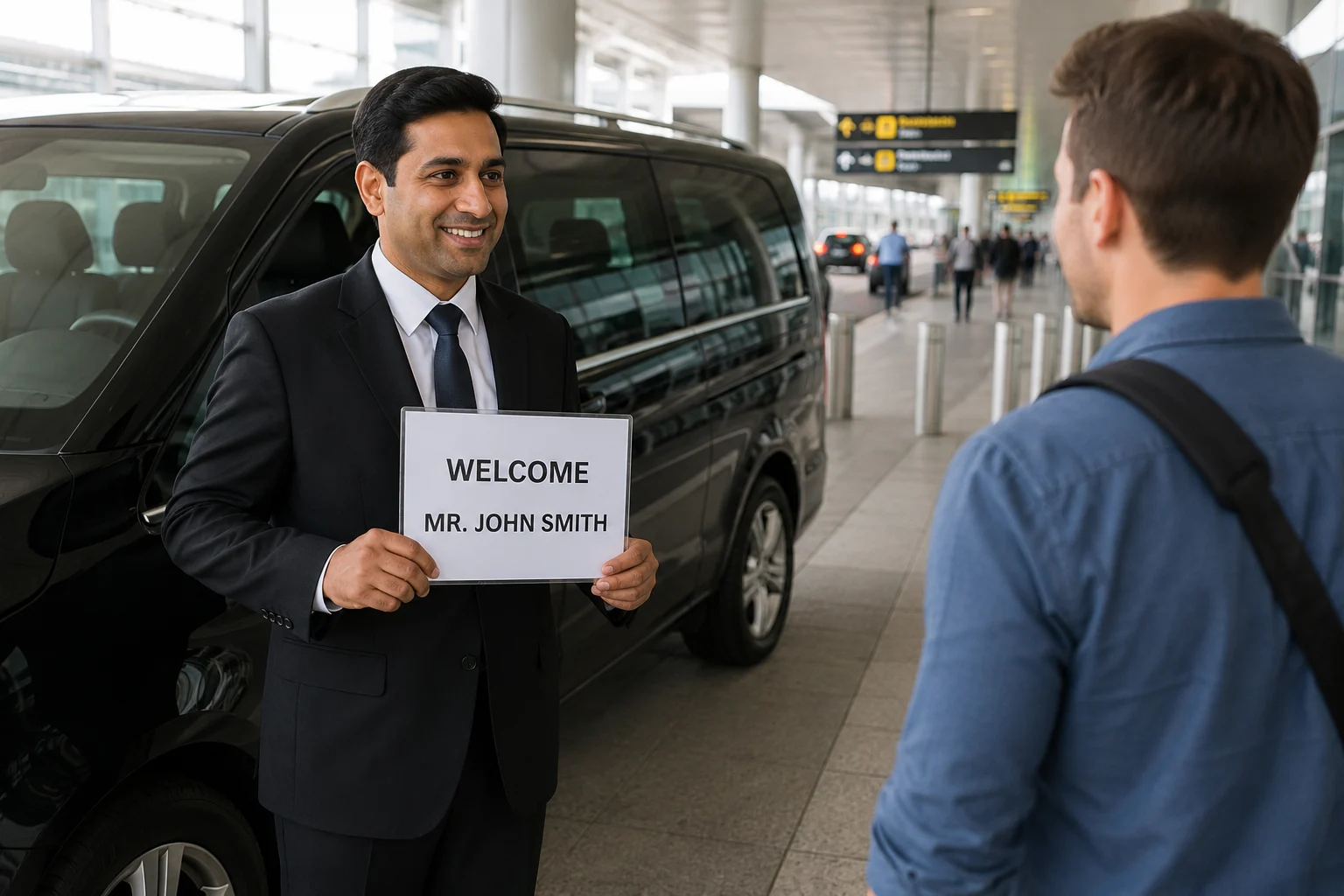
By the destination. Tell us where you are going and the sector is chosen for you, the right licence is sent, and the confirmation names the hall before you fly. Nothing is decided at a kerb with a trolley.
Sector arrangements, bus stops and car park rules are the airport’s own and do change. Read the airport’s own transport pages in the week you fly.
Start here
Five things, in this order, and the first is not the booking form. Settle them and the journey itself asks nothing of you.
The short answer To arrange a private taxi at EuroAirport, settle the destination first because it decides which sector you leave from, then give the full address, count the large bags including skis, put the flight number on the booking, and ask for seats or a language while you book.
Each step decides the next. The destination sets the sector, the address sets the fare, the bag count sets the vehicle, the flight number sets the time. Do them in that order and nothing has to be improvised in an arrivals hall that happens to be in a different country from your hotel.
Walk towards the sector your confirmation names. There is no rank to join, no app to open, no currency to choose and no price to agree, because all of that happened before you flew. If the board is not where you expect it, ring the number in the confirmation while you are still inside.
A figure here depends on the day, the hour, the vehicle and the side of the airport you leave from. Yours is calculated on the booking page, shown before you pay, and then held.
Our vehicles
Nine classes, from an executive car for three to a 50-seater coach. The figure buys the vehicle rather than a seat in it, so the number that settles the choice here is usually the ski bags or the trade-fair cases.
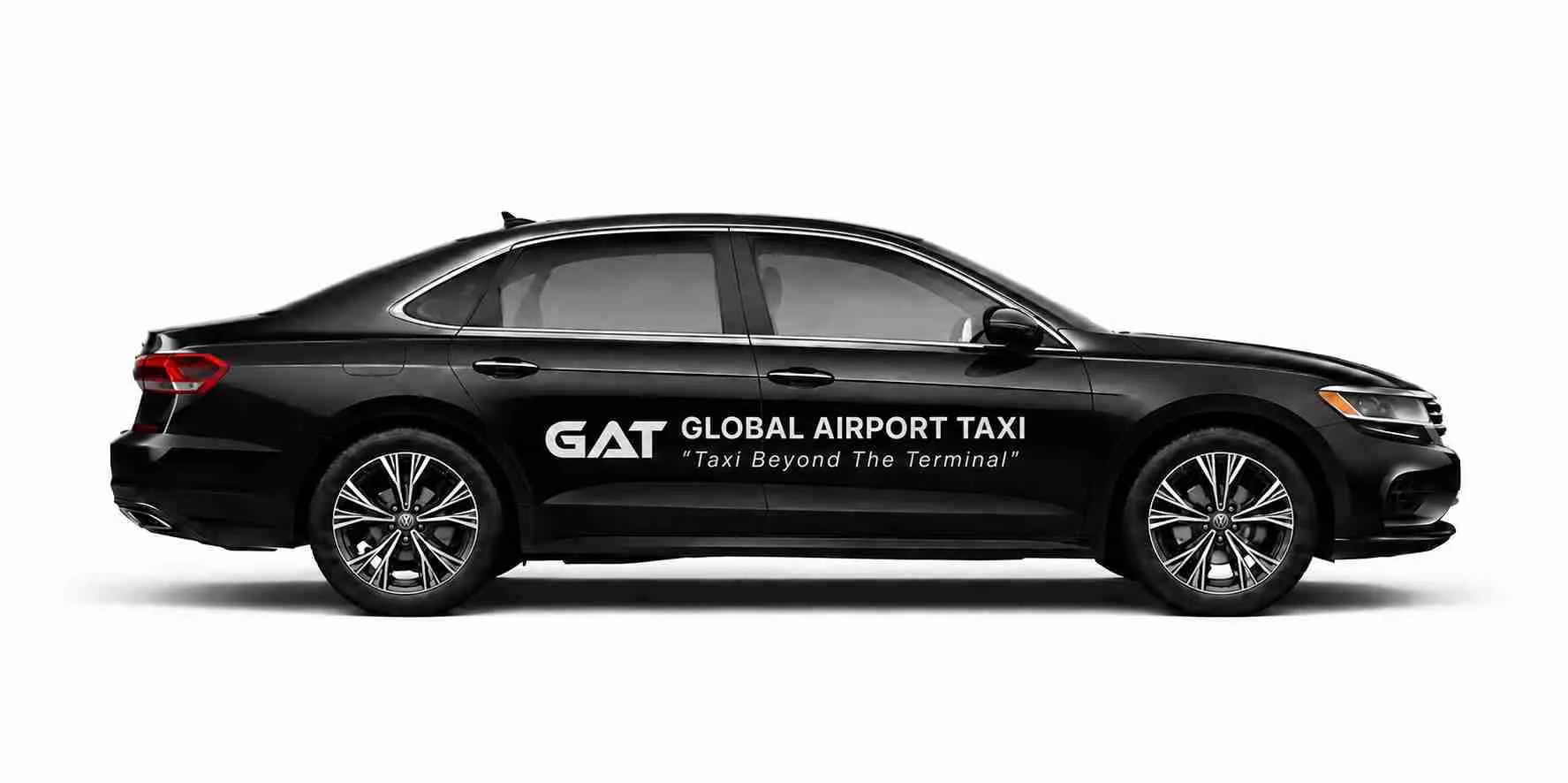 Class example: Volkswagen Passat or similar
Saloon taxi
4 passengers, 2 large bags
Two people, or one, with cases that behave.
View vehicle →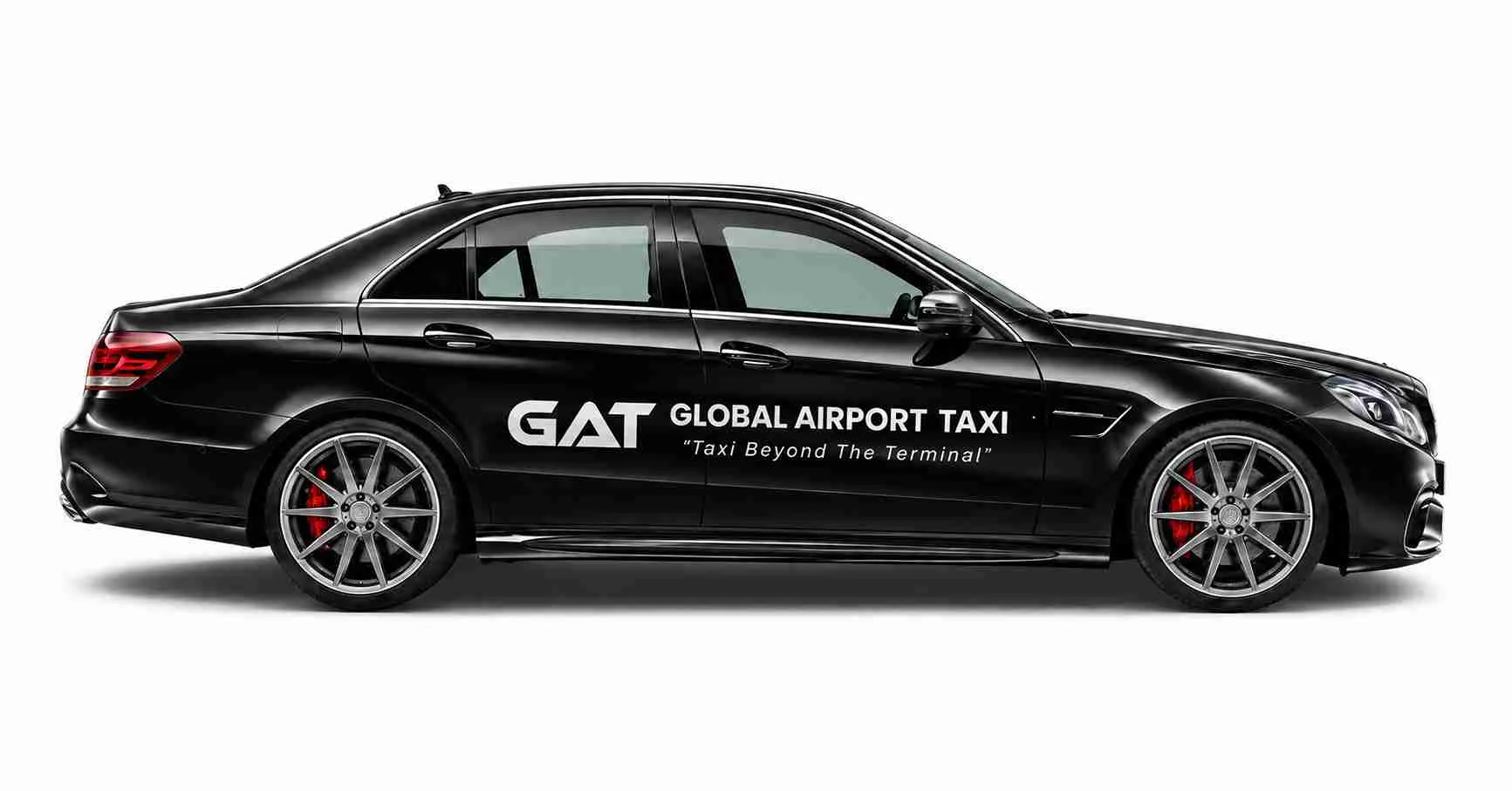 Class example: Mercedes E-Class or similar
Executive car
3 passengers, 2 large bags
When the arrival itself is part of the meeting.
View vehicle →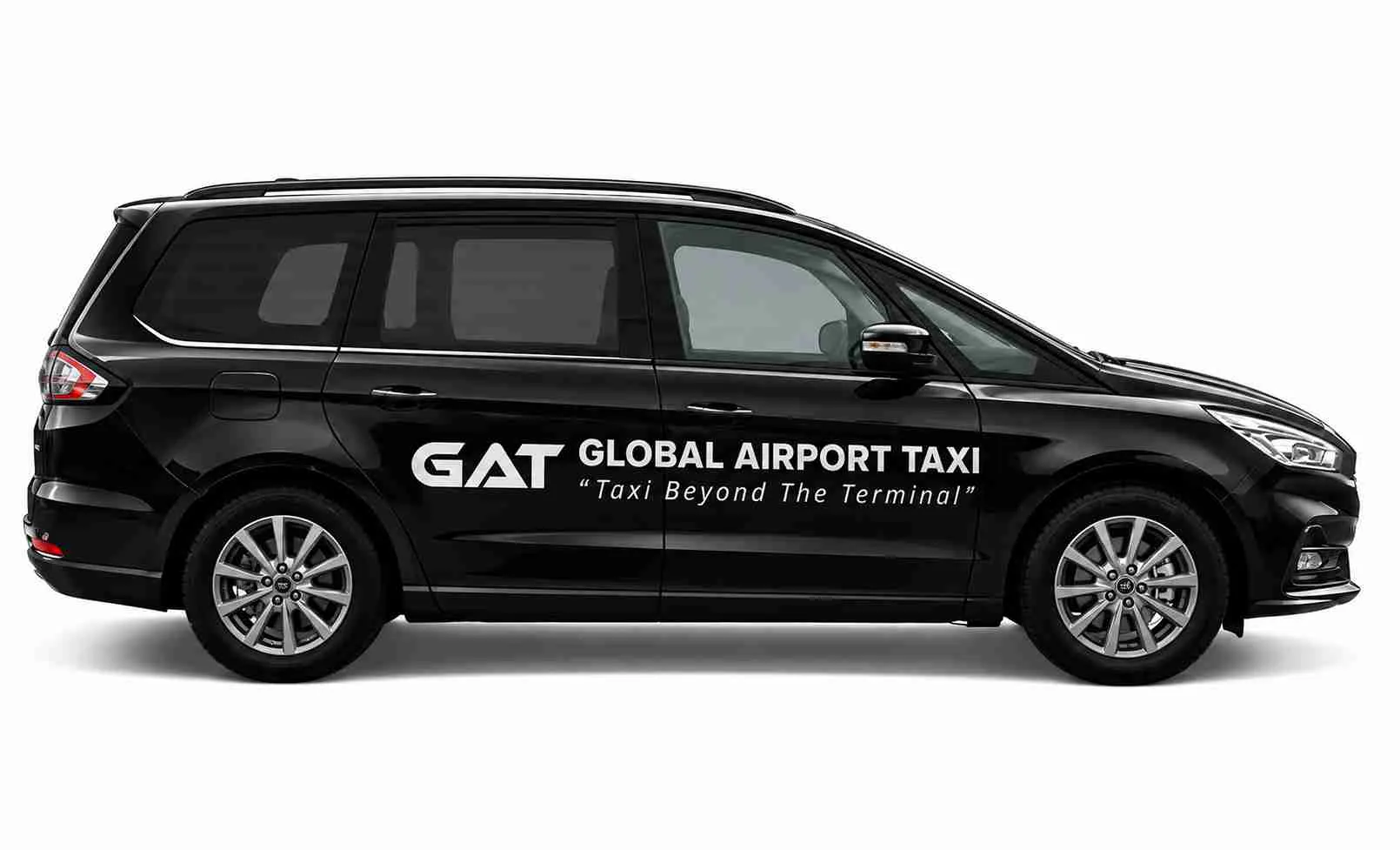 Class example: An estate taxi
Estate taxi
4 passengers, 3 large bags
Four, once the boot of a saloon has been ruled out.
View vehicle →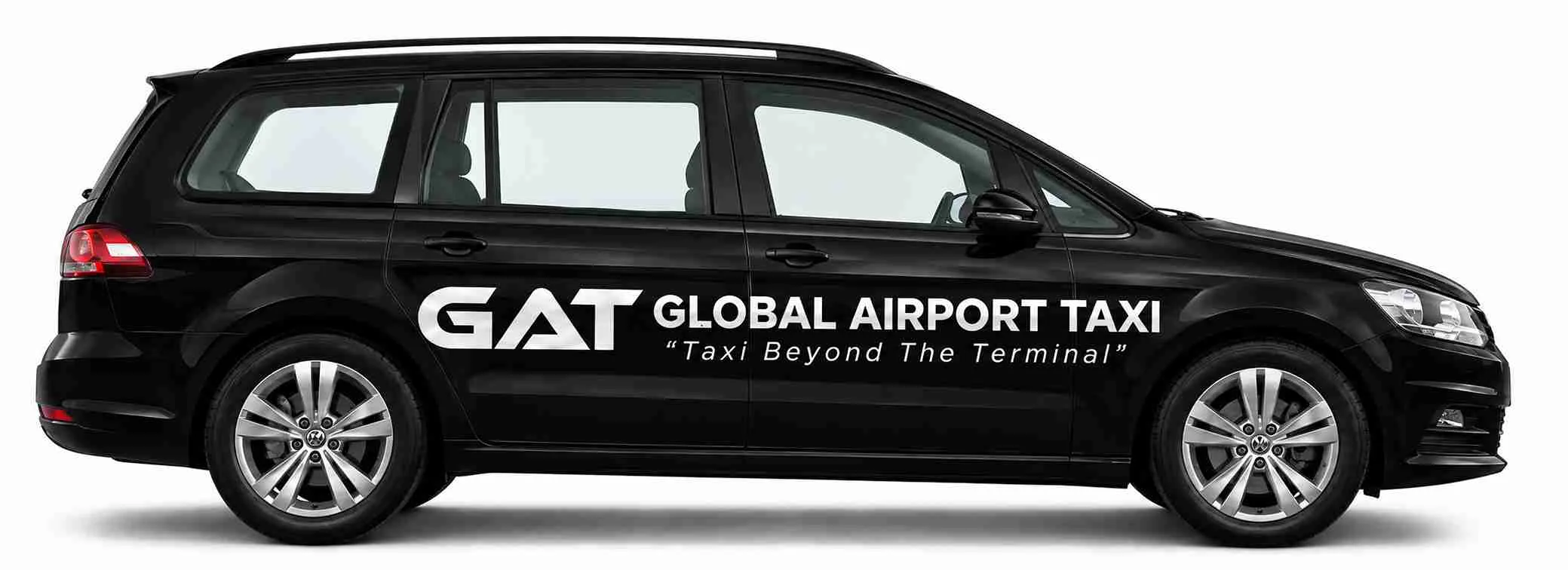 Class example: 6-seater MPV people carrier
People carrier
Room for five or six, and four or five large bags
A family of five or six, with the pushchair still up.
View vehicle →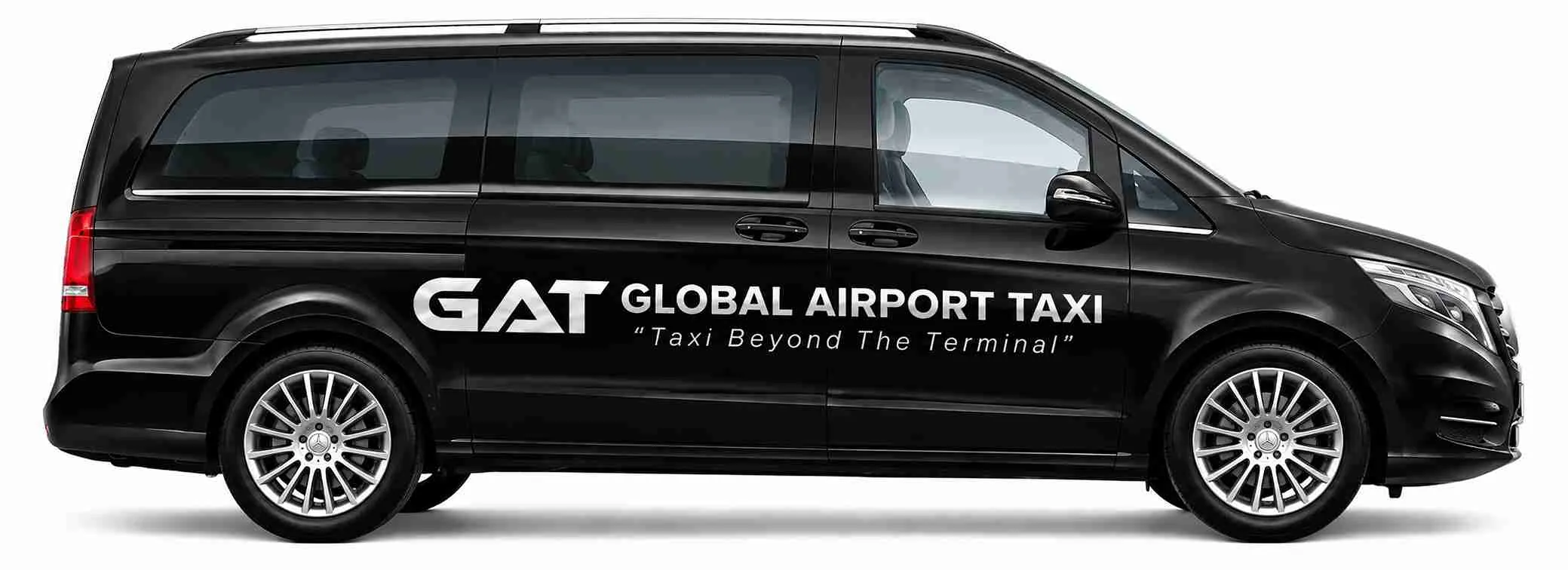 Class example: A 7 seater taxi
7 seater taxi
7 passengers, 7 cabin bags
Seven, packed with some restraint.
View vehicle →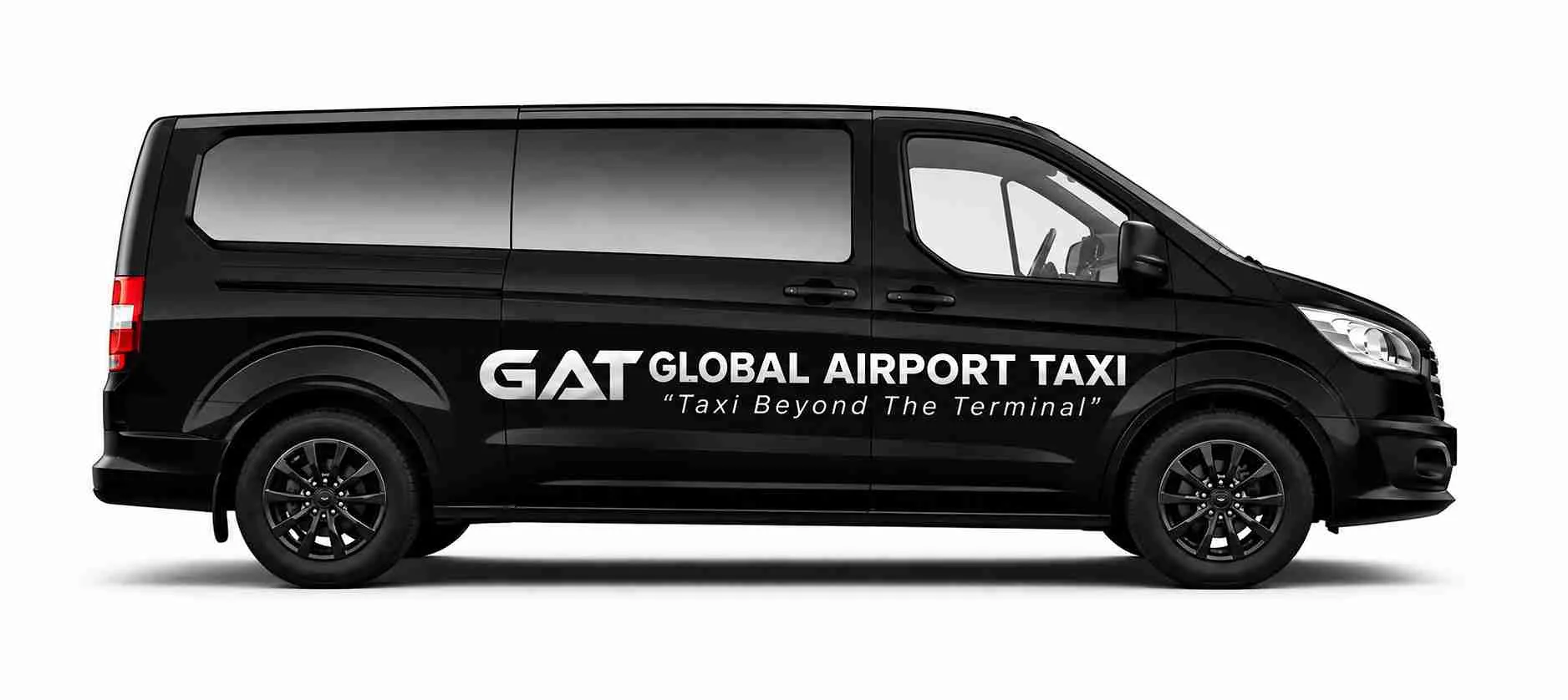 Class example: An 8 seater taxi
8 seater taxi
Eight seats, six to eight large bags
Eight aboard, or six with skis between them.
View vehicle →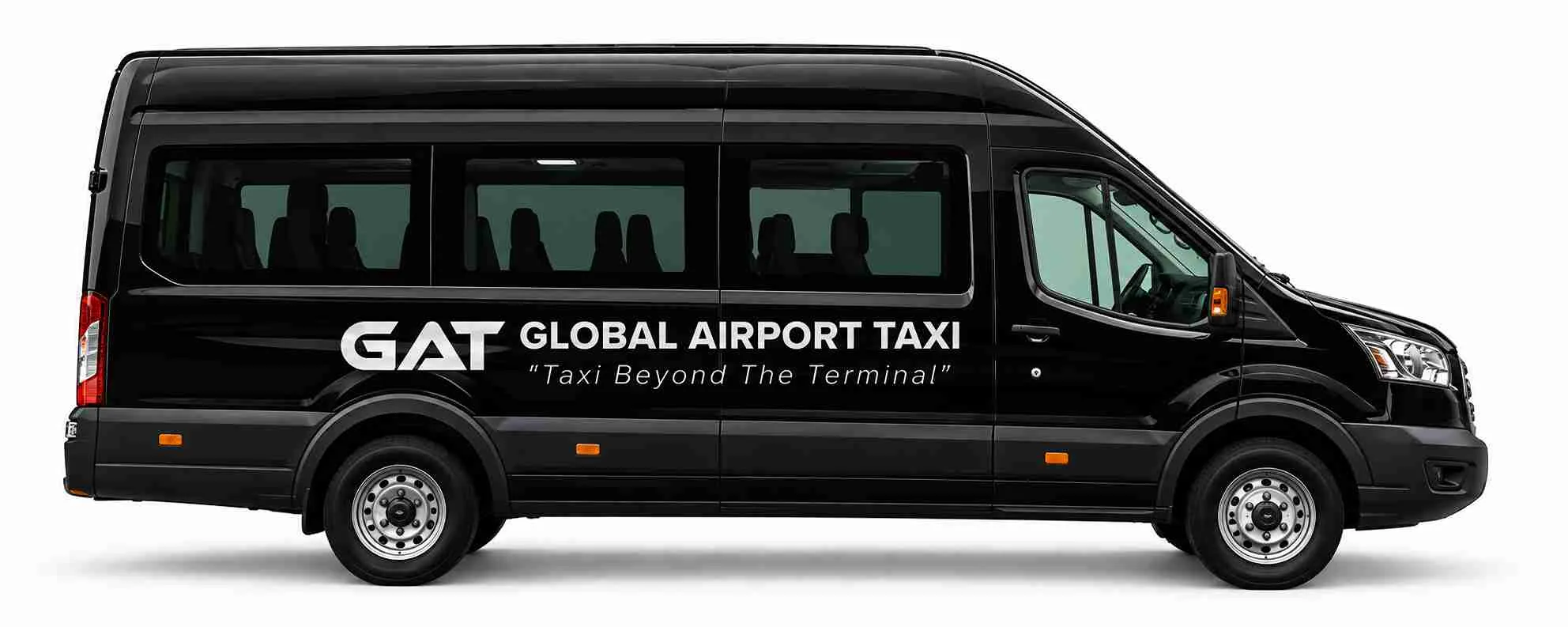 Class example: A 16 seater minibus
16 seater minibus
Sixteen seats and about fourteen large bags
Congress delegations, choirs and touring parties.
View vehicle →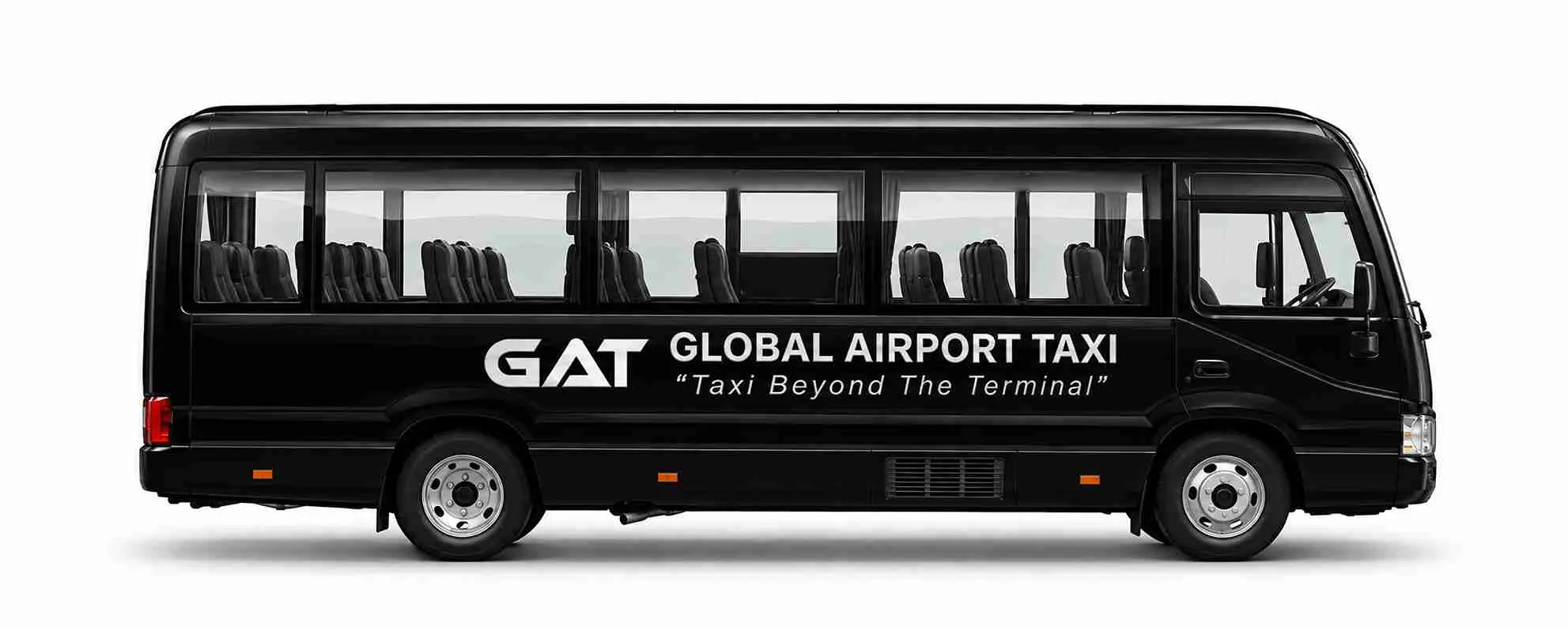 Class example: A 30-seater coach
30-seater coach
30 seats
Trade-fair groups arriving on one flight.
View vehicle →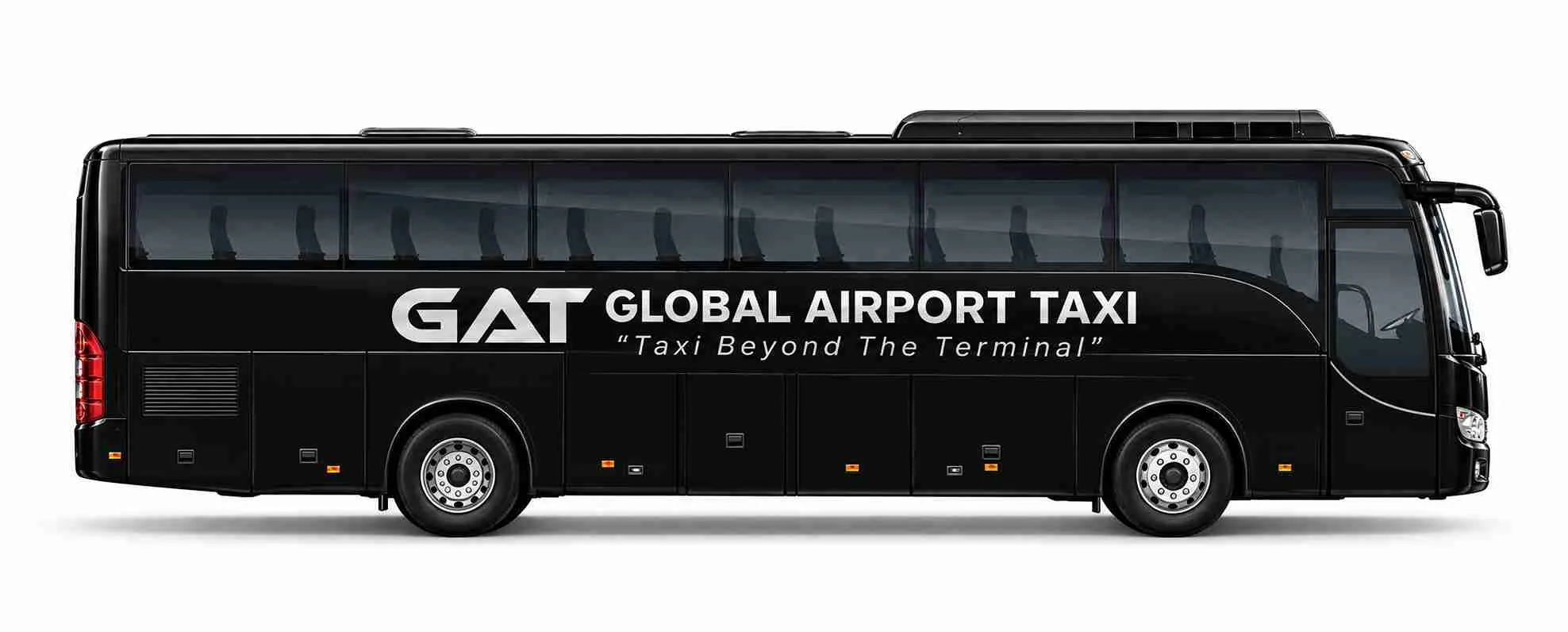 Class example: A 50-seater coach
50-seater coach
50 seats
Large events and incentive travel, settled months out.
View vehicle →| Extra | What to know |
|---|---|
| Child seats | Infant, child and booster seats are fitted on request and add nothing to the figure. France and Switzerland both require a restraint for small children, and the rules are not identical either side of this border, so put each child’s age on the booking. |
| Skis, boards, bikes | Carried, provided they are declared. Give the item and its length and a vehicle with the load space behind the seats is allocated. |
| Wheelchair-accessible vehicles | Ask on the booking and a suitable vehicle is confirmed for that route and that date. |
Every vehicle is shown on our fleet page. The photographs stand for the class rather than naming the car, and your quote says what is offered. Send the party size and the bag count and the allocation follows.
Reviews
The scores below are the ones our review widget publishes, checked on 14 October 2026. Every one was written by somebody we carried, at one of the airports on the network. A selection is shown here and each stays published where its author left it.
Excellent4.9453 reviewsShowing all 10 reviews
Excellent service...arrived at terminal and driver was waiting...helped with luggage to the car...smooth drive...perfect overall
Very reliable and easy to get a hold of. I was very confused leaving the airport - user error haha - and they were super helpful. My flight was also delayed and the guy who picked me up was on top of it.
Super affordable and professional service! The pricing was very clear from the start, with no hidden charges, which I really appreciated. Everything went smoothly, and the professionalism of the global airport taxi service stood out. Highly recommended for anyone looking for a hassle-free and budget-friendly option.
Amazing taxi service to the airport! Our driver was friendly, on time, and made the whole trip so easy. The car was clean and comfortable, and we got to the airport right on time. Would definitely use this service again!
Excellent service , driver waited for us as flight was delayed, clean car and smooth ride
I would totally recommend Global Airport Taxi to anyone needing a taxi service for their airport commute. I decided on way to the airport that I was flying out of that I will need a cab service at LHR. They were quick to respond to and accommodated some of my last minute schedule change requests after I had landed at LHR. Totally reliable and willing to be flexible. Outstanding customer support provided by Jennifer and Root. Keep it up guys !!
This was a brilliant service our driver was excellent he was friendly and helpful. Used again for the return journey and driver was professional and ensured we made it to the airport on time with heavy traffic
The service was extremely reliable. My cab arrived exactly on time for my early morning flight, which was a huge relief. Everything went smoothly, and I felt confident choosing this service. Highly recommend global airport taxi for stress-free airport transfers!
Amazing customer service, on time driver helped with cases. A pleasant experience Thank you
Very clean car and on time very polite driver will use them again
These scores cover the whole network rather than Basel by itself. Trustindex supplies the widget, and every review appears as its author wrote it.
The airport in numbers
The figures a transfer here actually turns on, with everything taken from a published source marked as reported.
The short answer EuroAirport handled a reported 9.6 million passengers in 2025, its busiest year, serving about 113 destinations with roughly 35 airlines from a single terminal split into a French and a Swiss sector.
Traffic and investment figures are restated from time to time; check anything you are planning around against the airport’s own publications.
BSL, MLH, EAP
Harmless at the airport, expensive at the booking stage, and a source of genuine confusion in between.
The short answer EuroAirport Basel-Mulhouse-Freiburg is sold as BSL in Switzerland, MLH in France and EAP for both; they are one terminal, and the only practical difference is that the same seat can be priced differently under each code.
| Code | Belongs to | Where you will meet it |
|---|---|---|
| BSL | Switzerland | What a Swiss booking, a Swiss timetable and most of the airlines use |
| MLH | France | What a French booking uses. A flight between MLH and another French airport can be sold as a domestic route |
| EAP | Both | The neutral code for the airport as a whole, used where neither country wants precedence |
| LFSB | Air traffic | The four-letter code on the flight plan, not on your ticket |
The commercial name is EuroAirport Basel-Mulhouse-Freiburg. In English the official name is Basel-Mulhouse International Airport; in French it is Aéroport de Bâle-Mulhouse, and in German you will see Flughafen Basel-Mülhausen. Swiss sources tend to write Basel first, French sources Bâle, and German timetables Mülhausen. They are one airport, one terminal and one runway, and a booking made under any of those names arrives at the same kerb.
There is one terminal, one apron and one set of aircraft. The codes exist because two countries have equal standing here and neither will use the other’s. It is harmless on the day and awkward at the booking stage, because a search under one code and a search under the other can return different fares for the same seat.
Nothing, provided the booking says where you are going. We use BSL because that is what appears on most boarding passes, and the destination is what settles the sector. If your ticket says MLH, it is the same airport and the same terminal.
The Swiss tariff
The canton publishes its maximum tariffs. Here they are, with the two clauses that decide an airport fare.
The short answer Basel taxis run on cantonal maximum tariffs reported at CHF 6.50 to start, CHF 3.80 a kilometre on weekdays inside the canton and CHF 4.30 at night, on Sundays and outside it; EuroAirport is outside the canton, so an airport journey sits on the higher rate at every hour.
| What | Reported maximum | When it applies |
|---|---|---|
| Base charge | CHF 6.50 | Where the meter starts |
| Per kilometre, tariff 1 | CHF 3.80 | Weekdays 06:00 to 20:00, inside the canton |
| Per kilometre, tariff 2 | CHF 4.30 | Nights 20:00 to 06:00, Sundays and public holidays, and anywhere outside the canton |
| Waiting, per hour | CHF 70.00 | If the meter is held |
| Ordering a car | CHF 2.80 | Added when the taxi is called rather than hailed |
| Ordering a large car | CHF 12.80 | The supplement for a Grossraumtaxi |
| Child seats | CHF 15.00 | Per booked journey, however many are fitted. Booster cushions are free |
The canton of Basel-Stadt sets a ceiling rather than a fare. A Basel taxi may charge less and may agree a fixed price above it, but it may not exceed these figures on the meter. They are published by the canton itself, which is why this page can print them at all.
EuroAirport is in France. Every journey between it and Basel therefore crosses the cantonal border, which puts it on the higher rate at any hour of any day. A two o’clock Tuesday afternoon run into the city is on the night-and-Sunday rate, and nothing about the clock changes that.
The ordinance also allows the driver to charge for the empty run back to the cantonal border when a journey starts or ends outside it, provided you were told in advance. On a short airport hop that is a large share of the total, and it is one of the things standing between the plain meter and the figure the airport publishes.
The Swiss figures in this section are the Basel-Stadt taxi ordinance, which sets maximum tariffs, reported from the canton’s own published text. They are not prices of ours and we do not control them.
Whatever this journey comes to, it is settled on the booking page in a single currency before any money moves, and it stays there.
The French tariff
The departmental tariff, reported for 2026, and the four-letter system that decides which half of it you pay.
The short answer French taxis here run on the Haut-Rhin tariff, reported for 2026 at €2.80 to take charge and €2.20 a kilometre by day, but tariffs C and D apply when the taxi returns empty and charge double, a reported €4.40 a kilometre.
| What | Reported | The detail |
|---|---|---|
| Taking charge | €2.80 | Where the meter starts |
| Per kilometre, daytime | €2.20 | 07:00 to 19:00, on tariff A |
| Per kilometre, night | €3.08 | 19:00 to 07:00, Sundays and public holidays, on tariff B |
| Per kilometre, empty return | €4.40 | Tariff C: double the daytime rate |
| Waiting and slow running, the hour | €33.14 | When the wheels are not turning |
| Minimum fare | €8.00 | Whatever the meter shows |
| Luggage that will not fit | €2.00 | A supplement |
| From the fifth passenger | €4.00 | Each |
| Receipt | From €25.00 | Required by law above that, and on request below it |
| Letter | When it applies | What it costs |
|---|---|---|
| A | Daytime, and the taxi has a return fare | The cheapest of the four |
| B | Night, Sunday or a public holiday, with a return fare | Reported at €3.08 a kilometre |
| C | Daytime, and the taxi returns empty | Double the A rate: a reported €4.40 a kilometre |
| D | Night or Sunday, and the taxi returns empty | Double tariff B, so a reported €6.16 a kilometre |
French taxi meters run four tariffs. A and B assume the taxi has a fare for the return journey; C and D assume it comes back empty, and they charge double the kilometre rate to cover it. The letter is displayed on the meter, and almost nobody looks at it.
The airport is the far end of the journey for a French taxi. A long run from here into Alsace, or over the Rhine into Germany, is exactly the case where the driver returns empty. Ask which tariff is running before the car moves, because on a 60-kilometre run to Colmar the difference between A and C is the difference between a reported €2.20 a kilometre and €4.40.
No letters, no columns and no hours. One figure, worked out for your journey on your date in the vehicle you chose, visible before you pay and fixed once you accept it. Whether it beats a meter depends on the hour and the distance, which is precisely why the meter is printed above it.
The French figures in this section are the Haut-Rhin departmental taxi tariff, reported for 2026 from an operator’s published schedule. They are not prices of ours, they are revised annually, and the page you are reading may be behind them.
Tariffs on both sides of this border are revised, and so are we. Only the figure the booking page puts in front of you binds either of us.
The published fares
Six journeys with a published figure, set beside our own road distances and against the two tariffs, so you can see whether they agree. Three of the four do; the fourth we explain rather than paper over.
The short answer The airport publishes about €60 to €65 by day for a French-sector taxi to Mulhouse, €125 to €135 to Colmar and €155 to €165 to Freiburg, and on the Swiss side a reported CHF 50 to Basel and flat rates of CHF 340 to Freiburg and CHF 440 to Zürich.
| Where | By day, reported | At night, reported | Distance |
|---|---|---|---|
| Mulhouse city centre | €60 to €65 | €85 to €90 | about 26 km |
| Colmar city centre | €125 to €135 | €170 to €180 | about 60 km |
| Freiburg im Breisgau | €155 to €165 | €225 to €235 | about 72 km |
| Where | Reported | What kind of figure it is |
|---|---|---|
| Basel | CHF 50 | the metered fare, reported |
| Freiburg im Breisgau | CHF 340 | a reported flat rate |
| Zürich | CHF 440 | a reported flat rate |
Indicative fares published in the airport’s own transport pages, reported here. They are not our prices and we do not control them. The French ones are quoted from the airport; the Swiss ones are quoted towards it, which is the direction the Basel operators publish.
Run the reported daytime rate of €2.20 a kilometre against 26 kilometres to Mulhouse and you land at the bottom of the published €60 to €65 band. Do the same for Colmar at 60 kilometres and Freiburg at 72, and both land inside their bands too. The Swiss side is less tidy, and we would rather show it than hide it: CHF 6.50 plus 8 kilometres at the out-of-canton rate of CHF 4.30 comes to CHF 40.90, while the airport publishes CHF 50. The difference is about what an order fee and a few minutes of waiting at a rank would add, and the Swiss figure is quoted towards the airport rather than away from it. Three of the four check out inside their bands. The fourth is close enough to explain and not close enough to claim, which is why we print the published figure rather than our own arithmetic.
Freiburg appears in both tables: a reported €155 to €165 by day from the French sector, and a reported flat CHF 340 from the Swiss side. Same city, same road, two countries of origin. Nothing else we publish makes the point as plainly.
The French figures in this section are the Haut-Rhin departmental taxi tariff, reported for 2026 from an operator’s published schedule. They are not prices of ours, they are revised annually, and the page you are reading may be behind them.
The Swiss figures in this section are the Basel-Stadt taxi ordinance, which sets maximum tariffs, reported from the canton’s own published text. They are not prices of ours and we do not control them.
None of these numbers is a quote for your journey. That one is built from your date, your party and your bags, and it appears before the payment step.
What the market charges
The commonest question here is what a car costs. Rather than answer it with one number, here is the band, with the date it was collected and what makes it so wide.
The short answer Other operators publish starting figures from about CHF 45 to about €113 for a transfer from EuroAirport into Basel, and from about €65 to about €221 to Colmar, collected on 15 October 2026; they are starting figures for the smallest car, they move constantly, and none of them is a quote.
| Where | Lowest published | Highest published | What the spread tells you |
|---|---|---|---|
| Basel city centre | CHF 45 | €113 | Quoted in francs by the Swiss operators and in euros by the booking platforms. |
| Mulhouse | €40 | €65 | The narrowest band on this page, and the shortest cross-border run. |
| Colmar | €65 | €221 | The widest band we found: more than three times between the cheapest and the dearest. |
| Freiburg im Breisgau | €90 | €221 | A German destination priced by French, Swiss and platform operators alike. |
| Zürich | CHF 200 | CHF 250 | Long-distance, and the one journey where the published rank fare sits above the band. |
| Strasbourg | €299 | €299 | One published figure only, so there is no band to show. |
| Class | Swiss operator, from | Platform, from |
|---|---|---|
| Saloon or economy | CHF 60 | €113 |
| Estate or standard sedan | — | €145 |
| People carrier or van | CHF 70 | €145 |
| Executive or first class | CHF 80 | €260 |
| 8-seater or large van | CHF 80 | €246 |
| Minibus | CHF 250 | €361 |
Because the commonest question at this airport is what a car costs, and the honest answer is that it depends on who you ask. 4 operators publish a figure for the run into Basel and the cheapest is a third of the dearest. A page that quoted one number and called it the going rate would be telling you less than this table does.
Different vehicles counted as the same class, two currencies converted at different moments, some figures that include the vignette and tolls and some that do not, and platform figures that already carry a booking commission. Comparing them like for like is most of the work, which is why the band is wide rather than because somebody is being dishonest.
Not from this table. Our figure is worked out for your actual journey, vehicle and party size on the booking page, shown before you pay, and then held. We print the band so you can see where that figure sits, not so you can read a price off it.
These are not final prices and they do not stay still. Every figure above is a starting figure taken from another operator’s public page on 15 October 2026, usually for the smallest car and two or three passengers. They move with the season, the hour, the vehicle, the number of bags, demand on the day and the rate between the franc and the euro, and a trade fair or a school holiday moves them further. None of them is a quote, and none of them is ours. Treat the band as the shape of the market, not as a price list, and read your own figure off the booking page before you pay.
Everything printed here can move with the season, the hour and the exchange rate. The number you accept on the booking page cannot.
Which kind of car
Two countries regulate this airport, which means two sets of rules for the car at the kerb and only one arrangement that can promise a figure in advance.
The short answer A rank taxi at EuroAirport charges a regulated meter, in euros on the French sector and francs on the Swiss one; a booked transfer carries a figure agreed beforehand and a driver licensed for the side you need; an app recalculates its price when demand rises.
There are two ranks, one on each sector, and they are not interchangeable. The meter decides the figure: the Basel ordinance in francs on one side, the Haut-Rhin tariff in euros on the other. Best when you have landed with nothing booked.
Arranged in advance, with the sector, the vehicle, the driver and the figure all settled before you fly. In France this is the VTC form, which must be booked ahead; in Switzerland the cantonal rules apply. Either way the price is agreed rather than measured.
Apps operate in Basel and across the region, but what may pick you up depends on which sector you are standing in and which country’s rules govern that car. The price is also recalculated when demand rises, which at a trade-fair airport is exactly when you need it not to.
| The question | Rank taxi | Booked transfer | App |
|---|---|---|---|
| Can it be taken from a rank? | Yes, on both sectors | No | No |
| How is the price set? | Two regulated meters, in two currencies | Agreed before the journey | Set by the app, and reset when it is busy |
| Is it known before you travel? | Only as a published indication | Yes, exactly | Only at the instant you book |
| Does the hour change it? | Yes, and so does the tariff letter | No | Usually yes |
| Can it cross the border for you? | Depends on the licence it holds | Arranged before the day | Depends on the driver who accepts |
| What if the flight is late? | You queue again | The flight number is tracked | Usually re-booked and re-priced |
Licensing is national on the French side and cantonal on the Swiss side, and both are revised. Applications change their terms often, so check the detail for your own date.
The terminal
Ten minutes of reading here settles which floor your driver is standing on, and which country.
The short answer EuroAirport has one terminal on four floors: car parks off level 1, arrivals and both forecourts on level 2, four check-in halls on level 3 and the gates on level 4, with non-Schengen flights at gates 22 to 32.
Where F1 on the French side and S1 on the Swiss side are reached from.
Baggage reclaim, the two arrivals halls, the ranks and the forecourts. Your driver waits on this floor, on your sector.
Four check-in halls, and the security search beyond them.
A Y-shaped pier. Six gates have air bridges; the rest are walk or bus boarding.
There is a single terminal here. It is split down the middle into a French sector and a Swiss one, with a customs point joining them inside, and the floors run the same way on both sides: car parks off level 1, arrivals on level 2, check-in on level 3, gates on level 4.
Switzerland has been inside the Schengen area since 2009, so moving between the two halves is not a passport matter. Flights from outside Schengen are handled at gates 22 to 32, and those are the arrivals that meet a passport desk before the belt.
Six gates have air bridges and the rest are reached on foot or by apron bus, which adds a few minutes at both ends of the flight. Allow for it on a tight connection, and allow for it when you are estimating how long it will be before you reach the hall.
Layout, gates and services belong to the airport and change, particularly while the current investment programme runs. Check its own pages in the week you fly.
Where we meet
The only airport on our network where the meeting point is in a different country depending on where you are going.
The short answer Your driver waits in the arrivals hall on level 2, on the sector your confirmation names: the Swiss side for Basel and Switzerland, the French side for Alsace, Germany and the rest of France.
In the arrivals hall on the sector your confirmation names, holding a board with your surname. Arrivals is on level 2. Because the sector is settled when you book, there is no decision to make at the doors and no chance of walking out of the wrong country.
Each sector has its own rank on its own forecourt, and its own bus stops. The 50 to Basel SBB leaves from the Swiss forecourt; the 11 to Saint-Louis, the 220 into Germany and the Freiburg coach all leave from the French one. Knowing which is which saves a walk with a loaded trolley across a border you cannot cross on foot outside the building.
Ring the number on your confirmation while you are still inside the building. Stepping outside to look is what makes it difficult here, because the two forecourts are not connected and you cannot simply walk round.
Forecourt rules and meeting points are the airport’s to set and have changed before. Read the airport’s own transport pages in the week you fly.
Read the figures here as the shape of the thing. Your own is priced against the address you give, on the date you give, and that is the one we stand behind.
Buses and rail
Four bus routes, two countries, and a railway line 900 metres away with no station on it.
The short answer Line 50 runs from the Swiss sector to Basel SBB every 7 to 10 minutes in about 20 minutes on a TNW ticket reported at CHF 4.90; line 11 runs from the French sector to Saint-Louis station for a reported €3; line 220 and an hourly coach serve Germany and Freiburg; and there is no railway station at the terminal.
| Line | Where it goes | Which sector | How often, reported | How long |
|---|---|---|---|---|
| Line 50, BVB | Basel SBB station | Swiss sector | every 7 to 10 minutes, 04:30 to midnight | about 20 minutes |
| Line 11, Distribus | Saint-Louis SNCF station | French sector | every 15 to 30 minutes, 05:00 to midnight | about 10 to 15 minutes |
| Line 220, FREUND | Lörrach and Weil am Rhein, by Huningue and Saint-Louis | French sector | every 30 minutes, 04:30 to midnight | varies by stop |
| Line —, Freiburger Reisedienst | Freiburg central bus station | French sector | hourly | about 60 minutes |
| From | What you can reach |
|---|---|
| Basel SBB, by line 50 | Zürich, Bern, Lausanne and Lucerne, plus the S-Bahn lines around the city |
| Saint-Louis, by line 11 | The TER to Mulhouse, Colmar, Sélestat and Strasbourg, reported about every half hour |
| Weil am Rhein or Lörrach, by line 220 | The German S-Bahn into the Wiese valley and the Rhine corridor |
| Basel Badischer Bahnhof, by line 50 and tram 2 | Deutsche Bahn long-distance services into Germany |
Reported every 7 to 10 minutes from 04:30 to midnight, and about twenty minutes to Basel SBB. For one or two people with light bags going into the city it is the sensible answer and a car is an indulgence. We sell transfers, so weigh that against our interest, but a comparison that concedes nothing is worth nothing.
It goes to one station in one city in one of the three countries this airport serves. Alsace, Germany, the Swiss interior and the mountains are all a different problem, and the French-side buses that do reach them put you at a station rather than at a door. With two cases and a connection that is the first leg of a journey rather than the journey.
A line passes about 900 metres from the terminal. There is no station on it, and the link has slipped to 2035 at the earliest after years of political delay. For an airport of 9.6 million passengers that is the single most striking thing about getting away from it.
Timetables and fares belong to the operators and change. Line 50 takes an ordinary TNW ticket, reported at CHF 4.90 for the two-zone journey on the tariff in force since 1 January 2026, with a network day ticket reported at CHF 10.50. A line 11 ticket is reported at €3, and the TER on from Saint-Louis at a reported €7.50 to Mulhouse and €13.50 to Colmar. Check all of them against your own date.
A figure here depends on the day, the hour, the vehicle and the side of the airport you leave from. Yours is calculated on the booking page, shown before you pay, and then held.
Parking
Even the parking at this airport is binational, and that is not a joke at the pay machine.
The short answer EuroAirport has car park F1 on the French side, paid in euros, and S1 on the Swiss side, paid in francs, each settled at machines in its own arrivals hall; over a fortnight the long-stay total usually passes two return transfers.
| Car park | Which side | Paid in | Who it suits |
|---|---|---|---|
| F1 | The French sector | Euros | For anybody driving from Alsace or the rest of France |
| S1 | The Swiss sector | Swiss francs | For anybody driving from Basel or the Swiss interior |
| A lost ticket | Either side | A reported €5 or CHF 5 | Paid on the side the car is parked, in that side’s money |
| Two-wheelers | Both covered car parks | Free, reported | A small mercy, and an unusual one |
The car parks follow the sectors, and so does the money. You pay for S1 in francs and for F1 in euros, at machines in the arrivals hall on that side. Park on one side and try to pay on the other and you have made the same mistake as the passenger who walked out of the wrong door, only with a car involved.
A fortnight. Long-stay totals at any airport pass two return transfers for a family sooner than people expect, and here there is a currency on top: a Swiss resident paying for a French car park, or the reverse, is also paying a conversion. For anybody on this border who flies several times a year, that arithmetic is usually the end of driving themselves.
Use the car park rather than circling a forecourt that belongs to another country’s customs regime. And tell whoever is meeting you which sector to wait on, before they set off.
Car park products, tariffs and forecourt rules are the airport’s and are revised; read its own parking pages for the figures that apply to your dates.
Whatever this journey comes to, it is settled on the booking page in a single currency before any money moves, and it stays there.
Where we go
41 journeys across three countries, from Saint-Louis four kilometres away to Zermatt at the end of the road. These are our own road figures, and each row opens the price for your date.
The short answer The shortest journey on this list is Saint-Louis at about 4 kilometres; Basel city centre is about 8 kilometres and 15 minutes; Colmar is about 60, Freiburg about 72 and Zürich about 100.
Showing all 41 destinations
| Destination | Area | Distance and time | Local money | Your price |
|---|---|---|---|---|
| Basel city centre | Basel · Marktplatz, the Rhine and the old town | about 8 km, 15 min | CHF | Get price to Basel city centre |
| Basel SBB station | Basel · The main station, for Zurich, Bern and Lucerne | about 9 km, 16 min | CHF | Get price to Basel SBB station |
| Basel Badischer Bahnhof | Basel · The German station on the Swiss side of the city | about 11 km, 18 min | CHF | Get price to Basel Badischer Bahnhof |
| Messe Basel | Basel · The congress centre, for Art Basel and the trade fairs | about 10 km, 18 min | CHF | Get price to Messe Basel |
| Allschwil and Binningen | Basel · The pharmaceutical campuses west of the city | about 7 km, 14 min | CHF | Get price to Allschwil and Binningen |
| Riehen | Basel · The Fondation Beyeler and the German border | about 14 km, 22 min | CHF | Get price to Riehen |
| Muttenz and Pratteln | Basel · The industrial belt east of Basel | about 18 km, 24 min | CHF | Get price to Muttenz and Pratteln |
| Liestal | Basel · The Baselland capital, up the Ergolz valley | about 25 km, 28 min | CHF | Get price to Liestal |
| Rheinfelden | Basel · The spa town on the Rhine, Swiss side | about 30 km, 30 min | CHF | Get price to Rheinfelden |
| Saint-Louis | France · The town the airport stands in, and its station | about 4 km, 8 min | EUR | Get price to Saint-Louis |
| Huningue | France · On the Rhine, at the three-country corner | about 8 km, 12 min | EUR | Get price to Huningue |
| Mulhouse | France · The city, its station and the motor museum | about 26 km, 25 min | EUR | Get price to Mulhouse |
| Colmar | France · Little Venice, and the gateway to the wine route | about 60 km, 45 min | EUR | Get price to Colmar |
| Eguisheim | France · The circular village among the vines | about 65 km, 50 min | EUR | Get price to Eguisheim |
| Riquewihr and Ribeauvillé | France · The heart of the Alsace wine route | about 72 km, 58 min | EUR | Get price to Riquewihr and Ribeauvillé |
| Thann and Guebwiller | France · The southern Vosges and the Grand Ballon road | about 48 km, 42 min | EUR | Get price to Thann and Guebwiller |
| Belfort | France · The lion and the citadel, in the Territoire de Belfort | about 60 km, 50 min | EUR | Get price to Belfort |
| Strasbourg | France · The cathedral, the parliament and the Christmas market | about 120 km, 90 min | EUR | Get price to Strasbourg |
| Besançon | France · The citadel, in the Doubs over the Jura foothills | about 140 km, 100 min | EUR | Get price to Besançon |
| Weil am Rhein | Germany · Vitra and the German bank of the Rhine | about 10 km, 15 min | EUR | Get price to Weil am Rhein |
| Lörrach | Germany · The first German town up the Wiese valley | about 16 km, 20 min | EUR | Get price to Lörrach |
| Freiburg im Breisgau | Germany · The minster, the university and the Black Forest edge | about 72 km, 55 min | EUR | Get price to Freiburg im Breisgau |
| Europa-Park, Rust | Germany · Germany’s largest theme park, and a long day | about 100 km, 70 min | EUR | Get price to Europa-Park, Rust |
| Titisee and Neustadt | Germany · The lake and the high Black Forest | about 95 km, 75 min | EUR | Get price to Titisee and Neustadt |
| Baden-Baden | Germany · The spa town and the festival hall | about 160 km, 105 min | EUR | Get price to Baden-Baden |
| Zürich | Switzerland · The lake, the Bahnhofstrasse and the banks | about 100 km, 70 min | CHF | Get price to Zürich |
| Bern | Switzerland · The federal city and its arcades | about 100 km, 75 min | CHF | Get price to Bern |
| Lucerne | Switzerland · The lake, the bridge and the Rigi | about 105 km, 80 min | CHF | Get price to Lucerne |
| Lausanne | Switzerland · Lake Geneva, the IOC and the vineyards | about 190 km, 130 min | CHF | Get price to Lausanne |
| Geneva | Switzerland · The lake, the UN quarter and the other airport | about 250 km, 160 min | CHF | Get price to Geneva |
| Interlaken | Mountains · Between two lakes, under the Jungfrau | about 160 km, 110 min | CHF | Get price to Interlaken |
| Grindelwald | Mountains · The Eiger village, for the Jungfrau railways | about 180 km, 130 min | CHF | Get price to Grindelwald |
| Zermatt, by Täsch | Mountains · As far as a car goes: the last road is the train | about 240 km, 180 min | CHF | Get price to Zermatt, by Täsch |
| Verbier | Mountains · Over the Rhône, into the Valais | about 220 km, 160 min | CHF | Get price to Verbier |
| Adelboden and Lenk | Mountains · The Bernese Oberland ski valleys | about 150 km, 115 min | CHF | Get price to Adelboden and Lenk |
| La Bresse and the Vosges | Mountains · The French ski stations, an hour and a half west | about 95 km, 80 min | EUR | Get price to La Bresse and the Vosges |
| Saint-Louis station | Station or airport · The TER to Mulhouse, Colmar and Strasbourg | about 4 km, 9 min | EUR | Get price to Saint-Louis station |
| Basel Euroairport bus terminus | Station or airport · Where the 50 and the airport coaches turn round | about 9 km, 16 min | CHF | Get price to Basel Euroairport bus terminus |
| Zürich Airport | Station or airport · The connection nobody should improvise | about 105 km, 75 min | CHF | Get price to Zürich Airport |
| Strasbourg Airport | Station or airport · Entzheim, for the regional connections | about 125 km, 95 min | EUR | Get price to Strasbourg Airport |
| Karlsruhe Baden-Baden Airport | Station or airport · The Baden-Airpark, up the Rhine plain | about 165 km, 110 min | EUR | Get price to Karlsruhe Baden-Baden Airport |
Every destination here is priced in both directions, and the last column opens the booking page with that journey already in it. Anywhere missing can be priced by typing the address; every EuroAirport route gathers the same list.
The currency column is the money of the country the destination is in, not the money you pay us: a booked transfer is quoted and settled in one currency whichever border it crosses. What each vehicle class holds is on the fleet page and the executive car page.
Tariffs on both sides of this border are revised, and so are we. Only the figure the booking page puts in front of you binds either of us.
Basel and the Swiss side
The shortest journeys at this airport, and the ones where the two tariffs differ most sharply.
The short answer Basel city centre is about 8 kilometres from the terminal and roughly 15 minutes, Basel SBB about 9, Messe Basel about 10 and the Allschwil campuses about 7.
| Where | Distance | Time | Worth knowing |
|---|---|---|---|
| Basel city centre | about 8 km | about 15 min | Marktplatz, the Rhine and the old town |
| Basel SBB station | about 9 km | about 16 min | The main station, for Zurich, Bern and Lucerne |
| Basel Badischer Bahnhof | about 11 km | about 18 min | The German station on the Swiss side of the city |
| Messe Basel | about 10 km | about 18 min | The congress centre, for Art Basel and the trade fairs |
| Allschwil and Binningen | about 7 km | about 14 min | The pharmaceutical campuses west of the city |
| Riehen | about 14 km | about 22 min | The Fondation Beyeler and the German border |
| Muttenz and Pratteln | about 18 km | about 24 min | The industrial belt east of Basel |
| Liestal | about 25 km | about 28 min | The Baselland capital, up the Ergolz valley |
| Rheinfelden | about 30 km | about 30 min | The spa town on the Rhine, Swiss side |
Basel is about 8 kilometres away and the meter does not care. Because the airport sits outside the canton, a Basel taxi runs the whole way on its higher rate and may add the empty return to the border. That is the honest explanation for a reported CHF 50 over a distance you could cycle.
Allschwil, Binningen and the city sites are the pharmaceutical belt, and they generate more midweek morning journeys here than any resort does. A car that knows the gate and the building saves the part of the trip that actually goes wrong.
The congress centre is about 10 kilometres from the terminal and it is the reason the February, June and October peaks exist. During Art Basel and the autumn fair the approach roads, not the airport, are the slow part.
Distances and times here are our own road estimates under ordinary conditions.
None of these numbers is a quote for your journey. That one is built from your date, your party and your bags, and it appears before the payment step.
Alsace and France
The French side of the airport, where the published fares exist and the tariff letter decides what you actually pay.
The short answer Saint-Louis is about 4 kilometres from the terminal, Mulhouse about 26 and roughly 25 minutes, Colmar about 60 and Strasbourg about 120.
| Where | Distance | Time | Worth knowing |
|---|---|---|---|
| Saint-Louis | about 4 km | about 8 min | The town the airport stands in, and its station |
| Huningue | about 8 km | about 12 min | On the Rhine, at the three-country corner |
| Mulhouse | about 26 km | about 25 min | The city, its station and the motor museum |
| Colmar | about 60 km | about 45 min | Little Venice, and the gateway to the wine route |
| Eguisheim | about 65 km | about 50 min | The circular village among the vines |
| Riquewihr and Ribeauvillé | about 72 km | about 58 min | The heart of the Alsace wine route |
| Thann and Guebwiller | about 48 km | about 42 min | The southern Vosges and the Grand Ballon road |
| Belfort | about 60 km | about 50 min | The lion and the citadel, in the Territoire de Belfort |
| Strasbourg | about 120 km | about 90 min | The cathedral, the parliament and the Christmas market |
| Besançon | about 140 km | about 100 min | The citadel, in the Doubs over the Jura foothills |
Saint-Louis is the commune the terminal stands in, about 4 kilometres away, which makes it the shortest run on this page and one where the French minimum fare of a reported €8.00 decides the total rather than the distance.
Colmar at about 60 kilometres and Strasbourg at about 120 are exactly the journeys where a French taxi comes back empty, and tariff C charges a reported €4.40 a kilometre for it. An agreed figure has no letters.
Eguisheim, Riquewihr and Ribeauvillé sit between 65 and 72 kilometres out, and their centres are old, narrow and often closed to traffic. Give the street and the drop-off is set at the nearest open point rather than guessed at.
Distances and times here are our own road estimates under ordinary conditions.
Everything printed here can move with the season, the hour and the exchange rate. The number you accept on the booking page cannot.
Germany and the Black Forest
A third country, reached from the French half of the airport, and two of the busiest journeys on this page.
The short answer Weil am Rhein is about 10 kilometres from EuroAirport, Lörrach about 16, Freiburg about 72 and roughly 55 minutes, and Europa-Park at Rust about 100.
| Where | Distance | Time | Worth knowing |
|---|---|---|---|
| Weil am Rhein | about 10 km | about 15 min | Vitra and the German bank of the Rhine |
| Lörrach | about 16 km | about 20 min | The first German town up the Wiese valley |
| Freiburg im Breisgau | about 72 km | about 55 min | The minster, the university and the Black Forest edge |
| Europa-Park, Rust | about 100 km | about 70 min | Germany’s largest theme park, and a long day |
| Titisee and Neustadt | about 95 km | about 75 min | The lake and the high Black Forest |
| Baden-Baden | about 160 km | about 105 min | The spa town and the festival hall |
Weil am Rhein is about 10 kilometres from the terminal and Lörrach about 16. Both are in Baden-Württemberg, both are closer than Mulhouse, and both are reached from the French sector rather than the Swiss one.
About 72 kilometres and roughly 55 minutes. The airport publishes a reported €155 to €165 by day from the French side and a reported flat CHF 340 from the Swiss side for the same city. There is no better illustration of what this airport is.
About 100 kilometres at Rust, roughly 70 minutes. The park closes all at once and several thousand people leave together, so the return leg wants booking rather than hoping. Count the pushchair as luggage.
Distances and times here are our own road estimates under ordinary conditions.
Read the figures here as the shape of the thing. Your own is priced against the address you give, on the date you give, and that is the one we stand behind.
Switzerland
The Swiss interior, served from an airport in France, on roads that are fast and tariffs that are not.
The short answer Zürich is about 100 kilometres from EuroAirport and roughly 70 minutes, Bern about 100, Lucerne about 105, Lausanne about 190 and Geneva about 250.
| Where | Distance | Time | Worth knowing |
|---|---|---|---|
| Zürich | about 100 km | about 70 min | The lake, the Bahnhofstrasse and the banks |
| Bern | about 100 km | about 75 min | The federal city and its arcades |
| Lucerne | about 105 km | about 80 min | The lake, the bridge and the Rigi |
| Lausanne | about 190 km | about 130 min | Lake Geneva, the IOC and the vineyards |
| Geneva | about 250 km | about 160 min | The lake, the UN quarter and the other airport |
Zürich is about 100 kilometres and roughly 70 minutes, Bern about the same distance, Lucerne a little further. These are motorway journeys where a meter would be on the out-of-canton rate for every kilometre of them, which is where an agreed figure stops being a nicety.
Because the schedule is better. EuroAirport carries about 113 destinations with about 35 airlines, and for a great many Swiss travellers it is simply the cheaper way in and out of the country.
Lausanne is about 190 kilometres and Geneva about 250: three to four hours of driving, and bookings that are made for a reason rather than casually. Both are perfectly ordinary journeys for us, and both are priced before you travel.
Distances and times here are our own road estimates under ordinary conditions.
A figure here depends on the day, the hour, the vehicle and the side of the airport you leave from. Yours is calculated on the booking page, shown before you pay, and then held.
The mountains
Three ski regions reachable from one terminal, and the only page on this airport that treats them as one question.
The short answer The Vosges stations are about 95 kilometres from EuroAirport, Adelboden about 150, Interlaken about 160, Verbier about 220 and Zermatt about 240 as far as Täsch, where the road ends.
| Where | Distance | Time | Worth knowing |
|---|---|---|---|
| Interlaken | about 160 km | about 110 min | Between two lakes, under the Jungfrau |
| Grindelwald | about 180 km | about 130 min | The Eiger village, for the Jungfrau railways |
| Zermatt, by Täsch | about 240 km | about 180 min | As far as a car goes: the last road is the train |
| Verbier | about 220 km | about 160 min | Over the Rhône, into the Valais |
| Adelboden and Lenk | about 150 km | about 115 min | The Bernese Oberland ski valleys |
| La Bresse and the Vosges | about 95 km | about 80 min | The French ski stations, an hour and a half west |
The Vosges are about 95 kilometres west, the Bernese Oberland about 150 south, and the Valais about 220. One airport, three ski regions, and transfer times that run from an hour and a half to three hours.
The road stops at Täsch, about 240 kilometres from here, because Zermatt is car-free. The transfer runs to the Täsch terminal and the last leg is the shuttle train, which is a detail worth knowing before rather than after.
A ski or board bag is luggage, not hand baggage, and six people with six bags and six pairs of skis are not a six-seater. Give the count when you book and the vehicle follows from it.
Distances and times here are our own road estimates under ordinary conditions.
Whatever this journey comes to, it is settled on the booking page in a single currency before any money moves, and it stays there.
Stations and other airports
There is no slack in a journey between two airports, and less still when it crosses a border on the way.
The short answer Saint-Louis station is about 4 kilometres from EuroAirport, Zürich Airport about 105 and roughly 75 minutes, Strasbourg Airport about 125 and the Baden-Airpark about 165.
About 4 km, roughly 9 minutes. The TER from here reaches Mulhouse, Colmar, Sélestat and Strasbourg about every half hour, and it is the cheap way into Alsace if you are travelling light.
About 105 km, roughly 75 minutes. The connection nobody should improvise: on separate tickets nobody moves your bags, so count back from the next airline’s bag-drop deadline.
About 125 and 165 km. Both are ordinary bookings from here, and both are the answer when a schedule has gone wrong rather than when it has gone right.
Tariffs on both sides of this border are revised, and so are we. Only the figure the booking page puts in front of you binds either of us.
All routes
Each name here opens the booking page with the journey already filled in, so a figure for your date is one click away. Every one is booked the same way in reverse, and the table above carries the distance and the time.
Somewhere else? The booking page will price any address typed into it. The destination table above holds the same names with their distances, and our team can answer anything it misses. Pages of their own are being built for these destinations; until they are there, these names lead to the price rather than to an empty address.
None of these numbers is a quote for your journey. That one is built from your date, your party and your bags, and it appears before the payment step.
Flights
A single terminal running at a record level, with one carrier taking most of the traffic and a calendar that spikes outside the holidays.
The short answer easyJet is much the largest airline at EuroAirport with a reported 78 destinations of its own, and the terminal is at its worst in the summer weeks and during Fasnacht, Art Basel and the autumn fair.
easyJet has a base here and a reported 78 destinations of its own, out of about 113 the airport serves in total. Wizz Air, SunExpress, Pegasus, Air Arabia Maroc and ASL Airlines France fly here alongside the network carriers, and the schedule is reshuffled between summer and winter.
Low-cost networks bank their flights, so the halls alternate between echoing and overwhelmed inside the same hour. That rhythm, rather than the annual total, decides whether either rank is a two-minute wait or a forty-minute one.
The summer weeks, and then the dates that have nothing to do with holidays: Fasnacht in February, Art Basel in June, and the autumn fair and the tennis overlapping at the end of October. On those the roads into Basel are the problem rather than the terminal.
Airline schedules change every season and some of these routes are summer-only. Your own booking is the authority rather than a list on a page.
Arriving
Five steps, and the one that is specific to this airport is the fourth.
The short answer After landing at EuroAirport you pass a passport desk only on a non-Schengen flight, collect your bags on level 2, then follow the sector your booking names, because the French and Swiss halls lead into different countries.
How the meeting itself is handled is set out at greater length in our guide to airport meet and greet.
Borders and customs
Two countries, one terminal and a customs road: worth ten minutes of reading before you fly, and almost nothing on the day.
The short answer Switzerland has been in Schengen since 2009, so moving between the French and Swiss sectors is not a passport check, but Switzerland is outside the EU customs union, so a customs point sits between them and the allowances differ in each direction.
| The question | What happens | The detail |
|---|---|---|
| Passports, inside Schengen | No desk | Switzerland has been in Schengen since 2009, so the sectors are not a passport matter |
| Passports, outside Schengen | A desk, at gates 22 to 32 | The arrivals that meet a control before the belt |
| Customs, between the sectors | A control point inside the terminal | Switzerland is outside the EU customs union, so goods limits apply even though your passport does not |
| Customs, leaving by the Swiss sector | The customs road to Basel | About two and a half kilometres, with no French post on it |
| Duty-free and allowances | Two sets of rules | What you may carry into Switzerland and what you may carry into France are different numbers |
| Whatever any queue does | The collection does not move | The hour began at the landing, so a slow control eats into it and not into your evening |
Most travellers conflate them. Schengen settles the passport: Switzerland joined in 2009, so moving between the halves of this terminal is not a border check. Customs is separate, because Switzerland is not in the EU customs union, and that is what the control point inside the building is for.
Almost nothing, for an ordinary traveller with ordinary luggage. It matters if you are carrying goods above an allowance, and it matters that the allowances differ in each direction. If you are moving anything substantial, read the two customs authorities rather than a transfer page, this one included.
Entry and customs rules are set by France, Switzerland and the EU and are revised. Read the current official guidance for your nationality and your goods, and the airport’s own pages for how the sectors work.
Flying out
The rest of this page looks at landing. This is the half that leaves, and every destination in the table carries a figure in this direction as well.
The short answer Set a collection for a flight from EuroAirport by working back from the airline’s bag-drop deadline: two hours inside the terminal, then the drive, then a margin, with more during Fasnacht and Art Basel.
| Starting from | The drive | Collect this long before departure |
|---|---|---|
| Saint-Louis | about 8 min | 2 h 45 min |
| Basel city centre | about 15 min | 2 h 45 min |
| Mulhouse | about 25 min | 3 h 00 min |
| Lörrach | about 20 min | 3 h 00 min |
| Colmar | about 45 min | 3 h 15 min |
| Freiburg im Breisgau | about 55 min | 3 h 30 min |
| Zürich | about 70 min | 3 h 45 min |
| Bern | about 75 min | 3 h 45 min |
| Strasbourg | about 90 min | 4 h 00 min |
The drive, then two hours inside the terminal, then half an hour of margin, rounded up to the next quarter hour. Add an hour for a long-haul connection, and add more again during Fasnacht or Art Basel, when the roads into and out of Basel are the slow part rather than the airport.
Into the border crossing if your journey starts in another country, into the check-in halls on level 3, and into the walk to a gate that may well board by bus. None of those is dramatic; all of them are real.
Every airline sets its own bag-drop deadline. The drive column is typical rather than promised, and the collection column is advice rather than instruction.
Everything printed here can move with the season, the hour and the exchange rate. The number you accept on the booking page cannot.
Early and late
An airport with a hard push-back deadline and a late-arriving schedule produces a great many journeys at hours nobody chooses.
The short answer Since 1 February 2022 an aircraft at EuroAirport must leave its parking position for take-off by 23:00, and while that pulls departures earlier, arrivals still land late, after both airport buses have stopped around midnight.
Since 1 February 2022 an aircraft at this airport must have left its parking position for take-off by 23:00. It is not a closure and not a curfew in the ordinary sense: it is a hard deadline on push-back, and a departure later than that is permitted only where the delay is not the airline’s fault. The regulator fines those that break it, reportedly more than €3.7 million by the middle of 2025.
Departures are pulled earlier and arrivals still land late, which is the worst combination for anybody relying on a bus. Line 50 and line 11 both run to about midnight. After that there is a rank, thinly, and whatever you booked.
Bookings run around the clock, every day of the year, which at an airport whose buses stop at midnight is the whole of the argument.
It watches the aircraft rather than the clock. A collection pinned to a booked time is the only arrangement that cannot absorb a delay, and a 23:40 landing that becomes 00:50 is exactly where that shows.
Night rules and noise charges are set by the French authorities and revised. Confirm the current position for your date.
Compared honestly
Our interest here is not hidden, which is why the table names the journey where the bus wins outright and the two ranks where the meter is perfectly reasonable.
The short answer For one or two people with light bags going into Basel, bus 50 from the Swiss sector is hard to beat; a car wins on luggage, on groups, on Germany and the mountains, on late landings, and on any journey that crosses a border.
One or two people with cabin bags going into Basel on a weekday afternoon: take the 50 from the Swiss sector. It runs every few minutes, it costs a fraction of a car and a transfer is an indulgence on that trip. We sell transfers, so weigh that against our interest, but a comparison that concedes nothing is worth nothing.
A chalet in the Oberland. Four people and four cases plus skis. A 00:30 landing. Colmar, Freiburg, Europa-Park, Zürich, a campus gate at seven in the morning. And every journey that ends in a different country from the one you walked out into, which here is most of them.
Not the car. The certainty: which sector, which licence, which currency, which figure. At an airport where all four of those can go wrong before you reach a kerb, that is what the booking is actually buying.
| Option | Cost | Directness | Best for | Our view |
|---|---|---|---|---|
| Pre-booked transfer | Agreed before you pay, per vehicle, in one currency | Direct to the address, either country | Groups, luggage, borders, late landings, either direction | Our service A driver in the right hall with your name, a vehicle sized to the party, and the figure settled first. |
| Rank taxi, Swiss sector | The Basel meter, on its out-of-canton rate: CHF 6.50 base plus CHF 4.30 a kilometre, so about CHF 40.90 into Basel before extras | Direct, once you reach the front | Arriving with nothing booked, going into Basel | Published Regulated and honest, but every airport journey is on the higher rate. |
| Rank taxi, French sector | The Haut-Rhin meter: €2.80 base, then €2.20 a kilometre at tariff A and €4.40 at tariff C | Direct, once you reach the front | Arriving with nothing booked, going into Alsace | Published Fine at tariff A. At C or D the kilometre rate doubles. |
| Bus 50 | A TNW single, reported at CHF 4.90, or CHF 10.50 for a network day ticket | Reported every 7 to 10 minutes to Basel SBB | A couple with cabin bags, heading into Basel | Cheapest Excellent into Basel. It goes nowhere else. |
| Bus 11 and the TER | A reported €3, then a reported €7.50 by TER to Mulhouse or €13.50 to Colmar | Reported every 15 to 30 minutes to Saint-Louis | Alsace on a budget, travelling light | Slow Two legs and a platform change, with the last mile still to solve. |
| An app | Recalculated when demand rises | From whichever sector the driver may work | A short off-peak run | Variable Frequently the cheapest off-peak, and the first thing to break when a bank of flights lands together. |
| Hire car | A daily rate, plus fuel, parking, and a Swiss vignette at a published CHF 40 if you cross | Add the desk queue at both ends | Touring three countries over a week or more | Depends Sensible for a fortnight in the Black Forest, poor for three nights in Basel. |
Bus, rail and hire fares belong to their operators, and the two meters to the authorities. Ours is reviewed from time to time and the booking page settles your own journey before you pay. Agreed fares against app pricing are covered at greater length in fixed-price taxis against ride-hailing apps.
The calendar
Eleven dated pressures, from the carnival in February to the Christmas markets in three countries.
The short answer The dates that matter most at EuroAirport are Basler Fasnacht from 23 to 25 February 2026, Art Basel from 18 to 21 June, the autumn fair and Swiss Indoors at the end of October, and the Christmas markets from late November.
| What | When | Where it bites | What it means for the drive |
|---|---|---|---|
| Basler Fasnacht | 23 to 25 February 2026 | Basel, from 04:00 on the Monday | The carnival starts in the dark with every light in the city switched off. Streets close across the centre for three days, and the Monday morning is the single hardest hour of the year to drive into Basel. |
| Art Basel | 18 to 21 June 2026 | Messe Basel and the whole city | The art fair fills every hotel bed in three countries and pushes visitors out as far as Mulhouse and Freiburg. Book the transfer when you book the room, not after. |
| Fantasy Basel | 14 to 16 May 2026 | Messe Basel | A convention that fills the halls and the trams with a young crowd, mostly arriving and leaving on the same two days. |
| Jodlerfest | 26 to 28 June 2026 | Basel | The Swiss yodelling festival, which brings coachloads into a city already busy with the summer season. |
| Basel Tattoo | 17 to 25 July 2026 | The Kaserne, Basel | Nine nights of military music in the old barracks, with late finishes and a long walk to any rank. |
| Floss Festival | 4 to 22 August 2026 | On and beside the Rhine | Three weeks on the river, in the middle of the Swiss and German holidays. |
| Swiss Indoors | 24 October to 1 November 2026 | St. Jakobshalle, Basel | The tennis fills the halls on the east side of the city, and it overlaps the autumn fair. |
| Basler Herbstmesse | 24 October to 8 November 2026 | Seven squares across Basel | The oldest autumn fair in Switzerland takes over the squares for a fortnight, and parking in the centre effectively stops. |
| The Christmas markets | 26 November to 23 December 2026 | Basel, and Colmar and Strasbourg over the border | Basel’s own market runs on those dates; the Alsace markets at Colmar and Strasbourg run on their own, and a great many of our December journeys cross a border to reach one. |
| The ski season | December to March | The Vosges, the Jura and the Bernese Oberland | Saturday changeovers, early collections and boot bags. The French Vosges stations are an hour and a half; the Swiss resorts are two and a half or more. |
| Europa-Park season | Late March to early January | Rust, about 100 km north | Germany’s largest theme park empties all at once at closing time, which is the argument for having the return leg already booked. |
It begins at four in the morning on the Monday with every light in the city switched off, and the centre closes to traffic for three days. A drop-off during it ends at the edge of the closure and the last part is on foot with your cases. Tell us the hotel and the street when you book and the driver plans around the barriers instead of meeting them.
The fair takes every bed in Basel and then spills into Mulhouse, Colmar and Freiburg, which is why so many of its transfers cross a border. Book when you book the room, not after.
Basel’s own market runs from late November, and the Alsace markets at Colmar and Strasbourg pull visitors over the border on their own dates. A great many of our December journeys here start in one country and end in another.
Event dates are the organisers’ own and move between years. Check with them before fixing a collection time.
Who flies here
A business airport midweek and a leisure airport at the weekend, serving three countries from one terminal.
The short answer EuroAirport carries the Basel pharmaceutical industry and the Messe trade fairs midweek, and city visitors, skiers, Europa-Park families and cross-border residents at the weekend, across France, Switzerland and Germany.
| Who | What they need |
|---|---|
| The pharmaceutical belt | Basel is a headquarters city for the industry, and the campuses at Allschwil, Binningen and in the city generate steady midweek travel. Early collections, a gate rather than a street, and an invoice that works in one currency. |
| Trade fairs and congresses | Messe Basel runs the calendar: Art Basel in June, the autumn fair in October, conventions in between. Groups arriving on different flights, and a return leg nobody wants to arrange on the day. |
| Weekend city visitors | Basel for the museums, Colmar and Strasbourg for the markets, Freiburg for the Black Forest. Two or three nights, light bags, and a border crossing in the middle. |
| Skiers, December to March | Three mountain ranges within three hours. Ski bags, Saturday changeovers and early starts. |
| Families for Europa-Park | About 100 kilometres to Rust. Pushchairs, child seats and a park that empties all at once. |
| Cross-border residents | The people who live on one side of this border and work on the other. They know the airport better than we do, and they book both legs at once. |
Traffic patterns here follow the trade-fair calendar as much as the holiday one, which is why the busiest weeks are not always the ones you would expect.
Read the figures here as the shape of the thing. Your own is priced against the address you give, on the date you give, and that is the one we stand behind.
What people go to see
Transfers are the job, but a good share of what we drive here is day trips, and this is the one airport in Europe where a day trip can take in three countries without trying.
The short answer From EuroAirport people are driven to Basel’s old town and museums, Colmar and the Alsace wine route, Freiburg and the Black Forest, Europa-Park at Rust, the Vitra Campus at Weil am Rhein and the Jungfrau region beyond Interlaken.
The Marktplatz and its red sandstone Rathaus, the Münster terrace above the Rhine, and the ferries that cross the river on the current alone, with no engine.
The Kunstmuseum, reported as the oldest public art collection in the world, the Fondation Beyeler out at Riehen, and the Tinguely museum beside the river.
Little Venice, the Unterlinden museum and the Isenheim altarpiece, and behind them the villages of the route des vins: Eguisheim, Riquewihr, Ribeauvillé.
The minster with its single tower, the gutters running through the old streets, and the forest climbing behind the city towards Titisee.
Germany’s largest theme park, at Rust, about an hour and ten minutes north of the airport, with its own hotels and a water park beside it.
At Weil am Rhein, ten minutes over the German border: buildings by Zaha Hadid, Frank Gehry, Tadao Ando and Herzog and de Meuron on one site.
The Cité de l’Automobile, the largest car museum in the world, and the French railway museum beside it.
The cathedral and its astronomical clock, the Petite France quarter, the European Parliament, and in December the oldest Christmas market in France.
Reported as Europe’s largest waterfall by volume, and the covered bridge and lake beyond it, both an easy day from Basel with somebody driving.
Interlaken, Grindelwald and the railways up to the Eiger, two hours south on a motorway that runs most of the way.
Opening hours, seasons and access rules are each operator’s own and change.
A figure here depends on the day, the hour, the vehicle and the side of the airport you leave from. Yours is calculated on the booking page, shown before you pay, and then held.
Hotels and areas
Eight areas across three countries, and the one decision that follows from your hotel: which half of the terminal your driver waits in.
The short answer Hotels at Saint-Louis are about 4 kilometres from the terminal, Basel city centre about 8, Weil am Rhein and Lörrach 10 to 16, Mulhouse about 26, Colmar from about 60 and Freiburg from about 72.
| Where | From the terminal | Worth knowing |
|---|---|---|
| Beside the airport, in France | About 4 km | Saint-Louis and Blotzheim: business stock, and the right answer for a flight out before six |
| Basel city centre | About 8 km, roughly 15 min | Most of the region’s hotel beds, and the only area bus 50 reaches. Hotel guests are usually given free city transport |
| Around Messe Basel | About 10 km | The fair hotels, which fill and empty with the calendar rather than the season |
| Weil am Rhein and Lörrach | About 10 to 16 km | German prices, ten to twenty minutes out, and a common choice during Art Basel |
| Mulhouse | About 26 km, roughly 25 min | A city with its own hotel stock and the cheapest beds within half an hour |
| Colmar and the wine route | From about 60 km | Hotels in the town and small guest houses in the villages, where the address matters more than the name |
| Freiburg and the Black Forest | From about 72 km | The city, then the forest hotels and the spa towns behind it |
| The ski valleys | From about 95 km | Chalets and apartments, where the keys often come from an office rather than a desk |
This is the practical version of everything else on this page. A hotel in Basel means the Swiss sector; a hotel in Colmar, Mulhouse or Freiburg means the French one. Put the hotel on the booking and the rest follows from it.
In the ski valleys the keys often come from a management office rather than a reception desk. Say so on the booking, give the office and its hours, and the collection is arranged around them, including a stop on the way if that is what it takes.
For a flight before six in the morning, or a landing after midnight with children, a night at Saint-Louis turns a brutal journey into a short one. Several of our bookings here are exactly that.
Each property sets its own check-in and key arrangements and they change, so no hotel is named here. Send the property and the address with the booking and the collection is built around them.
Whatever this journey comes to, it is settled on the booking page in a single currency before any money moves, and it stays there.
Beyond the standard run
Four kinds of EuroAirport journey that need a vehicle chosen rather than assumed.
The short answer Ski parties with bags, trade-fair groups arriving on different flights, families heading for Europa-Park and early-morning campus runs are the four EuroAirport journeys that most often need something other than a standard saloon.
Three ranges, three distances, and bags that decide the vehicle rather than the seats. Give the count of ski and board bags when you book, and book both legs together for a Saturday changeover.
Messe Basel sets the calendar here. Groups arrive on different flights and leave together, which is a booking built around the last landing rather than the first.
About 100 kilometres to Rust, roughly 70 minutes. Pushchairs count as luggage, child seats are free on request, and the park empties all at once.
A campus gate at seven in the morning, an invoice in one currency, and a driver who has been there before. Midweek, this is most of what we do at this airport.
Tariffs on both sides of this border are revised, and so are we. Only the figure the booking page puts in front of you binds either of us.
Special requirements
Not one of these adds to the figure. Every one of them has to be on the booking, because the request is what sends the right vehicle and the right driver. A driver who speaks English, French or German sits on the same list.
The short answer Child seats, an accessible vehicle, an animal, ski bags and a driver who speaks English, French or German all cost nothing extra on a EuroAirport booking, but each has to be requested on it.
Infant, child and booster seats cost nothing when they are on the booking. A Basel taxi may charge a reported CHF 15.00 for one, and the French and Swiss rules on restraints are not identical, so every age belongs on the form.
Request an accessible vehicle on the booking, with the chair’s measurements and whether it folds. Help inside the terminal comes from your airline or the airport, and we set the meeting point around what you have arranged with them.
No licensed driver may refuse an assistance dog or charge for one. Every other animal depends on the driver agreeing, and crossing a border with one has its own paperwork, which is yours rather than ours.
Skis, boards, bikes, instruments and pushchairs are all carried once they are on the booking. Name the item and its length, and a vehicle with the load space behind the seats is sent.
Groups and luggage
Four adults fit a saloon. Four adults, four large cases and four pairs of skis do not, and that is the Basel booking that goes wrong.
The short answer The boot decides the vehicle here, not the seat count: a saloon takes four people with two or three large bags, a people carrier five or six, an 8-seater adds room for ski bags, and the 16-seater minibus carries about fourteen bags with its sixteen passengers.
| Class | Seats and bags | Suits |
|---|---|---|
| Saloon | Four seated, with two large bags | Two people with ordinary cases |
| Estate | Four seated, with three large bags | Four whose luggage defeats a saloon boot |
| People carrier | Five or six seated, with four or five large bags | A family with a pushchair still up |
| 8-seater | Eight seated, with six to eight large bags | Eight, or six with ski bags between them |
| 16-seater minibus | Sixteen seated, and about fourteen large bags | A congress party or a ski group |
These five are the classes these journeys actually use; the executive car, the 7-seater and the two coaches have pages of their own on the fleet. A pushchair, a ski bag, a bike or a mobility scooter each count as one bag. Anything from ten to sixteen people belongs in the 16-seater minibus.
Safety and licensing
Two regulators, one building. The regulation only helps if you know which one applies to the car at the kerb.
The short answer Taxis at EuroAirport are licensed by France or by Switzerland and the two are not interchangeable; a booked transfer names the driver, the vehicle, the meeting point and the sector on your confirmation before the day.
Every taxi and private-hire car working legally here holds a licence from one country or the other, and the two are not interchangeable. A booked transfer is arranged with a driver licensed for the sector you need, which is part of why the sector is settled when you book.
Before you fly you already hold the driver’s name, the vehicle, the meeting point and the sector. No informal arrangement at an airport with two forecourts in two countries puts that in your hand.
Payments by card, PayPal or Google Pay pass through certified gateways, so no money is owed when the car stops and nothing has to be converted at a kerb.
A licensed driver stands with your name on a board and can show you the booking behind it. Anybody working an arrivals hall for a fare is doing something else entirely, and the place to say no is there, not at a car.
Licensing runs through French national rules on one side and cantonal rules on the other. Ask us before the day if you want the licence particulars for your own journey.
What is included
Everything two different meters might add, in two different currencies, is already inside the one figure you were quoted. The conditions behind each line sit in our terms and in your confirmation.
Your driver stands in the arrivals hall on your sector with a board, and carries the cases out.
The inbound flight is followed, so a delay moves the collection rather than costing you one.
On an airport arrival the first hour after touchdown is free, which covers the customs point and the belt (booking terms apply).
The figure is settled at booking and it buys the vehicle, not a seat. Tax and any airport charge appear as their own lines in the summary.
Baby, toddler and booster seats on request. A Basel taxi may charge for one; here it is part of the booking.
A licensed driver makes the journey, and the confirmation names both the driver and the car.
Free to cancel up to 24 hours before the collection. Inside 24 hours, and for a no-show, the booking terms set the charge, so read them before you book.
Phone, WhatsApp or email, from the booking until the door you asked for.
Luggage up to the vehicle’s capacity is already paid for. A second stop, or waiting past the free hour, is priced on request.
Trust
The company, the undertakings, and the document each one is written in.
The booking is arranged by QMH Technologies Ltd, trading as Global Airport Taxi: company number 13506378, VAT GB 469 6859 13, registered in England and Wales at 10-16 Tiller Road, London E14 8PX. Reach us at bookings@globalairporttaxi.com or on WhatsApp.
We arrange the booking; a driver licensed on the appropriate side of this border makes the journey, and the confirmation names both.
Card, PayPal and Google Pay all run through certified gateways, and personal data is handled under the GDPR.
| Promise | What it means | Where to check |
|---|---|---|
| Fixed fare | The figure on the booking page is the figure that leaves your account. | Booking page |
| Flight following | The flight number steers the collection, and the aircraft moves it. | Booking confirmation |
| Free waiting | An hour from the wheels touching down, on an airport arrival. | Your booking terms |
| Child seats | No charge, provided the age is on the booking. | Booking notes |
| Licensed driver | Licensed on the right side of the border, and named beforehand. | Booking confirmation |
| Free cancellation | At any point while you are more than a day out. | Terms, “Cancellations & refunds” |
| Late cancellations and no-shows | Refunded in the one case where the provider was at fault. | Terms, “Cancellations & refunds” |
| Right details | An incorrect flight number, address or telephone number can cost extra. | Terms, “General booking terms” |
Where this page and your confirmation disagree, the confirmation governs. Every condition is set out in our terms and privacy policy.
How it works
The form takes a few minutes. This is everything after it.
It is the field that does the most work. The aircraft is followed rather than the schedule, so neither a late landing nor an early one asks anything of you.
Before the collection you are sent the driver’s name, a mobile number, the meeting point and which half of the terminal it is in. Turn the phone on as the wheels come down.
Customs points and baggage belts both overrun, which is what the free hour from touchdown is for. Held longer than that, one message to the driver settles it.
Payment is taken on the secure booking page and the confirmation follows once it clears. That email is the end of it: no meter runs and no cash changes hands at a kerb.
Everything else
59 questions, in the words passengers use, and every answer opens with the answer.
Across France
Flying on from another French airport? The same arrangement runs at every one of these.
The capital, the business districts and Disneyland.
The south of Paris and the Loire.
The Rhône, the Alps and the ski transfers.
The Côte d’Azur, Monaco and Cannes.
Provence, Aix and the Mediterranean coast.
The vineyards and the Atlantic coast.
The Garonne, and the south-west.
The low-cost gateway north of Paris.
An executive car from the fleet: a Mercedes E-Class or its equivalent. Photographed for Global Airport Taxi.
Settle the figure now and, when the aircraft is down at Basel, somebody is standing in the right half of the terminal holding your surname. A late landing moves the collection and nothing else, the hour after touchdown is free, a child seat adds nothing, and cancelling costs nothing while a day remains.