Madeira Airport Taxi – Private Transfers to and from FNC
Private door-to-door transfers from Madeira Airport, arranged before you fly, with one figure for the car rather than a count of seats. Down into Santa Cruz, west along the coast to Funchal and the hotel strip, across to Caniço or Machico, or the long way over the island to Ribeira Brava, Calheta and the north. A licensed driver is in arrivals holding your name, dispatched against your aircraft rather than the timetable, and the journey ends at a door rather than a bus stop. Send the address and the number comes back before anything is settled.
Half the runway is not on the ground. The eastern end stands on a deck carried by concrete columns above the shoreline, which is why the airport exists at the size it does — and why the island beyond it is harder to cross than its width suggests.
Vehicles
Vehicles Available for Madeira Airport Transfers
Nine car classes, chosen as often by the luggage as by the head count.
A taxi here seats four, and so does a saloon. That single limit decides more bookings at this airport than price does, because there is no larger vehicle waiting on the rank to ask for: a party of five either splits across two cars and two fares, or pre-books one. Choose by counting heads and hold bags separately. On the routes that serve Madeira almost everyone has checked something in, and it is usually the cases rather than the legroom that rule the smaller classes out.
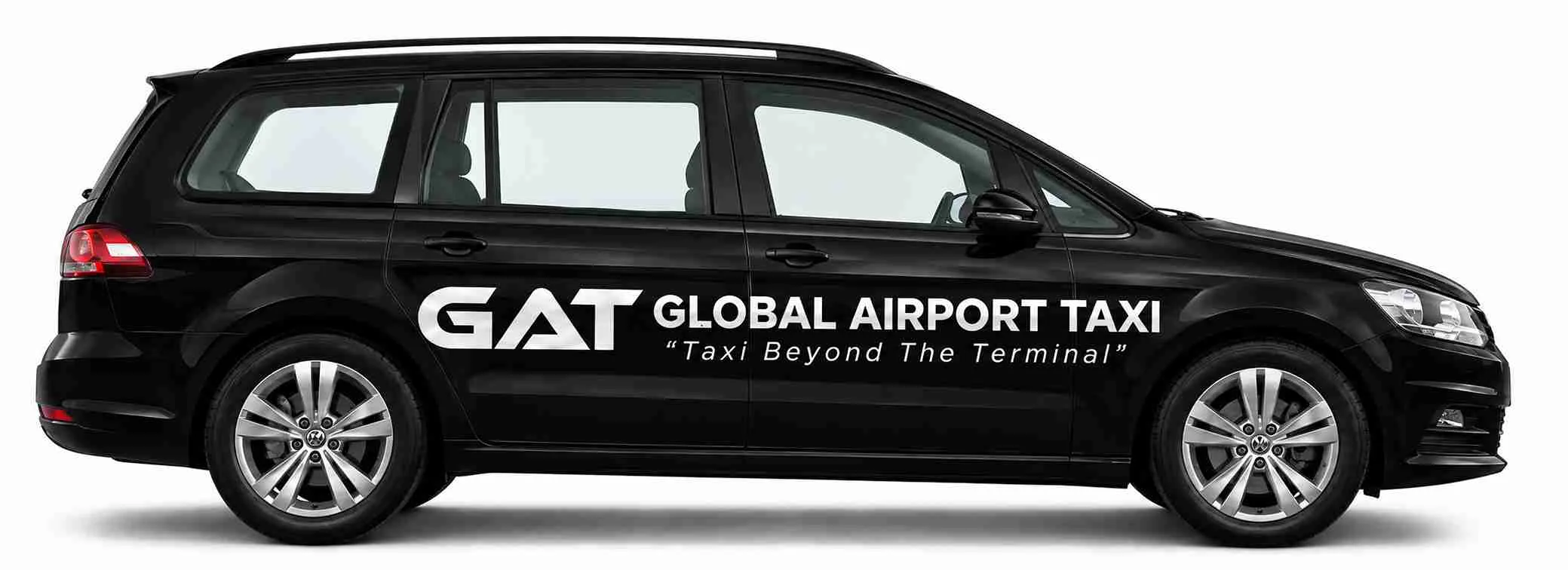
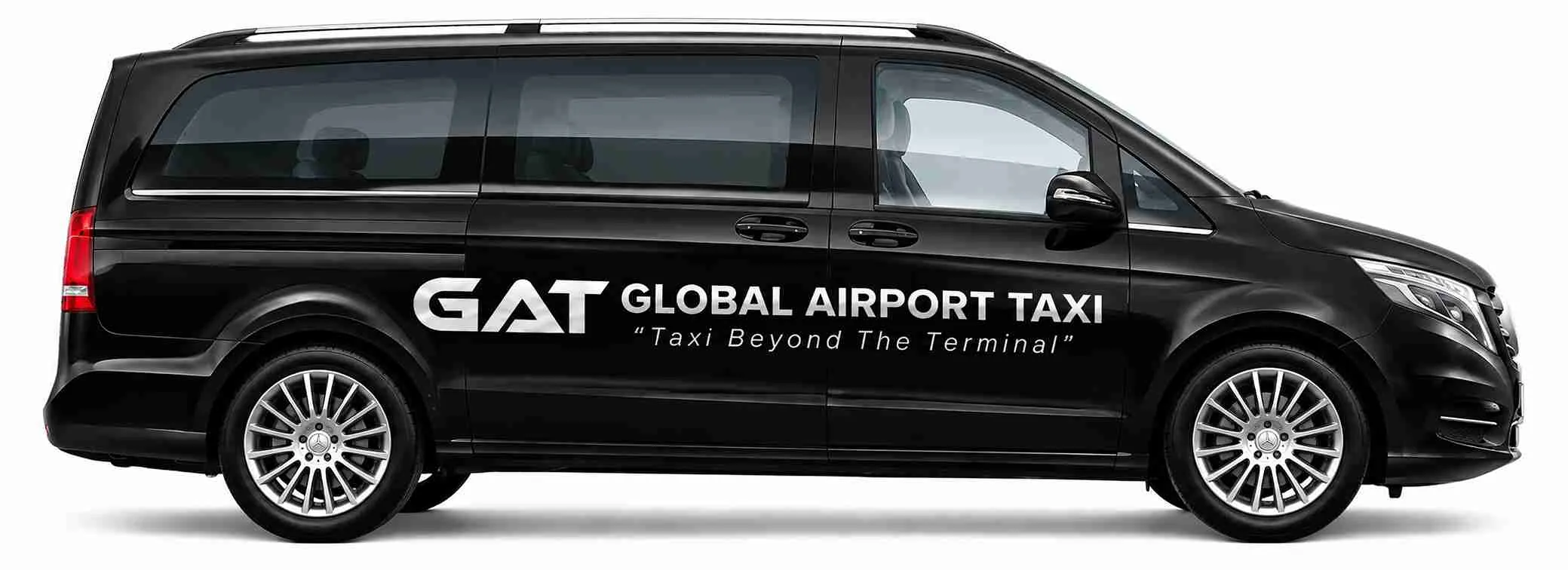
Saloon — up to 4 passengersExecutive car — one seat fewer, better carEstate — four people, four casesSix-seat MPV — the five-passenger fixSeven seats, with room to spareEight-seat van — the largest car class
What each class is actually for
Below is the fleet exactly as the client publishes it, with a note against each class on what it is for in this particular place. The capacities are the fleet’s own figures and nothing has been rounded upward: four large cases means four.
Vehicle classes for Madeira Airport transfers
Class
Passengers
Luggage
Where it fits
Saloon
Up to 4
3 large (3 passengers), or 2 large and 2 hand bags (4 passengers)
Two or three people with a case each. The commonest booking on an island where most arrivals are couples and small parties.
Executive car
Up to 3
2 large and 2 hand bags
A better car with one seat fewer. Worth knowing before four of you book it.
Estate car
Up to 4
3 large and 3 hand bags
Four people whose cases, rather than heads, rule out a saloon.
MPV, 5-seater
Up to 5
Up to 4 large suitcases
Five kept in one vehicle rather than split across two, which matters here because a taxi seats four and there is no larger car on the rank.
MPV, 6-seater
Up to 6
4 to 5 large suitcases
Six with a week’s luggage, or a family with a pushchair.
Executive 7-seater
Up to 7
Up to 7 bags
Seven seats with room to spread out on the long run to the west or north.
Executive MPV
Up to 7
Up to 7 bags
The same seven seats in a higher-specification vehicle.
Van, 8-seater
Up to 8
Up to 7 bags
Eight with luggage — the largest single car-class booking.
8-seater minibus
Up to 8
6 to 8 large suitcases
Eight where the cases outnumber the people. Hiking packs and golf bags come up constantly on this island.
What the island does to the luggage arithmetic
Madeira collects two kinds of traveller who arrive with more than a suitcase. Walkers come with packs and poles for the levadas, and the golf courses up at Santo da Serra and Palheiro bring bags that will not go in a boot alongside anything else. Neither is a suitcase and neither should be a surprise at the kerb: tell us at the booking, because the vehicle that takes a set of clubs is not always the one that would otherwise have been sent.
The other thing worth saying out loud is that a bigger car is not only about comfort here. Much of this island is approached by road that climbs, turns and tunnels, and a car with one seat too few is a different experience over forty minutes of that than over ten.
Priced for the vehicle, not the seat. Every class above is quoted as a whole car. Six people in a six-seat MPV pay the MPV figure between them rather than six times anything, and the quote does not rise because the car filled up. Fleet capacities, class by class is worth a look if your party sits awkwardly between two sizes, and transfers for groups and larger parties covers what happens above eight.
A figure on a page describes a journey in general. The figure the booking returns describes yours, against the actual address, party and vehicle, and that is the one we are held to.
Reviews
What Our Passengers Say About Their Journeys
Feedback from across the network, served live from the platforms it was written on.
These are the network’s reviews, not this airport’s. Nothing below has been filtered to Madeira and nothing is going to be: a selection picked to flatter one destination page is not evidence, and a score invented for a single airport out of network-wide feedback would be a number we had made up. The rating is the one on our own Google Business Profile, and it describes the company rather than any one airport. What loads underneath it comes straight from the review platforms, in the words the passengers used.
Rated 4.9 out of 5. From 505 reviews on our Google Business Profile, covering journeys across the whole network. The reviews that load below are served separately, by Trustindex, from the platforms they were written on — so the two are not the same set and are not added together anywhere.
The review panel loads here, from the platforms the reviews were written on. If it stays empty, that service has not responded — the same journeys are gathered on our page of customer reviews.
Scores and reviews are served by Trustindex from the platforms they were written on, and they cover journeys across the whole network rather than this airport alone. None of them was written by us. The rating stated above is the one on our Google Business Profile, it is published as a company rating rather than an airport one, and nothing here turns it into a figure for Madeira. More of them are gathered on our reviews of network journeys.
Booking
Book Your Madeira Airport Taxi Online
A Madeira Airport taxi booking in six fields, with the car dispatched against your aircraft.
Everything awkward about arriving here is easier to deal with at a keyboard than at a kerb. A pre-booked Madeira Airport taxi is settled in the order below: you give an address, a flight number and a party; a single figure comes back for the vehicle; you take it or you do not. Nothing is metered, nothing is counted at the far end, and the figure does not change because the road did. Payment is taken in full at the time of booking, and what you keep afterwards is the document that governs the price.
The address, not the resortA hotel name is not an address on an island where two villages share one. The expressway part of a journey is the easy part; the turning off it is what needs a street.
The flight numberNot the time it is due. Wind here can send an aircraft round again or send it to another island altogether, and a booking tied to the flight survives both.
Heads and hold bags, counted apartFour seats is four seats whether the car is a taxi or ours. It is usually the cases, not the passengers, that rule the smaller classes out.
Child seats, by ageGive us ages. Portuguese law measures a child by height and years, so a seat ordered against a head count may not fit the child it is bought for.
The return, with its own timeSet it now. Portuguese law lets a pre-booked car stand at an airport only while it holds a booking, so there is nothing to arrange with the driver later.
Confirm, and keep what arrivesYour car, your driver and the figure, in writing. Where that document and anything else disagree, it wins.
Why the flight number carries more weight here
Any transfer desk will ask for one. At this airport it does more work than usual, because the thing that goes wrong here is not traffic. Every landing here has to be made in visual conditions, and a straight-in approach to one of the two directions is not authorised at all, and an aircraft that runs out of visibility does not circle until it clears — on an island it leaves. What happens then is the question this airport raises and the one its transfer pages skip.
Dispatching against a flight number rather than a clock is what lets a booking survive any of that. The included waiting runs from wheels down rather than from the timetable: 60 minutes ordinarily, 90 where the hold is slow, and 15 where the pick-up is not an airport at all and there is no aircraft to watch.
What to have in front of you
A street address. Hotel names repeat across this island and so do village names; a parish and a town frequently share one. The expressway part of any journey is the part that needs no help.
The flight number, not the landing time. For the reason two paragraphs up.
Heads and hold bags, counted apart. Four adults with four large cases has outgrown a saloon even though it has not outgrown its seats.
Ages for any children. Portuguese law sets what a child needs by height and age rather than by the word "child", and how child seats work on a booked transfer goes through it.
A number that rings on the island. It is how a driver finds you when something has moved.
Anything with an awkward shape. Clubs, a walking pack, a folded pushchair, a board. It is a question about the boot rather than the seats.
The return, if you already have the date. It takes a collection time of its own, for a reason that is as much legal as practical: why a return must be booked, not arranged.
Changing your mind, and seats for children. Cancellation costs nothing up to 24 hours before the collection time. Child seats are free on request, and they are fitted before the car leaves for the airport — which is the practical reason the booking asks for ages instead of a head count.
Taxi fares here are set by a public body and revised on its timetable, not on ours. What is explained below is how such a fare is put together, not what it currently comes to.
The airport
What to Know About Madeira Airport Before You Land
A small airport with a large reputation, and a published record that disagrees with itself more than once.
Start with where it is, because the name misleads. It is not in Funchal. It stands in the municipality of Santa Cruz, on the south-east coast of Madeira, with the Atlantic along two sides of it, and even the distance between the two is disputed: two public bodies give two different distances to Funchal. The air navigation service publishes just over thirteen kilometres, measured to the cathedral; the airport operator says about sixteen and does not say measured to what. Both are public bodies and neither is wrong; they are measuring different things, and the only honest thing to do with that is to say so.
The names are worth getting out of the way first, because all of them describe one place: Madeira International Airport on Madeira Island, Cristiano Ronaldo Airport, Funchal Airport, FNC. A Cristiano Ronaldo Airport taxi, an FNC Airport taxi and a Funchal Airport taxi are the same booking under four headings.
The end of a flight is the start of a road journey. On Madeira the second one is rarely as short as the map suggests.
Even the name is unsettled. Official bodies do not agree on what to call it. The air navigation service and the airport operator both use the plain form, the regional tourism board uses the international one with the footballer’s name in it, the regional archive uses a third form, and the operator’s own newsroom used two in a single announcement. There is no single canonical form to quote, so nothing here claims one.
The airport names no road. Its own directions page gives a postal address and a route-planner box and nothing else. The regional roads directorate publishes the expressway that runs along this coast, but publishes it as a concession between two towns rather than as the road to the airport — so you will not find a sentence here asserting that it serves the terminal, because no body publishes one.
What the airport does publish about itself is thin on exactly the things people want: no official body publishes how many passenger terminals this airport has — not the operator, not the regulator, not the aeronautical publication, and the airport publishes no floor plan and no terminal map. The only level drawings anywhere on its site are two unlabelled images on its reduced-mobility page.
The runway, and why it is the thing everyone has heard about
There is one runway, thirty metres wide, grooved between the thresholds, with concrete at both ends. Its length is one of the places the official record disagrees with itself. The regional government’s own expansion resolution gives one figure and the current aeronautical publication carries a shorter one that is not attached to any named measurement in the table it sits in. Neither figure is printed here, because printing one would mean choosing between two official records with nothing but preference to choose on.
The structure everybody describes — a platform carried on columns above the shoreline — is not described by any official body that could be reached. The operator calls the airport one of the biggest feats of engineering in Portugal and gives not a single dimension. That is worth stating plainly, because the platform on columns above the sea is the one thing almost every visitor arrives knowing, and the number of columns that circulates with it comes from no source we could verify. The engineering is real. The figure attached to it is not something an official body publishes.
How it is flown, which is unusual and published
Every landing here has to be made in visual conditions, and a straight-in approach to one of the two directions is not authorised at all. The airport sits on a plateau beside high ground, so the published hazards are wind variation, turbulence, low-level windshear and microbursts — and with a westerly wind, tail windshear is to be expected on one of the two approaches. Those are not a reputation; they are in the aeronautical publication, in those terms.
A captain cannot simply be rostered here. Before training for it a pilot needs at least two hundred hours in command on the type, the qualification has to be renewed every six months, and a captain may only operate here at night after having operated here in daylight. The national civil aviation authority runs a separate approval process for operating here at all, requiring an airline to name its pilots and amend its operations manual. Very few European airports work that way, and it is the clearest evidence that the approach is genuinely demanding rather than merely photogenic.
Hours, and a gap in what is published
No official source states that this is a twenty-four-hour airport, and the aeronautical publication leaves the rows for airport administration, customs and health blank. What it does publish is ground handling from the early hours until just after midnight, and on request outside that. The control tower is listed around the clock; approach control is listed with an abbreviation the section never expands.
There is a second gap worth knowing about if you are planning around the edges of the day: the published hours do not say whether they are local time or universal time, so no clock time for them is reproduced here. Published hours that do not say which clock they are on are not hours you can plan a collection against, so none is reproduced here and the booking works from your flight instead.
Who actually uses it
The regional statistics office puts it at about four point eight million passengers in its most recent full year, counting this airport on its own, and the operator publishes a position for it: fourth busiest of the Portuguese airports by passenger numbers. The operator’s own reporting is harder to read than that, because it carries a single line for the region without saying whether the island’s second airport is inside the figure — and its newsroom has attributed a round five million to this airport alone. The difference between those figures is the island’s second airport, on Porto Santo, which the regional statistics office counts separately and the operator’s own reporting may or may not fold in.
Where
Santa Cruz, Madeira, Portugal
Codes
FNC · LPMA
Runway
One, 05/23
Terminals
Not published by anybody
Floor plan
None published
Landings
Visual conditions only
Position
Fourth busiest in Portugal, per the operator
Operator
ANA Aeroportos de Portugal
Everything in this section comes from the air navigation service’s published aerodrome entry, the airport operator’s own pages and corporate reporting, the national civil aviation authority, the regional statistics office or the regional government’s own gazette. Where two of those disagree — and on this airport they disagree about the name, the distance to Funchal, the runway length and what the passenger figures cover — both are given rather than one chosen.
Prices
Madeira Airport Taxi Prices and Transfer Fares
What a meter here is actually made of, and why three published figures are not a fare.
There is no fixed airport fare here, to Funchal or to anywhere else. A taxi from this airport runs on the meter. There is no airport supplement either. The convention that sets these fares contains none, and it does not mention airports anywhere. Those two sentences dispose of most of what is published about taxi prices at this airport. Every fixed airport fare you will find quoted for Madeira is somebody’s estimate in a confident typeface: no instrument creates one, and the national rule that would permit one does not reach this region unless the regional government adopts it, which it has not.
The body that fixes these fares is not the one you would expect
The fares are not set by a ministry or by a town hall. They are fixed by a signed convention between the regional transport authority and the island’s taxi associations, under the national taxi framework. That is unusual enough to be worth a sentence of its own. There is no gazetted tariff regulation to look up: the operative document is a signed agreement, published administratively, and most recently amended so that it took effect from the start of a calendar year.
A journey starting at this airport is not on the town tariff. The lowest of the schedules applies only inside the Funchal municipality, and the airport is in Santa Cruz — so even the run into Funchal is charged as an inter-town journey. This is the structural fact that explains why an airport run feels dearer than a trip across Funchal, and not one commercial page mentions it.
The three figures the airport itself publishes
These are the taxi charges as the airport publishes them on its own public-transport page, and they are the whole of what it gives you. The first two are reproduced as it states them; the third and fourth come from the convention behind them and are marked as reported.
Taxi charges published by Madeira Airport
Charge
Amount
What it means
Starting charge, weekday journeys beginning at the airport
€4.00
The convention behind it is reported to include the first kilometre in that charge, so the meter does not begin adding distance immediately.
Night, weekends and public holidays
+20%
The airport describes it as a supplement. The instrument is built differently — see the note below the table.
Luggage or animals
€1.50
Charged when the luggage needs the boot or the roof rack. Hand luggage within the usual cabin size, wheelchairs and mobility aids, and child carriers are carried free.
More than four passengers
+20%
Reported in the convention as an express uplift on the metered amount. It is not on the airport’s page.
The airport calls the night rate a twenty per cent supplement. The convention behind it does not work that way: it runs two separate tariff schedules, a day one from six in the morning until nine at night and a night one outside those hours, with Saturdays, Sundays and public holidays on the night schedule all day. The night starting charge is indeed exactly a fifth higher, which is where the airport’s figure comes from — but the distance and time fractions are not a flat fifth apart, so a whole night journey does not come out at exactly twenty per cent more than the same journey by day. The convention is also reported to add a further quarter on Christmas Day, which the airport does not mention.
Three figures are not a fare. The airport publishes a starting charge, a night uplift and a luggage charge. The convention behind them also contains the per-distance and per-time fractions that do most of the work on any journey longer than a kilometre, and those are not on the airport’s page. They are not reproduced here either: the instrument is a scanned signed document whose figures we could not read with enough confidence to publish, and one of them contradicts itself between two pages of the same annex. A number read off a crooked scan is not a verified number.
What a taxi owes you on the way
The schedule on display. The fare schedule in force has to be kept on display inside the vehicle where a passenger can read it, and the notice carries an instruction to ask for a receipt.
A receipt, properly. A receipt is not an optional courtesy. Taxi operators are required to run certified electronic invoicing connected to the meter, and if you ask, the receipt must also show the time, the origin, the destination and any supplements.
The complaints book. Every taxi has to carry the complaints book, in paper or electronic form, and the vehicle must display how to reach the electronic version, the transport regulator’s complaints address and the dispute-resolution routes open to you.
Your luggage carried. Luggage may be refused only where what you are carrying would actually cause a problem, and hand luggage within the usual cabin size travels free, as do wheelchairs and mobility aids and children’s carriers.
What we quote instead
What we sell is not a cheaper meter. It is a different thing under a different regime: one number for one car, settled in advance, immune to the traffic and to the hour you actually land. Private hire prices are not set by the authorities the way taxi fares are — they are agreed between the parties. What the law does require is disclosure: before you are committed, the platform must show you the total price and how it was worked out, including the intermediation fee, and the invoice must show the same.
On a short hop within Santa Cruz the meter will often come out lower, and you should take it. On the long runs — the west coast, the north, anywhere that involves climbing — a figure agreed in advance is worth having for the same reason an open-ended meter on a mountain road is worth avoiding.
An island of this shape makes distance a poor guide to anything. Price the journey you are making rather than the one the map suggests.
Pick-up
Madeira Airport Taxi Pickup and Arrivals
The Madeira Airport pickup: where the rank is, what a licensed taxi looks like, and the driver meeting point that does not exist.
The taxi rank is in the arrivals area on the ground floor, level 0, and that is the only location the airport publishes. No door number, no gate, no exit letter: the level is the whole of what the airport publishes, so follow the signs rather than a web page that claims more precision than the airport itself offers.
The roads, and what is published about them
The airport publishes no road at all for its own approach. The regional roads authority publishes the VR1 expressway as a concession between Ribeira Brava and Machico and does not say that it serves the airport, and the island’s other main routes are the VE roads that branch off it. Those are the published facts; anything beyond them — which road your transfer actually takes, and how long it takes — depends on the day and is not published by anybody.
Telling a licensed taxi from something else
A licensed taxi on Madeira is a particular colour, and the regional rules say so: cadmium yellow with a blue stripe down the side. A car that is not those colours is not a licensed taxi here. The rank is worked by the island’s taxi association, which the airport names on the same page. Between the colour and the rank, identifying a legitimate taxi here takes about a second — which is unusual, and worth using.
The taxi licence itself has to be in the vehicle, on paper or digitally. If anything about a journey goes wrong, the receipt and the complaints book are the two things that make it actionable, and both are set out in how a fare here is assembled.
Where a pre-booked car waits, and what nobody publishes
Here the honest answer is an absence, and it is an unusually well-evidenced one. The airport publishes no meeting point, zone or lane for pre-booked private vehicles — and this is not an oversight in its website. The same operator publishes exactly such a designated area at Lisbon, naming the booking platforms it serves and the drop-off points it uses. At Madeira there is no equivalent entry at all.
That contrast is the finding. It is not that a small airport has a thin website; it is that the same operator, running the same system, documents a pre-booked pick-up area at one of its airports and documents nothing at this one. So any page that names a specific meeting point, zone or lane for pre-booked cars at Madeira is naming something no public source publishes. The arrangement for your own booking comes with your booking confirmation instead: at airport arrivals your driver waits at the meeting point with a name board and helps with the bags. Your confirmation shows the driver and vehicle details.
A car present because a booking exists. Where it meets you is in your confirmation, not inferred from a published map that does not exist.
The legal position behind that is in what the law asks of either kind of car, and it is not pedantry: a pre-booked car is not a taxi and the two are not interchangeable. Portuguese law allows a private hire vehicle to be engaged only through a prior booking placed on an electronic platform; it may not be flagged down in the street and it may not use a taxi rank.
Which is also why the return leg is a booking rather than an arrangement made with the driver on the way in.
Being set down, and what is not published about it
For setting someone down the airport publishes no named zone, no level, no space count, no free period and no maximum stay. Its instruction is to respect the designated parking areas, and it names none. Pages that give you a named drop-off zone with a free period and a maximum stay at this airport are publishing something its operator does not.
If something moves
The booking follows the aircraft rather than the schedule. A late flight arrives late and the driver is there for it. The case worth planning for at this particular airport is not a delay at all, and it has a section of its own because it is the question this airport actually raises.
Assistance inside the airport is a separate arrangement made with your airline or the operator, and what the operator publishes about it — and what it does not — is set out in accessible transfers and reduced mobility.
Routes
Popular Taxi Routes from Madeira Airport
Where people actually go from here — and why there is no distance table below.
No public body publishes a road distance from this airport to any of them, and none publishes a driving time either. The airport’s own directions page gives a postal address and a route-planner box. The regional tourism board publishes flight times and municipal areas. The one official distance that exists for any town on the list is measured from Funchal rather than from the airport, and the airport is inside that town’s municipality, so it is not a substitute. That is the finding rather than a gap in our research.
The journeys people ask for by name are a Madeira Airport to Ponta do Sol taxi, a Madeira Airport to São Vicente taxi and a Madeira Airport to Santana taxi, alongside the cards below; the west and the north are grouped there because the road, not the destination, is what makes them one kind of journey.
A Madeira Airport hotel transfer is the simplest of them, and a hotel drop-off asks nothing of you beyond the name: the journey ends at its door. It is a villa, a quinta or an apartment that needs the street, because passenger luggage and a steep lane decide between them how close a car can actually get.
How far apart the published figures actually are
Published figures for journeys from this airport disagree with each other to a degree that is hard to credit until you line them up. The distance to Funchal appears as six different numbers across six sources, a spread of about sixty per cent, because some are measuring the road and some are measuring the map and none of them says which. One northern route is given as about sixty-six kilometres and an hour by three different booking engines, in figures tight enough to suggest they share a source rather than a road, while a long-form guide puts the same journey at an hour and forty minutes. One page contradicts itself inside a single screen: sixty-six kilometres in its data block and about seventy-five in its own introduction. A northern town appears at twenty to twenty-five minutes on one site and forty to fifty-five on another. And the same route, on the same day, in the same class of car, is sold at prices that differ by more than five times from one page to the next.
None of those operators is named here and none needs to be. The point is structural rather than personal: a figure nobody maintains decays quietly, a reader cannot tell a maintained one from an abandoned one by looking, and on an island where the road rarely goes where the map suggests, the errors are large. So what follows describes journeys rather than measuring them, and the only measurement that matters is the one your own mapping application makes on the day.
The destinations, described rather than measured
FunchalMadeira Airport to Funchal taxi
The capital · no official distance published. Not one place but several for a driver: the centre, the old town, the promenade and the long hotel strip west of it are different drop-offs with different approaches, and the cruise port is a different job again, tied to a sailing time rather than a check-in. Give the address rather than the city.
Santa CruzMadeira Airport to Santa Cruz taxi
The airport’s own town · no official distance. The shortest paid run on the island, because the airport is inside this municipality. On a short hop like this the meter will usually beat a booked figure, and we would rather say so.
MachicoMadeira Airport to Machico taxi
The nearest town of any size · no official distance. Close enough that a metered taxi is genuinely competitive, which is worth knowing before you pre-book anything. Where a transfer earns its place here is a late arrival, a party of five, or luggage that will not fit one car.
Caniço and Caniço de BaixoMadeira Airport to Caniço taxi
Coastal resort · no official distance. Two places with one name: the town up the hill and the resort strip below it, and the difference between them is a real climb. A booking that says only "Caniço" is a booking with a guess in it.
Câmara de LobosMadeira Airport to Câmara de Lobos taxi
West of Funchal · no official distance. Past Funchal and on along the coast. The harbour end of the town is narrow and steep, so the useful detail at the booking is which end of it you are staying at.
Ribeira BravaMadeira Airport to Ribeira Brava taxi
Where the island changes · no official distance. The pivot of almost every western and northern journey: the expressway ends its easy run here and the roads beyond it are a different kind of driving. Worth knowing even if you are only passing through it.
Ponta do Sol and CalhetaMadeira Airport to Calheta taxi
The west · no official distance. The west coast resorts, and the ones where a transfer most clearly beats the alternatives: the public route involves changes, and the drive is long enough that an open meter is an uncomfortable way to travel.
São Vicente, Santana and Porto MonizMadeira Airport to Porto Moniz taxi
The north · no official distance. The north coast, reached by crossing the island rather than following it. These are the longest transfers on the board and the ones where published figures are least trustworthy — see the note below the cards.
What the terrain actually does to a journey. The regional transport plan puts it plainly: the geography of this region imposes significant constraints on getting around inside it, and the plan was written with the road network still incomplete. Everything else commonly written about this island’s roads — the expressway along the south, the tunnels, the slow climb to the north coast — is true in our own experience of driving it, and is published by nobody, so it appears here as our experience and not as a fact with a source behind it. The practical consequence is the same either way: kilometres are a poor guide to minutes here, in both directions.
We will quote any of these, because a quote is a commitment about a journey rather than a claim about a map. What we will not do is print a distance we cannot attribute, and long-distance transfers covers how the longer runs are handled. Journeys that begin at another airport in the network work the same way.
Our own figure covers the whole vehicle and is agreed before you confirm it. Nothing written around it changes that.
Diversions
What Happens If Your Flight Cannot Land
The question this airport actually raises, and the one nobody answers.
On an island, an aircraft that cannot land does not simply arrive late. It arrives somewhere else — and somewhere else is across water. This is the single most useful thing to understand before you book anything here, and of the pages currently ranking for transfers at this airport, not one connects the weather it describes to the booking it is selling.
Why it happens here and not at most airports
Every landing here has to be made in visual conditions, and a straight-in approach to one of the two directions is not authorised at all. The airport sits on a plateau beside high ground, so the published hazards are wind variation, turbulence, low-level windshear and microbursts — and with a westerly wind, tail windshear is to be expected on one of the two approaches. Those are not a reputation or a video clip; they are what the aeronautical publication says, in those words. A captain cannot simply be rostered here. Before training for it a pilot needs at least two hundred hours in command on the type, the qualification has to be renewed every six months, and a captain may only operate here at night after having operated here in daylight.
What that adds up to is an airport with a genuinely narrower weather window than most, and a decision that is made in the air rather than on the ground. No public body publishes how often an aircraft actually gives up and goes elsewhere. The regulator, the operator, the air navigation service, the accident investigation body and the regional statistics office were all checked, and not one of them publishes a diversion rate or a count — so anybody telling you how often it happens is estimating.
Where an aircraft goes instead
No official document names an alternate aerodrome for this airport, so nothing here presents one as designated. What is reported, when it happens, is that flights have gone to the island’s second airport on Porto Santo, to the Canaries, and to the Portuguese mainland. Those are three very different problems: a short hop back, a flight the next day, or a journey that resumes from another country.
This is what a prepaid transfer with an hour of waiting does not survive. A booking whose waiting window is counted in minutes is built for a delayed flight, not for a diverted one. It is worth reading any transfer’s terms for this case specifically, ours included, rather than for the delay case that every page describes.
What we do about it
The booking follows the aircraft. Waiting is counted from when it is actually on the ground — 60 minutes, 90 if the bags are the hold-up — which covers a late landing and a go-around that works on the second attempt.
A diversion is not a delay, and we do not pretend it is. Tell us where you have actually ended up and when you now expect to arrive, and the booking is amended to the new flight rather than lost.
Cancellation stays free until 24 hours before collection. If you learn the night before that you are not coming, that is the route out.
Your airline owns the rebooking and the duty of care, not us. Hotel, meals and the replacement flight are its responsibility under European passenger rights. We can move a car; we cannot move an aeroplane.
The honest summary is that no transfer, from anybody, is insurance against the weather here. What a booking can do is remove the second problem: when you finally land, at whatever hour, there is a car with your name on it rather than a rank you have to take your chances with.
Nothing in this section is a prediction. The hazards and the qualification requirements come from the aeronautical publication and the national civil aviation authority; the destinations aircraft have been sent to are as reported when it has happened; and the frequency is not published by anybody, so none is given.
Pre-booking
Why Pre-Book a Private Madeira Airport Transfer?
Four arguments for a Madeira private airport transfer — what some pages call a Madeira Airport chauffeur service — that hold here and would not hold at most airports.
None of what follows is an argument about transfers in general. Each of the four is a property of this airport that you can go and check: a tariff with no fixed airport rate in it, a legal regime with no waiting period in it, a weather window narrow enough to move aircraft to other islands, and a rank on which nothing seats more than four.
One. No published fare exists to measure a quote against
Elsewhere a traveller can hold a quote up against an official flat rate and judge it in seconds. That is impossible here: there is no fixed airport fare here, to Funchal or to anywhere else. A taxi from this airport runs on the meter. There is no airport supplement either. The convention that sets these fares contains none, and it does not mention airports anywhere. Which means nobody — the driver included — can tell you in advance what the meter will say. No criticism of the taxi is intended; that is simply what a meter is. The consequence is that a quoted figure is the only number anyone can give you before you travel.
Two. Nothing in Portuguese law makes you wait before travelling
There is no minimum notice period for booking a private hire car in Portugal. The law requires the booking to exist before the journey and says nothing about how long before. The claim that Portuguese law imposes a fixed interval between making the booking and travelling is repeated widely and has no instrument behind it. Where you see a window stated, it is somebody’s commercial term rather than the law.
Earlier is still better, and for ordinary reasons. The vehicle that fits your party and your cases has to be free, a child seat is fitted before the car sets off, and the island’s supply of pre-booked cars is not large.
Three. A booking tied to the aeroplane survives what the weather does
This is the reason that exists here and almost nowhere else in Europe. Every landing here has to be made in visual conditions, and a straight-in approach to one of the two directions is not authorised at all, and the published hazards are the ones set out in what happens if your flight cannot land. A transfer booked against a flight number absorbs a late arrival and survives a diversion as an amended booking. One booked against a clock does neither.
Four. The rank seats four
Five people at the rank is two cars, because nothing larger is standing there to ask for — and a taxi that does carry more than four is reported to add a fifth to the metered amount for doing it. Two cars is two meters, two arrivals and an argument about which boot holds which case. Our own vehicle classes reach eight without splitting anybody up.
What the booking actually fixes. The vehicle, the driver, the figure, and the time the car is there — counted from when the aircraft lands rather than when it was meant to. Cancellation is free up to 24 hours before collection, and child seats are free on request.
Amounts attributed to a public body are reproduced as that body published them. Attribution says where a number came from; it does not promise the number has not moved since.
Families
Madeira Airport Transfers for Families and Groups
One vehicle rather than two, from a car to a Madeira Airport minibus transfer, with the seats in it before it leaves.
Portuguese law decides what a child travels in by height and age, not by whether the word "child" applies. Seats are free on request and they go in before the car sets off for the airport, so what the booking needs is ages — a seat chosen from a head count is a seat that may not fit the child who ends up in it.
What the four-seat ceiling does to a family
Four seats is the ceiling on anything waiting at the rank, and there is no larger vehicle there to ask for. Two adults and three children is therefore two cars: children divided between vehicles, two sets of restraints to organise, luggage split across both, and two arrivals at a hotel reception. There is a second sting as well — a taxi carrying more than four is reported to add a fifth to the metered amount for the privilege. A six-seat MPV is one car, one figure and one set of seats, fitted in advance.
Luggage is the other half of the arithmetic and it decides more bookings than seats do. A family week here is cases plus a pushchair, and frequently plus whatever the holiday is actually for. Count hold bags rather than people when you pick a class, then say what among them is not a suitcase.
One car, one set of restraints, one arrival. Five at the rank is two of everything.
Capacities for every class are in fleet capacities above, taken from the client’s own fleet page and not rounded up. A taxi is governed by the regulated allowance instead, which what the law asks of either kind of car sets out — including the fact that a wheelchair, a mobility aid or a child carrier travels without the luggage charge.
Distance is a poor guide to how long any of this takes. A journey of twenty-odd kilometres here can involve crossing a ridge, and the roads off the expressway climb and turn. All of it is longer with a child in a restraint that does not fit properly.
Things better said now than at the kerb
Ages, individually. An infant, a toddler and a nine-year-old need three different things in the back of a car.
A pushchair occupies boot space. Folded or not, it counts against the cases rather than against the seats.
Walking gear, clubs, a board. Named in advance, because the car that takes them is not always the car that would otherwise arrive.
A number that rings on the island. How a driver reaches you if anything shifts.
Where the return starts. A hotel, the cruise berth or the end of a walk are three different collections.
Read any amount here as background. The one your booking returns is the one we are actually held to, and it is the one in writing.
Accessibility
Accessible Transfers and Reduced Mobility at Madeira Airport
What the operator publishes, what it does not, and what we arrange separately.
Assistance inside the airport is the airport’s own service and is not ours to provide. Assistance inside the airport is the operator’s own service, booked through your airline or travel agent, or requested up to forty-eight hours before the published departure time. It is free, it is a legal entitlement under the European regulation on air passengers with reduced mobility, and it is requested from the airline rather than from a transfer company.
Where to ask for it, and what is missing
The published meeting point is a designated point of arrival, which the operator describes as a telephone post marked with the service’s own logo, with signage directing passengers to it. That is the whole of the published description, and it is thinner than it should be: the operator publishes no level, no door and no position for those posts — the page carries two level drawings with no labels on them at all — and no telephone number or address for the service itself, only the airport’s general ones.
So the practical advice is the one the absence forces: arrange it through your airline when you book the flight, well before the forty-eight-hour deadline, and let the airline tell you where to present yourself. A transfer company cannot book it for you, and any page that gives you an exact meeting position for it is giving you something the operator does not publish.
What we can and cannot promise
We can send a vehicle with a boot that takes a folded wheelchair, a driver told in advance what to expect, and a car that waits at the point you nominate once the airport’s own service has handed over. We can carry an assistance dog, and so must a taxi: a certified assistance dog must be carried, and is exempt from the animal charge. A taxi is also required to carry wheelchairs and mobility aids without the luggage charge.
What we will not do is promise a ramp-equipped wheelchair-accessible vehicle at this airport from a web page. Whether one is available is a question about a specific date rather than a standing fact, and the honest answer to it comes from asking us rather than from reading a claim. How accessible vehicles are arranged explains the general shape of it.
The forty-eight-hour deadline and the right behind it belong to the European regulation on air passengers with reduced mobility, and the request goes to the airline or to the airport operator. What we can do is repeat what the operator publishes and point out what it leaves out. Making the request is not something a transfer company is able to do for you.
The rules
Taxis, Pre-Booked Cars, and Three Checks Worth Making
Two kinds of car, two legal regimes, and three checks that take a second each.
A pre-booked car is not a taxi and the two are not interchangeable. Portuguese law allows a private hire vehicle to be engaged only through a prior booking placed on an electronic platform; it may not be flagged down in the street and it may not use a taxi rank. That is not a technicality. It is why a pre-booked car cannot be hailed at the kerb, why it may not join the taxi rank, and why the return leg is a booking rather than an understanding reached with the driver on the way in.
The three checks
The colour, for a taxi. A licensed taxi on Madeira is a particular colour, and the regional rules say so: cadmium yellow with a blue stripe down the side. A car that is not those colours is not a licensed taxi here.
The sticker, for a pre-booked car. Every licensed private hire car on Madeira carries an identifying sticker that cannot be peeled off, on the right of the windscreen and the left of the rear window. Nationally it shows the word for the regime and the operator’s licence number, and newer vehicles carry a scannable code tied to the registration plate.
The certificate, for the driver. The driver has to hold a certificate to do the work, and in Madeira it is a regional one — the island requires its own course covering driving on this terrain. The certificate has to be in the vehicle while the driver is working.
What the law does NOT require is for the driver to show you the booking itself. The duty to carry documents covers certificates, not paperwork about your journey, so the sticker and the certificate are the checks worth making. That is worth saying because several pages tell travellers to ask a driver to produce the booking, and no instrument requires it. The sticker and the certificate are the things the law actually puts on board.
What the law asks of a taxi
The meter, and the schedule on display. The fare schedule in force has to be kept on display inside the vehicle where a passenger can read it, and the notice carries an instruction to ask for a receipt.
A receipt. A receipt is not an optional courtesy. Taxi operators are required to run certified electronic invoicing connected to the meter, and if you ask, the receipt must also show the time, the origin, the destination and any supplements.
The complaints book, and how to reach it. Every taxi has to carry the complaints book, in paper or electronic form, and the vehicle must display how to reach the electronic version, the transport regulator’s complaints address and the dispute-resolution routes open to you.
Your luggage carried. Luggage may be refused only where what you are carrying would actually cause a problem, and hand luggage within the usual cabin size travels free, as do wheelchairs and mobility aids and children’s carriers.
An assistance dog carried. A certified assistance dog must be carried, and is exempt from the animal charge.
The licence in the car. The taxi licence itself has to be in the vehicle, on paper or digitally.
What the law asks of a pre-booked car
Private hire prices are not set by the authorities the way taxi fares are — they are agreed between the parties. What the law does require is disclosure: before you are committed, the platform must show you the total price and how it was worked out, including the intermediation fee, and the invoice must show the same. Which is worth stating carefully, because it is commonly overstated in both directions. Portuguese law does not require a transfer to be sold at a fixed price at all, and it does not allow a charge you were never shown. A fixed price is our commercial choice; disclosure is the obligation.
And there is no waiting period to serve before you may travel. There is no minimum notice period for booking a private hire car in Portugal. The law requires the booking to exist before the journey and says nothing about how long before.
Nobody should be offering you a ride inside the terminal. A pre-booked car may only carry a passenger who booked it beforehand, and it may not use the rank. A taxi that is not the island’s licensed colour is not a licensed taxi. If you did not book it and it is not on the rank, it is not your car.
The instruments behind this section are the Portuguese taxi act and the private hire act, the regional adaptation of the latter for Madeira, the regional livery regulation, and the price convention that sets the fares. Where the regional and national rules differ — and on the identifying sticker they did, with the region requiring a permanent one years before the national law caught up — the regional one governs here.
Published figures for this island disagree with one another by a wide margin, which is why every number here carries its source and why the gaps are left as gaps.
Other options
Getting Off This Airport Without Us
What else leaves this airport, and the arrivals on which we would send you to it.
More people search for the bus from this airport than for the taxi. That is worth leading with, because it says what travellers actually want to know, and because a transfer page that treats the lowest-cost option as a throwaway paragraph is ignoring the larger half of the question. Sometimes the bus is the right answer and we will say so.
What leaves the airport
A shuttle leaves from the arrivals area for Praia Formosa, calling near several hotels on the way. The airport puts the whole run at about fifty minutes, and the onward connection from there into central Funchal at about twenty more. Ordinary buses run every day except Christmas Day, to a range of places across the island.
The airport and the regional transport portal do not quite agree about what serves this airport. The airport says ordinary buses run from it every day except Christmas Day, to a range of places across the island, and names no operator and no line. The regional government’s own portal lists only the shuttle under a service name containing the airport; no ordinary line appears there under an airport name. Both are official. Check the regional portal for the line you want rather than trusting either summary, including this one.
No line number appears here, the shuttle’s included. The regional network has been renumbered and the operator’s own announcements describe a transition during which buses show both the old number and the new one. A number copied onto a page in the middle of that is a number that sends somebody to the wrong stop.
When a bus beats a transfer, honestly
One or two people, light bags, into Funchal, in daylight. The shuttle runs to the hotel strip and connects onward to the centre. Take it.
An unhurried day with nothing waiting for you. Fares are low and the island is small enough to change your mind halfway.
A short hop within Santa Cruz or to Machico. Short enough that a metered taxi is competitive too — see how a fare here is assembled.
When it does not
A late arrival. The shuttle does not run through the night, and the ordinary network thins out in the evening. This airport takes late and weather-displaced arrivals, so a meaningful share of flights land when the public option has stopped.
Christmas Day. The airport states plainly that the buses do not run that day. Flights do.
A party of five or more. A fare per head does not improve because there are more heads.
The west or the north. Calheta, São Vicente, Santana and Porto Moniz by public transport mean changes, and the connections are built around island life rather than around flight arrivals.
Checked bags, a pushchair, clubs, a walking pack. Carrying all of it onto a bus turns the journey into something else.
An address that is not on a route. Which on this island is a great many addresses, because the road climbs away from the coast and the bus stays on it.
We would rather lose the booking than mis-sell it. Two people with cabin bags going into Funchal in the afternoon should take the shuttle, and we have said so. Six people with hold luggage going to Porto Moniz at eleven at night is not a close call.
Read anything below as background for a decision rather than as a budget. It is reviewed at maintenance and published in good faith.
Return
Book Your Return Taxi to Madeira Airport
A Madeira Airport return transfer, booked with its own time and planned backwards from a check-in that closes before you expect.
The return journey is its own booking with its own time, and not something settled by agreement in the car. A pre-booked car is not a taxi and the two are not interchangeable. Portuguese law allows a private hire vehicle to be engaged only through a prior booking placed on an electronic platform; it may not be flagged down in the street and it may not use a taxi rank. Which means no driver can promise to come back for you on the strength of a conversation during the journey in. Set both legs at once and the second one has a time you are free to change.
Working backwards from the flight
Take whatever check-in time your airline asks for, work back through the drive, and then leave something over for the road itself. We propose a time at the booking and you are free to move it — how long you are willing to sit in a departure lounge is your call, not ours.
The Madeira-specific part is the road itself, and it is the thing most often got wrong on the way out. The regional transport plan puts it plainly: the geography of this region imposes significant constraints on getting around inside it, and the plan was written with the road network still incomplete. In our own experience of driving it, the expressway along the south of the island is a chain of tunnels, and a queue in one of them is both invisible on a map and impossible to leave. Departure day is the wrong day to discover that, so we build the collection time around the road rather than around the distance.
Collections that are not from a hotel
Three come up constantly on this island and all three are worth flagging at the booking rather than at the kerb. A sailing from the cruise port is tied to the ship rather than to you. A walk that ends somewhere other than where it started is a one-way drop and a separate collection, which is a better fit for the classified trails than a hire car is now that they are booked into timed entry slots. And a golf course is a collection with clubs, which is a question about boot space rather than about seats.
Waiting on a collection that is not at an airport is 15 minutes, because there is no flight to follow — so a time you can actually make is worth more here than an optimistic one.
A regulated amount belongs to whoever set it, and bodies move amounts without telling the pages that copied them down. For a metered journey, the meter is the authority.
Why us
Why Choose Global Airport Taxi?
What we are, what the figure covers, and five things we have refused to publish.
We are a booking platform. Your transfer is carried out by a licensed private hire driver. That sentence is doing real work on this island rather than covering a legal base. Portugal treats a taxi and a pre-booked car as two different things with two different sets of obligations, and the one you have booked is the second. How to check the car in front of you gives you the three-second test for telling them apart.
What the quote covers
The vehicle
Quoted whole, never per seat
The driver
Licensed, professional, briefed before setting off
Meeting you
In arrivals, name board, hands for the bags
Waiting
From wheels down: 60 minutes, or 90 where the hold is slow
Child seats
Free on request, fitted before departure
Changing your mind
No charge until 24 hours before collection
Payment
In full at the time of booking
What governs the price
Your confirmation, not anything here
Five things we have refused to publish
A distance table. No public body publishes one for this airport. The gap is named in where people actually go from here rather than filled with an estimate.
A journey time. Same reason. The only durations here are our own terms and two bus figures the airport publishes itself.
A meeting point for pre-booked cars. The operator publishes none here, though it publishes one at Lisbon. Inventing the missing one would be the easiest paragraph on the page to write.
Most of the tariff. Three figures come from the airport and the rest from a scanned document we could not read with confidence, so the rest is absent and how a fare here is assembled says so.
We are QMH Technologies Ltd, a company registered in England and Wales, number 13506378, trading as Global Airport Taxi. Our terms and conditions and privacy and security policy set out the rest, and who we are is the short version.
A blank on this subject is deliberate. Where no amount appears, none could be verified at a source, and an unmarked estimate would be worse than the gap.
Questions
Frequently Asked Questions About Madeira Airport Taxis
Fifteen of them, weighted towards what the demand research says gets asked here and answered nowhere.
The short version, if you read nothing else: the airport is not in Funchal, there is no fixed taxi fare from it and no airport supplement, no public body publishes a distance or a driving time to anywhere on the island, the operator publishes no meeting point for pre-booked cars here although it does at Lisbon, and the thing worth planning for is not a delay but a diversion. Every one of those is counter-intuitive and every one changes how you plan the journey.
How much is a taxi from Madeira Airport to Funchal?
There is no fixed answer, because there is no fixed fare. A taxi from this airport runs on the meter, and no instrument creates a flat airport rate to Funchal or anywhere else. The airport publishes three figures: a starting charge of €4.00 on weekday journeys beginning there, a twenty per cent uplift at night and all day at weekends and on public holidays, and €1.50 when the luggage needs the boot. Those three are not the whole fare — the distance and time fractions that do most of the work on a longer journey are in the tariff convention rather than on the airport’s page. One structural point nobody else mentions: the lowest tariff applies only inside the Funchal municipality, and the airport is in Santa Cruz, so even the run into Funchal is charged as an inter-town journey.
Is there an airport supplement on a Madeira taxi?
No. The convention that sets these fares contains no airport supplement, and it does not mention airports anywhere. That is worth knowing because it is the opposite of several other Atlantic island airports, where such a supplement does exist and is lawfully charged.
Can I pre-book a Madeira Airport taxi?
You can book a private transfer, which is a different product from a taxi under Portuguese law. A pre-booked private hire car may only carry a passenger who booked it beforehand; it cannot be flagged down and it may not use the taxi rank. There is no minimum notice period in Portuguese law — the booking simply has to exist before the journey — so a booking made from the baggage hall is a lawful booking. Earlier is still better, because the car that fits your party has to be free and a child seat is fitted before it sets off.
Where is the taxi rank at Madeira Airport?
In the arrivals area on the ground floor, level 0. That is the only location the airport publishes: there is no door number, gate or exit letter, so follow the signs rather than any page that claims more precision than the airport itself offers. A licensed taxi on Madeira is cadmium yellow with a blue stripe along the side, which makes identifying one about a one-second job.
Is there a meeting point for pre-booked drivers at Madeira Airport?
The airport publishes none, and that absence is better evidenced than most things on this subject. The same operator publishes a designated pick-up area for pre-booked platform vehicles at Lisbon, naming the drop-off points it uses; at Madeira there is no equivalent entry at all, in any language version of its site. So a page naming a specific meeting point, zone or lane here is naming something no public source publishes. The arrangement for your own booking comes with your confirmation.
How far is Madeira Airport from Funchal?
Two public bodies publish two different answers and neither is wrong. The air navigation service gives just over thirteen kilometres, and it comes with a compass bearing attached, which tells you it is a point-to-point measurement rather than a road one. The airport operator says about sixteen and does not say measured to what. Figures published commercially for the same journey run from about thirteen to about twenty-one kilometres — a spread of roughly sixty per cent — largely because some are measuring the map and some the road, and none of them says which.
How long does a taxi take from Madeira Airport to Funchal?
No public body publishes a driving time from this airport to anywhere, so none is given here. Every journey time you will read for this route is an estimate, and the published ones disagree with each other. The airport does publish two bus times — about fifty minutes on the shuttle to Praia Formosa and about twenty more onward into central Funchal — but those are a multi-stop bus on a fixed route and are not a driving time. Use a mapping service on the day: it knows about the traffic and the tunnels, and a web page does not.
What happens if my flight is diverted because of the wind?
This is the question this airport actually raises and almost nobody answers. All landings here must be made in visual conditions, the published hazards include wind variation, turbulence, low-level windshear and microbursts, and captains need a separate qualification renewed every six months. No public body publishes how often a diversion follows, so nobody can honestly tell you the odds. When it happens, flights have been reported going to the island’s second airport on Porto Santo, to the Canaries and to the Portuguese mainland — three very different problems. A transfer with an hour of waiting is built for a delay, not for that. Tell us where you have actually landed and the booking is amended to your new flight; your airline, not a transfer company, owns the rebooking and the duty of care.
What happens if my flight is just delayed?
The booking follows the aircraft rather than the schedule. Waiting is counted from the moment it is actually on the ground: sixty minutes as standard, ninety if the bags are what is holding you up, and fifteen on a collection that is not at an airport, because there is no flight to follow. A late landing and a go-around that works at the second attempt are both covered by that.
Is Madeira Airport dangerous?
It is demanding rather than dangerous, and the difference is published rather than a matter of opinion. The aeronautical publication requires all landings to be made in visual conditions, does not authorise a straight-in approach to one of the two directions, and lists wind variation, turbulence, low-level windshear and microbursts among the hazards. A captain needs at least two hundred hours in command on the type before training for it, must renew the qualification every six months, and may only fly here at night after having flown here in daylight; the national civil aviation authority runs a separate approval process for operating here at all. Very few European airports work that way. The famous platform carried on columns above the shoreline is real, but no official body publishes its dimensions or the number of columns, so the figure that circulates with the photographs comes from somewhere we could not verify.
Is Madeira Airport in Funchal?
No, and this is the most consequential misunderstanding about it. The airport is in the municipality of Santa Cruz, on the south-east coast, and Funchal is a paid road journey away. It is also known by several names at once — the air navigation service and the operator use the plain form, the tourism board uses the international one with the footballer’s name in it, and the old name for the airport is still in circulation. All of them mean the same place, and no single canonical form is published by anybody.
Can I book a transfer to Caniço, Machico or Câmara de Lobos?
Yes, and two of those deserve a caveat we would rather give than withhold. Machico is the nearest town of any size, close enough that a metered taxi is genuinely competitive; a transfer earns its place there on a late arrival, with a party of five, or with luggage that will not fit one car. Caniço is two places with one name, the town up the hill and the resort below it, and the difference is a real climb — so give the address rather than the resort. Câmara de Lobos is past Funchal and along the coast, with a harbour end that is narrow and steep.
Are private transfers available to Calheta, Porto Moniz and the north?
Yes, and these are the journeys where a transfer most clearly beats the alternatives: the public routes involve changes and are built around island life rather than around flight arrivals. They are also the routes where published figures are least trustworthy. One northern run is given as about sixty-six kilometres and an hour by three different booking engines, in figures tight enough to suggest they share a source rather than a road, while a long-form guide puts the same journey at an hour and forty minutes. We quote the journey rather than publishing a distance we cannot attribute.
Are family MPVs and child seats available?
Yes, up to eight passengers in a single car class, and child seats are free on request. This matters more here than at most airports because a taxi seats four and there is no larger vehicle on the rank to ask for — a party of five either splits across two cars or pre-books one, and a taxi carrying more than four is reported to charge a fifth more. Seats are fitted before the car leaves for the airport, which is why the booking asks for ages rather than a count: what a child needs in a car in Portugal depends on height and age rather than on being a child.
Can I book a return taxi to Madeira Airport?
Yes, and it has to be a booking rather than an arrangement made with the driver on the way in: a private hire car may only carry a passenger who booked it beforehand. Book both legs together and the return gets its own collection time, which you can move. Build that time around the road rather than the distance — the expressway along the south of the island is a chain of tunnels, and a queue inside one is invisible on a map and impossible to leave.
Anything general rather than Madeiran lives in help and answers for travellers. For a question about a journey you are really making, it is faster to ask than to search: send us the details, or use the WhatsApp action on the card at the foot of the page.
A quote answers the journey you described. Describe a different one and it is re-priced with you beforehand rather than adjusted at the end.
Where to go next: the Portuguese airports, the other Atlantic islands we cover, and the pages behind the detail above
Flying into Madeira? Send the flight and the street.
Madeira is small on a map and slow on the ground: the ridges decide the route, and twenty kilometres west is not twenty kilometres north. Settle the journey before you fly rather than at the kerb. Send the flight number, the destination address, how many of you there are and how many hold bags. What comes back is one figure for one vehicle, agreed before you confirm it, with a licensed driver in arrivals holding a board with your name on it.