A Murcia Airport taxi settled before you fly, with one figure agreed in writing and a driver set against your flight number at RMU. The rank outside arrivals runs on the city’s own fare between the airport and the centre of Murcia, all supplements included; the moment a journey crosses the urban boundary that fare stops and the region’s interurban maxima take over. A pre-booked private transfer is a third thing again, quoted for your own journey and held once you accept it.
One published fare runs between this terminal and the centre of Murcia, all in, and it ends at the edge of the published zone. Past that edge nothing is fixed: a rank taxi moves onto the region’s maxima and a booked car onto its own quotation, with the confirmation naming the spot where it waits.
Vehicles
Choose Your Vehicle for a Murcia Airport Transfer
Count the seats second. Count what goes in the boot first.
A party of four with four large suitcases is not a saloon booking, whatever the seat count says. On this coast the luggage decides the class more often than the passengers do, and a class chosen that way is the one that takes everything that came off the belt.
These capacities belong to the network and apply in every country it covers, since a seven-seat van is a seven-seat van in Murcia or in Manchester. What is particular to RMU is the range of jobs one list has to cover: twenty minutes to a barrier at a golf resort and three hours up the coast to Benidorm pick very different vehicles off it.
Vehicle classes, passengers and luggage
Class
Passengers
Luggage
Booked for
Saloon
Up to 4
3 large (3 passengers), or 2 large and 2 hand bags (4 passengers)
Two travellers with a case each going to an apartment in Murcia or a hotel in Cartagena. The commonest booking off a Ryanair arrival and the one that comes apart when a third suitcase appears at the doors.
Estate car
Up to 4
3 large and 3 hand bags
The same four seats over a boot that swallows a fortnight on the Mar Menor: the cases, the cool box, the beach chairs and the inflatable nobody admits to packing.
Executive car
Up to 3
2 large and 2 hand bags
Three seats and a quiet fifty minutes for an arrival going straight to an office in Murcia or the naval and industrial end of Cartagena.
MPV, 5-seater
Up to 5
Up to 4 large suitcases
Five people kept in one vehicle rather than split across two cars, which on a coast road means two drivers, two routes and two arrival times at the same gate.
MPV, 6-seater
Up to 6
4 to 5 large suitcases
Six seats over a deep boot, which is the Los Alcázares and La Manga booking: a fortnight for a family, with the pushchair flat underneath.
Executive 7-seater
Up to 7
Up to 7 bags
A seventh seat and a boot deep enough for the drives counted in hours rather than minutes: Águilas, Mojácar, Benidorm. Nothing rides on anybody’s knees.
Executive MPV
Up to 7
Up to 7 bags
Seven places again, finished to a standard an office is happy to put a visitor in. This is the booking made when somebody is being received rather than simply fetched.
Van, 8-seater
Up to 8
Up to 7 bags
The legal maximum for a single vehicle. A ninth traveller turns a car booking into a group movement, arranged as one journey.
16-seat minicoach
Up to 16
Luggage confirmed with the booking
A golf party or a wedding arriving together on one flight: one vehicle, one meeting point, one set of clubs loaded once.
Saloons, estates and executive cars
Four seats in a saloon will take three large cases; put a fourth passenger in and it becomes two large and two hand bags. The estate holds the seats and extends the space behind them, which is what a fortnight on the Mar Menor generally needs. A Murcia Airport executive taxi trades the fourth seat for a quieter cabin, and it is ordered by an office rather more often than by the person travelling, which is why the business section asks for two telephone numbers.
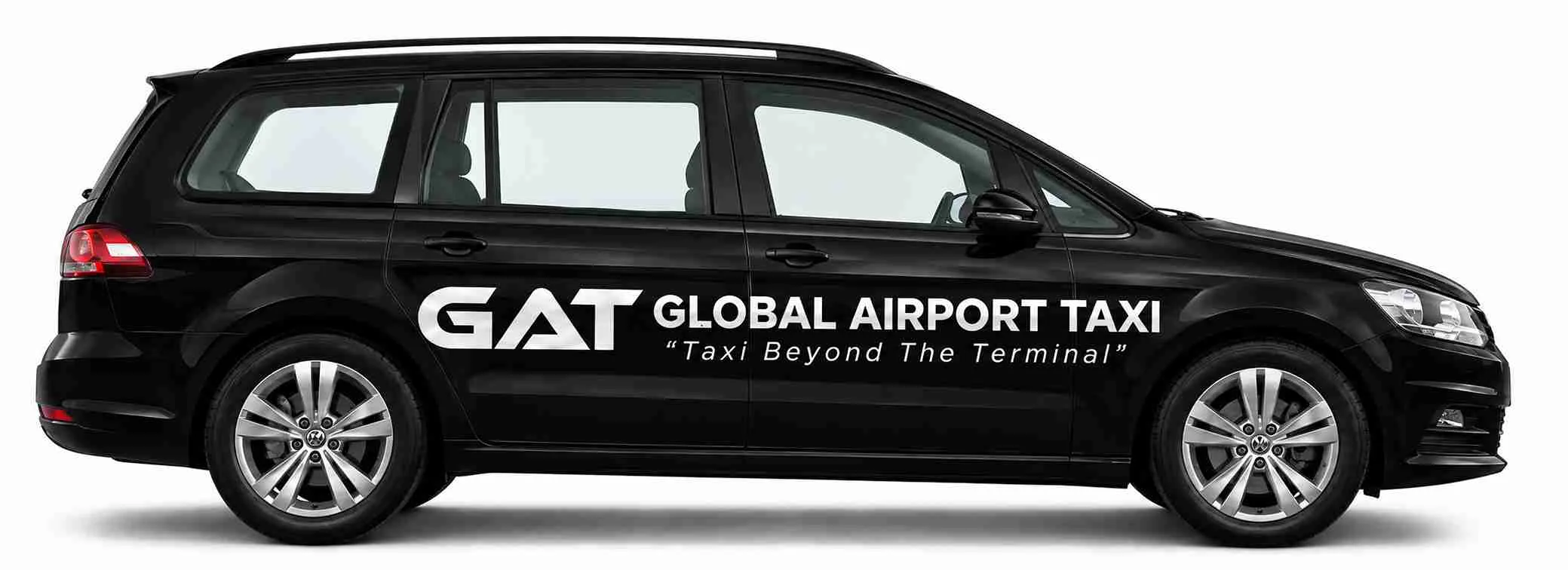
Two people, two cases, and no further decisions to take.Four seats again, behind a load space that swallows a fortnight at the sea.One seat given up in exchange for a cabin quiet enough to take a call in.Half a dozen seats above a deep boot: the summer fortnight, in one vehicle.
Family MPVs, seven and eight seats
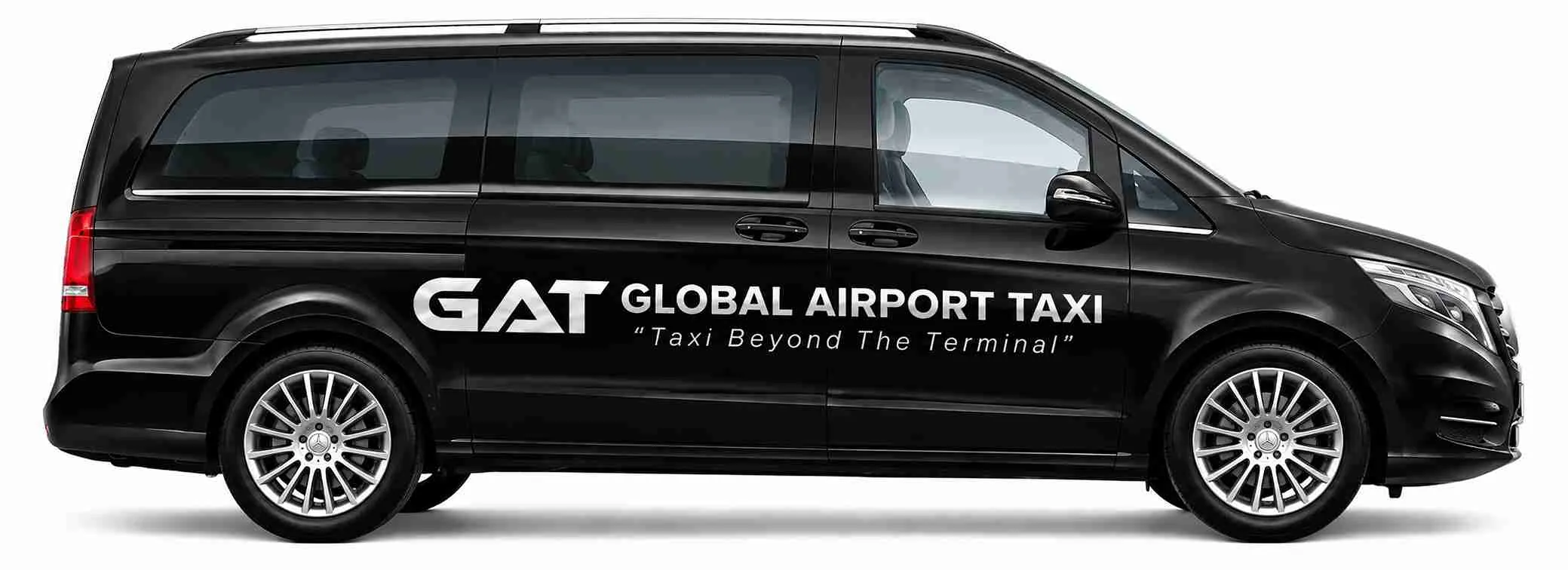
Most families here end up in an MPV: five or six travellers plus everything that came with them, pushchair included, and that pushchair never folds as small as the photograph suggested. Above the MPV come the Murcia Airport 7 seater taxi in standard and executive trim, and then the Murcia Airport 8-seater transfer, the largest thing the network books as a single car.
Minibuses, golf parties and group movements
Add a ninth traveller and the thing you are booking is no longer a car. It becomes a group movement, handled as one journey instead of three vehicles attempting to stay in sight of each other on the RM-19. A Murcia Airport minibus taxi is quoted on the same handful of details as a saloon — the address, the hour and a bag count somebody has actually done — with one addition that matters on this coast: how many golf bags are coming, and whether they are hard cases or soft.
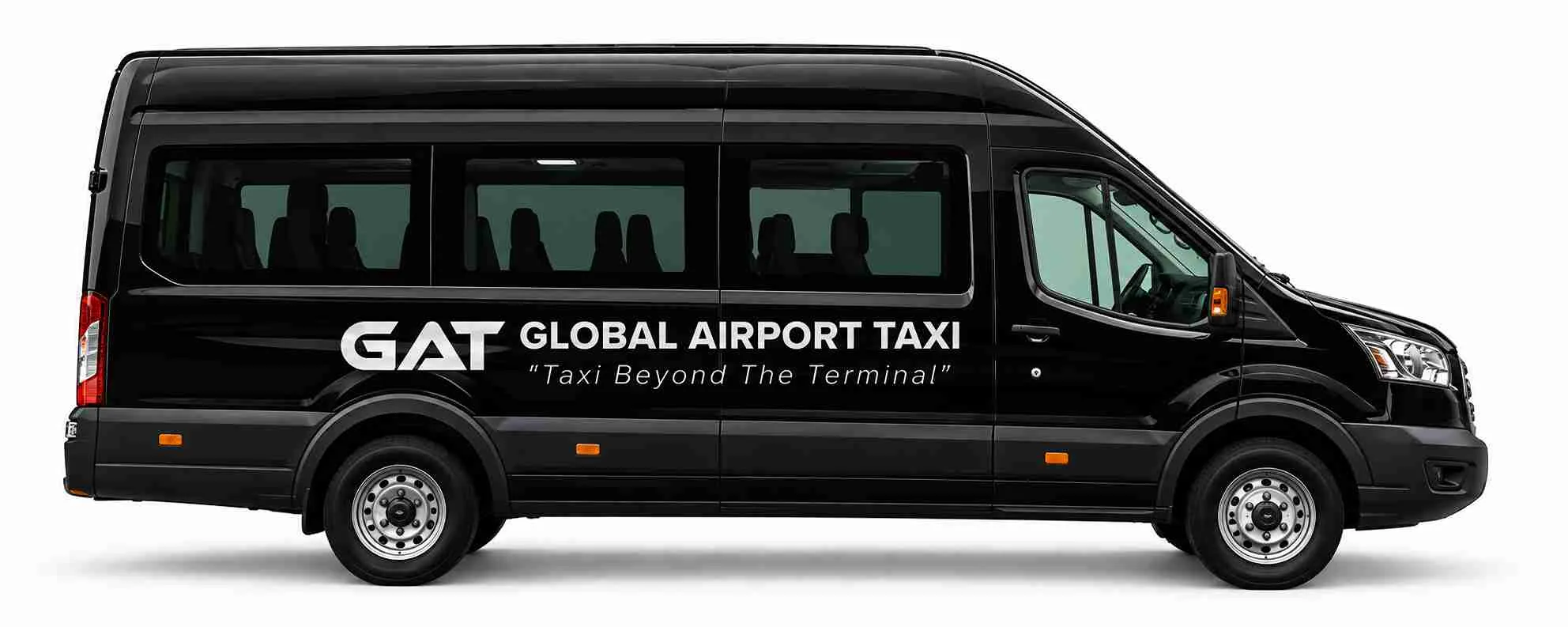
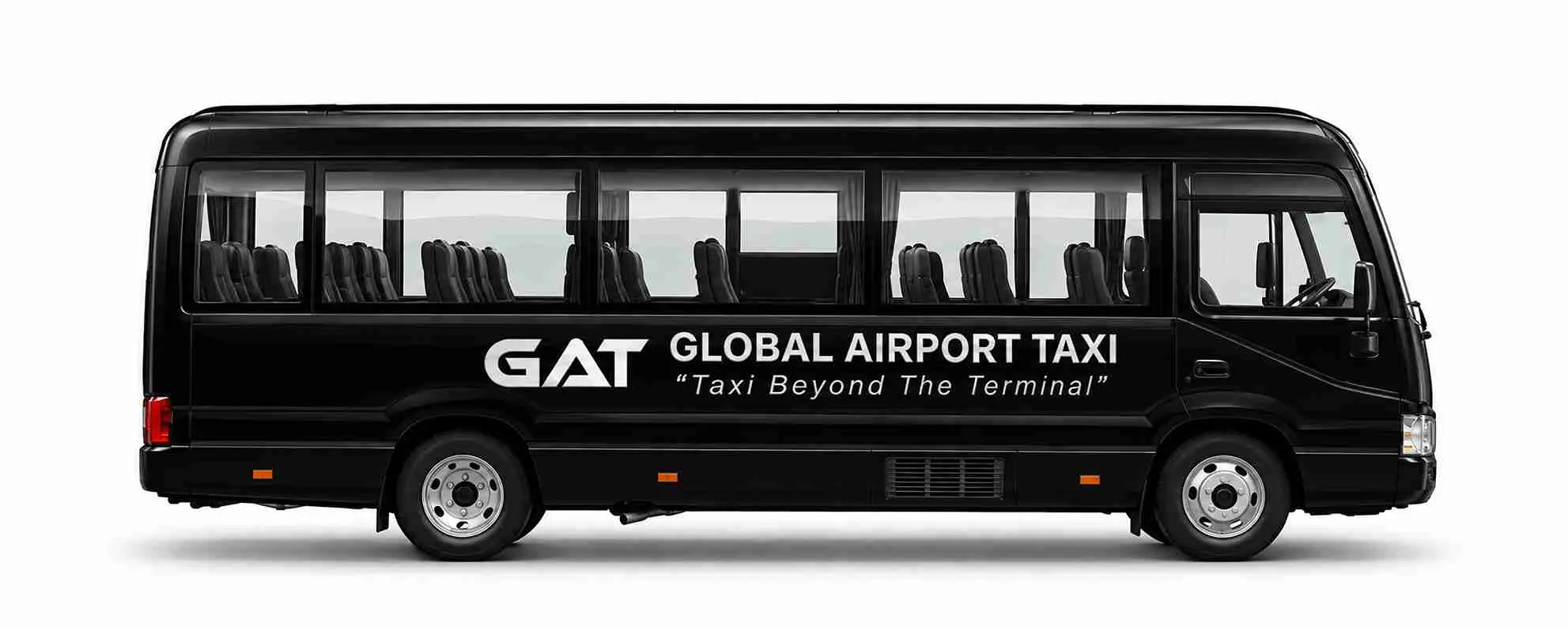
A back row grown-ups can actually sit in for an hour, not only children.Eight seats, and the end of the line for anything booked as one car.Sixteen places, for the golf party that would otherwise mean four cars and four sets of directions.A full coach, for the party too big to divide and still keep to one arrival time.
About these vehicle photographs. They show the classes as the network photographs them, and no caption under them names a city, an airport or a kerb. The four wider pictures further down were made for Murcia and say so; these cars were not, and captioning one as though it stood outside the terminal would be the first untrue line here.
No figure is attached to a class anywhere below. The class is one input into the cost of one journey, and whether it can be supplied on your date is answered by the booking system and by nothing else.
Reviews
What Travellers Say About Their Transfers
Other people’s journeys, in their own words and on somebody else’s platform.
The panel underneath is served by the review platforms, and each line in it was written by the traveller whose journey it describes. None of it was composed, chosen or rearranged here.
No score is shown for this airport alone, and none has been made up to fill the space. What the panel reflects is the network everywhere it works, written by whoever felt moved to write, leaving from wherever they happened to be.
Nothing a traveller says about a journey tells you what the next one costs. The figure comes from the form, on the day, for the route you actually want.
At a glance
Murcia Airport Taxi Service at a Glance
Everything below, compressed into one table.
You are booking a whole vehicle for your own party, at a sum you have read before the day arrives. The rank outside is something else entirely: a public service running on fares written by two separate authorities, with one boundary deciding which of them applies to you.
Each row returns in full below with its publisher attached. Aena gets credit for what Aena prints, the council for what its tariff sets, the regional government for what its order sets, and anything belonging to us is labelled as ours and nothing more.
The short answers about a Murcia Airport transfer
The question
The answer
Airport
Murcia Airport (RMU), Aeropuerto Internacional de la Región de Murcia in Spanish
Also called
Murcia–Corvera, and Corvera Airport by almost everybody who lives near it
Where it is
Inside the Murcia municipality, in the province of Murcia, the Region of Murcia, Spain
Who runs it
Aena
The terminal
one terminal building serves everything, with twenty-five check-in desks reported inside it
How busy it is
Aena reports annual traffic a little under a million passengers, which is the reason arrivals here can be read at a glance rather than followed sign by sign
Official taxi rank
Listed by Aena and marked on the car park plan
The city fare
€37 between the airport and the centre of Murcia, every supplement already in it
What that fare covers
the journey between the airport and the centre of Murcia, in either direction, with every supplement already inside it
Beyond the boundary
everywhere past the urban boundary, where the regional interurban order applies and no fixed figure exists
Our fares
Calculated from the journey you describe, and unchanged once accepted
Flight watching
Standard on arrivals, tracked against the number you entered
Free waiting after landing
60 minutes measured from the wheels touching down, stretching to 90 if the delay is at the belt
Public transport
Scheduled coaches to Murcia and Cartagena and three coastal routes, all run by operators rather than by the airport
Where the journeys go
Murcia, Cartagena, the Mar Menor, La Manga, the golf resorts, Mazarrón, Águilas, Lorca and the Costa Blanca
Booking
Online at any hour, subject to availability
It is the Aeropuerto Internacional de la Región de Murcia, named after the aeronautical pioneer Juan de la Cierva, RMU to an airline and LEMI to a pilot, and it is run by Aena. Reported distances put it roughly twenty-five kilometres from Murcia and thirty-five from Cartagena; the airport publishes neither figure, so both are given as reported rather than as fact. In Spanish the same service is searched for as a taxi aeropuerto Murcia or a taxi aeropuerto Corvera, as a traslado aeropuerto Murcia or a transfer aeropuerto Murcia, and by anybody using the full official name as a taxi aeropuerto Región de Murcia, or in English as a Región de Murcia Airport taxi. A Murcia Corvera Airport taxi, an RMU Airport taxi, a Corvera Airport transfer and a Murcia Airport transfer are all the same arrangement under different search habits.
It took over the commercial traffic of Murcia–San Javier, MJV, whose runway belongs to the Spanish Air Force and its officer academy; San Javier is now a town the airport serves rather than an airport in its own right. That one fact clears up more confusion than anything else here, because a decade of holiday memories and a good deal of surviving signage still point at the old place. Alicante–Elche, ALC, is a separate airport in a separate province, roughly an hour up the coast, and a booking made against the wrong one of the two codes is the commonest mistake on this run, and the airport-to-airport section deals with the people who meant to use both.
Three sorts of money run through everything below and they are never mixed: the city fare the council sets, the regional maxima that apply beyond the boundary, and a private quotation worked out for one journey.
Booking
Book Your Murcia Airport Taxi Online
Eight answers, and what each one changes.
Can you book a taxi from RMU in advance? You can, and it is the only route to landing with the sum already settled. To pre-book Murcia Airport taxi journeys is to arrive with a Murcia Airport taxi booking that carries your name, your flight and your destination before the aircraft has even left. Eight questions are asked; six of the answers between them pick the vehicle.
The same eight questions cover inbound and outbound and mean different things in each. Coming in, everything hangs on an aircraft, and a car can afford to wait for one. Going out, everything hangs on a counter that closes at a fixed minute and waits for nobody.
Choose RMU, not the airport you rememberThe form takes the code. Murcia has one commercial airport and it is RMU; San Javier no longer takes holiday flights and Alicante is a different province.
Give the far end in full, not by resort nameStreet and number, or the urbanisation, the phase and the block. On a coast built out of gated developments, the name on the brochure is rarely enough to reach a door.
Set the day and the hourFor an arrival, enter the scheduled landing rather than your own estimate of how long the belt will take. For a departure, work backwards from the minute check-in shuts.
Add the flight number on an arrivalSchedules get rewritten and aircraft substituted. The number is the one thing that survives both, so the collection is pinned to it.
Count the passengers, then count the casesIt is the second of those two numbers that usually picks the car. A fourball with four hard cases and four holdalls has outgrown a saloon long before it has run out of seats.
Declare anything that is not a suitcaseGolf clubs, a child seat, a pushchair, a wheelchair, a bicycle, a set of diving gear off the Cabo de Palos boats: each packs differently, and two of them move the booking up a class.
Pick the class, or let the luggage pick itThe table above gives the capacities. Where a booking sits on the line between two classes, the larger one is the cheaper mistake.
Read the figure before you commit to itThe amount on screen is for the whole journey, door to door. Once you accept it the confirmation returns with the vehicle, the driver and the meeting arrangement named on it.
A private taxi from Murcia Airport arrivals
Send the flight number, the date, the destination written out and a real count of the bags. The aircraft is then watched and the meeting arrangement goes into the confirmation rather than being improvised at the terminal doors. At airport arrivals your driver waits at the agreed meeting point with a name board and helps with the bags.
The booking is for the vehicle and not for a seat in it. Nobody else is collected on the way, no second resort appears on the route, and nobody is already aboard waiting on a flight that is not yours. On a coast where one road serves twenty urbanisations, that is the difference between fifty minutes and two hours.
A taxi to Murcia Airport for a departure
Going the other way, the car collects from a hotel, a villa, an apartment block, a resort barrier or a house with no street number and leaves you at departures. The number to be generous with is the gap between pulling up and the counter shutting, since that is the one stretch of the morning nobody driving can do anything about. To reservar taxi aeropuerto Murcia for a dawn flight, do it the same day you buy the ticket: the earliest scheduled coach does not reach the terminal in time for all of them.
How a Murcia Airport private transfer price is produced
The figure is built from the journey itself: the class, the road it takes, the hour it leaves and anything added to it — a second address, a child seat, a set of clubs. All of it comes from what you type, which is why an address given in half has to be priced twice. A traslado privado aeropuerto Corvera and a reserva taxi aeropuerto Corvera are the same booking under two search phrases, and a private Murcia Airport transfer is the English way of asking for the same thing. the fares section takes the inputs one at a time.
There is no charge for asking and no commitment in it. A figure appears as soon as the destination, the class and the flight are entered, and it is in front of you long before anything is booked.
Pick-up
Arrivals, the Rank and Meeting a Pre-Booked Driver
The hall, the rank, and the spot where a booked car is actually standing.
Where is the Murcia Airport taxi rank? Aena lists a taxi rank and marks it on the car park plan rather than describing a spot inside the building. That is the honest answer about the Murcia Airport official taxi rank: it exists, it is signed from the hall, and the airport prints no walking directions for it — which matters less here than it would almost anywhere else, because the building is small enough to read in one look. A Corvera Airport arrivals pickup is a short walk whichever of the two you are taking.
Aena describes three double security filters and nine boarding gates beyond them, six for flights from outside the Schengen area and three for Schengen flights, so a flight from outside the Schengen area clears passport control before anything else happens. The baggage reclaim hall has three belts and a fourth for special baggage, and it opens straight into the arrivals lobby, which Aena calls the building’s star feature. Nothing described below starts before that lobby.
Meeting a pre-booked driver
A private Corvera arrival as it is sold: the vehicle settled, the figure settled, and the meeting arrangement already in writing.
The Murcia Airport taxi pickup point that matters is the one written on your confirmation. What Aena publishes is a taxi rank and a bus stop, and nothing else; there is no chauffeur bay in its plans at all. So an official RMU airport taxi meeting point, offered as though the airport had designated one, is a thing the airport has never printed.
Which makes a Murcia Airport Meet and Greet a definable service rather than an incantation: somebody with your name on a board, help with the cases, and a place agreed in advance. What meet and greet actually covers takes two minutes to read and is worth them.
What separates a rank taxi from a Murcia Airport private driver pickup is the purchase, not the pavement. Anybody may join the rank queue and pay the regulated fare at the end of it. A car booked beforehand carries your name, a sum fixed in advance and Murcia Airport flight tracking underneath, which turns a late aircraft into a later collection rather than a missed one.
Take nothing from anybody who approaches you inside the building. Licensed drivers do not tout in an arrivals lobby. A driver you booked knows your name before you say it and can show you the booking; anybody who cannot is not your transfer, whatever they are holding and whatever they say the queue outside is like.
Step by step, from the aircraft to the car
Land, and follow the signsA single terminal and a single hall mean a short walk wherever the aircraft is parked.
Clear passport control, if your flight requires itTwo thirds of the gates here handle flights from beyond the Schengen area. That queue is invisible from the car park, which is precisely why our free allowance is counted from the wheels touching down.
Take the bags off the belt and count themThree belts and a fourth for special baggage, so skis, clubs and pushchairs arrive separately from the suitcases. A case that did not travel is worth reporting at once.
Walk through into the arrivals lobbyAena calls it the building’s star feature, and from a passenger’s point of view what matters is that everything public is in it and visible from the door.
Reread the confirmation before setting offDriver, vehicle and meeting arrangement are all on it. Thirty seconds with that message saves the lap of the building most arrivals do instead.
Go to the one that applies to youBooked ahead? The place named in the message. Taking a taxi as you find it? The signed rank.
Check the name board, then the number plateIn that order, both against what the confirmation says, before a single case is handed over.
Ask for a receipt in a rank taxiA receipt is what any later question about the fare rests on, and it costs nothing to ask for one as you get in.
A driver kept waiting is a driver losing money, at RMU as anywhere else. On a booking made here that cost sits inside the sum you agreed to; it does not turn up later as an extra.
Fares
What a Taxi Costs at RMU, and Who Sets the Figure
Three kinds of money, and the boundary that decides which one you are on.
How much is a taxi from Murcia Airport? Into the centre of Murcia, €37 at the rank, with everything included; anywhere else, there is no published figure at all. That is the whole of the Murcia Airport official taxi fare in one line. A Murcia Airport taxi price and a Murcia Airport taxi cost are the same question asked twice, and in Spanish it is asked as a precio taxi aeropuerto Murcia or a tarifa taxi aeropuerto Murcia.
Aena publishes a single fare of €37 for journeys to or from the airport and the centre of Murcia. Its wording leaves no room: that fare covers the entire cost of the service, with all supplements included, and no other charge may be applied. The same €37 appears in the city’s own approved tariff, authorised by order of the regional government on the council’s proposal and published in the Boletín Oficial de la Región de Murcia, where it is listed among the supplements as the fixed airport fare.
Where the €37 fare applies
The published zone runs out to Ronda Sur and the avenues Miguel Induráin, Reino de Murcia, Doctor Guillén and Ronda Oeste, and it takes in Espinardo along with the districts of La Arboleja, La Albatalía, Los Dolores, Santiago y Zaraíche and Puente Tocinos. Read that list again if you are booking a hotel: it is not a radius and it is not the old town. It is a set of named roads and named districts, and an address a street past one of them is outside the fare even though it is plainly in Murcia.
Inside the fare
The journey between the airport and the centre of Murcia, in either direction, with every supplement already inside it
Outside it
Everywhere past the urban boundary, where the regional interurban order applies and no fixed figure exists
What the fare includes
Every supplement in the city tariff, by Aena’s own wording
What may be added to it
Nothing
The surcharge almost every other page adds, and should not. That tariff also carries a supplement for a pick-up at the port or the airport and another for each case, and neither is added to the flat fare; they belong to the metered urban journeys the same document governs. The city tariff puts the airport pick-up supplement at €4.00 and each case at €0.70, and both are real — on a metered journey around town. Against the airport fare, Aena’s sentence settles it: all supplements included, and no other charge may be applied.
What the meter does inside the city
The same approved tariff runs the meter for every journey that is not the airport run, and it is worth seeing because it shows what the flat fare is standing in for. There are three settings: weekdays by day, nights, and weekends and public holidays.
The Murcia city taxi meter, as the approved tariff sets it
Setting
Weekday, 07:00–22:00
Night, 22:00–07:00
Weekend and holiday, 07:00–22:00
Flag-fall
€2.60
€3.60
€3.40
Per kilometre
€1.15
€1.45
€1.40
Minimum fare
€5.00
€7.00
€6.00
Waiting, per hour
€22.85
€28.80
€26.90
Alongside those sit the supplements: €1.50 for a pick-up at the railway or bus station, €4.00 at the port or the airport, €0.70 for each case or parcel, €1.30 for an animal other than a guide dog, and €4.00 for a seven-seat vehicle. Two supplements in it exist nowhere else in Spain: one for Christmas Eve and New Year’s Eve from eight in the evening, and one for the Bando de la Huerta and the Entierro de la Sardina, the two days the spring fiestas turn on — €5.00 on the two December nights and €5.00 on the two spring ones, both from eight in the evening.
What happens the moment you leave the city
Beyond the urban boundary a rank taxi moves onto the regional interurban tariff, an order of the Region of Murcia setting maximum rates for passenger vehicles of fewer than ten seats. That order sets no fixed airport fare of any kind, which is why no published number answers a question about Cartagena, La Manga or Torrevieja, and it is the reason no honest page can answer how much is a taxi from RMU to Cartagena with a single number.
The regional interurban maxima, as the order sets them
Item
Maximum
Per kilometre
€0.60
Per kilometre at night and on holidays
€0.71
Waiting, per hour
€18.00
Waiting, per quarter of an hour
€4.50
Minimum fare
€3.29
Excess luggage, per ten kilos per kilometre
€0.05
Its night rate runs from eleven at night to six in the morning on weekdays, and applies all day on Sundays and public holidays. The per-kilometre and waiting figures in it are maxima that may be reduced by agreement between the parties; the minimum fare is the one figure that cannot. It sets the luggage allowance by weight rather than by piece: fifty kilos free in a vehicle of up to four seats and sixty in a larger one when every seat is taken, thirty kilos more for each seat left empty, and a charge per ten kilos per kilometre beyond that, which is a rule worth knowing before four people with six cases get into a four-seat car.
And what a pre-booked transfer is instead
A Murcia Airport private transfer price is neither of the two above. It is worked out for your journey — the address at the far end, the class, the hour, the extras — and shown to you before anything is confirmed. A Murcia Airport fixed price taxi is fixed in that sense: fixed at the moment you accept it, and not moved afterwards by the traffic on the RM-1 or by a carousel that took forty minutes.
How the three arrangements differ
Arrangement
What sets the figure
What you get
Pre-booked private transfer
Worked out for the journey you describe, and shown before booking
Your address to theirs, in a vehicle nobody else is sharing
Official taxi, airport to the centre of Murcia
€37, all supplements included, as Aena publishes it
Door to door, taken at the rank
Official taxi, anywhere past the urban boundary
The regional interurban rates, which are maxima per kilometre
Door to door, taken at the rank
Interbus to Murcia or Cartagena
Set and printed by the coach company, not by Aena
Bus station to bus station, with a walk at either end
Airportbus along the coast
Also the operator’s to publish and to change
Whatever stops the route makes, in the order it makes them
Every number printed above was set by somebody else: by Aena, by the council’s tariff or by the regional order. Any of them may be revised by its owner without notice, and whatever is displayed on the card inside the vehicle is what governs the journey you take.
Every amount in this section was published by somebody else and is credited to them. No transfer price of ours appears, because one form books a flat in Espinardo and a villa in Mojacar.
Delays
Flight Delays and Waiting Arrangements
A late aircraft moves the time. It does not touch the arrangement.
Give the booking a flight number and the car follows the aeroplane instead of the clock. So the answer to what happens if my flight is delayed is brief: the pick-up slides along with it, and the free allowance is counted from the moment of landing rather than from the time printed on your ticket.
Free waiting after an arrival
60 minutes from touchdown, whatever the scheduled time said
When the hold-up is the baggage hall
As much as 90 minutes, since a belt detains people for longer than any passport queue does
Waiting somewhere other than the airport
15 minutes where the vehicle has been sent out to collect you for a flight
Cancelling for nothing
Free of charge so long as more than 24 hours remain before collection
What the booking needs from you
The flight number exactly as the airline wrote it: the number itself, not the route and not the aircraft type.
A phone somebody will answer on landing — roaming switched on, or the one person in the party with a Spanish SIM.
A message the moment anything moves, sent before you reach the belt rather than while standing at it.
Two flight numbers if the party is arriving on two aircraft. The vehicle belongs to the booking, not to whoever walks out first.
Rebooked onto another flight? Send the new number and the existing arrangement is transferred onto it, with nothing cancelled. A diversion is the harder case, since the journey now starts from a different airport altogether, and on this coast the alternate is almost always Alicante. Tell us from the aircraft, not from the hall.
How the whole arrangement works is laid out on the airport taxi page. The precise point at which waiting stops being free is written into the terms and conditions, which every confirmation links to directly.
What happens after the free allowance expires is governed by the terms the confirmation links to, and that is deliberately where it lives. A charge typed onto a sales page ages badly and binds nobody.
Coaches
The Scheduled Coaches Compared With a Private Transfer
What the scheduled coaches do well, and where they stop doing it.
Is there a bus from Murcia Airport to Cartagena? Yes — Aena lists a scheduled coach to the bus station there, and another to San Andrés in Murcia. Whether either is the right answer depends almost entirely on how much you are carrying and how far the bus station is from the bed.
Aena names Interbus for two scheduled runs, one to San Andrés bus station in Murcia and one to the bus station in Cartagena. It names Airportbus for three more, grouped as San Juan, Torrevieja and La Manga, each with a long list of coastal stops. The bus stop, like the taxi rank, is marked on the car park plan rather than described in words.
The three coastal routes, as Aena lists them
The San Juan route is listed through Pulpí, San Juan de los Terreros, Calarreona, Águilas, Mazarrón, Puerto de Mazarrón, Mazarrón Country Club, Camposol and Condado de Alhama.
The Torrevieja route is listed through Cabo Roig, Mil Palmeras, Playa Flamenca, La Zenia, Campoamor, Pilar de la Horadada, San Pedro del Pinatar, Lo Pagán, Santiago de la Ribera, San Javier, Los Narejos, Los Alcázares, Torre-Pacheco, Roldán and La Torre Golf Resort.
The La Manga route is listed through La Manga, Cabo de Palos, Playa Honda, Mar de Cristal, Los Belones, La Manga Club and Cartagena.
Aena prints no times, no fares and no frequencies for any of them, and tells readers to check with each operator before they travel. No times, fares or frequencies appear here for that reason. Anything you have read elsewhere about the price of a seat is one site copying another, and a route that runs four times a day in August may not run at all in February.
Murcia Airport bus vs taxi, honestly
What each one is good at
The question
A scheduled coach
A pre-booked transfer
Where it ends
A bus station or a route stop, with the last leg still to arrange
The address you typed, including a resort gate
What it costs
Published by the operator, per seat
Quoted per vehicle, before you book
Luggage
What you can carry and lift yourself
A vehicle sized for the bags, with a driver who lifts them
A delayed flight
The timetable does not know about it
The booking moves with the aircraft
When it suits best
One or two travellers with light bags going somewhere the route actually stops
A family, a group, an awkward hour or an address off the route
Put as a Murcia Airport taxi vs bus contest it sounds like one has to lose, and neither does. For a single traveller with a cabin bag heading to Murcia or Cartagena city centre it is the obvious one. The point at which it stops being obvious is sharp and easy to spot: a second suitcase, a child, a resort gate four kilometres off the route, or an arrival after the last departure of the day.
Bus fares belong to the operators, and Aena prints none of them. Anything you have read elsewhere about the price of a seat is somebody copying somebody; check it with the operator.
Into Murcia
From RMU to the Cathedral, Gran Vía and the Stations
The one journey from this airport that has a published price.
The RMU to Murcia city centre taxi fare is the single fixed figure anywhere in this region, and it runs in both directions. Everything else on the page is quoted; this one is published, and it is published by the city rather than by anybody selling you a ride.
What that means in practice is worth spelling out. A rank taxi from the terminal to an address inside the published zone is €37, whatever the hour, whatever the day, whatever the traffic and however many cases come out of the boot. A rank taxi to an address a street outside it is on the meter or the interurban rate instead, and the two outcomes can be a few hundred metres apart.
Murcia city centreMurcia Airport to Murcia city centre taxi
Inside the flat fare, if you take the rank. Plaza Cardenal Belluga and the Cathedral front, the Glorieta, the shopping lanes of Trapería and Platería. A good deal of that is closed to traffic, so what a driver needs is not the quarter but the last corner a car may legally stand at — and the hotel knows which one that is.
Gran Vía and Plaza CircularMurcia Airport to Gran Vía taxi
The working spine of the city. Gran Vía Escultor Salzillo runs north from the Cathedral quarter to Plaza Circular, and most of the business hotels sit on it or a street off it. A bus lane and a tram line make the kerb the deciding factor at the busy hours rather than the address.
Murcia del Carmen railway stationMurcia Airport to Murcia del Carmen station taxi
Across the river, and timed to a departure. The station sits on the Carmen side of the Segura, which is a different approach from the centre. A train to catch changes nothing about the fare and everything about the margin you should leave.
San Andrés bus stationMurcia Airport to San Andrés bus station taxi
Where the scheduled airport coach ends. The coach Aena lists runs between the airport and this station, so a passenger who takes it still has the last leg to arrange. A pre-booked car removes both the leg and the timetable.
Espinardo and the universityMurcia Airport to Espinardo taxi
Named in the fare zone. Espinardo is written into the published zone, so the flat fare reaches the campus and the science park even though both sit well out of the old centre. Term dates, not tourism, fill this run.
La Arboleja, La Albatalía and Puente TocinosMurcia Airport to Puente Tocinos taxi
Huerta districts, inside the boundary. Three of the districts the tariff names by hand. They are huerta villages the city grew around, with narrow lanes off wide approach roads, which is why a house number matters more here than a postcode.
Los Dolores and Santiago y ZaraícheMurcia Airport to Los Dolores taxi
The other two the tariff names. Residential districts on either side of the centre, both inside the published fare zone. An apartment block here is found by its street and number; the block name alone has sent more than one driver round twice.
Hotels, apartments and the streets a car cannot enter
Murcia’s centre is more pedestrianised than first-time visitors expect. Trapería and Platería are walking streets, the Cathedral square is not a kerb, and a tram line runs up part of Gran Vía. None of that changes the fare; all of it changes where the car can stop, which is why the useful line in a booking is the hotel’s own name rather than the square you recognise from a photograph. The hotel transfers page covers apartments with keypads and anything else without a reception desk.
Catching a train or a coach on the same day
Murcia del Carmen and San Andrés are both inside the fare zone, so the rank answer is the same €37 as any other address in it. In the other direction the city tariff adds €1.50 for a pick-up at either, which is a meter supplement rather than an airport one. A connection you have to make changes none of the arithmetic and all of the margin: build the margin in, because it costs nothing until you need it.
The flat fare is the whole answer inside the published zone and no answer at all outside it. The zone is written out below, street by street, so you can see which side of it you are on.
Cartagena
Cartagena, the Cruise Quay and the Mar Menor Shore
Out of the municipality, and off the published fare.
Every destination in this section is outside the Murcia urban boundary, so not one of them has a fixed published fare. That is not a sales line: it is what the two tariff documents say, and it is why a question about a Murcia Airport to Cartagena taxi cannot be answered with one number by anybody, including us.
A rank taxi on any of these runs is charged on the regional maxima — €0.60 a kilometre by day, with the mandatory minimum of €3.29 underneath it — and those are ceilings rather than prices. A pre-booked transfer is quoted for the address instead, which is the arrangement most people arriving with luggage actually want.
Cartagena city centreMurcia Airport to Cartagena taxi
A different city, and a different tariff. Calle Mayor, the Roman Theatre, the modernist streets and the hotels between them. Cartagena is its own municipality, so a rank journey here leaves the Murcia flat fare behind the moment it leaves the boundary.
The cruise terminal and the naval portMurcia Airport to Cartagena cruise port taxi
Ships, and a strict call time. The quay is a short run from the old centre but a long one from the airport, and a ship does not wait. Give the vessel and the sailing time when you book rather than the word port.
Los AlcázaresMurcia Airport to Los Alcázares taxi
The shortest coastal run of the set. A seafront town on the inland shore of the Mar Menor, with the apartment blocks and the air base either side of it. Short enough to feel like a suburb and far enough to be priced as a journey.
Los NarejosMurcia Airport to Los Narejos taxi
Next door, and not the same drop-off. The stretch north of Los Alcázares, holiday apartments almost end to end. The urbanisation name and the block number do the work here; the town name on its own does not.
San Javier and Santiago de la RiberaMurcia Airport to Santiago de la Ribera taxi
The old airport town, and the beach beside it. San Javier is the town whose airfield used to take the holiday flights; Santiago de la Ribera is its seafront, with the paseo and the jetties. Arriving at RMU and asking for San Javier Airport is the confusion worth heading off at the booking stage.
San Pedro del Pinatar and Lo PagánMurcia Airport to San Pedro del Pinatar taxi
The salt pans and the mud baths. The northern tip of the Mar Menor, where the salinas, the flamingos and the mud baths at Lo Pagán are the reason most visitors come. Two adjoining places with separate street grids, so name the one you want.
Torre-Pacheco and RoldánMurcia Airport to Torre-Pacheco taxi
Inland, and closer than the map suggests. Market-garden country between the airport and the sea, with golf urbanisations scattered through it. Several of them share a gate road, which is why the resort name and the phase number travel together.
Cartagena: the old city, the port and the ships
Cartagena rewards precision more than most. The Roman Theatre and the Calle Mayor sit in a compact centre with steep approaches; the cruise quay is minutes away on foot and a different instruction for a driver; and the naval and industrial districts are a separate city again. Give the hotel by name, or the ship and the sailing time, rather than the word port.
The Mar Menor shore, town by town
Searched in Spanish these are a taxi aeropuerto Murcia Cartagena and a taxi aeropuerto Murcia Los Alcázares, which is worth knowing if you end up telephoning a rank rather than booking online. From Los Alcázares round to San Pedro del Pinatar the towns run into one another along a single shoreline, and the names overlap in ways that catch people out. Los Narejos is the northern end of Los Alcázares; Santiago de la Ribera is the seafront of San Javier; Lo Pagán is the waterside part of San Pedro. A Murcia Airport to Los Alcázares taxi and a Murcia Airport to Santiago de la Ribera taxi are different journeys with ten minutes between them, and a Murcia Airport to San Pedro del Pinatar taxi is different again.
The old airport is the other trap. A Murcia Airport to San Javier taxi now means the town, because the airfield there stopped taking holiday flights when this one opened. Anybody who flew into San Javier in the past and books from memory is booking the wrong end of the Mar Menor.
Not one of these is inside the Murcia urban fare. Each is quoted as a journey of its own, and the rank alternative runs on maxima per kilometre rather than on a published figure.
La Manga
La Manga del Mar Menor, Cabo de Palos and Playa Honda
Twenty-one kilometres of address, and one word that cannot find it.
Can I book a Murcia Airport taxi to La Manga? Yes, and the booking needs more than the name. La Manga is a sand bar reported at twenty-one kilometres long and about a hundred metres wide, running from Cabo de Palos to the Punta del Mojón, so two bookings that both say La Manga can be the better part of half an hour apart at the far end.
The coast road at the end of the run, where the urbanisation name decides which side of the strip the car stops on.
Searched in Spanish it is a taxi aeropuerto Murcia La Manga, and the same caution applies in either language: the strip has the Mediterranean on one side and the Mar Menor on the other, and a single road running its length. Blocks are identified by the kilometre point, the urbanisation or the building name, and the useful booking carries at least one of the three.
A Murcia Airport to La Manga taxi quoted on the word alone is a quotation for an average that nobody is actually travelling. Quoted on the address, it is a figure for the journey you will take.
La Manga, the strip itselfMurcia Airport to La Manga taxi
Twenty-one kilometres of address. The sand bar runs from Cabo de Palos to the Punta del Mojón with the sea on both sides. A booking that says only La Manga can be out by the better part of half an hour at the far end, so send the kilometre point, the urbanisation or the block.
Cabo de PalosMurcia Airport to Cabo de Palos taxi
The lighthouse end. The fishing village and diving port at the southern tip, where the strip begins. Compact, steep in places, and a different drop-off from anywhere on the strip proper.
Playa Honda and Mar de CristalMurcia Airport to Playa Honda taxi
Before the strip starts. Two developments on the mainland side of Cabo de Palos that people routinely book as La Manga. They are nearer, they are reached off a different junction, and they are quoted as themselves.
Los Belones and La Manga ClubMurcia Airport to La Manga Club taxi
Inland of the strip, up the hill. The village and the resort behind it, which is not on La Manga at all despite the name. Gate access and a villa number are what the driver needs; the resort is large enough to have internal addresses.
The places people mean when they say La Manga
Three of them are not on the strip at all. La Manga Club is inland, up the hill behind Los Belones, and it is a resort rather than a stretch of coast. Playa Honda and Mar de Cristal sit on the mainland before Cabo de Palos. A Murcia Airport to Cabo de Palos taxi stops at the lighthouse end where the strip begins. All four are shorter runs than the far end of La Manga proper, and all four are routinely booked as though they were the same place.
Arriving late, and leaving early
The strip empties out of season, and so does the public transport along it. An arrival after the last coach, a villa at the far end and a party with a fortnight’s luggage is the booking this airport sees most often in summer, and the one that goes worst when it is left to the rank.
Twenty-one kilometres of sand bar is twenty-one kilometres of possible drop-off. The quotation follows the address you give, so the address is worth getting right before anything is priced.
Golf
Golf Resort Transfers Across the Costa Cálida
Gates, phases, villa numbers and a boot that takes the clubs.
A golf transfer is two bookings in one: the people and the equipment. Four players and four golf bags will not go in a saloon, and a resort gate is an address in its own right — which between them account for most of what goes wrong on this run.
The resorts below sit in a band between the airport and the sea, and several are closer to the terminal than Murcia itself. What they share is a layout: an entrance off a country road, a barrier, and numbered phases or buildings spread over a long internal network. The resort name reaches the barrier; the phase and the number reach the door.
La Torre Golf ResortMurcia Airport to La Torre Golf Resort taxi
The closest of the resorts to the airport. A gated resort near Roldán with its own plaza and apartment blocks numbered by phase. Give the block and the phase: the gate is one address and the apartment is another.
Mar Menor Golf ResortMurcia Airport to Mar Menor Golf Resort taxi
Torre-Pacheco, and a long internal road. The resort sits off the Torre-Pacheco road with villas and apartments set well back from the entrance. Clubs travel better in an estate or an MPV than in a saloon boot, whatever the seat count.
Hacienda del ÁlamoMurcia Airport to Hacienda del Álamo taxi
Fuente Álamo, inland and quiet. A large resort out towards Fuente Álamo with a hotel, villas and a long approach. The last junction is unlit at night, which is a reason to have the car booked rather than found.
Hacienda RiquelmeMurcia Airport to Hacienda Riquelme taxi
Sucina, and numbered buildings. Apartments grouped in numbered buildings around the course near Sucina. The building number is the address; the resort name alone will get you to a barrier and no further.
Condado de AlhamaMurcia Airport to Condado de Alhama taxi
Alhama de Murcia, west of the airport. A resort of apartments and villas under the Sierra Espuña, far enough west that it is a different road out of the airport from everything on the Mar Menor list.
El Valle Golf and Altaona GolfMurcia Airport to El Valle Golf taxi
Baños y Mendigo, almost next door. Two neighbouring resorts in the hills between the airport and the city, close enough to the terminal that the run is among the shortest here and still outside the urban fare.
Roda GolfMurcia Airport to Roda Golf taxi
San Javier, near the water. A resort behind San Javier with the Mar Menor a few minutes away. Low-rise, spread out, and reached through a gate that wants a villa number.
Las Colinas GolfMurcia Airport to Las Colinas Golf taxi
Over the provincial line, in Alicante. A valley resort near Campoamor, which is in the province of Alicante rather than Murcia. The drive is straightforward; the booking only needs to say which Las Colinas is meant.
What to send with a golf booking
The number of golf bags, and whether they are hard travel cases or soft carriers. Two hard cases take the space of a large suitcase each.
The resort, the phase or building, and the villa or apartment number. Three lines, and they do more work than any postcode here.
Whether the party is arriving on one flight or two. A fourball split across two aircraft is two collections unless it is written as one booking with two numbers.
The tee time, if the transfer has to beat it. It changes nothing about the price and everything about the hour the car is ordered for.
Gated access is the one thing worth confirming rather than assuming. Some resorts admit a booked vehicle to the villa door, others stop everything at the barrier and the last two hundred metres are on foot with the clubs. A booking that names the resort lets that be settled in advance instead of at midnight at a closed gate.
Clubs, trolleys and a party of four change the vehicle and therefore the figure. The resort name alone changes neither, which is why the booking asks for both.
West coast
Mazarrón, Camposol, Águilas and Lorca
The long runs, where the road is the easy part.
Mazarrón, Camposol, Águilas and Lorca are the four that catch people out, because each is really two places with one name. The port is not the town, the urbanisation is not a street, and the castle town is not on the coast at all.
Puerto de MazarrónMurcia Airport to Puerto de Mazarrón taxi
The port, not the town. The seafront half of the municipality, with the marina, the beaches and most of the holiday apartments. Six kilometres and a hill separate it from the town, so the two are not interchangeable on a booking.
Mazarrón townMurcia Airport to Mazarrón taxi
Inland, up the hill. The older settlement above the port, with the town hall, the market and the streets the port side does not have. Quieter, and a shorter run from the airport than the coast road suggests.
CamposolMurcia Airport to Camposol taxi
Sectors, not streets. A large urbanisation inland of Mazarrón, laid out in lettered sectors spread over several kilometres. The sector letter is the single most useful thing a booking can carry here.
ÁguilasMurcia Airport to Águilas taxi
The far south-west corner. A working port and resort town at the Almería end of the region, with the castle above it and a string of coves either side. One of the longest runs on the list and one worth pricing before you fly.
LorcaMurcia Airport to Lorca taxi
Inland, on the motorway. The castle town on the road to Andalusia, reached on dual carriageway most of the way. Business and family traffic rather than beach traffic, and the drive is the easy part of it.
Why a Murcia Airport to Puerto de Mazarrón taxi is not a Mazarrón one
Mazarrón town sits inland and uphill; the port sits on the sea with the marina and most of the holiday accommodation. They share a municipality, a name and almost nothing else useful to a driver. A booking that says Mazarrón and means the port finishes six kilometres and a hill from the bed.
Camposol, and the problem with sector letters
Camposol is laid out in lettered sectors spread across several kilometres of hillside, with its own internal road network and very little street lighting at the edges. The sector letter is the single most useful thing a booking from here can carry, and a plot number after it settles the rest.
Águilas and Lorca
A Murcia Airport to Águilas taxi is among the longest runs on the page, down to the corner where the region meets Almería, and it is a journey worth having priced before you fly rather than discussed at a rank. A Murcia Airport to Lorca taxi is shorter and almost entirely dual carriageway, which makes it one of the most predictable on the list. Both are covered under long-distance airport transfers.
Kilometres are only one ingredient in a run of this length. Each is set up as one journey, and exactly what the figure takes in is spelled out before either side agrees to it.
Costa Blanca
Torrevieja, Orihuela Costa and the Alicante Line
Over the provincial line, and nearer than the search results think.
Torrevieja, La Zenia, Campoamor and Pilar de la Horadada are in the province of Alicante, not Murcia, and several of them are closer to RMU than to Alicante–Elche. Several of the resorts an RMU arrival is headed for sit in the province of Alicante rather than Murcia, which changes nothing about the journey and everything about the search that found them.
TorreviejaMurcia Airport to Torrevieja taxi
In the province of Alicante. The salt-lake town with the long seafront, the marina and a resident population from half of Europe. Served from both airports, which is exactly why the code on the booking matters.
La Zenia, Cabo Roig and Playa FlamencaMurcia Airport to La Zenia taxi
Orihuela Costa, one after another. Three neighbouring developments on the same stretch of coast, with the shopping centre at La Zenia as the landmark everybody knows. The urbanisation name is what distinguishes them on a street plan.
Campoamor and Mil PalmerasMurcia Airport to Campoamor taxi
The southern end of Orihuela Costa. Dehesa de Campoamor and the Mil Palmeras beach beyond it, the last of the Alicante coast before the provincial line. Villas and apartment blocks, reached off the N-332.
Pilar de la HoradadaMurcia Airport to Pilar de la Horadada taxi
The border town itself. The last municipality in Alicante province, with Torre de la Horadada on the sea below it. Closer to RMU than to Alicante, which surprises most people who book it.
Alicante cityMurcia Airport to Alicante taxi
A city run, up the coast. The Explanada, the castle, the port and the business district. A long enough journey that the hour it leaves at changes the road it takes.
BenidormMurcia Airport to Benidorm taxi
The far end of the Costa Blanca. Levante, Poniente and the towers between them, well beyond Alicante. A genuine long-distance transfer, and one that wants the hotel name rather than the beach.
Which airport is actually closer
For the southern end of the Orihuela Costa the honest answer is usually RMU, and for Benidorm it is just as plainly Alicante. Between those two points the sensible test is not the map but the flight: a Murcia Airport to Torrevieja taxi on a direct arrival beats a cheaper airport two hours and a connection away, and a Murcia Airport to La Zenia taxi or a Murcia Airport to Orihuela Costa taxi is a short run on a good road.
Further up the coast the arithmetic reverses. A Murcia Airport to Alicante taxi and a Murcia Airport to Benidorm taxi are both real bookings and both long ones; the Alicante to Benidorm route is the shorter way to the same hotel if your flight can land there instead.
South and west, into Almería
A Murcia Airport to Vera transfer and a Murcia Airport to Mojácar taxi leave the region altogether, down the coast past Águilas. They are arranged as single long journeys, confirmed as available before they are quoted, and they are the clearest case on the page for settling the vehicle and the figure at home rather than at a rank at midnight.
Crossing the provincial line changes no price of ours and no rule you need to know. It changes which airport most search results will offer you, which is a different problem.
Airport to airport
Connecting Between RMU and Alicante–Elche
Two airports, two codes, and one booking that has to name the right one.
Is Murcia Airport the same as San Javier Airport? No — and it is not Alicante–Elche either. Three airport names circulate for this corner of Spain and only one of them takes holiday flights today.
Región de Murcia, RMU
The airport described here, inland at Corvera, inside the Murcia municipality
Murcia–San Javier, MJV
The old holiday airport on the Mar Menor, now military; San Javier is a destination rather than an arrival point
Alicante–Elche, ALC
A separate airport in a separate province, up the coast past Torrevieja
A Murcia Airport to Alicante Airport transfer is a straightforward booking and a common one, usually for a connection that cannot be made in the air. It is priced like any other journey, from the two addresses and the hour, and the vehicle is yours for the whole of it.
Leaving enough time between the two
The part worth planning is not the drive, which is predictable, but everything stacked either side of it: a bag drop that may not open until a fixed hour, a security queue at the second airport, and an airline that treats the two flights as entirely separate contracts. Nobody is underwriting the connection, so the margin is yours to set — and the road is the one part of it that behaves.
Our own Alicante arrivals and departures are covered on the Alicante Airport taxi page, and the same booking form handles a journey that starts at one airport and ends at the other.
A transfer between two airports is priced like any other journey, from the two addresses and the hour. What it is not is a connection anybody else is underwriting.
Business
Business and Executive Transfers from RMU
Landings that begin a working day instead of a fortnight off.
When you book a Murcia Airport chauffeur service, put two mobile numbers on it: the passenger’s and the arranger’s. Omit the passenger’s and every message goes to the desk that made the booking rather than to the person standing in the lobby wondering where the car is — which is the only place the information is any use.
Business traffic through RMU is not the volume the beaches are, but it is steady and it is specific: the industrial and naval end of Cartagena, the agri-food companies out around Torre-Pacheco and Fuente Álamo, the university and the science park at Espinardo, and the regional government offices in Murcia itself. None of those is a hotel, and several of them are a gate with a security desk.
The vehicle
Executive where the journey warrants it; otherwise the bags decide
The flight
Tracked on the number supplied, with free time counted from touchdown
The figure
Agreed up front, and unmoved by whatever the road does
The paperwork
One confirmation carrying driver, vehicle and meeting point
Repeat journeys, invoicing to an account and conference arrivals all go through corporate transfers. Where a journey ends at a works entrance rather than a reception desk, say so in the booking notes; the satnav will not work it out for itself.
Billing arrangements, account terms and consolidated invoices are a matter between a company and us, agreed case by case. No page written for the general reader can commit anybody else to them.
Families
Family and Group Transfers
Suitcases, a buggy, and two children who slept the whole way over.
Boot space decides a family booking; the number of seats rarely does. Plenty of the classes above will seat six. Rather fewer will seat six and still swallow six large cases and a buggy.
A Murcia Airport taxi with child seat
A family arrival at RMU where the vehicle was settled before the flight rather than after the luggage appeared.
Child seats are asked for when you book and carried at no extra charge. Tell us the number and the age of each child while the booking is being made: an infant carrier, a toddler seat and a booster cushion are three different fittings, and the right one has to travel out with the vehicle rather than be hunted for in the lobby.
The value of a group booking shows itself in the ten minutes beyond the customs doors, because that is where parties disintegrate. A single vehicle gives you one spot to gather at, one round of loading and one arrival time. Weddings, golf fourballs and extended families habitually arrive on one flight and then work out that they number seventeen with twenty-two bags between them; the rest is on the group transfers page.
Two details from the public tariffs are worth knowing even if you never use a rank. A seven-seat taxi carries its own supplement on the city meter, and the interurban order measures luggage in kilos rather than in pieces and reduces the allowance for every seat left empty. Both say the same thing from different directions: on this coast, the luggage is the booking.
Deliberately, no amount appears anywhere in this section. A family pays for the vehicle, the vehicle follows from the bags, and the bags are consequently the one count worth doing properly.
Accessibility
Accessible Transfers and Wheelchair Vehicles
The order is reversed here: confirm the vehicle, then book it.
Arrange a Murcia Airport wheelchair accessible transfer beforehand, because there is no arranging one on the day. Equipment belongs to the individual, and the car that works perfectly for one passenger is no use whatever to the next, so whether a vehicle suits is established before a booking is accepted at all.
The chair itself: manual or powered, its width, and whether it folds.
Whether a transfer into an ordinary seat is possible, or the passenger remains in the chair throughout.
Everything else travelling with them — walking frame, crutches, mobility scooter — and whether it comes apart to fit a boot.
Who is travelling with the passenger, because an assistant needs a seat as much as a suitcase needs a boot.
What the airport does, and where it stops
Assistance for a passenger with reduced mobility is requested at least forty-eight hours before departure, through the airline or the agency that sold the ticket or direct from Aena. The signposted meeting points for that service are inside and outside the building, among them the car park, the arrivals forecourt and the check-in area. Aena is explicit that it is not a custody service, and that minors and passengers who are not self-sufficient have to travel accompanied. That service takes a passenger to a meeting point; it does not arrange the vehicle waiting there, which is the part a booking has to cover.
Answering those four takes an exchange of messages, which makes this the single arrangement described anywhere here that cannot be assembled in an hour. What can be agreed ahead of time is described in our guide to accessible vehicles.
An accessible vehicle is priced only after somebody has confirmed one is available for your date and your equipment. The suitability comes first; the money comes second.
Going back
Book Your Return Taxi to Murcia Airport
The outbound leg: planned least, and in need of it most.
Leaving takes more planning than arriving did. There is give in an arrival: the aeroplane comes down when it comes down and everything after it adjusts. There is none at all in a departure, because check-in closes at a printed minute regardless of what the road has just done to you.
The way out: the same party and the same luggage, but a closing desk in place of an incoming aircraft.
Where you can, put both legs on one booking. That way the journey home is fixed before you have left your own front door, which matters most when the flight departs before any coach runs and the villa sits twenty minutes off the route anyway.
Include the outbound flight number as well as the collection time. Should the aircraft already be running late before you lock up, the car moves with it rather than waiting at a barrier.
Villa gates, resort barriers and checkout
The return from a gated resort is the one that needs a line of notes. A barrier that is manned at ten in the morning may be closed at five; a villa road may be unnamed; a checkout at midday and a flight at nine in the evening means somewhere for the cases to sit in between. None of that is unusual here and all of it is easier arranged in writing than at the time.
How much time to leave
Begin with whatever check-in time the airline specifies, add the road at the hour you will be on it, then add again the cushion you would wish you had if the road misbehaved. That third number is the one everybody quietly deletes. During the week of the spring fiestas — the week the city tariff itself puts a supplement on two of the nights — make it twice as big.
The price of leaving is built from where the car collects you, which flight it has to make and when it must therefore pull away. A resort barrier at dawn counts as part of that sum, not as an afterthought.
About us
Why Book Your Murcia Airport Transfer With Us?
What we actually sell, and what belongs to somebody else.
We sell one thing: a named vehicle for your party at a figure you read before you agree to it. Every regulated fare above belongs to a public body, and each of them is credited where it appears.
It is the distinction the whole build rests on. The €37 city fare belongs to Murcia and Aena prints it; the interurban maxima belong to the region; the coach fares belong to the operators who run the coaches; the queue at the baggage belt belongs to nobody. Ours is the number on your confirmation and nothing above it.
One vehicle, yours alone, with nobody picked up en route.
A figure read in advance, which does not move once you have said yes to it.
Flight tracking on every inbound booking, keyed to the number you typed.
A written confirmation on which the driver, the car and the place you will meet are all named.
We are a booking platform. Your transfer is carried out by a licensed private hire driver.
Every class is clean, modern and driven by a professional, licensed driver.
About the airport itself
Aena gives the postal address as Avenida de España 101, Valladolises y Lo Jurado, which is inside the Murcia municipality itself, out among the villages of Corvera, Los Martínez del Puerto and Valladolises. That is why almost everybody still calls it Corvera: the village gave the building site its working name long before the airport had a published one. Airports Council International has named it the best airport in Europe in its under-two-million-passenger category, which is a reasonable description of what it is like to use: small, quick and almost impossible to get lost in.
No published figure above belongs to us. The city fare is the council’s, the interurban maxima are the region’s, the bus fares are the operators’, and the only number of ours is the one on your confirmation.
Questions
Frequently Asked Questions About Murcia Airport Taxis
Twenty questions, each answered in its first sentence.
Each answer starts with the answer. The reason follows it, and wherever a figure belongs to Aena, to the city tariff or to the regional order, the answer says whose it is.
How much is a taxi from Murcia Airport?
Between the airport and the centre of Murcia, Aena publishes a single rank fare of €37, and says that fare covers the entire cost of the service with all supplements included, so nothing may be added to it. For anywhere outside the published city zone there is no fixed figure at all: a rank taxi runs on the region’s interurban maxima and a pre-booked private transfer is quoted for your own journey.
Where is the Murcia Airport taxi rank?
Aena lists a taxi rank and marks it on the car park plan rather than describing a spot inside the building, so follow the signs out of the arrivals lobby. A car booked in advance is a different arrangement and will not be waiting in the rank queue; the confirmation says where it is.
Is Murcia Airport the same as Corvera Airport?
Yes. Corvera is the village the construction site was named after, and the name stuck locally long after the airport opened as the Aeropuerto Internacional de la Región de Murcia. Murcia Airport, Murcia–Corvera, Corvera Airport and RMU all mean the same terminal.
Is Murcia Airport the same as San Javier Airport?
No. San Javier, MJV, is the older airport on the Mar Menor whose commercial traffic moved to RMU; its runway belongs to the Spanish Air Force and its officer academy. San Javier is now a town you travel to from this airport rather than an airport you land at.
Can I book a taxi from RMU in advance?
Yes, and doing so is the only way to land with the sum already settled. Set RMU as one end of the trip, spell out the address at the other, give the date, the hour and the flight number, count heads and then count cases, and read what comes back before confirming anything.
How much is a taxi from RMU to Cartagena?
There is no published figure, and anybody quoting one as official is guessing. Cartagena is outside the Murcia urban boundary, so a rank taxi is charged under the regional interurban order, which sets maximum rates per kilometre rather than a fixed airport fare. A pre-booked transfer is quoted for the address you give.
Can I book a Murcia Airport taxi to La Manga?
Yes, and the booking needs more than the name. The strip runs about twenty-one kilometres from Cabo de Palos to the Punta del Mojón, so send the kilometre point, the urbanisation or the building. La Manga Club, Playa Honda and Mar de Cristal are separate places that are routinely booked as La Manga and are not on the strip at all.
What is the cheapest way from RMU to Murcia?
Almost always the scheduled coach to San Andrés bus station, if you are travelling light and the timetable suits. Aena publishes the operator and the route but no fares or times, so check with the operator. The coach ends at a bus station rather than at your door, which is the trade.
Is there a bus from Murcia Airport to Cartagena?
Yes. Aena lists a scheduled coach between the airport and the bus station in Cartagena, alongside the Murcia service and three coastal routes. It prints no times, fares or frequencies for any of them and tells travellers to check with each operator first.
Do taxis at Murcia Airport charge extra for luggage?
Not on the €37 city fare. Aena states that it includes all supplements and that no other charge may be applied. The city tariff does carry a per-case supplement and an airport pick-up supplement, but those attach to metered journeys around town rather than to the airport fare.
Does the airport fare change at night or at the weekend?
The €37 city fare is a single figure with no night or weekend setting. The city meter does have three settings, and the regional interurban rate has a higher night and holiday rate, so an hour that changes nothing inside the fare zone can change a good deal outside it.
Can I book a taxi with a child seat?
Yes, and there is no charge for one. Ask at the time of booking and say how many children and how old each is, because an infant carrier, a toddler seat and a booster cushion are three separate fittings and the correct one has to leave with the car rather than be found at the airport.
Can I book an 8-seater Murcia Airport transfer?
Yes. Eight seats is the largest single car booking in the network; past that a party becomes a group movement and is arranged as one journey in a minibus or a minicoach. Count the cases as well as the passengers, because the luggage decides the class more often than the seats do.
What happens if my flight is delayed?
The booking carries your flight number, so the car follows the aircraft rather than the clock and the collection moves with it. Free waiting starts when the wheels touch down, not at the scheduled time, and runs for sixty minutes, or up to ninety when the baggage hall is the hold-up.
Can I book a return airport taxi?
Yes, and booking both legs together is worth doing while you are still at home. The departure is the leg with no slack in it, because the desk closes at a published minute, and a resort gate at six in the morning is easier arranged in writing than on the day.
Can a taxi reach a gated golf resort?
Usually, and it is worth confirming rather than assuming. Some resorts admit a booked vehicle to the villa door and others stop everything at the barrier. Send the resort, the phase or building and the villa number, and the arrangement can be settled before you travel.
Is Torrevieja closer to Murcia Airport or to Alicante?
For the southern Orihuela Costa, including La Zenia, Campoamor and Pilar de la Horadada, RMU is usually the nearer of the two. For Benidorm it is plainly Alicante. In between, the better test is which airport your flight actually lands at rather than which looks closer on a map.
Can I book a transfer between Murcia Airport and Alicante Airport?
Yes. It is priced like any other journey, from the two addresses and the hour, and the vehicle is yours for the whole of it. Leave a real margin: nobody underwrites a connection made by road between two separate airline contracts.
Can I get a receipt from a rank taxi?
Ask for one as you get in. A receipt is what any later question about the fare rests on, and it costs nothing. On a pre-booked transfer the confirmation and the booking record do the same job in advance.
Do you carry wheelchairs and mobility equipment?
Accessible vehicles are arranged in advance rather than found on the day, because the equipment is specific to the passenger. Tell us whether the chair folds, whether the passenger transfers into a vehicle seat, and what else is travelling, and suitability is settled before anything is booked.
Each amount quoted in an answer below can be changed by whoever publishes it, with no notice to anybody who has copied it down. Naming the owner beside the number is the only honest way to print one.
Where to go next: the rest of Spain, the services behind this transfer, the vehicles that carry it and the guides worth reading before you book
Book Your Murcia Airport Taxi Today — four answers and the car is arranged.
It comes down to four things: which flight, which address in full at the other end, how many of you there are, and how many cases are genuinely coming off that belt. Answer those and you have a vehicle, a sum already agreed, an aeroplane being tracked on the number you supplied and a meeting place written down — rather than a quarter of an hour in the lobby at RMU choosing between a rank queue, a coach timetable and a resort barrier you have never laid eyes on.